In real-time embedded systems like VxWorks, reliable and predictable Ethernet communication is crucial. To enhance both reliability and real-time performance, we can mathematically model network behavior and apply queueing theory to determine the optimal buffer size, thereby minimizing both packet loss and latency.
This article explores modeling methods, optimization processes, and engineering recommendations for tuning network performance in VxWorks.
Why Network Modeling is Important in VxWorks
When a VxWorks system sends Ethernet frames, delays can arise from two sources:
- 1. Transmission delay – caused by the physical medium.
- 2. Queueing delay – occurs when frames wait in the sending buffer for transmission.
If a frame fails to send within the current cycle, it must wait until the next cycle, leading to significant delays. On the other hand, if the queue is too short, it results in underutilization of the link. The goal is to:find the optimal balance for buffer size.
Building an Ethernet Queue Model
The frame sending process in VxWorks can be modeled using Poisson arrivals (independent frame arrivals, unlimited quantity). Let:
- • λ – average frame arrival rate (frames/time unit)
- • μ – average transmission rate (frames/time unit, μ > λ)
- • ρ = λ / μ – traffic intensity
- • L – buffer length
- • L₀ – optimal buffer length
If <span>L</span> is too large → frame backlog, some are discarded due to delaysIf <span>L</span> is too small → link idle, causing capacity waste
Cost-Based Optimization Method
We introduce the concept of loss cost:
- • c₁ – cost of discarded frames when
<span>L > L₀</span> - • c₂ – cost of idle link when
<span>L < L₀</span>(usually c₁ ≥ c₂)
By deriving steady-state probabilities using birth-death process and geometric distribution, we can calculate:
- • N_d – average number of discarded frames in busy state
- • N_p – average number of idle frames during underutilization
- • F(L) – total communication loss cost:
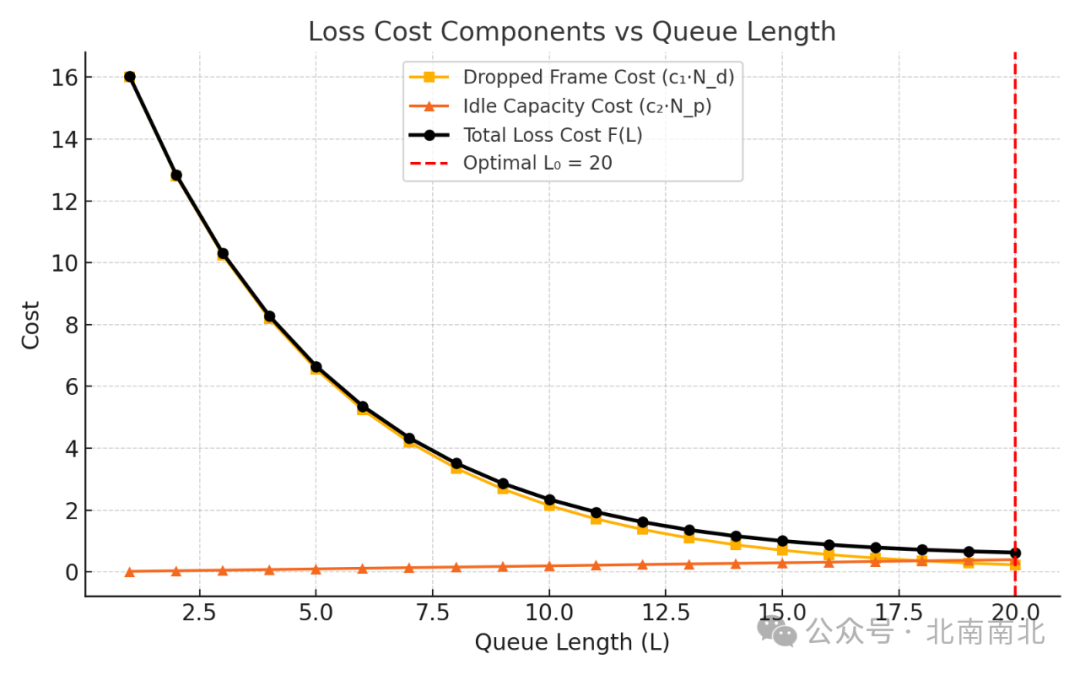
F(L) = c₁ * N_d + c₂ * N_p
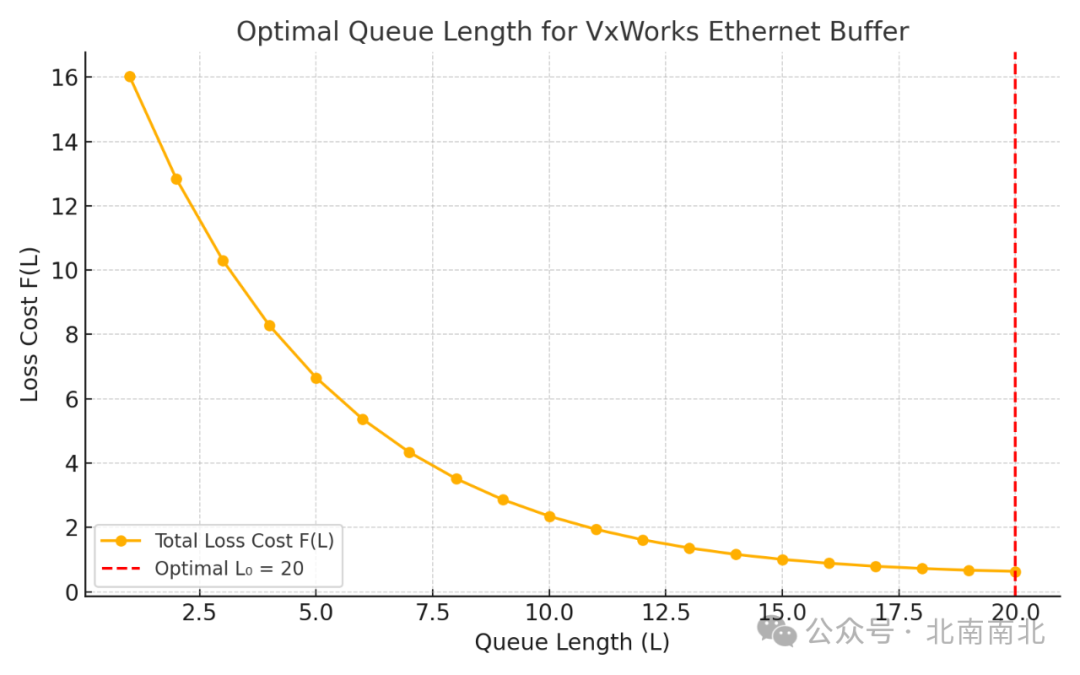
The optimal queue length <span>L₀</span> is the integer that minimizes <span>F(L)</span>.
Visualization: Optimal Queue Length
The following figure shows the relationship between the loss cost curve and queue length, marking the optimal point L₀.
Visualization: Cost Components
To better understand the trade-offs, the following figure separates the frame loss cost, idle capacity cost, and total loss cost. The intersection of these cost curves indicates the optimal queue length.
Key Engineering Recommendations
Through simulation and analysis, we found that tuning buffer size can significantly reduce queueing delays and enhance performance. In addition to mathematical analysis, here are practical recommendations for VxWorks network design:
- 1. Design a reasonable topology – use a redundant mesh structure for critical nodes.
- 2. Separate sending and receiving buffers – achieve zero communication idle time at the application layer.
- 3. Increase resources to avoid congestion – enhance bandwidth, use multiple routers, and add backup links.
- 4. Optimize timeout and retransmission mechanisms – set timeouts to one complete round-trip time (send, process, and ACK).
- 5. Separate data and control channels – use two sockets: one for data and one for monitoring/acknowledgment.
- 6. Implement a fast reconnection mechanism – quickly rebuild sockets to restore normal communication during link failures.
Conclusion
By modeling the queuing behavior of Ethernet in VxWorks and finding the optimal buffer size, we can reduce packet loss, improve utilization, and enhance real-time performance. Combined with reasonable topology design, timeout optimization, and redundancy mechanisms, these strategies can significantly improve the reliability of VxWorks networks.
This method has strong engineering practicality in embedded systems requiring deterministic network performance.
References
- 1. Wang Guang, Yue Song, Li Yan, et al. Research on Software Architecture of Networked Command and Control Systems, Modern Defense Technology, 2013(2).
- 2. Qiu An, Zhang Tao, Gu Yu. Research on Real-Time Ethernet Technology for Spacecraft, Journal of Space Science, 2015(3).
- 3. Miao Xiao. 11 Industrial Real-Time Ethernet Standard Architectures, Instrumentation and Metering Standardization and Measurement, 2009(3).