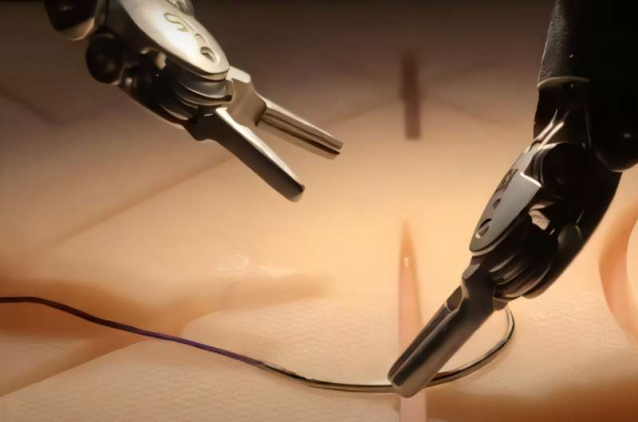
The surgical lights are on, and there is no lead surgeon at the table, only a mechanical arm with a “wrist” examining the organ. In the next moment, it precisely grips instruments and sutures the wound—this is not science fiction! AI surgical robots can independently complete key steps in 8 gallbladder surgeries with a 100% success rate, suturing 30% faster than doctors, and self-correcting an average of 6 times per surgery. Are they a “super assistant” for doctors or a “job-stealing competitor”? This article will introduce you to the topic.

AI Surgical Robots

Not “Puppets”, but Intelligent Assistants
When it comes to surgical robots, many people think of the da Vinci system—but that is a “high-end remote control” where the doctor manipulates the mechanical arm to “copy the movements”.
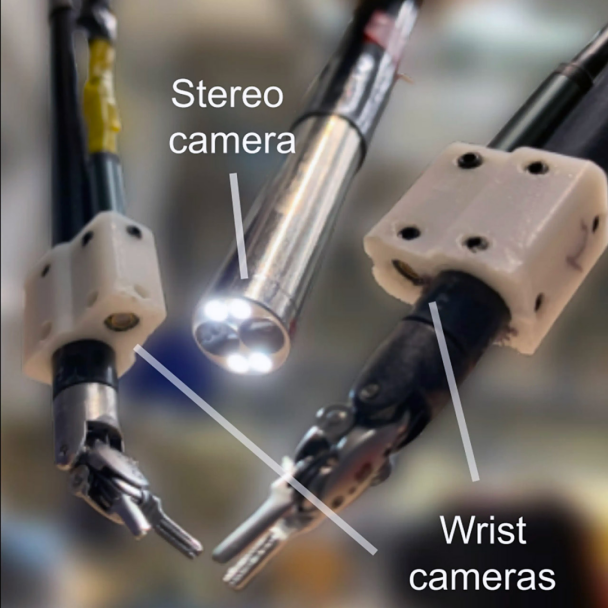
Today’s AI surgical robots are intelligent devices equipped with “vision + motion brains”: cameras act as “eyes” (some have wrist-mounted cameras for 360° visibility), mechanical arms serve as “hands”, and AI algorithms function as the “brain”—capable of observing the scene, judging actions, and correcting errors without needing the doctor to guide them step by step.
To put it simply: traditional robots are “scalpels held by doctors”, while AI robots are “interns who can learn skills on their own”. Orthopedic robots are only the size of two basketballs, designed for delicate tasks; SRT-H robots can independently perform gallbladder removals.
Source: Johns Hopkins University

Features of AI Surgical Robots

“Learning by Watching Videos” + “Layered Work”
01
How does it “learn” to perform surgeries?
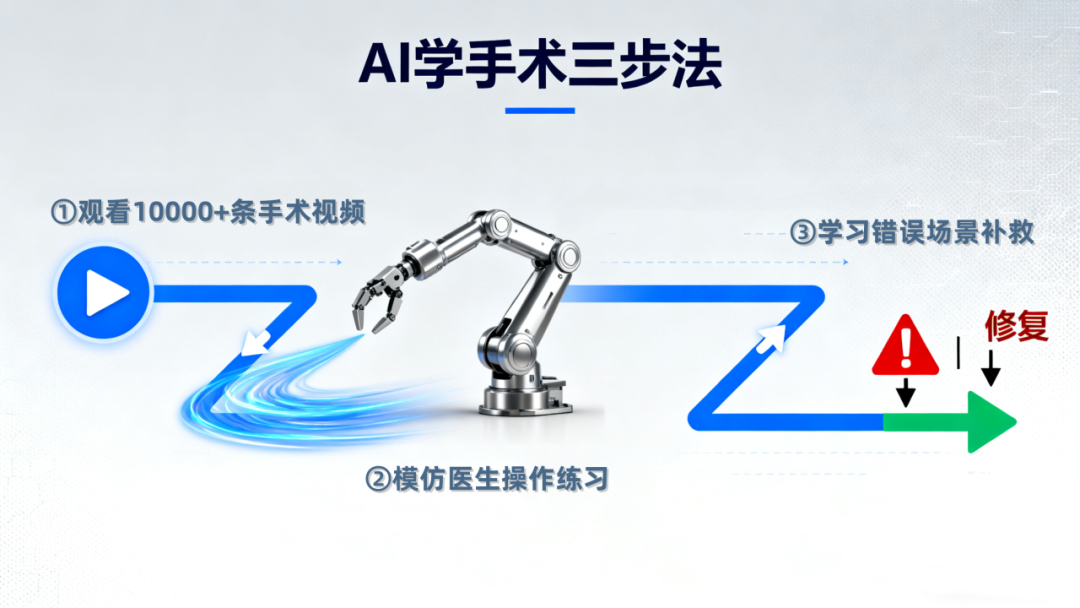
Like a child practicing writing, the robot learns skills by watching over 10,000 real surgery videos, capturing details like “gripping instrument force and tissue angle”. It then uses “imitation learning” technology to practice alongside “doctor mentors” and learns how to remedy issues like “misplaced clamps and obstructed views”.
02
Three Major Advantages
🤏🏻 Millimeter-level Precision: Penetration accuracy of 0.1mm at 5cm, cutting blood vessels without leakage, with extremely high stability.
🤔 30% Faster: Suturing, clamping, and other operations save time, crucial in emergencies.
💪🏻 Self-Correcting: If a needle drops or the view is obstructed, it self-corrects an average of 6 times per surgery, remaining calmer than a novice.
Source: Johns Hopkins University

Is it usable now?

5-15 years for widespread use in county hospitals
Current Status
Passed “Simulation Tests”, Approaching “Real Combat”
🔹 100% Success in Animal Experiments: The SRT-H robot operated on 8 pig gallbladders with zero errors, adapting to different anatomical structures.
🔹 Specialist Robot Trials: An expert team’s orthopedic robot can identify cancer cell boundaries in real-time, a world first.
🔹 High Autonomy: Top robots reach “LoA IV level”, capable of making decisions independently but require doctor supervision.
Future Prospects
Potential Applications
🔹 County Hospitals: Robots can “download” expert experiences, allowing remote patients to avoid traveling to big cities.
🔹 Extreme Environments: In space or deep sea, humanoid robots can instantly become “surgeons” in emergencies.
🔹 General Assistants: By changing algorithms and tools, they can switch from orthopedic to neurosurgery.


Rapid Development of Robots

Better to Stay Healthy
1
Protect Gallbladder: Diseases from Diet
-
Eat less high-fat and high-sugar foods, and consume 25-30 grams of dietary fiber daily (celery, oats).
-
Get an ultrasound of the gallbladder annually after age 40 to detect stones early.
2
Bone Health: Avoid Orthopedic Surgery
-
Sunbathe for 10 minutes daily to help the body synthesize Vitamin D.
-
Check bone density after age 50, and follow medical advice for calcium supplementation (800-1000mg daily).
3
Cancer Prevention: Early Screening is More Important than Surgery
-
Quit smoking and drinking, avoid staying up late, and get HPV and hepatitis B vaccinations.
-
Smokers over 40 should have annual lung CT scans, and those over 50 should have regular colonoscopies.


Key Points about AI Surgical Robots
✅ Essence: Not “puppets”, but intelligent surgical assistants with “vision + motion brains”.
✅ Expertise: Millimeter-level precision, 30% faster than doctors, capable of self-correction.
✅ Current Status: 100% success in animal experiments, specialist robots are already in trial use.
✅ Future: Widespread use in 5-15 years, applicable in remote areas and extreme environments.
✅ Core: Cannot replace doctors, but serves as a “super tool” for them.
✅ Key: Maintaining personal health is fundamental; early screening and dietary control are more important.
References:
[1] Lu Shixin Medical Foundation. “Can Medical AI Replace Doctors? Academician Meng Qinghu Explains the Specialization of Surgical Robots and Practical Applications of Intelligent Scenarios”. September 15, 2025.
[2] DeepTech. “AI Surgical Robots Debut: Capable of Manipulating Needles and Suturing Wounds, Suturing Surgeries 30% Faster than Human Doctors”. January 5, 2025.
[3] Robot Lecture Hall. “Breaking News! Latest Cover of Science Sub-journal! Milestone Breakthrough: Robots Successfully Perform Autonomous Surgery with 100% Success Rate!”. July 11, 2025.
[4] “Science Robotics” 2025 Cover Paper: “Hierarchical Surgical Robot Transformer for Autonomous Soft-Tissue Surgery”.
#HealthScience #AI Surgical Robots #Cutting-edge Medicine #Preventive Medicine #AI Healthcare
This is for public welfare promotion only, with no commercial use. If there are any text or image infringements or violations, please inform us for deletion.