Clickthe blue textto follow us

The popularity of intelligent cooking robots continues to rise! From cross-industry players to leading restaurant enterprises, everyone is rushing into this new battlefield, marking the beginning of a transformation in the dining industry centered around “robotic cooking”.
1
Various players are entering the market,
with a surge of cooking robot restaurants
Recently, the new move by Guoquan Foods has attracted industry attention — announcing plans to open a “cooking robot model” Chinese stir-fry restaurant called “Guoquan Stir-fry” next year. The backbone of this new store format is the cooking robot brand Xiong Miao Master, which they strategically invested in.
In the Guoquan Stir-fry restaurant, you won’t see chefs flipping woks: robotic arms precisely pour ingredients and seasonings into a semi-open frying chamber, and moments later, a steaming dish is ready. More importantly, it maintains the “community central kitchen” positioning, with no dine-in option; customers order online and pick up in-store, perfectly catering to the daily needs of community residents.
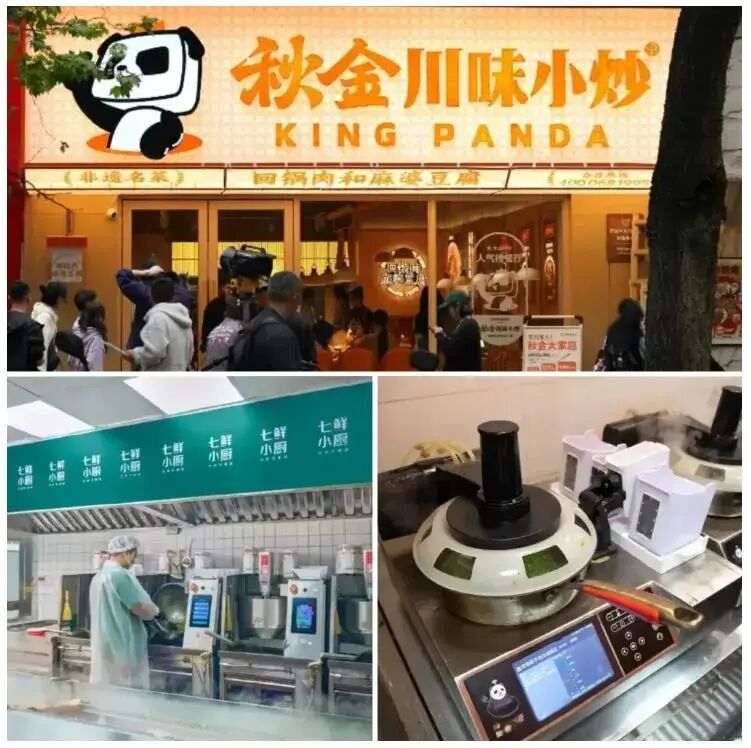
In fact, Xiong Miao Master has already tested the stir-fry market through “Qiu Jin Chuan Wei Stir-fry.” At the Qiu Jin Chuan Wei Stir-fry Tianlang store, six cooking robots operate simultaneously, requiring only two people to manage, and can produce a dish in 1-2 minutes, with efficiency visible to the naked eye. Not only Guoquan and Xiong Miao Master, but this year, “cooking robot restaurants” are rapidly emerging:
JD’s “Qixian Kitchen”: officially launched in July, focusing on fresh stir-fry, covering 30 items including stir-fry, snacks, and rice bowls, equipped with four cooking robots (Xianglu cooking robots) invested by JD, with an expected daily capacity of over 4000 orders;
Blue Edge Bowl: focuses on Jiangxi stir-fry and has launched a “robot chef” store, with the person in charge stating, “the robot chef is the core,” accurately replicating the master’s standards from controlling oil temperature to adding ingredients, restoring the authentic “wok flavor”;
Ba Wan Gai Ma Fan: is the fastest brand in the cooking robot stir-fry market, with over 1000 stores all equipped with self-developed cooking robots, now in their third generation, and has launched a 15 yuan stir-fry rice bowl, focusing on extreme cost performance, even earning over 20 million annually from robot leasing (calculated based on an annual rent of 12,000 per unit and 1800 units across 600 stores).
More noteworthy is the action of leading restaurant enterprises: Xiaocai Garden plans to use part of its fundraising to purchase 3000 cooking machines, with a budget of 50,000 each; as of April this year, Laoxiang Chicken has already equipped 388 restaurants with cooking robots, smart steam cabinets, and other equipment. The enthusiasm of restaurant owners undoubtedly presses the “accelerator” for the cooking robot market.
2
Why are small stir-fry restaurants particularly fond of cooking robots?
Interestingly, apart from the group dining sector, the ones most eager to introduce cooking robots in bulk are small stir-fry restaurants.The reasons behind this can be explained from both consumer and business perspectives.
Consumer side: The demand for “fresh stir-fry” is surging, and robots become “trust substitutes”
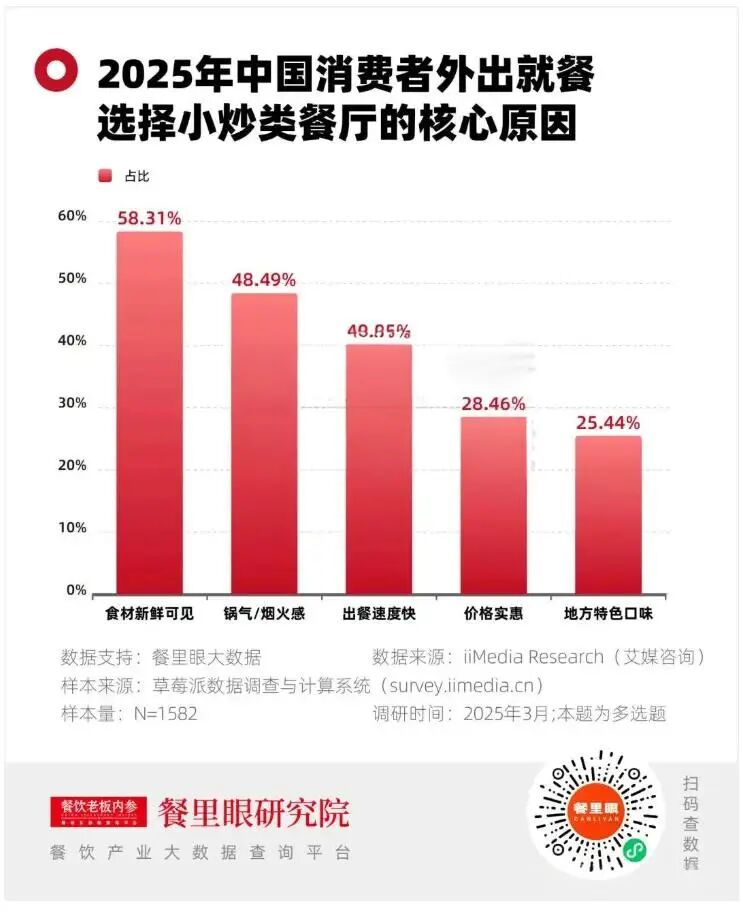
In recent years, consumer panic over pre-prepared dishes has made “fresh stir-fry” the core demand in dining consumption. According to iiMedia Consulting, by 2025, when Chinese consumers choose small stir-fry restaurants, “fresh and visible ingredients,” “wok flavor/smoke feeling,” and “fast serving speed” rank in the top three — and cooking robots can precisely meet these demands.
The cooking process of robots is completely transparent, and many brands even use transparent glass windows to allow consumers to see the cooking process, dispelling concerns about “lack of freshness” and providing a direct experience of the “fresh stir-fry” atmosphere. More importantly, after the outbreak of “pre-prepared dish panic” this year, consumers found that cooking robots are actually a “better solution”: surveys show that over 70% of consumers aged 18-35 accept cooking robots and even actively post short videos on social platforms.
Business side: In a competitive market, robots become the “key to breaking through”
The current dining industry has already entered a “stock reshuffle” phase. New entrants must present differentiated advantages to establish a foothold, and cooking robots are seen as a “breakthrough” by many players.
In the fast-food sector, leading brands like Xiangcunji redefine competitiveness through “fresh stir-fry”; cuisines like Hunan and Jiangxi, known for their stir-fry, are pushing “fresh stir-fry” to new heights; community stir-fry shops and “takeout + self-pickup” stores near office buildings (like Qixian Kitchen) are attracting customers with “fresh stir-fry.”
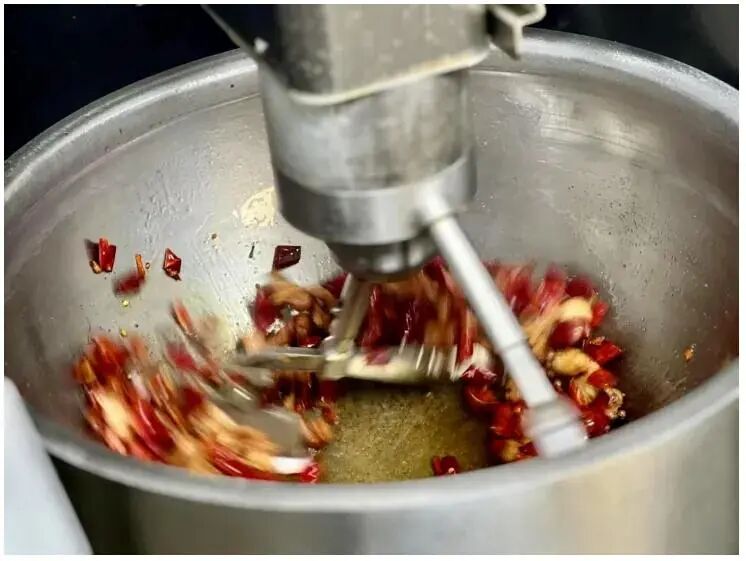
For cross-industry players, robots are also the “entry ticket”: Guoquan originally specialized in hot pot ingredients and entered the stir-fry market by investing in Xiong Miao Master; JD has strategically invested in Xianglu Technology twice (10 million in 2023 and nearly 200 million in 2025), using “Qixian Kitchen” to layout the fresh stir-fry field. The success of Ba Wan further validates the feasibility of the robot model — not only opening thousands of stores with fresh stir-fry rice bowls but also creating a new revenue source through equipment leasing.
Ultimately, the collective embrace of cooking robots by small stir-fry restaurants is not only a response to consumer demands for “fresh stir-fry, freshness, and wok flavor” but also an inevitable choice for the dining industry to cope with cost pressures and promote technological revolution.
3
Robotic cooking:
Is it a trend or just a passing fad?
Although cooking robots are gaining momentum, we must also think critically:Is it a short-term trend, or can it change the long-term dynamics of the industry?
First, let’s look at the advantages: addressing the three core pain points of the dining industry
It is undeniable that robotic cooking indeed targets the “soft spots” of the dining industry:
Cost reduction: Xiaocai Garden’s semi-annual report shows that employee costs have decreased by 8.2% year-on-year, with research indicating that the core reason is the optimization of personnel structure through the “cooking machine + single-store model”;
Efficiency improvement: Jiangxi Stir-fry has reduced serving time to under 5 minutes after using AI robots, with the R&D director of Blue Edge Bowl citing that “fresh spicy chicken feet can be replicated by robots in 3 minutes”;
Strong standards: The endorsement from leading restaurant enterprises is more convincing; the founder of Xiaocai Garden revealed that nearly 200 stores nationwide use robots to stir-fry dishes like shredded potatoes, scoring “80 points” for the machines.
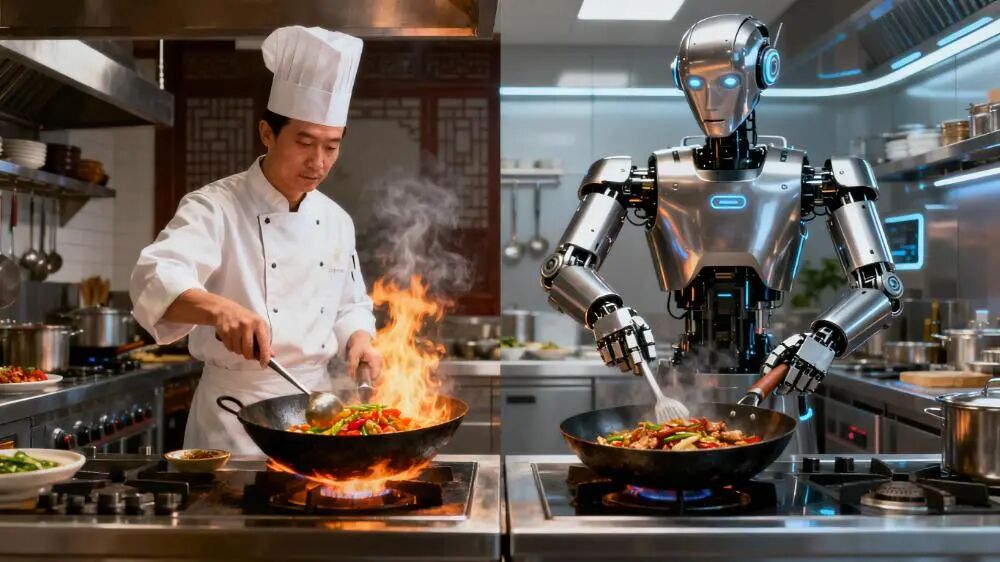
Now, let’s look at the problems: the conflict between “efficiency” and “human touch” is hard to balance
However, the shortcomings of robotic cooking are also quite evident:
From the customer experience perspective, it currently remains in the “curiosity – trial – limited repurchase” stage. The charm of Chinese cuisine has never been about “precise quantification,” but rather the feel of the cooking process, the flexibility of seasoning, and the chef’s intuitive judgment. For instance, robots rely on fixed programs, pursuing “uniform taste across thousands of stores,” and cannot adjust oil and salt based on customer preferences — this is a point of criticism from many netizens; there have also been media reports of a brand where due to humidity in the kitchen, salt clumped together, and the robot still executed the command to “add 3 grams of salt,” resulting in clumps of salt falling into the pot, leading to complaints from customers about the dish’s taste being off.
From the business perspective, high costs and maintenance issues are “roadblocks”: a single machine starts at over 100,000 yuan, and with maintenance, cleaning, and consumable costs, many small shops simply cannot afford it. Even if chain brands can bear the costs, they must consider scene adaptability — robotic cooking is more suitable for high customer flow and standardized requirements in chain fast food and takeout scenarios; while small restaurants like street-side couple shops and community stir-fry shops remain the mainstream of the market, these scenarios have low average spending and strong personalized demands, where manual cooking cannot be temporarily replaced.
4
Conclusion: In the era of diverse fresh stir-fry,
AI is a tool, not a disruptor
Ultimately, robotic cooking is not meant to completely replace traditional fresh stir-fry but serves as an “incremental tool” and “efficiency optimization method” for the dining industry. As consumer stratification intensifies and technological penetration deepens, a “coexistence of human cooking, robotic cooking, and semi-automated cooking” era of diverse fresh stir-fry is slowly approaching.
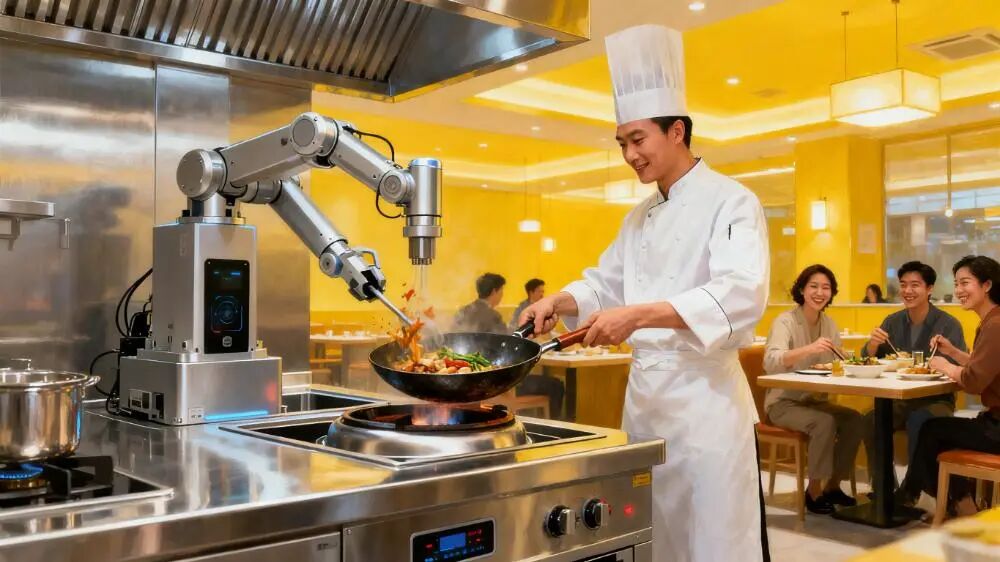
The arrival of the AI era in dining is unstoppable, but how can we make cooking robots truly become operational tools? How can we find a balance between efficiency and experience? This requires more brands to continuously explore in practice. Perhaps in the future, we can enjoy both the efficient and convenient fast food cooked by robots and the flavorful stir-fry made by master chefs — this is the true significance of technological innovation in dining.
【Disclaimer】The descriptions and images in this article are sourced from the internet, and this article aims to promote positive social energy without any vulgar or negative guidance. If there are any copyright or personal infringement issues, please contact us promptly, and we will delete the content immediately! If there are any questionable parts of the events, we will delete or modify them immediately upon contact.



 Click to read the original text for more information