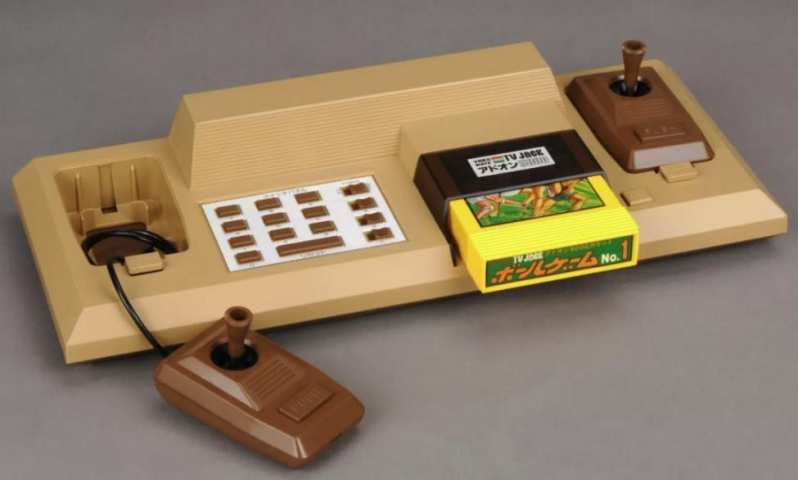
In the mid-1980s, Japanese toy and game manufacturers began exploring new forms of handheld gaming. As a long-established toy company in Japan, Bandai has extensive experience in electronic gaming devices, such as the early TV JACK 1200, 1500, 2500, 3000, and 5000.
The Digi Casse (Japanese name “デジカセ”, meaning Digital Cassette) was launched by Bandai in 1984 in Japan as a handheld gaming console.
The background of this product’s birth is similar to that of Palmtex, aiming to break the limitation of “one game per device” and allow the handheld to achieve a multi-game experience through interchangeable game modules. The difference is that Bandai adopted a design approach that was completely opposite to that of Palmtex to achieve this.
Before the launch of Digi Casse, the handheld gaming market mainly had two types of devices. One type is represented by Nintendo’s Game&Watch, which are single-game LCD handhelds that play one fixed game but are beautifully compact. The other type is like Microvision, which are interchangeable cartridge handhelds that can switch games but are more complex.
Smartly, Bandai also noticed that the success of Game&Watch was due to the exquisite static pattern designs tailored for the LCD screen of each game, presenting clear and intuitive effects. In contrast, the problem with Microvision was that it shared a low-resolution pixel screen, which could not fully express the unique artwork of each game. Thus, Bandai cleverly combined the two to create the Digi Casse, a new form of “base + game screen module”.
In 1984, the Japanese gaming console market was flourishing, with major battles in the console sector between companies like Nintendo and Sega, but there was no dominant player in the handheld sector. Bandai, as a giant in the toy industry, hoped to secure a place in the handheld market.Digi Casse’s emergence coincided with Japanese consumers’ interest in novel electronic toys. It was launched in Japan under the name “LSI GAME Digi Casse” (LSI refers to large-scale integrated circuit games). In 1986, Bandai introduced Digi Casse to several European countries.
It is worth noting that from 1984 to 1986, Nintendo’s Game&Watch series was still releasing new titles, while Game Boy had not yet been released. Therefore, the era in which Digi Casse existed was a transitional exploration period for handhelds from single-game to multi-game. It was considered a novel attempt at the time, embodying Bandai’s vision for the future form of handhelds.
Bandai’s Digi Casse device consists of two main parts: a white base unit and a colorful game module. The base unit has simple controls, including a red directional controller, which comes in both joystick and button designs. There are two blue buttons, labeled “START” and “ACTION” for starting/selecting and executing actions), as well as a power switch and sound switch. Interestingly, the Digi Casse base unit also features an electronic clock/alarm function: by pressing the two blue buttons on the left side of the base, users can switch between 12/24 hour formats and view the date. This is similar to the clock design in the Game&Watch series, making it function as a practical electronic watch.
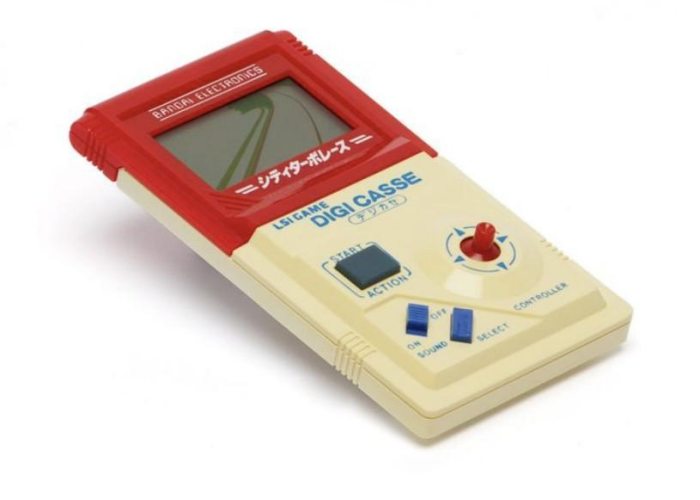
The true uniqueness of Digi Casse lies in its game modules, each module is essentially a complete LCD game, containing its own LCD screen, game circuitry, and artwork. The module is shaped like a small upper half of the console and directly plugs in, or more precisely, replaces the top part of the base unit. When changing games, players do not simply insert a cartridge; instead, they remove the entire top cover and replace it with another. Therefore, Digi Casse does not have a traditional “cartridge slot”; instead, it connects different game screen modules to the base through a mechanical structure. It does not have a true cartridge—changing games requires replacing the entire upper part with the LCD screen.
Each game module comes with a custom LCD display, pre-printed with the game’s fixed background and character patterns, usually in black and white or monochrome graphics, with corresponding parts lighting up or flashing during gameplay, similar to Palmtex, using the “lit static graphics” method to present animation effects. The top of the module usually prints the game name, with small icons around the bottom or screen indicating the function of each button in that game.
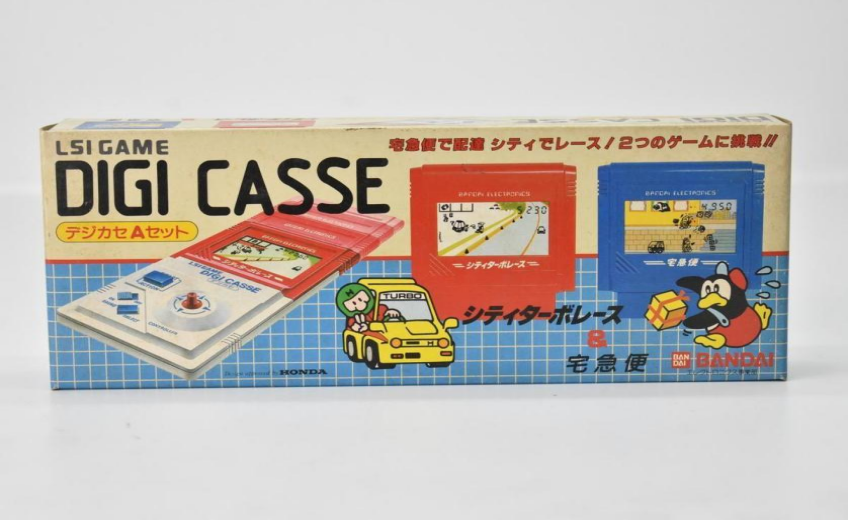
The blue module is printed with the Japanese “宅急便”, indicating that the module’s game is called “宅急便” (Express Delivery); the red module is printed with “シティターボレース”, indicating the game “City Turbo Race.” These modules are designed so that each game has its own unique appearance and screen layout, just like each independent handheld console, sharing only a base for power and control.
In terms of hardware technology, the Digi Casse base unit uses 1 to 2 LR44 button batteries for power, with the number of batteries depending on the model; some bases only require one battery, while later versions used two for longer battery life.
This handheld console does not have a power switch, and is essentially in a constant standby state; inserting a module or pressing a button will activate the screen to start the game. However, because it uses an LCD display and has extremely low power consumption, along with the clock function, the always-on standby does not quickly deplete the battery. The base unit also does not have volume control, only providing a simple on/off sound effect switch, and fortunately, its beeper is quite soft and not bothersome.
The Digi Casse base unit is responsible for providing power, beeper sound output, and button input, while the game module contains the chip that processes game logic and presents images on the LCD. So it can be understood that, the base unit= controller + battery + speaker, module= screen + game. This architecture tightly binds the display and content, allowing each game to have a specifically designed screen pattern and layout. In contrast, Palmtex’s shared screen pixel array solution seems less intuitive. Digi Casse achieved a unique technical route of “changing screens and changing games” through its modular top cover, which was quite ingenious at the time.
In 1984, Bandai’s Digi Casse was released in Japan. At launch, the base unit was typically bundled with two game modules, meaning consumers could purchase a set to get the console and 2 games. According to records, there were at least two different configurations of the set in Japan: Set A included the games “宅急便” (Express Delivery) and “City Turbo Race”; Set B included “ハゲランス” (Hageransu) and “富士山大爆発” (Mount Fuji Eruption).
These games cover driving, action, puzzle, and other genres, catering to the interests of children and teenagers. “宅急便” requires players to control a delivery person dodging obstacles on the street; “City Turbo Race” is a racing competition game; “富士山大爆発” is related to volcanic eruptions, involving gameplay of avoiding volcanic debris; “Hageransu” has a somewhat mysterious name (literally translated as “Bald Head Spear”), but is actually a humorous action game. These creative ideas reflect Bandai’s imagination as a toy manufacturer.
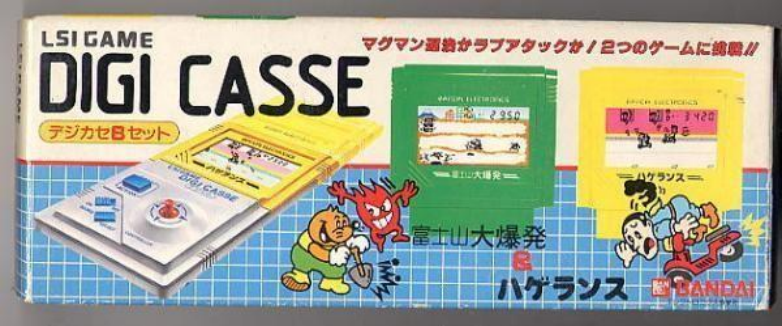
After its launch in Japan, Digi Casse attracted some attention with its novel modular concept. However, overall sales did not spark a frenzy. On one hand, its pricing and functionality did not show significant advantages compared to single-game LCD handhelds of the same period. On the other hand, starting in 1985, Japanese players’ interests gradually shifted towards home consoles like the Famicom, which featured more beautiful graphics, leading to a decline in the novelty of simple LCD games. However, Digi Casse clearly achieved some success; otherwise, Bandai would not have attempted to push it overseas. In 1986, Bandai introduced Digi Casse to the European market, where it was distributed by local companies in some countries.
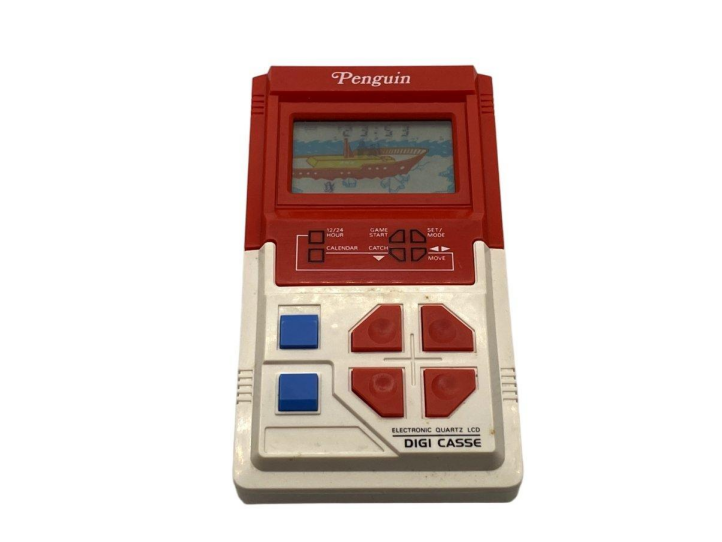
Reports indicate that the European version released up to 6 game modules, in addition to those released in Japan, including “Pelican”, “Penguin”, “Soccer”, “Tennis”, “Submarine”, and “Frog & Insects”.
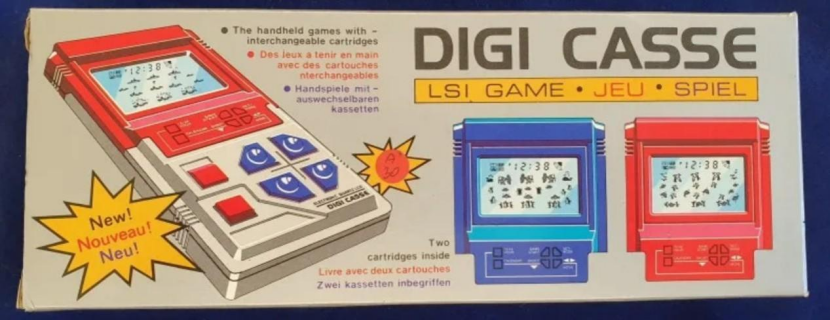
How did European players respond to this handheld console? Perhaps because the Famicom had also landed in Europe by then, and LCD handhelds were not as popular in Europe as they were in Japan, Digi Casse did not create much of a wave, and it was only a fleeting moment overseas.
Digi Casse’s market performance was mediocre, not becoming a phenomenon like Game&Watch and failing to shake Nintendo’s position in the handheld sector. The period from 1984 to 1986 was a transitional phase for the electronic toy market, moving from LCD games to more advanced handhelds. Digi Casse occupied a place during this transition but quickly faded from the commercial stage. In the following years, Bandai did not continue to develop this product line. Around 1987, with the advancement of Game Boy development and Sega and other companies brewing more powerful handhelds, LCD handhelds with similar technical routes to Digi Casse gradually ceased production.
Therefore, Digi Casse’s market life was quite short, lasting about 1 to 2 years in Japan, and only a small-scale release in Europe before quickly being discontinued.
Similar to Palmtex, Digi Casse did not form a wide player base due to limited sales. Among Japanese children at the time, it still left a certain impression. For children back then, owning a Digi Casse meant having both a video game console and an electronic clock, along with the novelty of interchangeable game modules, making it a source of pride among peers.
From the memories of some Japanese players, Digi Casse’s gameplay was simple yet fun, such as in “宅急便”, where the delivery person must dodge cars, dogs, and other obstacles on the street, testing reflexes; “City Turbo Race” resembles traditional racing video games, constantly changing lanes to avoid cars. The styles of these games are similar to those of the Tiger Electronics LCD handhelds common at the time, belonging to the “picture-based game” type, where the fun mainly comes from repeatedly challenging high scores or competing for reaction speed. For children in the mid-1980s, this kind of electronic toy was already considered quite technologically advanced entertainment.
Digi Casse and its “screen cartridge” concept sparked some followers and knockoffs in the industry. In the game console market in China and Hong Kong, there were cheap handhelds imitating the Digi Casse concept. For example, the “QGH-78 Game Kid” (also known as Game Child) series launched by Hong Kong’s Queentex company borrowed from the Digi Casse design, mimicking the shape of Nintendo’s Game Boy, but with screens and games made as pluggable modules, allowing one base to switch between multiple different LCD games.
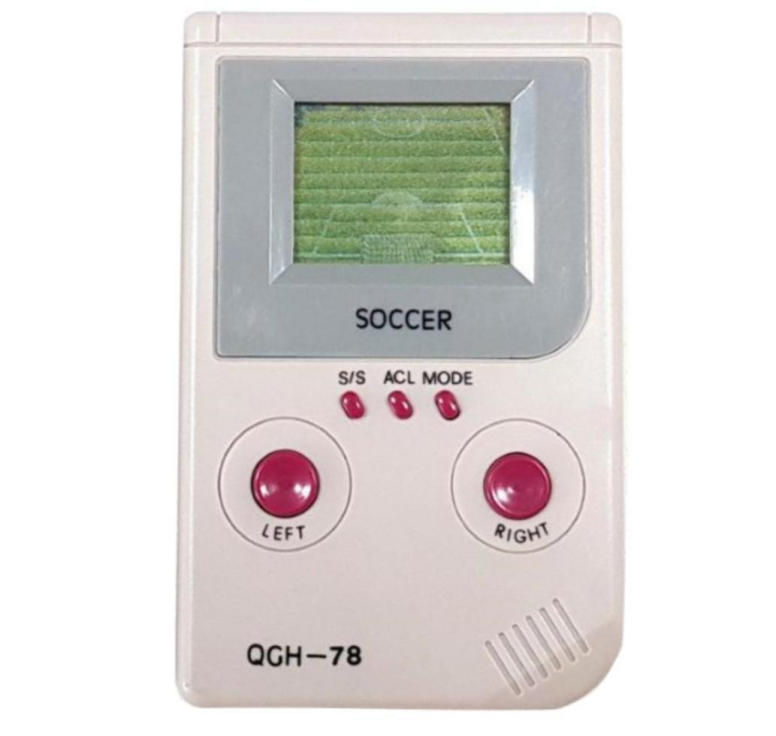
It is reported that the Game Kid series released more than a dozen game modules in the late 1980s, with gameplay being quite similar, mostly involving moving left and right to dodge obstacles, selling well in some regions at low prices. The existence of such knockoff products indirectly indicates that Digi Casse’s creativity was indeed commendable, but it was overshadowed by cheaper implementations, causing the original Digi Casse to fade into obscurity.
In Japan, Digi Casse, as a handheld product in Bandai’s history, is occasionally mentioned by nostalgic media. Bandai’s most famous subsequent products in the handheld sector include the WonderSwan developed by Gunpei Yokoi in the late 1990s and the earlier Tamagotchi electronic pet.
Digi Casse’s position in the history of handheld consoles can be seen as an innovative product from the late handheld era before the Game Boy’s emergence. Its appearance expanded people’s imagination of handheld consoles, showing that handhelds do not necessarily have to have fixed screens; they can even switch “cartridges” like cassette tapes to change content. This design of embedding the LCD screen into the cartridge is unique among mainstream products and is considered one of the ingenious ideas in the history of handheld development.
From a commercial impact perspective, Digi Casse’s failure was relatively mild. Bandai itself has a wide range of businesses, and the lack of success of this product did not cause significant harm to the company. Bandai continued to explore other products in the electronic entertainment field, such as the “TV Boy” (a portable TV game console with a built-in screen) in 1985 and video game textbooks in the 1990s. Compared to the Game Boy, Digi Casse is merely a small interlude of the past, quickly submerged by the tides of history.
As a “side character” in the history of handheld development, Digi Casse’s subsequent influence mainly lies in its conceptual level. It reminds us that the evolution of handhelds is not a straight line, with many creative branches along the way. Some ideas (such as backlighting and modularity) later integrated into the mainstream in different forms, while others became footprints in history.
Digi Casse, although not well-documented, has some interesting tidbits. Firstly, its name “デジカセ” is clearly an abbreviation and Japanese pronunciation of “Digital Cassette”, indicating that its design intention was to change game modules like changing tapes.
In the 1980s, cassette tape portable players were popular in Japan, and Bandai may have hoped to make consumers feel that changing games was as simple as changing songs. The packaging of DigiCasse often printed the words “LSI Game”, emphasizing its identity as a video game and also hinting at its use of large-scale integrated circuit technology, which was one of the hallmarks of high technology at the time.
Another interesting fact is that Digi Casse adopted different brands when released in different regions. According to European players’ memories, the French toy manufacturer Lansay once distributed Digi Casse, but used French packaging and localized names. Some players even found variants of Digi Casse in places like Romania, indicating that this product had sporadically entered multiple markets. However, due to the communication difficulties at the time, players in these regions were often unaware that their handheld console originated from Bandai’s Digi Casse in Japan.
Most of the seven or eight games of Digi Casse were developed by Bandai’s internal team, and the specific designers are hard to trace. However, from the game concepts, many show the influence of Game&Watch. “Penguin” may be similar to Nintendo’s “Penguin Ice Block”; “Pelican” might involve controlling a pelican to catch fish; “Frog&Insects” evokes the idea of a frog catching bugs in an LCD game.
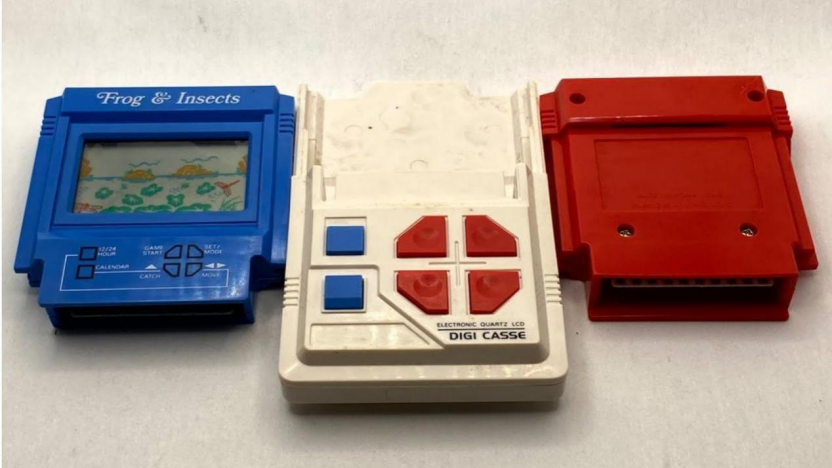
These themes are very “LCD game-like”, indicating that Bandai took a safe route in content, using familiar animal and sports themes for children, paired with simple and fun gameplay. This also reflects the creative thinking of handheld game development at the time: winning with intuitive imagery and simple rules, without pursuing complex plots or depth, allowing for quick play.
One detail that old players find amusing about Bandai’s Digi Casse is that it does not have a separate “off” button. Players can only stop the game by removing the module or waiting for it to automatically sleep. This seems incredible now, but many cheap electronic watch games were like this back then—defaulting to always-on, with very low power consumption.
Bandai’s Digi Casse was an early attempt in the handheld market of the 1980s, occupying a place among early handhelds with its unique cartridge design and simple gaming experience. Although it had a limited number of games and influence, it still showcased creativity.