“Tianjin Robot” is the official subscription account of the Tianjin Robot Industry Association. Follow us to learn about the robot industry news both domestically and internationally.
On July 15, Wang Xingxing, founder and CEO of Hangzhou Yushu Technology Co., Ltd., attended the “Strivers on a New Journey” press conference for Chinese and foreign journalists and engaged in discussions on-site.
When asked, “What are the differences in the development of humanoid robots between China and the US?” Wang Xingxing candidly stated that the global technological goals for humanoid robot technology and product development are similar. However, due to the differences in cultural and industrial backgrounds of each country, for example, China has a strong foundation in manufacturing and hardware, while the US has a rich AI software ecosystem, each has its advantages, which is worth promoting and collaborating on together.
Wang Xingxing emphasized that we also hope for a more open collaborative ecosystem, as our company has previously done a lot of software open-source work, including many clients developing and applying on our robots. This is what I feel happiest and proudest about, promoting the development of the entire industry together.
On-site, Wang Xingxing revealed that since its establishment in 2016, Yushu Technology has focused on the research and development of high-performance quadruped and humanoid robots. He stated that in the field of quadruped and humanoid robots, Yushu is the company with the highest shipment volume. Its quadruped robot sales account for 60%-70% of the global market, and its large-sized general-purpose humanoid robot business covers more than half of the countries and regions worldwide, promoting “Made in China” to go global.
The humanoid robot industry is one of the most promising and innovative frontiers in today’s technology field. It integrates cutting-edge achievements from multiple disciplines, including artificial intelligence, mechanical engineering, electronic technology, materials science, and cognitive science, aiming to develop robots that can simulate human appearance, behavior, and cognitive abilities.
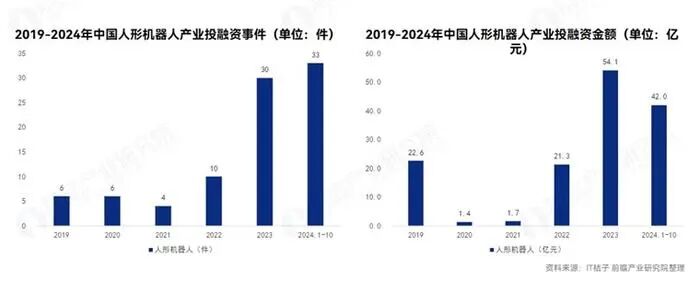
After 2021, the number and amount of investment and financing in China’s humanoid robot sector have shown an upward trend, in 2023, the number of investment and financing cases in China’s humanoid robot industry reached 30, a year-on-year increase of 200%; the financing amount was 5.41 billion yuan, a year-on-year increase of 153.5%, indicating a positive development trend in the industry.
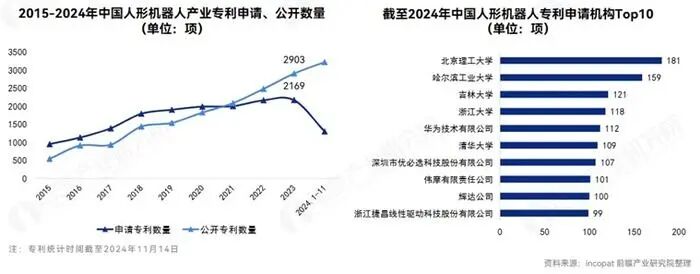
According to incoPat data, from 2015 to 2023, the number of patent applications and publications for humanoid robots in China has shown a fluctuating upward trend, in 2023, the number of published patents for humanoid robots in China reached 2,903, entering an explosive stage; in terms of application institutions, as of November 2024, Beijing Institute of Technology is the institution with the largest number of patent applications in the humanoid robot field, with 181 applications.
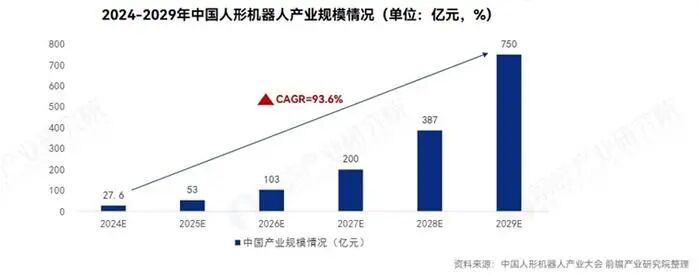
The Chinese humanoid robot market shows enormous growth potential. According to information disclosed at the China Humanoid Robot Industry Conference, the market size of humanoid robots in China is expected to be approximately 2.76 billion yuan in 2024. Regarding the future development of the entire humanoid robot market, the Ministry of Industry and Information Technology released the “Guiding Opinions on the Innovative Development of Humanoid Robots” in November 2023, clearly stating that by 2027, the industry will accelerate to achieve large-scale development, with more diverse application scenarios, and related products deeply integrated into the real economy, becoming an important new engine for economic growth.
Wang Xingxing believes that the next five years will be a critical period for humanoid robots to move from the “laboratory” to “thousands of households”. With the empowerment of large model technology in motion control and the continuous release of cost advantages in China’s industrial chain, humanoid robots are expected to first land in logistics, healthcare, education, and other fields.
Professor Liu Huaping from the Department of Computer Science and Technology at Tsinghua University believes that the greatest advantage of humanoid robots lies in their physical characteristics, which can achieve work efficiency similar to that of humans in many workspaces, enhancing work efficiency. In addition, the role of large models in promoting humanoid robots is still in the exploratory stage; in the future, the motion control of robots should enhance coordinated motion control capabilities and perception and learning abilities, with the integration of body structure control and perception learning being key to promoting the development of humanoid robots.
Professor Zhang Linghan, a member of the United Nations High-Level Advisory Board on Artificial Intelligence and a professor at China University of Political Science and Law, pointed out that the essence of humanoid robots is the combination of generative artificial intelligence and physical form, which can enhance the robot’s ability to understand the world. At the same time, for humanoid robots to truly enter thousands of households, it will take time, considering factors such as ethical requirements of artificial intelligence, technical difficulties, and costs.
Forward-looking Economist APP News Team

Some content is sourced from the internet, and the copyright belongs to the original author. If there is any infringement, please contact us, and we will handle it as soon as possible.