
Source | Journal of Energy Storage
Link | https://doi.org/10.1016/j.est.2025.117895
01
Background Introduction
The thermal conductivity (λ) of composite phase change materials determines their response rate to external heat, which is crucial for chip thermal management. Traditional methods, such as incorporating thermal fillers into phase change materials, have had limited success in improving λ, significantly restricting their ability to quickly absorb and dissipate heat generated by electronic components. This defect prevents phase change temperature control devices from responding promptly to changes in thermal load, thereby compromising the stability and efficiency of thermal management systems. Consequently, extensive research has been conducted in academia to enhance the thermal conductivity of organic phase change materials.(λ)。
02
Highlights of the Results
Recently, Professor Chen Yanhui’s team from Northwestern Polytechnical University proposed a new strategy combining physical blending and compression molding to construct a sandwich structure CPCMs with segregated thermal conduction paths. The upper and lower layers consist of expanded graphite (EG) films, while the middle layer is composed of n-docosane encapsulated with graphene nanoplatelets (GnP) and polydimethylsiloxane (PDMS). The excellent in-plane thermal conductivity of the EG films ensures rapid heat diffusion, thereby reducing the risk of overheating. The GnP-coated n-docosane particles create an isolated network structure during the molding process, forming efficient thermal conduction channels. Furthermore, the strong interfacial bonding between GnP and EG films reduces interfacial thermal resistance, establishing a continuous and unobstructed thermal conduction path, significantly enhancing heat transfer efficiency. This structure allows the CPCMs to achieve a thermal conductivity of up to 9.82 W/(m·K), which is 39 times that of pure n-docosane (0.25 W/(m·K)). This composite material also exhibits a high phase change latent heat of 189.3 J/g and excellent shape stability—with only a 2.3% loss in melting enthalpy after 30 thermal cycles. In laboratory chip thermal management systems, the CPCM extended the chip operating temperature range (30℃ to 70℃) by 239%, demonstrating outstanding thermal management performance. This research provides a new approach for preparing high thermal conductivity CPCMs, with significant application prospects in advanced chip thermal management.The research results were published in the Journal of Energy Storage under the title “Boosted heat dissipation efficiency by sandwich structure containing the thermally conductive segregated network in phase change materials for advanced chip thermal management”.
03
Illustrated Guide
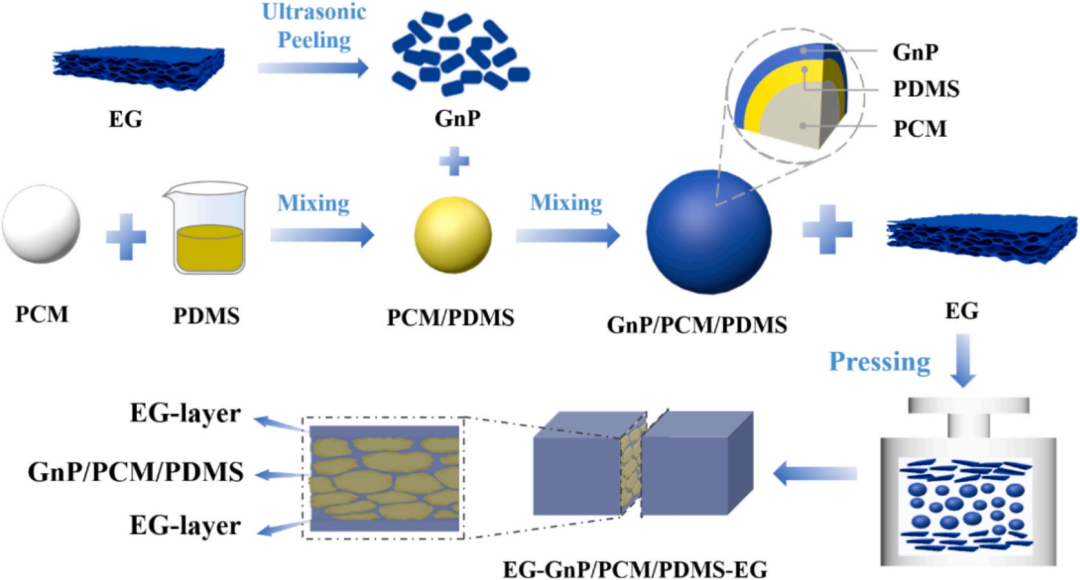 Figure 1. Schematic diagram of the CPCMs preparation process.
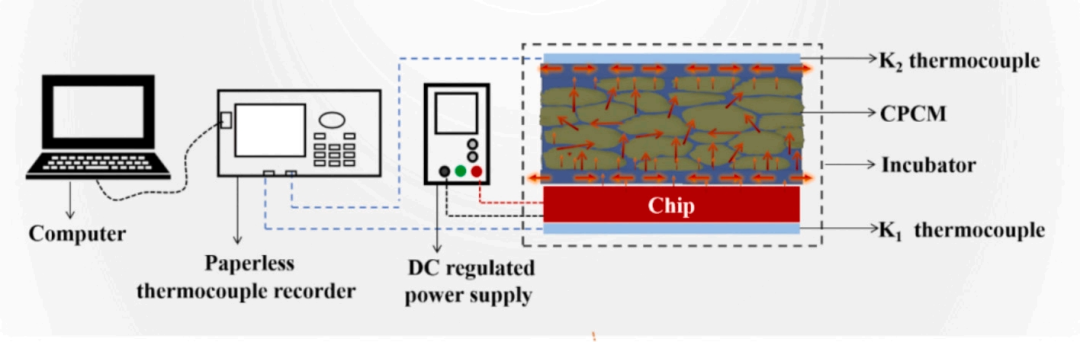 Figure 2. Schematic diagram of the electronic device heat dissipation experimental setup.
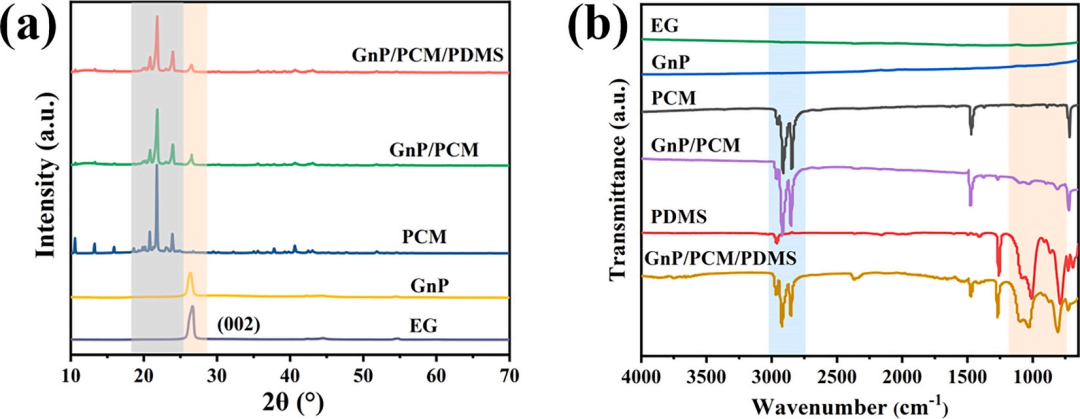 Figure 3. (a) XRD spectra of EG, GNP, PCM, GNP/PCM, GNP/PCM/PDMS and (b) FT-IR spectra.
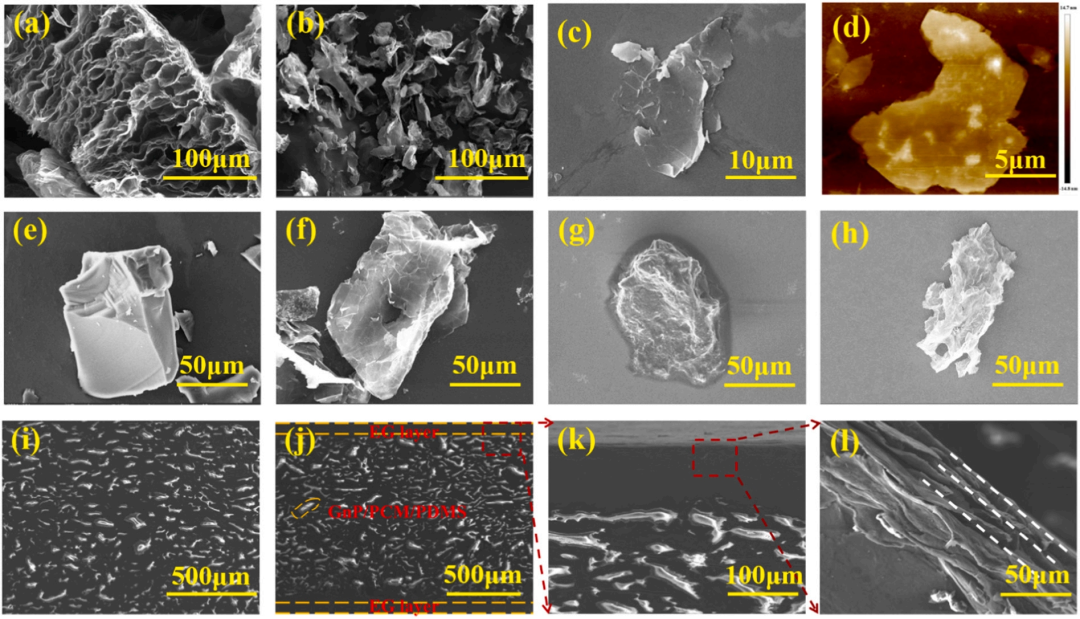 Figure 4. (a) SEM images of EG; (b) and (c) SEM images of GNP at different magnifications; (d) AFM images of GNP; (e) SEM images of PCM; (f) SEM images of GNP/PCM; (g) SEM images of PCM/PDMS; (h) SEM images of GNP/PCM/PDMS mixture; (i) SEM images of EGPE-0; (j) SEM images of EGPPE-2; (k) Local magnified SEM images of the intermediate layer and upper layer of EGPPE-2; and (l) Local magnified SEM images of the graphite film of EGPPE-2.
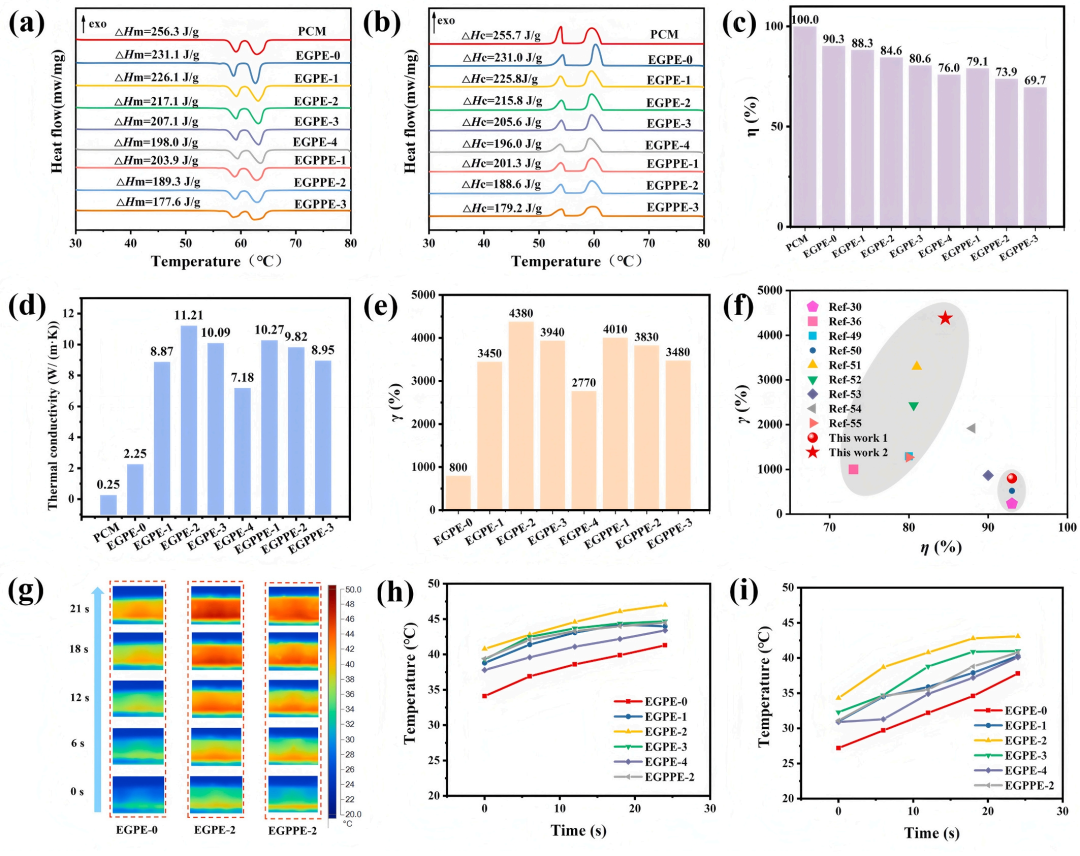 Figure 5. (a) DSC melting curve, (b) DSC crystallization curve, (c) Energy storage efficiency, (d) Thermal conductivity, (e) Thermal enhancement rate of phase change materials and composite phase change materials (γ = (λ(CPCM) − λ(PCM)/λ(PCM) × 100%); (f) Comparison of energy storage efficiency and thermal enhancement performance of EGPE-2 with other materials in the literature [49–55]; (g) Infrared thermal imaging of EGPE-0, EGPE-1, EGPE-2, EGPE-3, EGPE-4, and EGPPE-2 at the bottom temperature under 50℃; and (h) Top temperature changes over time for EGPE-0, EGPE-1, EGPE-2, EGPE-3, EGPE-4, and EGPPE-2.
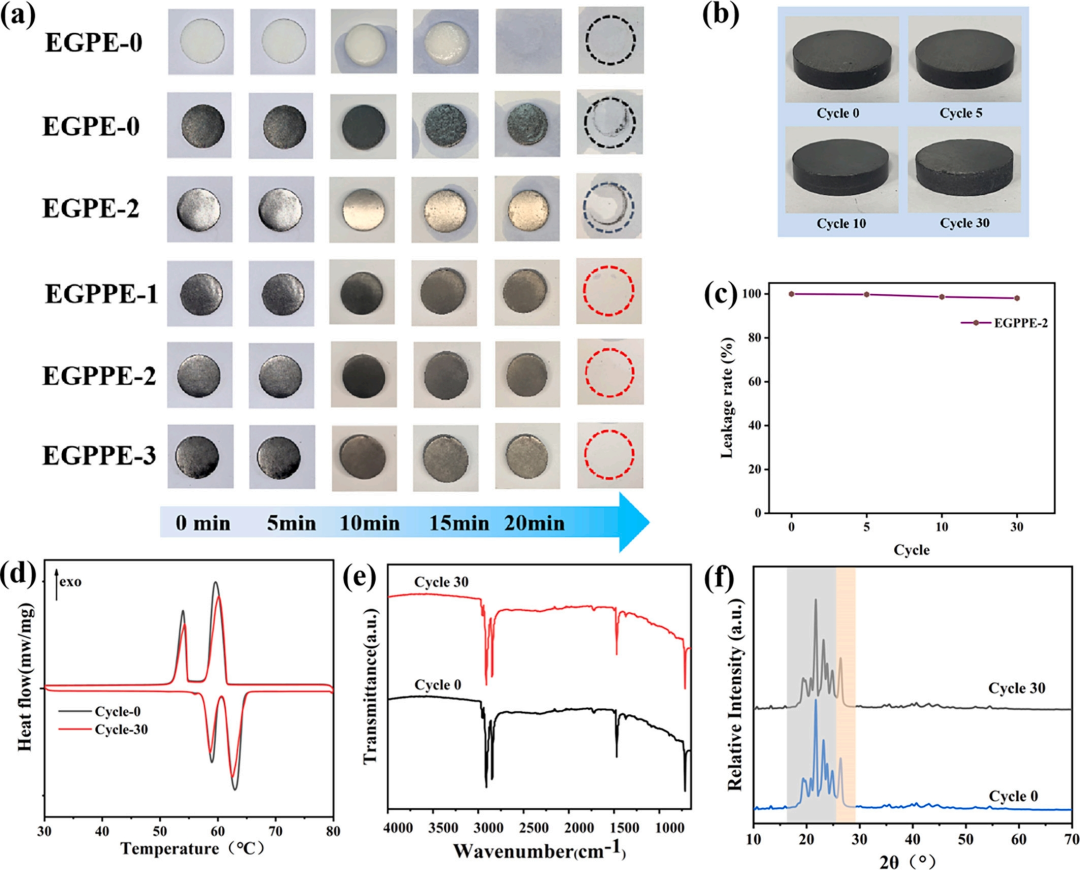 Figure 6. (a) Digital images of CPCM shape changes over time at 80 ℃; digital images of EGPPE-2 after multiple thermal cycles in an aging oven (b) and leakage rate (c); DSC curves of EGPPE-2 after 30 thermal cycles (d), infrared curves (e), and XRD curves (f).
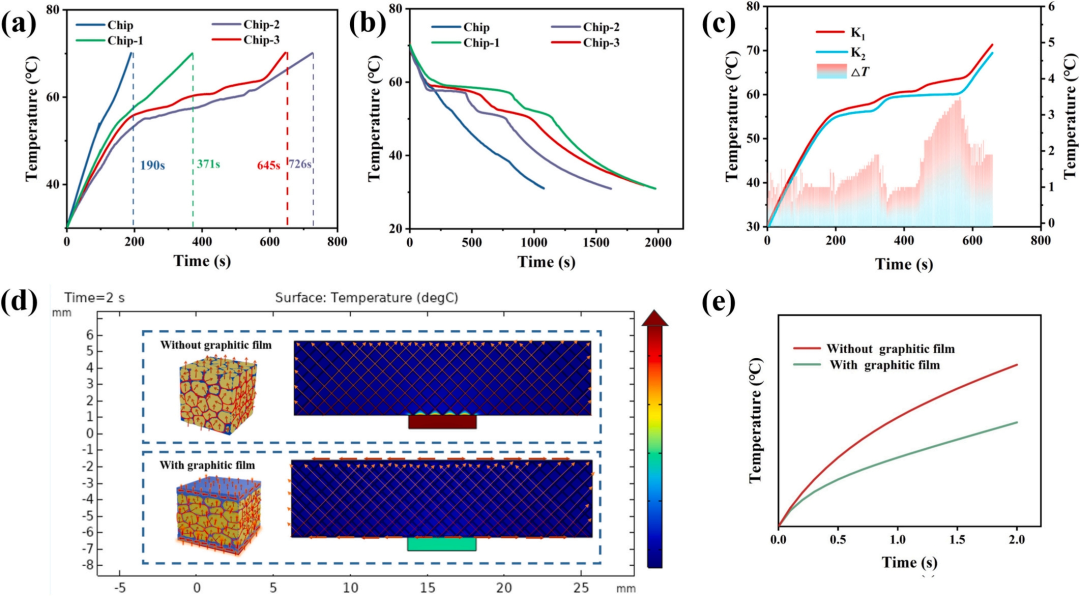 Figure 7. Changes in chip surface temperature over time (Chip, Chip-1, Chip-2, Chip-3 represent chips without CPCM, and chips with EGPE-0, EGPE-2, and EGPPE-2 respectively). (a) Temperature changes during heating, (b) Temperature changes during cooling, (c) Temperature and time curves recorded by thermocouples K1 and K2 when measuring Chip-3, and (d) and (e) thermal management simulation results of chips with and without graphite films in CPCM.——Recommended Reading——





 ★ Platform Statement
Some materials are sourced from the internet, and the copyright belongs to the original authors. The purpose of sharing is solely for industry information dissemination and communication, and does not represent the position of this public account or verify its authenticity. If there are any issues, please contact us for timely handling. Contributions and sharing are welcome!
★ Contact Information
Phone: 15356097253 (WeChat same number)