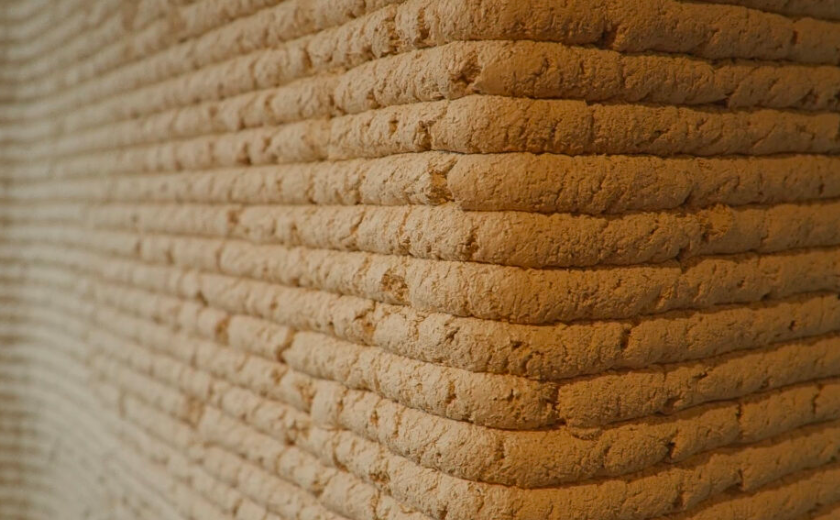
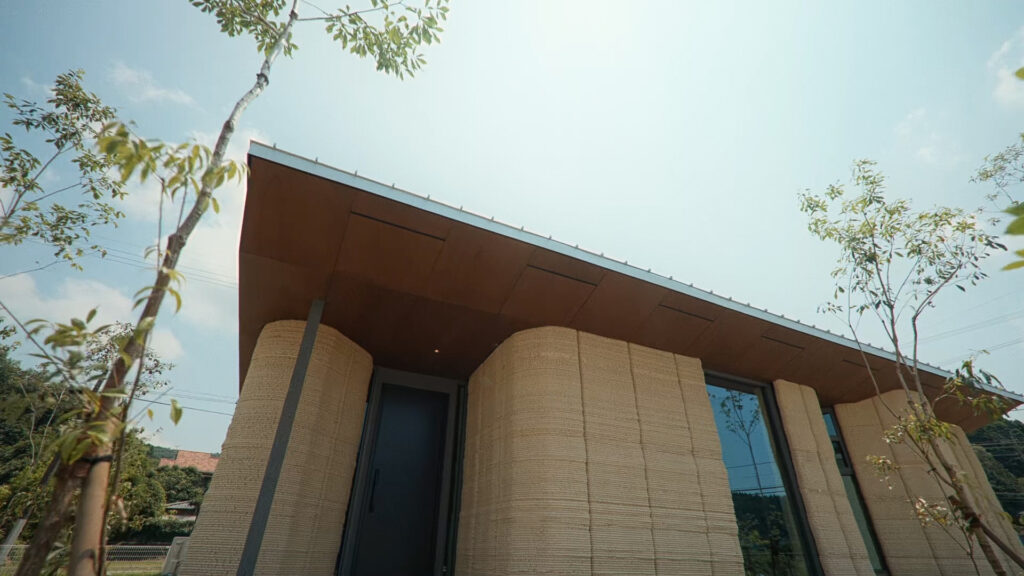
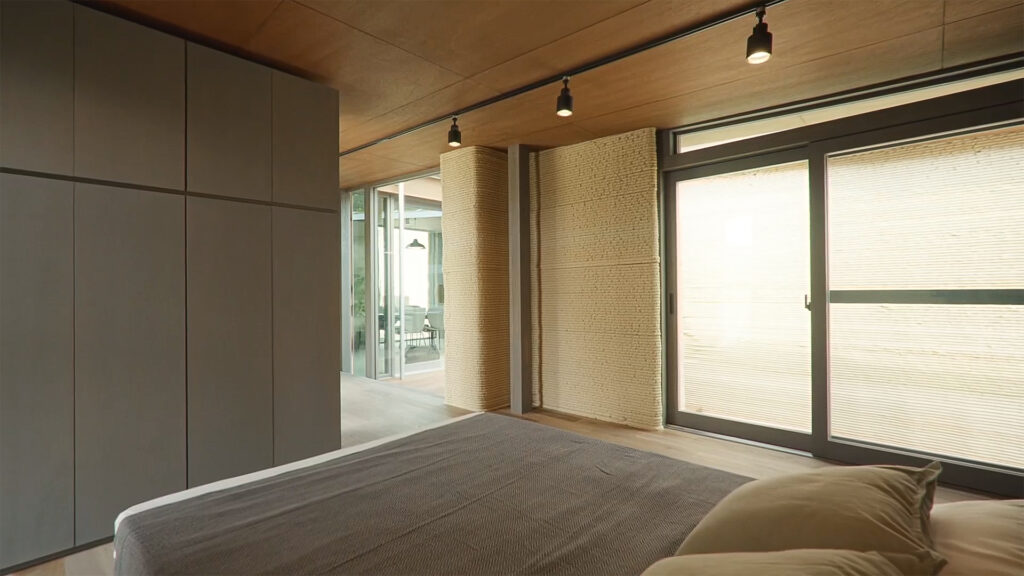
Japanese construction company LibWork has recently successfully printed a residential unit using a WASP 3D printer and soil materials. The house covers an area of approximately 100 square meters and was constructed using the Crane WASP printer. This type of printer offers a printing volume of 50 or 100 square meters, with a starting price of 160,000 euros, and dimensions of 550x580x420 cm. The Crane WASP pumping system can deliver 250 liters of material per hour, with a printing speed of up to 200 mm/s.
The single-story house, named “Lib Earth House Type B,” features a wooden frame structure but is committed to a fully circular concept, integrating solar power systems, battery technology, and soil materials. In addition to LibWork, the project also involves the London engineering consultancy Arup, Ogawa Design Studio, and Kyogoku Architectural Design Office. Notably, Arup, known for its involvement in the design of many global landmark buildings, venturing into the soil 3D printing field is quite symbolic.
WASP founder Massimo Moretti stated:
“We sincerely congratulate the LibWork team for perfectly interpreting the fusion of 3D printing and natural materials. It is an honor to collaborate with organizations like LibWork that share the vision of ‘technology, natural materials, and sustainability.’ This is a vivid practice of international cooperation and cultural integration promoting the construction of a sustainable future.”
The key difference lies precisely in the use of “concrete”—unlike other additive construction (AC) companies that commonly use high environmental cost unsustainable materials like cement, WASP is promoting a more revolutionary solution: building with soil composite materials. While 3D printed concrete is more environmentally friendly than traditional cement construction, if the global construction industry were to adopt 3D printed concrete, it would still lead to ecological degradation.
Can soil 3D printing become a viable alternative to traditional construction? Looking at large cement companies, Holcim Group has an annual revenue exceeding $33 billion, Heidelberg Cement $26 billion, Anhui Conch Group $16 billion, Siam Cement Group $16 billion, and West China Cement Group $16 billion. Given the wealth and influence of these companies and the widespread corruption in the global construction industry, soil construction is unlikely to significantly replace cement—too many interests are at stake. However, for environmentally conscious groups capable of self-building homes, this may become a niche option.
The Japanese market is particularly unique: temples and houses are often rebuilt using recyclable materials like wood, and Japanese homes are typically demolished every 30 years, with about 15% of homes using prefabricated components. According to relevant data, new homes depreciate by 20% immediately after purchase, and after thirty years, the property value remains only the land value minus demolition costs. These unique factors make Japan more suitable than other markets for developing soil 3D printed homes. If the earthquake resistance standards are met and the concept of soil homes gains public acceptance, this technology may flourish in Japan.
In other regions, rural homes or luxury villas may also gain a new sustainable status symbol through soil construction. Perhaps a broader shift in mindset is occurring: more people wish for their homes to no longer symbolize waste and destruction, but rather coexist harmoniously with the nature they claim to love. Although the road ahead is challenging, for those willing to embrace change, soil 3D printing has already proven the feasibility of constructing livable homes, and perhaps one day they will be able to move into such dream homes.
 @ 3D Printing Insights
I am Xu Fanglei, a design professional, PhD, Fellow of the Royal Society of Arts, focusing on industrial design, additive manufacturing, and business models. Here, I will use my expertise and experience to take you deep into the world of 3D printing, sharing the latest industry trends, interpreting cutting-edge technologies, and discussing commercial applications.
 END
END


 Welcome to add the editor’s WeChatto learn about the latest trends in the 3D printing industry
 About 3D Printing Technology
To provide timely integration of industry insights, technology trends, application scenarios, competitive strategies, and in-depth dynamics for practitioners in 3D printing and artificial intelligence, offering high-value information. We are passionate about 3D printing and welcome contributors from around the world.
Disclaimer:3D Printing Technology has no commercial cooperation, sponsorship, employment, or other interests with the companies mentioned in this article.3D Printing TechnologyImages and videos are sourced from the internet and are for auxiliary reading purposes only, with no commercial intent.All rights belong to the original authors; if there are any infringement issues, please contact the rights holders promptly, and we will delete them immediately. The copyright of the images in this article belongs to the copyright holders,3D Printing Technologywatermarks are automatically added for auxiliary reading and do not represent ownership of the images; for image usage, please consult the relevant copyright holders.3D Printing TechnologyThe article does not constitute any investment advice,3D Printing Technologyis not responsible for any direct or indirect losses caused by the use of the information in this article.For more exciting content, please follow