Practical Case of Defective Product Sorting Using Huichuan PLC Programming

Practical Case of Defective Product Sorting Using Huichuan PLC Programming

1. Status Control of Workstation 1 When the conveyor belt (Y0) is running, and the defective product detection (M10) is triggered, “Workstation 1 (M1)” is “activated” (set); if the defective product detection is in another state (normally closed logic of M10), then “Workstation 1 (M1)” will be “deactivated” (reset). 2. Timing Logic of the Conveyor … Read more

28 PLC Programming Standards and Recommendations from an Experienced Engineer

28 PLC Programming Standards and Recommendations from an Experienced Engineer

The Design Requirements for a Perfect PLC Program A complete PLC program is not just about making the system operational; it also requires comprehensive comments, excellent architecture, good scalability, a complete alarm protection system, and a simulation system before operation. 1. Simplicity Keep the PLC program as simple as possible. Simplicity means using standardized program … Read more

Implementing a Three-Position Self-Resetting Selector Switch with Touch Screen

Implementing a Three-Position Self-Resetting Selector Switch with Touch Screen

1. Effect demonstration, as shown in the video below:2. Function implementation:2.1 Place a multi-state indicator component, with the following general property settings: number of states set to 3, PLC address set to 4x 4300.2.2 Place a bit state toggle switch on the left side of the multi-state display component, as shown in the figure below: … Read more

Fundamentals of PLC Programming: How Are Values Stored in the CPU? (A Comprehensive Analysis from Binary to Data Types)

Fundamentals of PLC Programming: How Are Values Stored in the CPU? (A Comprehensive Analysis from Binary to Data Types)

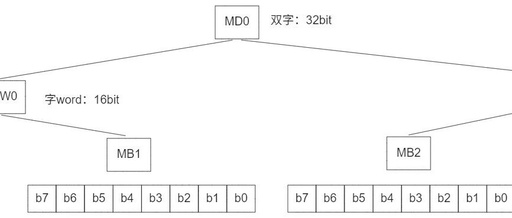
When first learning PLC programming, many people wonder: in what form do the values we set, such as “Temperature 25℃”, “Pressure 0.4MPa”, and “Motor Speed 1500r/min”, exist in the PLC’s CPU? Why do we need to distinguish between “byte”, “word”, and “double word” when writing programs? Today, we will start from the most fundamental binary … Read more

PLC Programming Design Methods

PLC Programming Design Methods

Q What is thought? It is the result or the system of viewpoints and concepts formed by the reflection of objective existence in human consciousness through cognitive activities. There are good and bad thoughts; correct thoughts can quickly achieve goals. PLC Programming Design Methods In short: Program = Data + Algorithm A good program structure … Read more

Efficient and Intuitive FB Implementation Using ST in PLC Programming

Efficient and Intuitive FB Implementation Using ST in PLC Programming

Why Choose ST for Writing FB? Clear Logic and Easy Maintenance The ST language expresses logic in text form, making it suitable for describing complex control processes. With a reasonable code structure and comments, developers can easily understand and maintain the code. Modular Programming FB itself is a modular programming unit, and ST allows developers … Read more

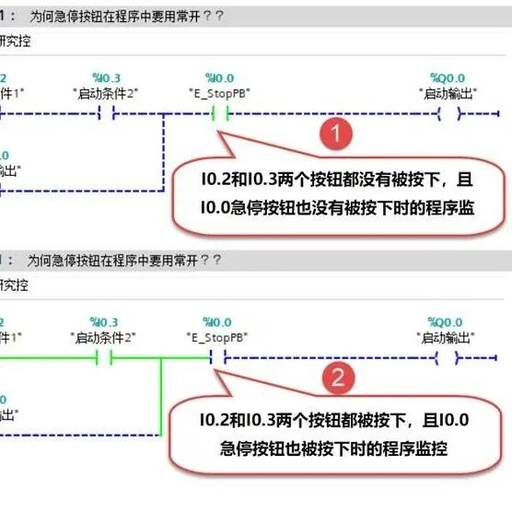
Why Should Emergency Stop in PLC Programming Be Wired as Normally Closed?

Why Should Emergency Stop in PLC Programming Be Wired as Normally Closed?

In PLC programming, the physical contact of the stop button is generally connected as normally closed, while in the program, it is written as normally open. This type of stop button only serves as a signal in this equipment.Why is the emergency stop in PLC programming opposite to that of a regular emergency stop button? … Read more

Programming Insights for PLC Engineers: Deconstructing Complex Problems with Structured Thinking

Programming Insights for PLC Engineers: Deconstructing Complex Problems with Structured Thinking

Reading time required 5minutes Quick read takes only 2 minutes Introduction As a PLC (Programmable Logic Controller) engineer, we face numerous complex control systems and engineering problems every day. Some of these issues may arise from equipment failures, while others may be due to process inefficiencies or improper program design. Regardless of the situation, we … Read more

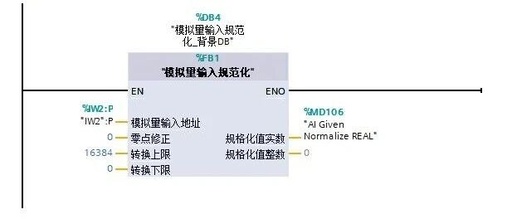
Example of Normalization Processing for Analog Signals in Siemens S7-1200/1500 PLC

Example of Normalization Processing for Analog Signals in Siemens S7-1200/1500 PLC

In automation control, analog signals are ubiquitous. Whether it is temperature, pressure, flow, or even position signals, they can be converted into voltage or current analog signals. As a type of continuously variable input signal, accurately measuring and converting analog signals is the foundation of an excellent control system. Mastering a reliable method for analog … Read more