When building a smart home, one of the most important decisions you need to make is not which devices to purchase, but which wireless protocol to use as the core foundation of your system. Z-Wave and Zigbee are the two mainstream wireless protocols designed specifically for smart home applications, each with significant advantages and considerations.
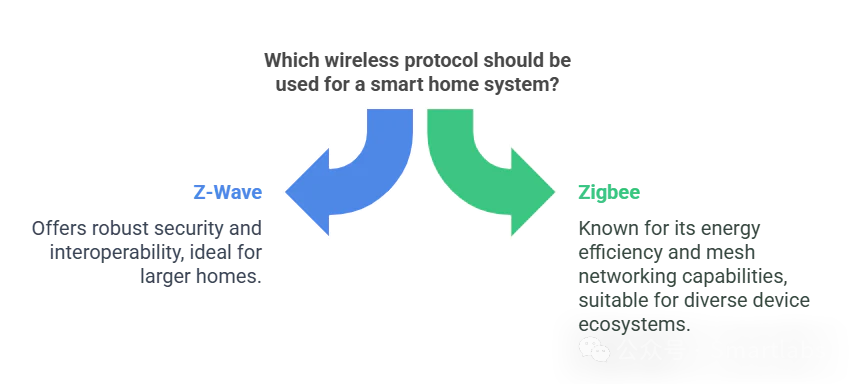
Unlike Wi-Fi, which is primarily designed for high-bandwidth data transmission, Z-Wave and Zigbee have been designed from the ground up for reliable, low-power communication between devices in a home environment. This targeted design makes them ideal choices for smart home applications, but it raises a key question: which protocol better meets your specific needs?
This article will comprehensively compare the core differences between Z-Wave and Zigbee, analyzing their technical parameters, actual performance, compatibility, and applicable scenarios to help you make an informed decision when building your smart home.
1. Understanding Wireless Protocols in Smart Homes
Before delving into Z-Wave and Zigbee, it is essential to clarify the role of wireless protocols in a smart home environment.
A wireless protocol is essentially a standardized set of “languages” and rules that devices follow to communicate with each other, determining:
- How devices connect to the network
- How devices transmit data
- How devices interact with each other
- The security of the communication process
- The power efficiency of the devices
Unlike general wireless technologies like Wi-Fi and Bluetooth, dedicated smart home protocols like Z-Wave and Zigbee are optimized for the following characteristics:
- Low Power Consumption: Supports battery-operated devices running for months or even years without battery replacement
- Mesh Networking: Devices can relay signals to extend network coverage, forming a “self-healing” network
- High Reliability: Ensures commands are reliably delivered to target devices
- Strong Security: Prevents unauthorized access to the home network
- Low Latency: Command responses are nearly real-time
Compared to Wi-Fi-based smart devices, Z-Wave and Zigbee perform better in these aspects, but they achieve these goals through different technical paths, each with its advantages.
2. Technical Foundations: How Z-Wave and Zigbee Work
1. Z-Wave Technology
Z-Wave operates in the sub-GHz radio frequency band, specifically at 868.42 MHz in Europe. This lower frequency band offers the following advantages:
- Better ability to penetrate walls, floors, and other obstacles
- Less interference from common household devices
- Wider coverage range for individual devices (up to 100 meters in open environments)
In a Z-Wave mesh network, all mains-powered devices (excluding battery-operated devices) can act as repeaters, extending network coverage by relaying signals. Even if one device fails, signals can be transmitted through other paths, forming a “self-healing” network, and the more devices connected, the stronger the network stability.
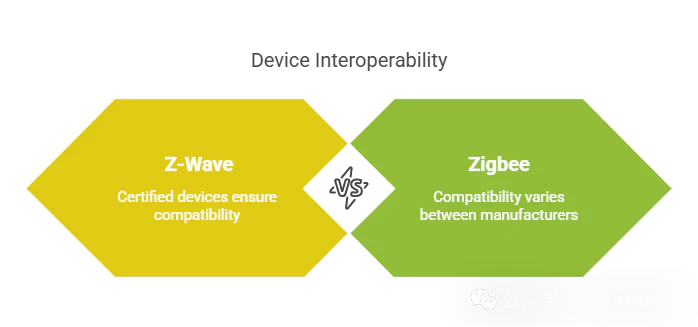
A core feature of Z-Wave is its strictly controlled ecosystem. The Z-Wave Alliance, which oversees the protocol, requires all certified devices to meet specific interoperability standards—meaning any certified Z-Wave device can be compatible with any Z-Wave controller, regardless of brand.
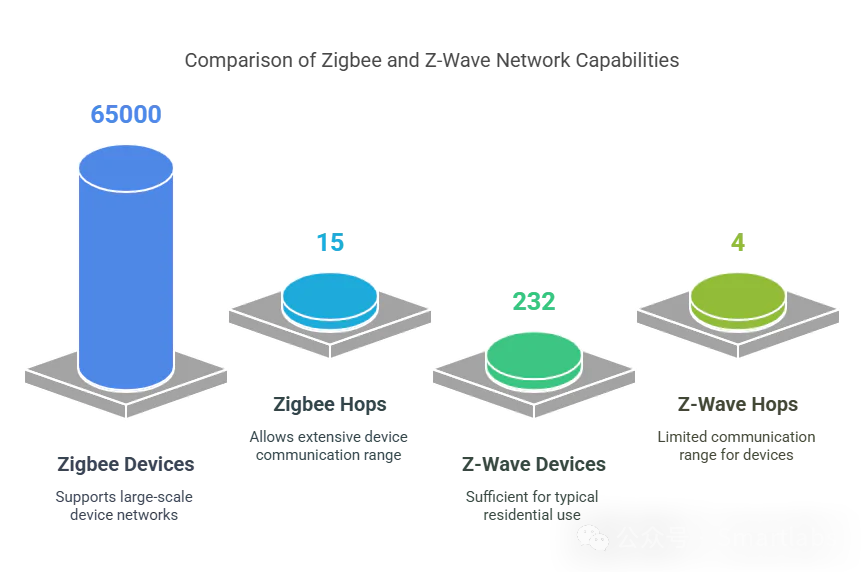
A Z-Wave network can support up to 232 devices, with signals reaching the target device through a maximum of 4 device hops. The latest Z-Wave Plus V2 technology enhances coverage, battery life, and security while maintaining backward compatibility with earlier Z-Wave devices.
2. Zigbee Technology
Zigbee operates in the 2.4 GHz frequency band, the same band used by Wi-Fi and Bluetooth. This higher frequency band provides the following characteristics:
- Faster data transmission speeds (250 Kbps, higher than Z-Wave’s 100 Kbps)
- Lower power consumption for some operations
- Unified global frequency band (no regional differences)
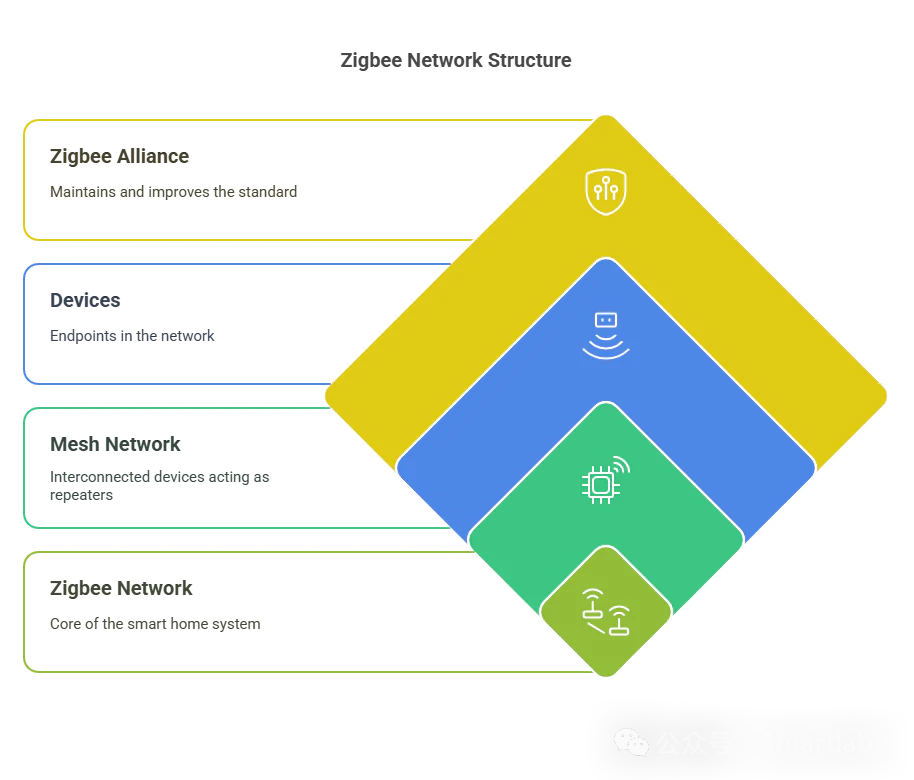
Similar to Z-Wave, Zigbee also builds a mesh network using mains-powered devices as repeaters, but its implementation allows for more device hops (up to 15 or more, depending on configuration), theoretically enabling larger networks.
Zigbee is maintained by the Zigbee Alliance (now renamed the Connectivity Standards Alliance), which offers greater implementation flexibility. This characteristic results in a wider variety of devices, typically at lower prices, but compatibility issues may arise between devices from different brands.
Theoretically, a Zigbee network can support up to 65,000 devices, making it highly scalable and suitable for large installations. The latest Zigbee 3.0 standard has significantly improved interoperability between devices from different brands.
3. Core Differences: Z-Wave vs. Zigbee
1. Coverage and Reliability
Z-Wave Advantages:
- Low-frequency design allows for better wall penetration
- Stable performance across different building structures
- Less interference from Wi-Fi networks and other 2.4 GHz devices
- Standardized routing protocols ensure consistent performance
Zigbee Considerations:
- Higher frequency makes it more challenging to penetrate walls and floors
- More repeaters may be needed to cover the same area
- More susceptible to interference from Wi-Fi, Bluetooth, microwaves, etc.
- More flexible routing mechanisms may lead to a more complex network structure
Practical Application Scenarios: In complex environments such as older homes (with plaster walls), multi-story buildings, or areas dense with Wi-Fi networks, Z-Wave coverage is typically more reliable; whereas Zigbee requires more strategic device placement to achieve similar coverage.
2. Speed and Responsiveness
Zigbee Advantages:
- Higher data transmission rates (250 Kbps vs. Z-Wave’s 100 Kbps)
- Faster response times for devices requiring quick control, such as lighting
- Better suited for bandwidth-intensive applications
Z-Wave Considerations:
- Response times may be slightly slower in some application scenarios
- Limited bandwidth may affect performance in data-intensive applications
- The latest Z-Wave Long Range (Z-Wave LR) technology has improved performance for the next generation of devices (direct communication distance > 2000 meters)
Practical Application Scenarios: For most smart home applications such as lighting control, security sensors, and thermostats, both protocols can meet response time requirements, and users typically find it hard to notice differences; however, in large systems with many devices requiring simultaneous command transmissions, Zigbee’s higher bandwidth offers a responsiveness advantage.
3. Device Compatibility and Ecosystem
Z-Wave Advantages:
- Strict certification mechanisms ensure interoperability among all Z-Wave devices
- New devices are required to be backward compatible (supporting use with older devices)
- High consistency in user experience across different brand devices
- Standardized device classifications simplify integration processes
Zigbee Considerations:
- High implementation flexibility can sometimes lead to compatibility issues
- Different protocol subsets (such as Home Automation, Light Link, etc.) may not seamlessly interoperate
- A wider variety of devices, typically at lower prices
- Zigbee 3.0 standard has improved cross-brand compatibility
Practical Application Scenarios: If you prioritize reliability and ease of installation over a vast selection of devices, Z-Wave is more suitable; if you want more device options and are more price-sensitive, Zigbee is a better choice, but you should research compatibility among different brand devices in advance.
4. Security Features
Z-Wave Advantages:
- Z-Wave Plus S2 security framework provides advanced encryption capabilities
- All certified devices are required to implement security features
- Particularly suitable for security-critical applications such as smart locks
- Security mechanisms prevent man-in-the-middle attacks
Zigbee Considerations:
- Zigbee 3.0 includes comprehensive security features
- Implementation of security features varies among different brands
- The latest version has significantly improved security
Practical Application Scenarios: Both protocols can provide strong security when configured correctly, but Z-Wave’s standardized security implementation and mandatory security requirements make it more advantageous for security-critical applications such as smart locks and security systems—this is why many smart locks and security systems prioritize Z-Wave technology.
5. Power Efficiency
Zigbee Advantages:
- Typically lower power consumption for battery-operated devices
- Better optimization for ultra-low power application scenarios
- Devices using Zigbee protocol, such as sensors, tend to have longer battery life
Z-Wave Considerations:
- Battery life remains good in most application scenarios
- Z-Wave Plus technology has significantly improved power efficiency
- Some operations may have relatively high power consumption due to protocol design
Practical Application Scenarios: For battery-operated devices such as door/window sensors, motion sensors, and environmental monitors, Zigbee’s longer battery life is advantageous, especially for devices that are inconvenient to change batteries frequently.
6. Network Scale and Scalability
Zigbee Advantages:
- Theoretically supports up to 65,000 devices
- Supports more device hops (up to 15 or more, far exceeding Z-Wave’s 4 hops)
- Better suited for large installation scenarios
Z-Wave Considerations:
- Single network supports a maximum of 4000 devices
- Signals can only hop through a maximum of 4 devices
- Generally sufficient for most household application needs
Practical Application Scenarios: For typical home users, Z-Wave’s limit of 4000 devices is rarely a constraint (most households have fewer than 50 smart devices); however, for ultra-large residences, commercial scenarios, or users planning to significantly expand the number of devices in the future, Zigbee’s superior scalability is more advantageous.
4. Practical Application Scenarios: Choosing a Protocol Based on Needs
The “most suitable” protocol depends on your specific needs and priorities. Here are some recommendations for different scenarios:
1. Seeking Reliability in Complex Environments
If your living environment meets the following conditions:
- Older homes (with plaster walls or metal stud structures)
- Multi-story buildings (with concrete floors)
- Dense surrounding Wi-Fi networks
It is recommended to choose Z-Wave: Its stronger signal penetration and anti-interference capabilities can provide more stable coverage in complex environments, and Z-Wave-compatible smart home controllers can ensure consistent signals throughout the house.
2. Pursuing Device Diversity and Cost-Effectiveness
If you prioritize the following needs:
- A wide variety of device options
- More affordable device prices
- Flexibility in system setup
It is recommended to choose Zigbee: Its open ecosystem offers more device options and lower prices, allowing you to find high-cost performance products by researching Zigbee-compatible devices.
3. Security-Critical Applications
If you have high security requirements, especially for the following devices:
- Smart locks and access control systems
- Home security sensors
- Access control systems
It is recommended to choose Z-Wave: Its standardized security implementation mechanisms and mandatory encryption requirements make it more suitable for security-sensitive scenarios, and Z-Wave’s security framework is particularly prominent in smart home security applications.
4. Extensive Use of Battery-Powered Devices
If you plan to deploy the following devices on a large scale:
- Motion sensors
- Door/window sensors
- Environmental monitors
- Battery-powered controllers
It is recommended to choose Zigbee: Its superior power efficiency can extend battery life and reduce the hassle of frequent battery replacements, and smart home sensors using Zigbee protocol typically have longer usage cycles.
5. Lighting Control Scenarios
For lighting control needs (such as smart switches/dimmers, smart bulbs, lighting scenes, and automation), both protocols perform excellently:
- Zigbee has slightly faster response times
- Z-Wave offers more reliable coverage
You can choose based on your living environment (such as wall structure, Wi-Fi interference) and specific needs, as both protocols have corresponding smart home modules available.
6. Large or Expandable Systems
If your system planning meets the following conditions:
- Ultra-large installations (more than 50 devices)
- Future plans to significantly expand the number of devices
- Need to cover auxiliary buildings or large areas
It is recommended to choose Zigbee: Its stronger scalability and support for more devices are better suited for such scenarios; additionally, consider a “dual-protocol” solution—choosing controllers that support both Z-Wave and Zigbee.
5. Balancing the Advantages of Both: Using Z-Wave and Zigbee Together
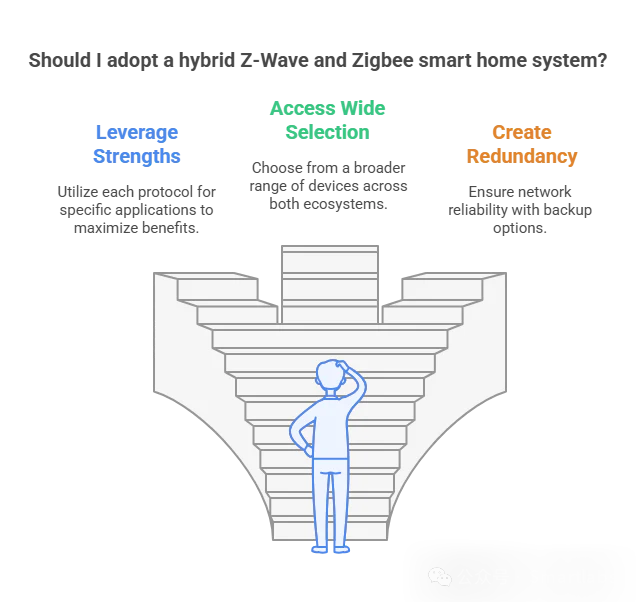
Many experienced smart home users ultimately adopt a “hybrid solution,” using both Z-Wave and Zigbee devices within the same system. This strategy allows you to:
- Leverage the strengths of both protocols for different application scenarios
- Access a richer selection of devices from both ecosystems
- Provide redundancy for the smart home network
- Optimize as needed (e.g., Z-Wave for reliability, Zigbee for battery device longevity)
Today, many modern smart home controllers support the simultaneous operation of both protocols, allowing you to build a hybrid system without complex configurations. For example, mainstream controllers like Home Assistant, Hubitat, and SmartThings can manage Z-Wave and Zigbee devices through a single interface.
When using both protocols, it is recommended to follow these best practices:
- For devices requiring stable coverage throughout the house (such as smart locks and thermostats), prioritize Z-Wave
- For battery-powered sensor devices, prioritize Zigbee to extend battery life
- Plan device locations reasonably to create stable signal relay paths for both protocols’ mesh networks
- When choosing a controller, pay attention to its management capabilities for dual-protocol systems
6. Future Compatibility: Z-Wave, Zigbee, and Emerging Standards
Both Z-Wave and Zigbee are continuously evolving—Z-Wave Plus V2 and Zigbee 3.0 are the latest technological achievements of the two protocols, significantly enhancing performance and compatibility. Additionally, emerging standards like Matter (formerly Project CHIP) are promoting interoperability between different smart home ecosystems.
When considering “future compatibility,” pay attention to the following points:
- Z-Wave has a mature backward compatibility tradition, ensuring current devices can work with future controllers
- Zigbee is moving towards higher standardization and interoperability
- Even with the rise of new standards, Z-Wave and Zigbee will remain relevant for many years to come
- Most controller manufacturers commit to supporting both protocols and emerging standards, ensuring long-term system usability
7. Decision Guide: Practical Selection Methods
Rather than viewing the choice as a “one or the other” scenario, follow these practical steps to make a decision:
- Assess your living environment: Consider the structure of your home (wall materials, number of floors) and surrounding interference sources (number of Wi-Fi networks, other wireless devices)
- Clarify core needs: Determine which metrics are most important to you—reliability, device diversity, security, battery life, or scalability?
- Choose a flexible controller: Prioritize smart home controllers that support dual protocols to allow for future expansion
- Start with key devices: Deploy the core devices that most impact your living experience (such as smart locks and lighting control) first, then gradually expand
- Gradually expand the system: Add devices in phases while evaluating performance and adjusting device choices based on actual usage experience
Remember, many successful smart home systems adopt a hybrid protocol approach—the key is to flexibly combine the strengths of both protocols based on your needs and living environment.
8. Conclusion: Choosing the Right Protocol for Your Smart Home
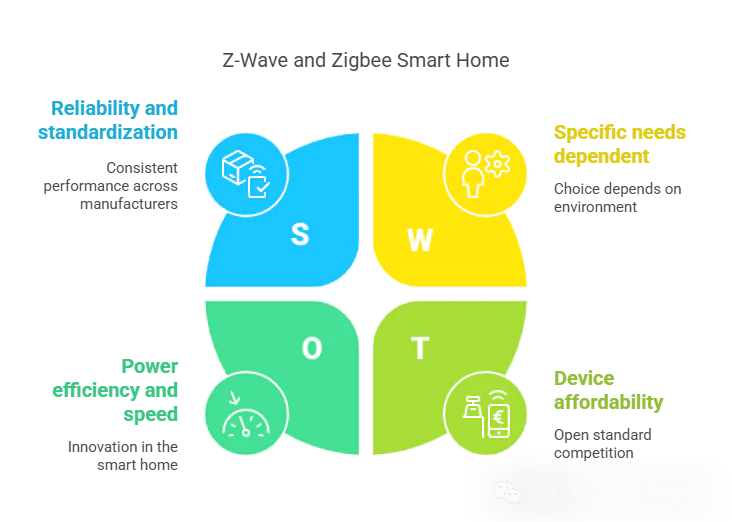
Compared to Wi-Fi-based smart devices, Z-Wave and Zigbee offer significant advantages in reliability, power efficiency, and are ideal foundations for building an efficient smart home system. Ultimately, the choice of protocol depends on your specific needs, living environment, and priorities.
- Z-Wave excels in reliability, standardization, and security, making it suitable for complex environments and security-critical applications, with its controlled ecosystem ensuring consistency and compatibility across different brand devices.
- Zigbee offers advantages in power efficiency, speed, and scalability, with a wider variety of devices at more affordable prices, and its open ecosystem fosters product innovation and competition.
For most users, the best approach is to start with a dual-protocol supporting controller, then choose Z-Wave or Zigbee products based on the specific application scenarios of the devices—this flexible strategy allows you to build a robust and efficient smart home system that truly meets your needs.