
ZigBee technology is considered one of the most likely communication technologies to change our lives like WiFi and Bluetooth. ZigBee enables certain devices, especially sensors, to connect to the Internet.
The demand for wireless data communication is increasingly strong in the fields of home automation control and industrial telemetry, and this wireless data transmission must be highly reliable and resistant to various electromagnetic interferences in the field.
The characteristics of ZigBee lie in its lower power consumption, real-time online capability, the ability to connect a large number of devices to the same gateway, and its self-organizing network capability, which offers a broad application space in the development of the Internet of Things.
ZigBee technology
The term ZigBee originates from the zigzag dance of honeybees to inform their companions of the location of pollen. It can be said to be a small animal achieving “wireless” communication in a simple way. People use this term to refer to a short-range wireless network communication technology that focuses on low power consumption, low cost, low complexity, and low data rates, which also carries this connotation.
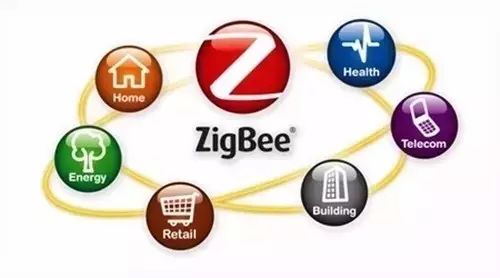
ZigBee is a short-range wireless communication technology developed based on the IEEE802.15.4 protocol, known for its low power consumption. It is considered the most likely wireless method to be applied in industrial control scenarios. ZigBee is a wireless data transmission network platform composed of up to 65,000 wireless data transmission modules, allowing each ZigBee network data transmission module to communicate with one another, with distances between network nodes capable of extending beyond the standard 75m.
ZigBee’s Technical Characteristics and Performance
ZigBee is a wireless connection that can operate in three frequency bands: 2.4GHz (global popularity), 868MHz (European popularity), and 915MHz (US popularity), with maximum transmission rates of 250kbit/s, 20kbit/s, and 40kbit/s respectively. Its transmission distance ranges from 10 to 75m but can be extended further.
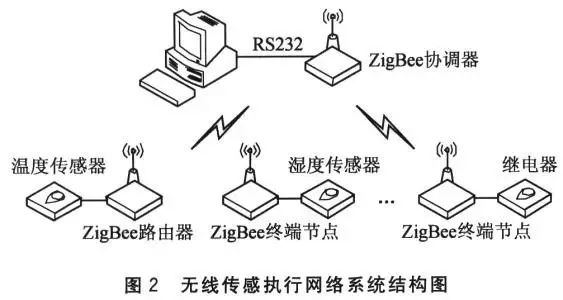
As a wireless communication technology, ZigBee has the following characteristics:
-
Low Power Consumption
Due to ZigBee’s low transmission rate, its transmission power is only 1mW, and it employs a sleep mode, resulting in very low power consumption. It is estimated that ZigBee devices can last from 6 months to 2 years on just two AA batteries, which is unmatched by other wireless devices.
-
Low Cost
The initial cost of a ZigBee module is around $6, which is expected to drop to $1.5 to $2.5 soon, and the ZigBee protocol is royalty-free. Low cost is also a crucial factor for ZigBee.
-
Low Complexity
The size of the ZigBee protocol typically ranges from 4 to 32KB, while Bluetooth and Wi-Fi generally exceed 100KB.
-
Short Delay:
The communication delay and the delay from sleep mode activation are both very short, with typical device search delays of 30ms, sleep activation delays of 15ms, and active device channel access delays of 15ms. Therefore, ZigBee technology is suitable for wireless control applications where delay requirements are stringent (e.g., industrial control scenarios).
-
Large Network Capacity
A star-structured ZigBee network can accommodate up to 254 slave devices and one master device, with a maximum of 100 ZigBee networks existing simultaneously in one area, and the network composition is flexible. Furthermore, up to 65,000 nodes can be connected within one network.
-
Network Establishment
ZigBee can automatically establish the desired network.
-
Reliability
It adopts collision avoidance strategies and reserves dedicated time slots for communication services that require fixed bandwidth, avoiding competition and conflicts in data transmission. The MAC layer employs a fully acknowledged data transmission model, where each sent data packet must wait for confirmation from the receiver. If issues occur during transmission, retransmission can be performed.
-
Security
ZigBee provides a data packet integrity check function based on cyclic redundancy check (CRC), supports authentication and authorization, and employs AES-128 encryption algorithms, allowing various applications to flexibly determine their security attributes.
ZigBee’s Technical Performance
1. ZigBee Frequency Bands and Data Transmission Rates
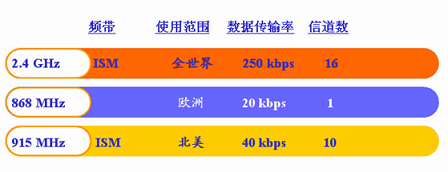
ZigBee can operate in three wireless frequency bands: the 2.4GHz ISM band, the 868MHz band in Europe, and the 915MHz band in the United States. Each band has a different number of available channels: 16, 1, and 10 respectively.
In China, ZigBee uses the 2.4GHz ISM band, which is frequency-free and has 16 channels with a bandwidth of 250K.
2. Short-range Wireless Network Standards
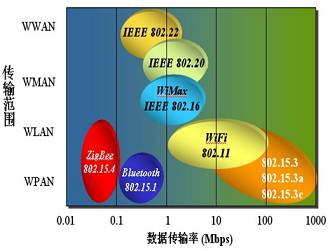
ZigBee and the 802.15.4 standard are suitable for low-rate data transmission, with a maximum rate of 250K. Compared to other wireless technologies, it is suitable for relatively short transmission distances; ZigBee wireless technology is suitable for building WPAN networks, which are networks of wireless personal devices, and is very suitable for data collection and control signal transmission. Its application positioning is low-rate, complex networks, low power consumption, and low-cost applications.
3. Comparison of Wireless Network Standards
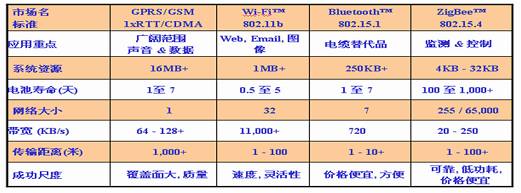
ZigBee wireless transmission bandwidth ranges from 20-250KB/s, making it suitable for sensor data collection and control data transmission, capable of forming large-scale networks with a node capacity of 65,535, providing a very powerful networking advantage; its unique low power consumption design ensures long battery life.
4. ZigBee Physical Channels
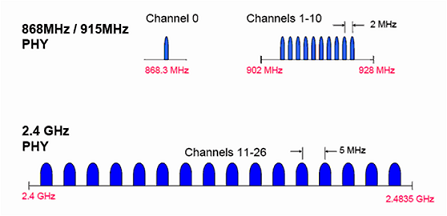
ZigBee has 16 channels in the 2.4GHz band, distributed between 2.405GHz and 2.480GHz, with a channel spacing of 5M, providing strong anti-crosstalk capabilities.
5. ZigBee Protocol Stack
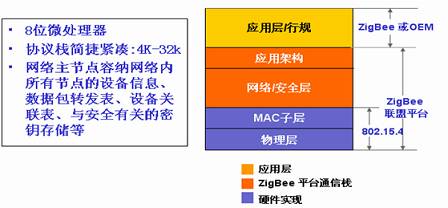
ZigBee takes full advantage of the robust wireless physical layer specified by IEEE 802.15.4, adding logical networking, network security, and application software, making it more suitable for product technology standardization, facilitating product interconnectivity. ZigBee continues to closely align with IEEE to ensure a complete integrated solution is provided to the market.
6. ZigBee Network Topology Structure
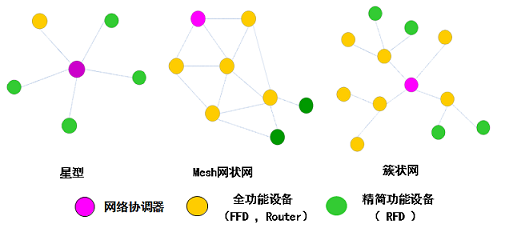
ZigBee technology has strong networking capabilities, capable of forming star, tree, and MESH topologies, allowing for the selection of appropriate network structures based on actual project needs.
The MESH topology network has powerful functionalities, enabling communication through “multi-hop” methods; this topology can also form extremely complex networks; the network has self-organizing and self-healing capabilities; star and tree networks are suitable for applications with many points and relatively short distances.
7. ZigBee Network Device Types
7.1 Network Coordinator:
Includes all network messages and is the most complex of the three device types, with the largest storage capacity and computational ability. It sends network beacons, establishes a network, manages network nodes, stores node information, finds routing messages between pairs of nodes, and continuously receives information.
7.2 Full Function Device (FFD):
-
Can act as a network coordinator, forming a network and connecting other FFDs or RFDs. FFD has controller functionality, allowing for bidirectional information transmission.
-
Includes all features designated by the standard 802.15.4.
-
More memory and computational capability allows it to act as a network router during idle times.
-
May also serve as a terminal device.
7.3 Reduced Function Device (RFD):
-
RFD can only send information to FFD or receive information from FFD.
-
Includes limited functionality to control costs and complexity.
-
Typically used as a terminal device in the network.
-
ZigBee’s relatively simple implementation naturally saves costs.
-
RFD reduces ZigBee component costs by eliminating memory and other circuits, while simple 8-bit processors and small protocol stacks also help reduce costs.
8. ZigBee’s Anti-Interference Capability
ZigBee employs high processing gain direct sequence/frequency agility (DS/FA) technology at the physical layer, achieving maximum processing gain and the strongest anti-interference and multipath delay spread capabilities. The frequency agility capability allows it to change frequencies to avoid interference from known sources.
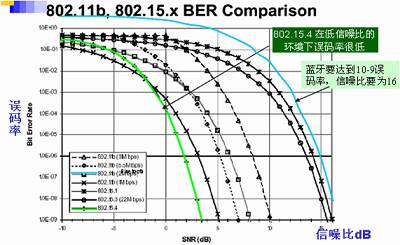
Experiments have shown that the bit error rate of IEEE 802.15.4/ZigBee, especially at a signal-to-noise ratio of 4dB, can reach 10^-9; to achieve the same bit error rate, Bluetooth/802.15.1 requires a signal-to-noise ratio of 16dB, and WLAN 802.11b requires 10dB. ZigBee’s anti-interference performance is significantly higher than that of Bluetooth and WLAN technologies.
9. ZigBee Reliable Links
9.1 Physical Layer RF Communication Links
-
Direct sequence spread spectrum uses high processing gain.
-
Clear channel detection.
-
Detection of interference energy.
-
Uses frequency hopping technology (Frequency agility).
9.2 Protocol
-
Bit error detection/correction based on CRC.
-
Adopts collision avoidance strategies (CSMA/CA).
-
Reserves dedicated guaranteed time slots for fixed bandwidth communication services.
-
All sent data packets await confirmation from the receiver, and retransmission occurs if issues arise.
-
Maintains data packet timeliness (Packet data freshness).
9.3 Communication Reliability Mechanism
ZigBee adopts the CSMA-CA collision avoidance mechanism while reserving dedicated time slots for fixed bandwidth communication services, avoiding competition and conflicts in data transmission; clear channel detection is employed.
The MAC layer adopts a fully acknowledged data transmission mechanism, where each sent data packet must wait for confirmation from the receiving party.
9.4 Strong Self-Organizing and Self-Healing Capabilities of the Network
ZigBee’s self-organizing function allows network nodes to sense the presence of other nodes and determine connection relationships, forming a structured network without manual intervention.
ZigBee’s self-healing function allows the network to repair itself and adjust its topology in response to the addition or removal of a node, changes in node positions, or node failures, ensuring the entire system continues to operate normally without manual intervention.
ZigBee technology’s RF physical layer design ensures strong anti-interference capabilities and communication reliability. ZigBee technology’s reliable design in communication protocols guarantees strong anti-interference capabilities and communication reliability.
ZigBee Alliance
The ZigBee Alliance was established in August 2001. To date, in addition to internationally renowned companies such as Invensys, Mitsubishi Electric, Motorola, Samsung, and Philips, the alliance has about a hundred member companies and is rapidly growing. This includes semiconductor manufacturers, IP service providers, consumer electronics manufacturers, and OEMs, such as Honeywell, Eaton, and Invensys Metering Systems in industrial control and home automation, as well as toy companies like Mattel.
All these companies participate in the IEEE 802.15.4 working group responsible for developing ZigBee physical and media control layer technology standards. The requirements for wireless networks in industrial, agricultural, automotive electronics, home networks, medical sensors, and servo actuators differ significantly from those in civilian applications, typically requiring low data throughput and low power consumption.
Moreover, simple and convenient wireless devices are emerging in large numbers, necessitating the deployment of numerous wireless access points, with low prices playing a crucial role. Therefore, the ZigBee standard aims to design a communication link that maintains minimal traffic and low complexity for wireless transceivers. The core issues to consider are low power consumption and low-cost design, which requires the standard to provide low bandwidth and low data transmission rate applications.

The IEEE 802.15.4 group and the ZigBee Alliance (ZigBee Alliance) jointly developed the ZigBee standard. The ZigBee standard is an evolving low-cost, low-power, low-power short-range wireless communication standard designed specifically for low-rate sensor and control networks.
The IEEE formed the 802.15.4 group in December 2000 to develop physical layer (PHY) and media access control (MAC) layer specifications, and the IEEE 802.15.4 standard was approved in May 2003; the ZigBee Alliance is a global consortium aimed at collaborating to achieve reliable, low-cost, low-power wireless networking monitoring products based on global open standards, founded by Honeywell, Mitsubishi, Motorola, Philips, and Invensys, primarily responsible for developing network layer, security management, and application interface specifications, with version 1.0 of the specification approved in December 2004.
ZigBee Technology Applications
1. Types of Data Suitable for ZigBee Transmission
-
Cyclic Data
Sensor data, water, electricity, and gas meter data, instrument data.
-
Intermittent Data
Industrial control commands, remote network control, home appliance control.
-
Repeated Low Response Time Data
Such as mouse and keyboard data, joystick data.
2. Application Scenarios Suitable for ZigBee Technology
Devices with low costs, small data transmission volumes, small sizes that make it inconvenient to place large rechargeable batteries or power modules, and lack sufficient power support, can only use disposable batteries. Requires a wide range of communication coverage, with many devices in the network, but only used for monitoring or controlling environments.
3. Typical Applications of ZigBee Technology
3.1 Wireless Data Transmission Combining ZigBee and GPRS
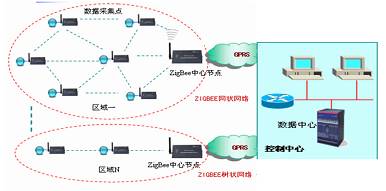
Utilizing GPRS networks to transmit data from Zigbee wireless sensor aggregation nodes, the complete wireless network design employs star or MESH topologies and communication methods that wake up Zigbee modules on demand, effectively reducing power consumption for each Zigbee sensor node and decreasing the probability of collision when reporting data to aggregation nodes, while using GPRS networks to transmit aggregated data, changing the traditional reliance on wired public networks for data transmission, providing significant advantages to the network.
The remote management center achieves remote communication with the ZigBEE network through public channels like GPRS, obtaining collected information for effective control and management of the field.
3.2 Medical Monitoring Systems
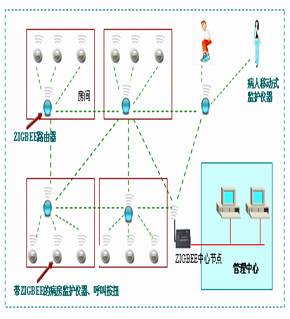
Utilizing ZigBEE technology to form a mesh routing network, suitable routing nodes are set up in the corridors for data relaying, with in-room calling nodes connected in a star network configuration, where one of the nodes acts as a ZigBEE router responsible for connecting to the central network and relaying data. All ZigBEE routers form a cellular mesh network, connecting to the central ZigBEE node set up at the management center, creating a complete ZigBEE wireless network that is a very reliable communication network structure.
3.3 Wireless Ordering Systems
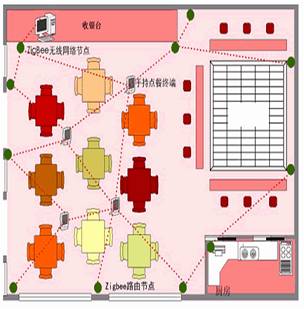
The restaurant ZigBee wireless node network is constructed by deploying ZigBee node devices throughout the restaurant, bar, kitchen, checkout, and processing center, achieving automation in information processing; waiters handle customer orders through handheld ordering terminals, with user orders automatically uploaded to the kitchen and checkout via the ZigBee network in the hall, forming a cellular communication network with ZigBEE central nodes, wireless ZigBEE routers, and wireless ordering terminals, allowing any node to communicate in a multi-modal manner.
Any ZigBEE router is responsible for connecting to the central network and relaying data; all ZigBEE routers form a cellular mesh network connecting to the ZigBEE central node set up at the main service desk, creating a complete ZigBEE wireless network that is a very reliable communication network structure.
3.4 Intelligent Traffic Control Systems
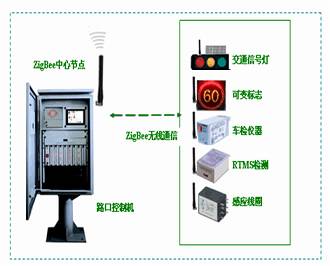
Using a wireless control system that combines ZIGBEE and solar energy, there is no need to dig roads to lay control lines, achieving wireless automatic networking connections between devices, which not only reduces installation costs but also avoids economic losses caused by traditional installation methods disrupting traffic, and avoids interference to existing buried pipelines due to rapid urban development and road expansion.
As ZigBee technology continues to improve, it will become the most advanced digital wireless technology in the world today. The significant advantages of ZigBee, such as low power consumption, low cost, low data rates, and ease of use, ensure it will have broad application prospects. The ZigBee Alliance predicts that in the next four to five years, each household will have 50 ZigBee devices, eventually reaching 150 devices per household. It is believed that in the near future, more and more products with ZigBee functionality will enter our lives, bringing great convenience and efficiency to our daily work and life.
– END –
The future of manufacturing is intelligence, and the foundation of intelligence is sensors; the direction of the Internet is the Internet of Things, and the cornerstone of the Internet of Things is also sensors;
“Sensor Technology” compiles a set of foundational knowledge on various sensors, introducing the principles of various sensors.
[Clickthe blue title to access the article]
1Understand MEMS Sensors in One Article
2Understand Proximity Sensors in One Article
3Understand Magnetic Sensors in One Article
4Understand Flow Sensors in One Article
5,Understand the Principles and Classifications of Pressure Sensors in One Article
6Understand Acceleration Sensors in One Article
7Understand Ultrasonic Sensors in One Article
8Understand Displacement Sensors in One Article
9Understand Photoelectric Sensors in One Article
10Understand Fiber Optic Sensors in One Article
11Understand Temperature and Humidity Sensors in One Article
12Understand Image Sensors in One Article
13Understand Biosensors in One Article
14,Understand Hall Sensors in One Article
15,Understand Distance Sensors in One Article
16,Understand Oxygen Sensors in One Article
17,Understand Wind Direction and Speed Sensors in One Article
18,Understand Nano Sensors in One Article
19,Understand Infrared Sensors in One Article
20,Understand Infrared Sensors – Thermal Imaging Instruments in One Article
21,Understand Gas Sensors in One Article
23, Today’s Discussion on Automotive Sensors
24Understand Smartphone Sensors in One Article
25Understand Medical Sensors in One Article
26Understand Chemical Sensors in One Article
27Understand Angular Velocity Sensors (Gyroscopes) in One Article
28,Understand Transducers in One Article
29,Understand Rotary Encoders in One Article
30Understand Transmissions in One Article
31,Understand Vibration Sensors in One Article
32,Understand Capacitive Sensors in One Article
33,Understand Eddy Current Sensors in One Article
34,Understand Inductive Sensors in One Article
35,Understand Grating Sensors in One Article
36,Understand Piezoelectric Sensors in One Article
37,Understand Smoke Sensors in One Article
38,Understand Resistive Sensors in One Article
39,Detailed Explanation of Wireless Network Sensors
40,Current Status of MEMS Sensor Market and Major Manufacturers
41,Current Status of Image Sensor Market and Major Manufacturers
42,Current Status of Gas Sensor Market and Major Manufacturers
43,Current Status of Fingerprint Sensor Market and Major Manufacturers
44,Current Status of Automotive MEMS Sensor Market and Major Manufacturers
Disclaimer: The copyright of this article belongs to the original author. If there are any copyright issues with the videos, images, or text used in this article, please inform us immediately, and we will confirm copyright based on the provided evidence and pay remuneration according to national standards or delete the content immediately! The content of this article reflects the views of the original author and does not represent this public account’s endorsement of its views or responsibility for its authenticity.


To publish your products, please click “Read the original text”