The comprehensive online examination platform for universities, YunKaoKu, is continuously pursuing performance optimization to provide candidates with a more comfortable online examination experience. This morning, the YunKaoKu platform achieved HTTP/2.0 protocol transmission, replacing the traditional, outdated, and inefficient HTTP/1.1 protocol, resulting in page load times of less than 0.4 seconds.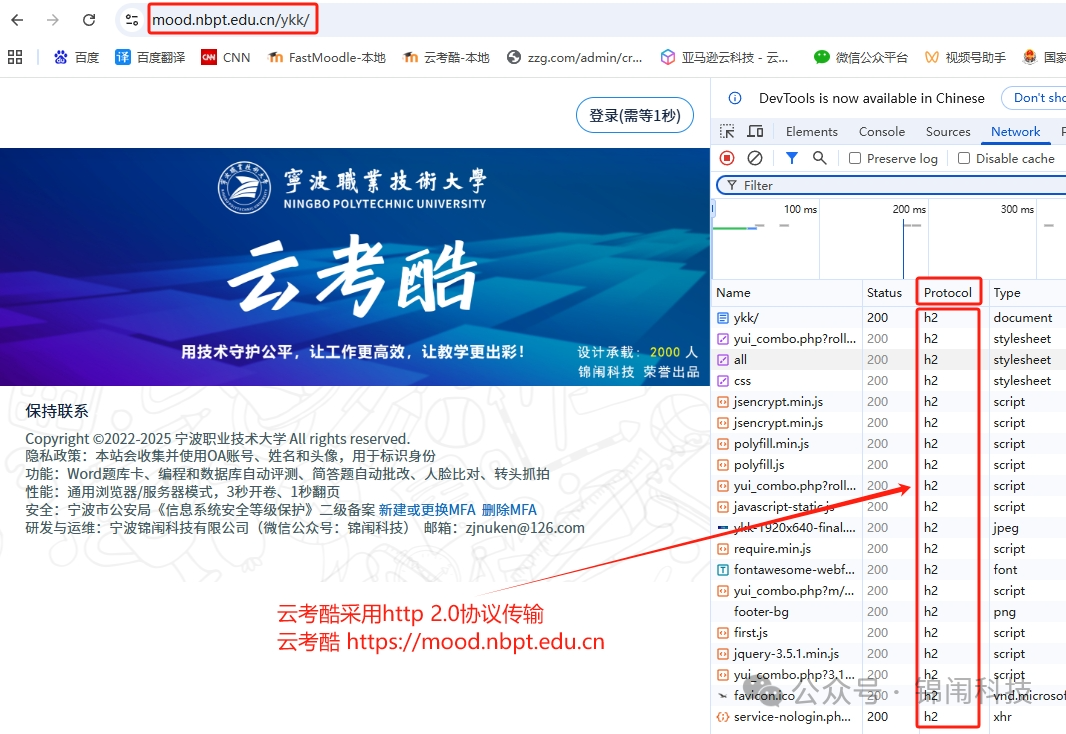
The core differences between HTTP/2.0 and HTTP/1.1 lie in transmission efficiency, concurrency performance, and protocol architecture. Through innovations such as binary framing and multiplexing, a comprehensive enhancement of network performance has been achieved.
1、Release Time and Version Positioning
HTTP/1.1: Released in 1999, it addressed the short connection issues of early HTTP/1.0 through long connections (Keep-Alive), becoming the mainstream protocol on the internet, but it has performance bottlenecks such as head-of-line blocking.
HTTP/2.0: Officially standardized in 2015 (RFC 7540), optimized based on Google’s SPDY protocol, it introduced binary transmission and multiplexing for the first time, marking a significant upgrade of the HTTP protocol.
2、Core Differences Comparison
(1) Transmission Mode:
HTTP/1.1: Transmits based on text format, with low parsing efficiency and high data redundancy.
HTTP/2.0: Uses a binary framing mechanism, splitting data into smaller binary frames, reducing parsing complexity and improving transmission efficiency.
(2) Multiplexing:
HTTP/1.1: Each TCP connection can only process requests serially, requiring multiple connections (usually 6-8) to enhance concurrency, but with high resource consumption.
HTTP/2.0: Supports bidirectional data stream parallel transmission within a single connection, solving the head-of-line blocking problem while reducing the number of TCP connections.
(3) Header Compression:
HTTP/1.1: Each request must carry the complete header, repeatedly transmitting fields like cookies, wasting bandwidth.
HTTP/2.0: Uses the HPACK algorithm to compress headers, reducing redundancy through static tables (61 common fields) and dynamic tables (custom fields), with header size reduced by an average of 50%-90%.
(4) Server Push:
HTTP/1.1: Resources must be explicitly requested by the client, requiring multiple round trips for page loading.
HTTP/2.0: Supports server-initiated pushing of associated resources (such as CSS/JS), reducing critical resource loading delays, with page rendering speed improved by over 30%.
3、Performance Comparison:
(1) High Latency Networks: Due to the multiplexing feature, HTTP/2.0 can achieve page loading speeds up to 3 times that of HTTP/1.1.
(2) Bandwidth Usage: Header compression allows HTTP/2.0 to save an average of 1KB-5KB per request, with typical webpage header overhead reduced by 80%.
(3) Concurrency Capability: A single connection in HTTP/2.0 can support hundreds of parallel requests, while HTTP/1.1 requires multiple connections and is limited by browser constraints (usually 6-8).
The development of YunKaoKu aims to achieve comprehensive online examinations in universities, completely eliminating traditional paper-based exams, reducing the massive backlog of paper exam archives, achieving green examinations, contributing to global emission reductions, and alleviating the burdensome labor of teachers in examination affairs, ultimately improving the effectiveness of educational assessments.
The YunKaoKu comprehensive online examination platform integrates the latest technological achievements from 25 years of global open-source developments in computing, software, databases, networks, artificial intelligence, and information security, capable of accommodating over 2000 candidates for simultaneous examinations in a general browser/server model, with 3 seconds to open the exam and 1 second to turn pages. Sample project: https://mood.nbpt.edu.cn/ykk, designed to support 2000 people.