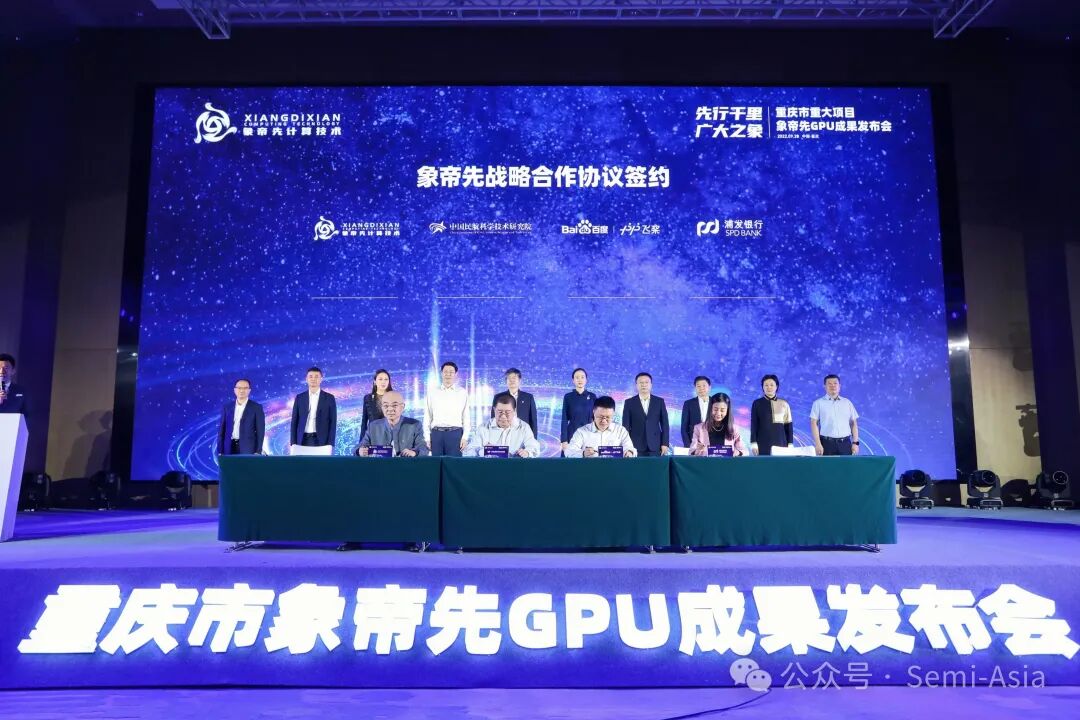
On September 3, Xiangdi Xian revealed on the investor interaction platform that the new generation “Fuxi” architecture chip developed by Xiangdi Xian has completed tape-out verification. This chip exhibits excellent performance in graphics rendering capabilities and parallel computing performance, with its performance and technical specifications comparable to the advanced levels of international mainstream display chips. Previously, it was reported that Xiangdi Xian Computing Technology (Chongqing) Co., Ltd. accelerated the iteration of new products after receiving investment from Anfu Technology. The new generation Fuxi architecture GPU will adopt a 5nm process, achieving a computing power of 160 TFLOPS and integrating 12GB of HBM2 video memory, with graphics rendering capabilities already adapted for “Black Myth: Wukong”.
The Key Value of Breaking the Monopoly
In the high-end rendering chip field, the Fuxi architecture GPU has achieved significant breakthroughs: Previously, domestic GPUs mainly used a 12nm process (such as Xiangdi Xian’s previous Tianjun series), and the launch of the 5nm product marks a leap from “basically usable” to “high-quality and usable” for domestic GPUs. In terms of industrial applications, this chip can also support machine vision inspection, digital twin, and other industrial control innovation scenarios, providing a new option for replacing imported GPUs.
Challenges Ahead
Mass Production Risks: Based on industry experience, even after tape-out verification is completed, there is still a 6-12 month yield ramp-up period required, and the yield sensitivity of the 5nm process is quite high. For every 1% increase in yield, production costs can be reduced by about 3%. The yield control during the subsequent mass production process will directly impact product competitiveness.
Ecological Shortcomings: Although it has been adapted for AAA games like “Black Myth: Wukong”, further testing and verification are still needed for compatibility with professional design software such as Adobe and Autodesk, and the software ecosystem development will still require time.
International Competition: Currently, international giants still maintain a technological advantage, for example, the NVIDIA H100 graphics card is equipped with 80GB of HBM3 memory, showing a clear performance lead; it is also possible that international manufacturers will squeeze the market space for domestic chips through price wars, leading to significant competitive pressure in the future.