Authors: Feng Feng, Wen An An
Published by: IoT Think Tank
Please indicate the source and origin when reprinting

Introduction
To further understand LoRa from a theoretical and fundamental perspective, thereby reasonably selecting suitable communication technologies to provide users with higher quality smart home products and services.
Anyone who has used smart home devices knows that the biggest headache is not insufficient functionality, but product instability, where configured functions may or may not work. When leaving home, the biggest concern is not what might happen, but what has happened but the product fails to work, potentially causing significant issues.
The root of this problem lies in the limitations of the wireless transmission technologies used by the system. Currently, the mainstream communication technologies for smart homes are still ZigBee, WiFi, or Bluetooth. Fortunately, in recent years, IoT technology has developed rapidly, leading to breakthroughs such as LoRa and NB-IoT. These new technologies effectively address the reliability issues of the system, providing users with a safe and reliable new experience.
Below, we will conduct a one-on-one comparison of LoRa and ZigBee from a technical perspective. This will further enhance the understanding of LoRa, allowing for the reasonable selection of suitable communication technologies to provide users with superior smart home products and services.
Performance Comparison of LoRa and ZigBee
LoRa (Long Range Radio) is a low-power wide-area network wireless standard created by Semtech. It allows for longer transmission distances under the same power conditions compared to other wireless methods, achieving a balance between low power consumption and long-range communication, extending the distance by 3-5 times compared to traditional RF communication under the same power. It is a type of LPWAN communication technology based on spread spectrum technology, which balances distance and power consumption well. With the global push for smart cities, smart communities, and smart factories, LoRa technology has gradually been applied in IoT across various regions.
ZigBee, also known as the purple bee, is a wireless networking protocol for low-speed short-range transmission, based on the IEEE 802.15.4 standard for media access and physical layer specifications. Its main features include wide bandwidth and short distance.
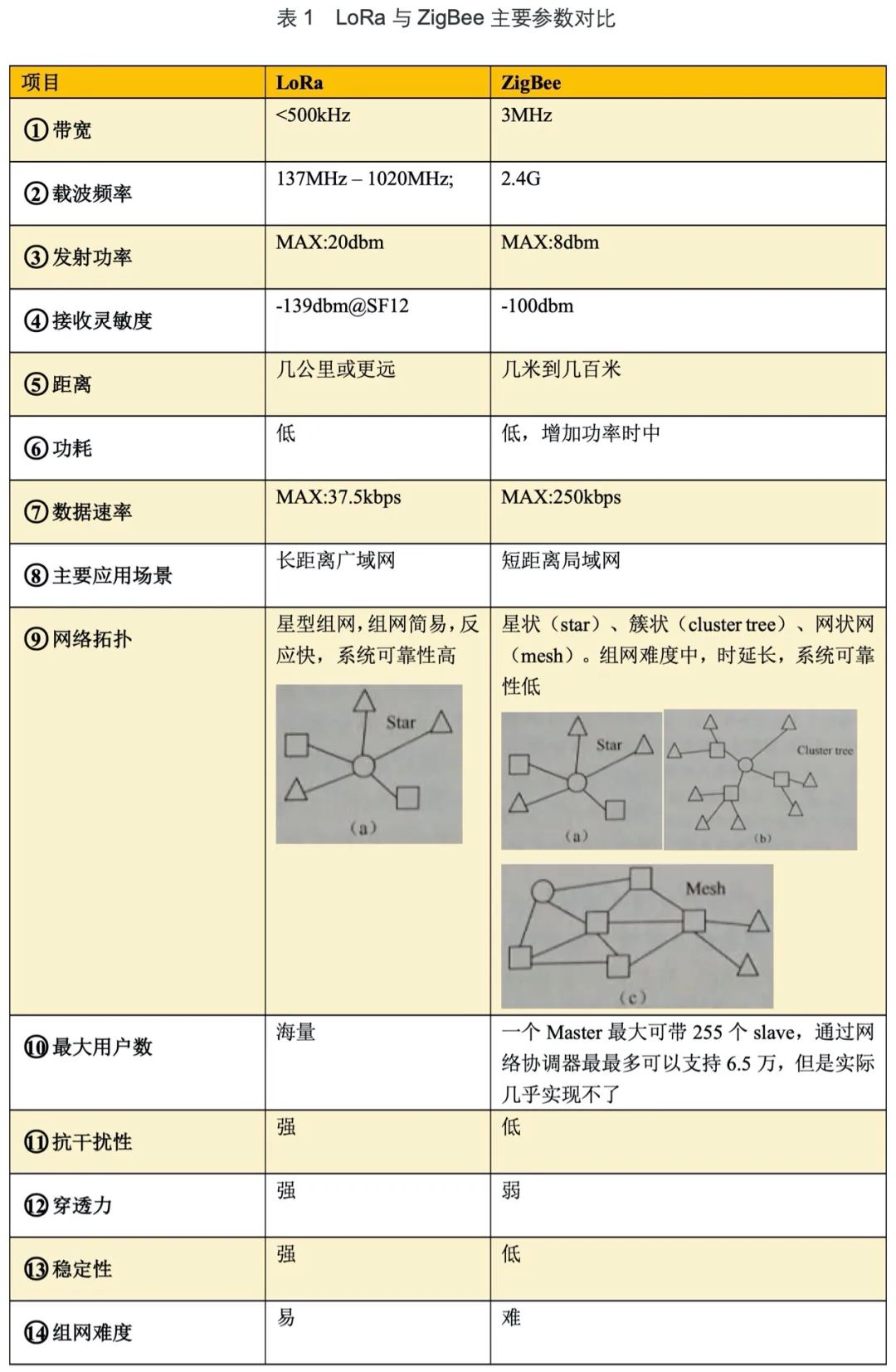
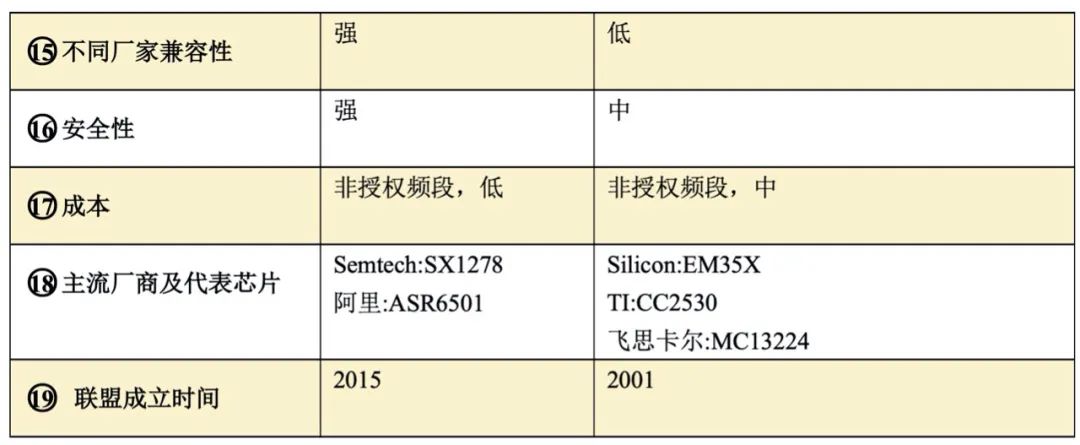
Analysis of Some Items in the Above Table:
-
Carrier Frequency
LoRa uses a lower carrier frequency, resulting in slower channel attenuation and stronger wall penetration capability, while ZigBee operates at 2.4G, which experiences faster channel attenuation and poorer wall penetration. Additionally, there are numerous products operating at 2.4G (ZigBee, WiFi, etc.), leading to significant mutual interference.
-
Receiving Sensitivity
LoRa is based on spread spectrum technology, which has strong anti-interference capabilities. The receiving sensitivities of some LoRa and ZigBee chips are shown in the following tables:
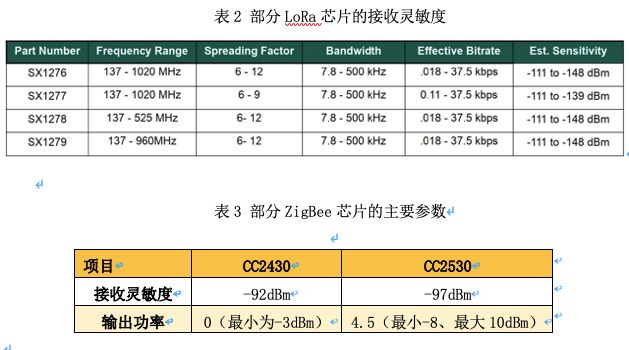
From Table 2, it can be seen that the receiving sensitivity achievable by LoRa theoretically provides the potential for high-reliability communication. Comparing Table 2 and Table 3, LoRa’s receiving sensitivity is significantly better than that of ZigBee. As mentioned in the introduction, the reliability issues that need optimization in current smart homes make LoRa a very good choice.
-
Distance
From the main characteristics of LoRa technology in Table 1, it is clear that the communication distance is long, making it feasible to deploy a large number of devices throughout an entire building or even an entire community, such as for data collection from water and electricity meters, security monitoring, and fire monitoring, facilitating centralized management.
-
Power Consumption
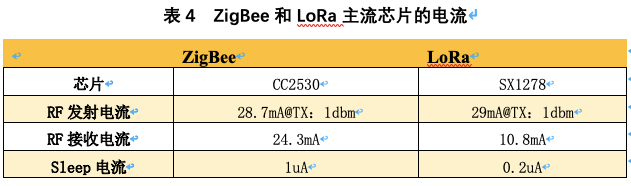
From the above table, it can be seen that the transmission currents of mainstream ZigBee and LoRa chips are similar, while LoRa’s receiving current is lower than that of ZigBee. Both have relatively low power consumption. Generally speaking, ZigBee systems send and receive more data packets during network formation and normal operation than LoRa, which also increases power consumption.
-
Data Rate
From Table 1, it can be seen that LoRa’s data rate is not very high, but it can still be used in smart homes for the following two reasons.
-
LoRa technology can be used for transmitting control signals in smart homes
Currently, one of the main features of smart home products is that various sensors execute different actions based on changes in external conditions (temperature, humidity, light). Therefore, this type of functionality involves minimal data transmission; another main feature is smart scenes composed of various smart home devices, such as opening the door when coming home, automatically turning on the lights, and adjusting the air conditioning to a preferred temperature. This type of functionality only requires configuring each device in the scene once, and subsequent activations of the scene only need to trigger and transmit a control signal for each device to execute the corresponding action, thus activating the scene. From these two main functionalities, most smart home devices require minimal control signal transmission, only a few bytes, making the low data rate of LoRa technology sufficient. LoRa not only meets the needs of such low-data control smart home devices, but also due to its strong anti-interference capability, wide signal coverage, and large capacity, requires fewer gateways, thus saving costs.
-
LoRa can be paired with WiFi and other communication technologies to connect applications with large data volumes, enhancing the overall performance of the smart home system.
In addition to the small amount of control information mentioned earlier, to further enhance the performance of smart homes, they can connect high data rate applications. Besides LoRa technology, smart homes can also utilize widely available WiFi signals for transmitting audio and video data and connecting to the internet. This way, the strong characteristics of LoRa can be used for transmitting overall control information, while fast data rates can be used locally with WiFi for transmitting audio and video data, elevating the smart home experience to a new level.
-
Main Application Scenarios
LoRa has advantages such as long-distance communication, strong anti-interference capability, and low power consumption. Based on this, common application scenarios for LoRa include smart cities, smart homes, smart buildings, smart environmental monitoring, smart measurement, smart agriculture, smart industry, smart retail, smart logistics, smart security, and smart firefighting. Especially in the realm of smart homes, LoRa extends application scenarios seamlessly from indoors to outdoors and even throughout entire communities.
ZigBee, on the other hand, is characterized by a wide communication band and short communication distance, with common application scenarios including smart homes, smart measurement, and smart agriculture.
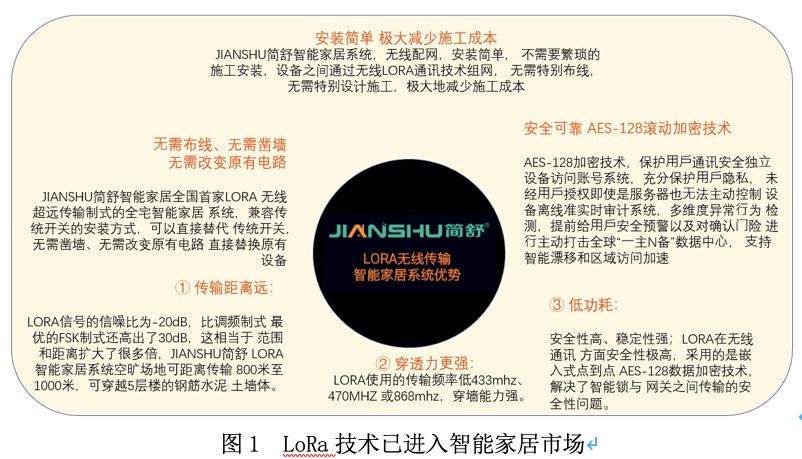
ZigBee entered the smart home field earlier than LoRa and has formed a certain scale of ecological chain. However, as applications have deepened, ZigBee’s limitations have led to bottlenecks for its products. Simultaneously, LoRa is making strong inroads into this field. Currently, manufacturers have implemented smart home solutions based on LoRa technology, such as YoSmart, Jian Shu, Hui Lian Wu Xian, and Amazon’s Sidewalk.
-
Network Topology
Most systems using LoRa technology currently adopt a star topology, which simplifies control and facilitates centralized data processing. Besides star topology, other topologies can be considered; a mesh topology combined with flooding data transmission methods and reasonable data packet management can improve system reliability. LoRa’s long communication distance allows for avoiding the use of relays in mesh networks, leading to a high degree of overlap among terminals and high system reliability. Device-to-device (D2D) communication is very suitable for data transmission in localized network areas, improving system real-time performance and effectively alleviating traffic congestion at critical nodes. Therefore, when building systems using LoRa technology, various topologies can be combined based on actual needs to further enhance system performance.
ZigBee’s network structure is not limited to one type, but due to its short communication distance and weak wall penetration, extending the network can be quite challenging.
-
Networking Difficulty
A ZigBee network typically includes coordinator nodes, routing nodes, and general terminal nodes. The coordinator node is responsible for creating and maintaining the network, while routing nodes are responsible for finding and maintaining routes. ZigBee networking involves network initialization and the process of general terminal nodes joining the network. The main process for network initialization includes determining the network coordinator, channel scanning, and setting the network ID. General terminal nodes joining the network includes connecting through the coordinator node or joining through existing nodes. Joining through the coordinator involves looking for the network coordinator, sending association requests, waiting for the coordinator to process, sending data request commands, and receiving replies. Joining through existing nodes requires scanning the network to find a suitable parent node; otherwise, joining fails. In contrast, LoRa networking primarily uses a star topology, where terminals scan for gateway information, send join requests, and the gateway replies, allowing normal operation. Compared to ZigBee, LoRa networking has significant advantages in complexity, difficulty, and time.
-
Cost
Due to LoRa’s long communication distance, strong wall penetration capabilities, and large system capacity, the number of LoRa gateways required for the same number of terminals is significantly lower than that for ZigBee, which can save system networking costs. The installation and use of LoRa products are simpler than those of ZigBee, resulting in lower installation and usage costs.
LoRa Attracts Many Players, Replacing ZigBee Is Not Impossible
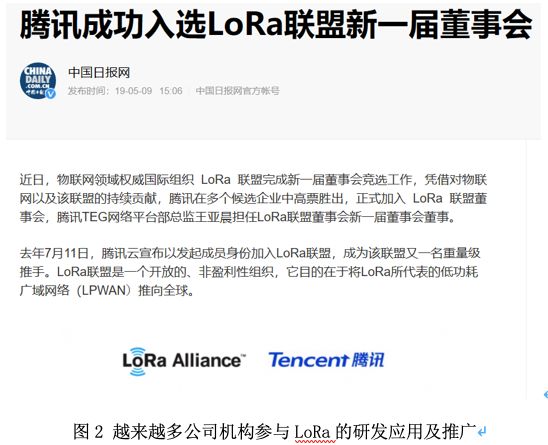
LoRa was commercialized more than a decade later than ZigBee, and its applications are more aligned with current needs. An increasing number of companies are investing in LoRa-related research and applications. In China, companies like Alibaba, ZTE, and Tencent are members of the China LoRa Application Alliance (CLAA) and are involved in promotion efforts. The number of members in the LoRa Alliance and the number of terminals supporting LoRa have significantly increased.
As ZigBee was commercialized earlier than LoRa, the smart home ecological chain that utilizes ZigBee technology for data transmission has reached a certain scale. Generally, the smart home ecological chain includes application control, data transmission, and data collection, with ZigBee responsible for the data transmission function. Transitioning the current ecological chain from ZigBee communication technology to the more advantageous LoRa only requires replacing the ZigBee modules with LoRa modules and gateways to realize the upgrade of the smart home ecosystem. For example, the LoRa smart locks, switches, and sockets launched by Deep Technology are a typical case of rapid iteration of ZigBee smart home products. They represent a new generation of comprehensive smart home solutions that utilize the original ZigBee supply chain and application systems.
Conclusion
In summary, LoRa has become a communication technology driving modern IoT applications. Besides common applications like water and electricity meters, it has now expanded into smart homes. For sensing and control items, such as locks, sockets, and lighting, LoRa offers better anti-interference capabilities and wall penetration abilities than other technologies like ZigBee. This makes system deployment simple and feasible, broadening the application range (from indoors to outdoors) and lowering system costs. LoRa can also be integrated with WiFi, BLE, and existing smart voice and video technologies to provide a complete smart home experience. An increasing number of leading enterprises and companies are participating in the development of LoRa applications, including YoSmart, Amazon’s Sidewalk, Jian Shu, and Hui Lian Wu Xian. LoRa technology is becoming the new driving force for smart homes.
References:
1. Xiaomi Mall: https://www.mi.com/index.html
2. Huawei Mall: https://www.vmall.com/list-115
3. Baidu Smart Selection Mall: https://dumall.baidu.com/?utm_source=pz&utm_medium=title
4. YoSmart: http://www.kingtingtech.com/product.html
5. Jian Shu: http://www.wifi59.com/
6. Tencent Invests in LoRa R&D Promotion: https://baijiahao.baidu.com/s?id=1633037146155535423&wfr=spider&for=pc
7. Amazon Sidewalk’s success is anything but assured: https://venturebeat.com/2019/09/26/amazon-sidewalks-success-is-anything-but-assured/
【Pneumonia Epidemic】 Special Report
“Where did Wuhan people go the day before the lockdown?”
See how IoT big data helps with epidemic monitoring

Confirmed cases increased from hundreds to thousands!
AI-driven algorithms successfully warned about Wuhan pneumonia…

Human-to-human transmission discovered last December? The author disregards the epidemic
and publishes a paper? Officials respond to various doubts…

In fighting the epidemic, 5G should be used for tough battles,
not for opportunistic marketing

Pneumonia epidemic, Kobe’s crash,
how to view disasters with IoT thinking?