If you ask in the programmer community, “Which language is both powerful and evokes mixed feelings?” C++ will likely be at the top of the list. It can be used to write operating systems, game engines, and is also applicable in audio and video processing as well as machine learning at a low level — yet, the meme of “Mastering C++ in 21 days” has circulated for over a decade (those who know, know; it’s actually a joke).
As a language that has been around for over 40 years and still ranks second on the TIOBE index, C++ has a vitality that surpasses many “trendy languages.” Today, we will discuss its past and present, covering essential core knowledge points that beginners must understand, along with learning strategies to help you avoid detours.
1. What makes C++ “evergreen”? Let’s look at its hardcore strengths.
First, let’s throw out some data: In the TIOBE index for June 2024, C++ holds a 10.03% share, firmly in second place, just behind Python. This is due to its irreplaceable application scenarios:
-
Low-level infrastructure: Operating systems (like the Windows kernel), compilers, and databases all rely on C++ for its efficient performance;
-
Audio and video development: The live streaming and short video applications you use are built on core libraries like FFmpeg and WebRTC, all written in C++;
-
Game engines: The core logic of Unity, UE4/UE5 engines is all supported by C++;
-
Embedded systems and AI: Control programs for smart bands and in-vehicle systems, as well as machine learning frameworks (like the underlying TensorFlow), all feature C++.
In simple terms, in scenarios where “speed” and “stability” are required, C++ is almost the first choice. For example, in high-frequency trading systems, millisecond-level delays can directly impact profits, and this is where C++’s performance advantages come into play.
2. From 1979 to 2026: How exciting is the “evolution history” of C++?
The story of C++ begins in 1979. At that time, Bjarne Stroustrup at Bell Labs felt that the C language was not “flexible” enough to handle complex projects (like simulation systems), so he added “object-oriented” features on top of C, which became the prototype of C++.
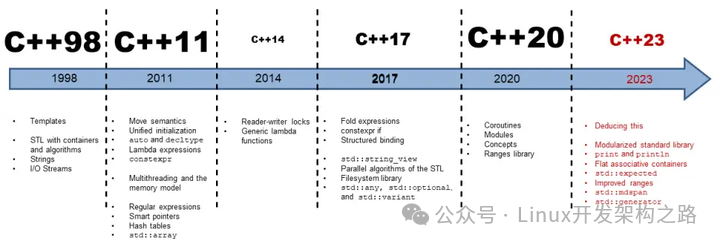
In 1983, it was officially named “C++” (the “++” is the increment operator in C, symbolizing “one more than C”), and its development can be described as “steady progress”:
-
1998: The first international standard C++98 was released, introducing STL (Standard Template Library), allowing developers to avoid reinventing the wheel;
-
2011: C++11 was a “revolutionary update,” adding lambda expressions, smart pointers, and thread libraries, modernizing C++ significantly;
-
2020: C++20 introduced coroutines and modularity, addressing the long-criticized issue of “code redundancy”;
-
2023: C++23 added the print function (finally eliminating the need to write cout<<endl;), and optimized the container library;
-
Future: C++26 is in the works, with the most anticipated “network library” possibly being launched (previously, C++23 did not include it due to internal disputes, humorously referred to as a “palace drama”).
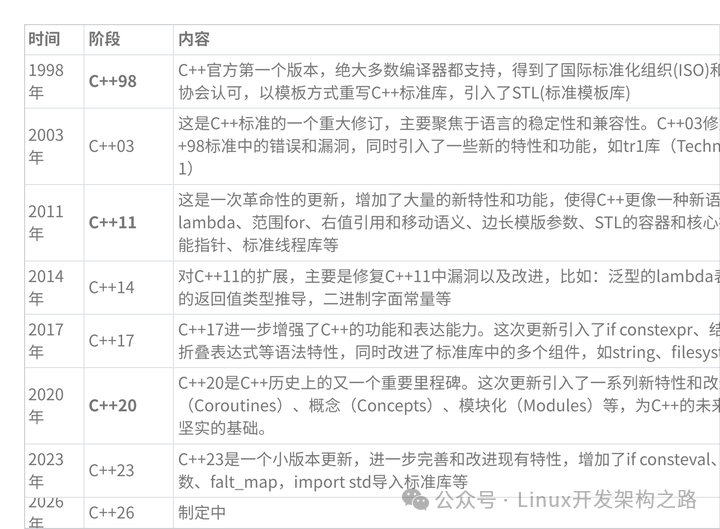
In fact, each version update addresses real issues: for example, the smart pointers in C++11 were introduced to reduce the long-standing problem of “memory leaks”; the modularity in C++20 finally eliminated the need to write a bunch of #include statements in every file.
3. Why learn C++?
3.1 Outstanding performance
C++ is undoubtedly the best choice for meeting high-performance expectations. In program development that fully utilizes the powerful capabilities of hardware, it can provide maximum assistance. This is mainly because it is a software language close to hardware, allowing developers to benefit from all hardware functionalities according to their needs.
For example, in game engines, the engine is responsible for obtaining physics, collision testing, and rendering 2D images of a 3D environment, while also performing a large number of mathematical calculations in the background, such as matrix operations. In some complex scenarios, a 3D environment consists of millions of triangles, each represented by three points, meaning there is a massive amount of point data to process. To achieve smooth gameplay, all this heavy processing must be completed within 1/60 of a second, requiring the program to run at extremely high speeds and fully utilize hardware resources. C++, with its direct access to hardware and efficient execution, has become the preferred language for game engine development. Many well-known game engines, such as Unreal Engine, are heavily developed using C++, providing players with an exceptional gaming experience.
Additionally, C++’s compilation method also makes its running speed stand out. Code written in C++ generates a directly executable application file during compilation, which contains native or machine code that can run without other programs or intermediaries. In contrast, languages like Java, C#, or Python generate intermediate code during compilation, which then requires other tools or programs to convert it into machine code, consuming various system resources and resulting in relatively slower execution speeds. C++’s compilation method, which eliminates the intermediate conversion step, significantly improves compilation and running speeds, reducing overhead.
3.2 Powerful language features
-
Object-oriented programming: C++ introduced the concept of object-oriented programming based on C, providing stronger data abstraction capabilities. Through classes and objects, developers can encapsulate data and operations together, achieving data hiding and protection, thus improving code maintainability and scalability. For example, when developing a graphics drawing program, a “Shape” class can be defined to encapsulate the properties (like color, position, size) and drawing methods of shapes. Different shape objects (like circle objects, rectangle objects) can then be created to call the corresponding drawing methods to achieve the drawing of shapes. This object-oriented programming approach makes the code structure clearer and easier to understand and maintain.
-
Generic programming: C++’s template mechanism supports generic programming, allowing developers to write generic algorithms and data structures without having to write separate code for each data type. For example, the containers (like vector, list, map, etc.) and algorithms (like sorting algorithms, searching algorithms, etc.) in the C++ standard library are implemented through templates. Using these generic containers and algorithms, developers can easily handle different types of data, improving code reusability and development efficiency. For instance, we can use the vector container to store integers, floating-point numbers, strings, and various types of data without defining a dedicated container for each data type.
-
Compatibility with C: C++ is a superset of C, meaning any valid C program is also a valid C++ program. This allows developers to easily reuse existing C code libraries in C++ projects while enjoying the advanced features that C++ offers. For example, many low-level hardware drivers and operating system-related code are written in C, and these C functions and libraries can be directly called in C++ projects, avoiding redundant development and improving development efficiency.
3.3 Large user community and abundant learning resources
C++ has a large user community, which means that developers can easily get help and support when encountering problems during learning and usage. Whether asking questions on professional technical forums like Stack Overflow and C++ Forums, or searching for open-source projects on GitHub for learning and reference, community members are usually responsive and helpful.
At the same time, abundant learning resources also provide convenience for beginners. There are many well-known online learning platforms, such as MOOC and NetEase Cloud Classroom, offering a wealth of C++ introductory and advanced tutorials, including video courses and online programming practice. Additionally, there are numerous books available, such as “C++ Primer” and “Effective C++,” which comprehensively and deeply explain C++ language from basic syntax to advanced programming techniques. These rich learning resources ensure that whether you are a beginner or an experienced developer, you can find suitable materials to help you continuously improve your C++ programming skills.
3.4 Wide range of application fields
C++ has a wide range of application scenarios, and different C++ career paths require different knowledge, but there will still be many overlaps. Friends currently learning C++ can refer to the following core technologies shared in C++, which can help you avoid many detours.
C++ syntax: https://www.bilibili.com/video/BV1JWp8zZE88/
Design patterns: https://www.bilibili.com/video/BV1s5WVz9EwN/
Linux system programming: https://www.bilibili.com/video/BV1Vr4wz7Exv/
Application layer protocol design: https://www.bilibili.com/video/BV1JJ4XzeEr4/
Now let’s take a look at the various directions in C++, and what skills are required for each direction.
3.4.1 Backend/Server Development Engineer
C++ backend/server development is currently a major language for internet backend development alongside Java and Golang, but C++’s main advantage is its exceptional performance, which maximizes CPU utilization; Java and Golang are more suitable for writing business code. Several Java experts I know switched to Golang during campus recruitment. Backends with strict performance requirements will prioritize C++ development, as seen in companies like Baidu and Tencent, where backend development is done using C++. I am currently working in the securities industry as a C++ backend developer.
Backend development requires proficiency in C++, familiarity with operating systems, computer networks, Linux network programming, design patterns, databases, as well as common data structures and algorithms, and various backend middleware.
Regarding backend development, my previous shares have generally been updated based on the needs of this area, from the simplest C language basics to more advanced algorithms, hoping to help everyone build a solid foundation so that when learning more advanced topics, they have a good base; moreover, campus recruitment not only values fundamentals but also practical abilities, so I hope everyone does not fall behind in the basics.
[Backend Development]
-
Solid programming fundamentals, mastery of C/C++/JAVA and common algorithms and data structures;
-
Familiarity with TCP/UDP network protocols and related programming, inter-process communication programming;
-
Understanding of Python, Shell, Perl, and other scripting languages;
-
Understanding of MYSQL and SQL programming, knowledge of NoSQL and key-value storage principles;
-
Comprehensive and solid software knowledge structure, mastery of operating systems, software engineering, design patterns, data structures, database systems, network security, and other professional knowledge;
-
Understanding of distributed system design and development, load balancing technology, system disaster recovery design, high-availability systems, etc.
Below is a company’s recruitment requirements for reference.
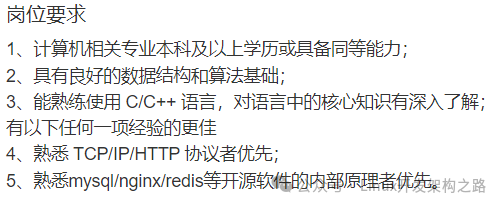
Looking at the requirements for these two positions, not only are there educational requirements, but some also require relevant internship experience. This has already filtered out a large number of candidates, as most people complete their school tasks in a routine manner, with only a few students who have planned ahead in this direction.
Additionally, a solid foundation in data structures and algorithms is necessary; those with ACM experience or competition backgrounds have an advantage. Therefore, if you are a freshman or sophomore, actively participate in such competitions, regardless of whether your school is prestigious, as it will be a great addition to your resume.
As for the language, it is essential to master it. If this is your first time seeing this article, I recommend that you pay attention to previous articles, as they will definitely help you improve.
Furthermore, TCP/IP knowledge is crucial; whether in development or testing, this content is definitely a must-ask in interviews for most companies.
Other tools like MySQL, Nginx, Redis, etc., are also essential for becoming an excellent backend development engineer, so learning them is a necessary path.
In conclusion, to excel in backend development, language proficiency is the most basic requirement. There are other learning materials available, which can be found in previous content.
3.4.2 Desktop Client Development Engineer
This type of client product mainly refers to applications on personal computers, including Windows client development engineers and Mac client development engineers, focusing on interface and logic development on Windows and Mac.
[PC Client Development]
-
Bachelor’s degree or above in computer software-related fields, a passion for programming, solid fundamentals, and understanding of algorithms and data structures;
-
Familiarity with memory management, file systems, and process/thread scheduling in the Windows operating system;
-
Familiarity with MFC/Windows interface implementation mechanisms, proficient in VC, and mastery of C/C++, with experience in Windows network programming;
-
Proficient in Windows client development and debugging, with prior experience in Windows application software development preferred;
-
Passionate about innovation and solving challenging problems, with a good foundation in algorithms and system analysis capabilities.
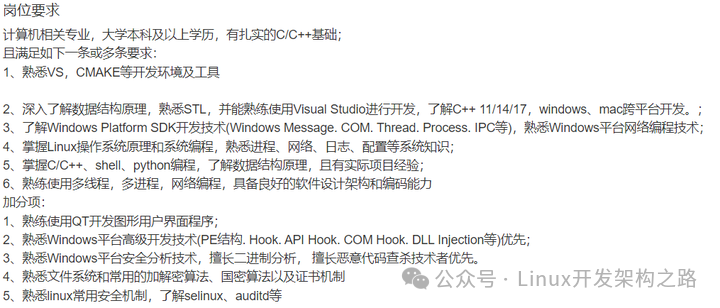
Similarly, language is fundamental. These positions are generally developed in Windows/Mac environments, using development tools like Visual Studio, and understanding the frameworks within it is also necessary.
Common tools like CMake are also essential in the client development process.
For operating systems and computer networks, regardless of the C++ position, these topics are always asked in interviews, so you must be proficient in them. Multi-process, multi-threading, and network programming are also indispensable.
In recent years, Qt has become a popular cross-platform C++ GUI application development framework. It can be used to develop both GUI programs and non-GUI programs, such as console tools and servers. Qt is an object-oriented framework that uses special code generation extensions (called Meta Object Compiler, moc) and some macros, making it easy to extend and allowing for true component programming. If you are interested, you can learn it, as job openings in this area are gradually increasing, and the prospects are good.
Therefore, if you want to do C++ development but are not interested in backend work, you can also consider this direction. It does not require Java and Objective-C like Android or iOS; the main entry barrier is still learning C++.
3.4.3 Graphics/Game/VR/AR
The above categories can be considered as one.
For instance, a graphics development engineer has a higher threshold than a general development engineer. The programming language is C++, but it requires a lot of mathematical applications, such as linear algebra, analytical geometry, calculus, etc., and an understanding of GPU architecture.
Common functionalities in graphics are generally provided by commercial game engines or renderers, and graphics development engineers mainly modify according to project requirements or develop new specialized features. Compared to other business-related jobs, this area is more challenging, resulting in fewer people entering.
Graphics are generally sensitive to performance, especially in real-time applications (like games), where there is a limit of 16.6 milliseconds per frame, placing high demands on programming.
Additionally, you need to learn to use game engines like Unity, cocos2dx, UE4, etc., which also require some time investment.
[Game Client]
-
Bachelor’s degree or above in computer science/engineering-related fields, a passion for programming, solid fundamentals, and understanding of algorithms, data structures, and software design;
-
At least one commonly used programming language for game development, with C++/C# programming experience preferred;
-
Experience with game engines (like Unity, Unreal) is preferred;
-
Understanding of specific game client technologies (like graphics, audio, animation, physics, artificial intelligence, network synchronization) is preferred;
-
Passionate about innovation and solving challenging problems, with strong learning ability, analytical and problem-solving skills, and good teamwork awareness;
-
Ability to read technical documents in English;
-
Passionate about games.
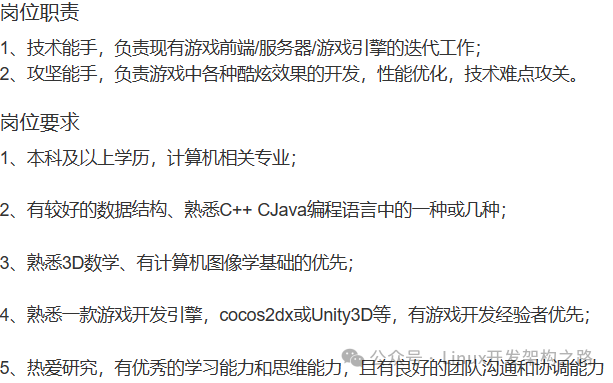
The above is a position developed by a game company. For game companies, effects and performance are highly pursued. For students preparing for the autumn recruitment, this is not an easy task, as most schools do not offer this course. If you are very interested in this direction, you can switch languages or directions, but generally speaking, the threshold is not low.
3.4.4 Test Development Engineer
Some may ask whether test development is testing or development; essentially, it is still testing. Testing is the core, while development is the means.
Generally, test development positions require you to understand both development and testing, and also have a certain depth of work capability. Therefore, you need to be proficient in Java, Python, Shell, SQL, etc., which are the basic requirements, followed by business testing.
[Test Development]
-
Bachelor’s degree or above in computer or related fields;
-
One to two years of programming experience in C/C++/Python or other computer languages;
-
Ability to write test plans, test cases, and implement performance and security testing;
-
Ability to implement automated systems;
-
Ability to locate and investigate product defects, as well as debug defects at the code level;
-
Proactive and responsible, with good teamwork spirit.

Let’s take a look at the requirements for a certain company’s position. For testing-related positions, a solid computer foundation is essential. During interviews, you don’t need to speak extensively, but you should be able to answer at least 80-90% of the questions.
For software engineering students, schools will definitely offer courses related to software testing, and basic concepts like black-box and white-box testing are fundamental…
Some may misunderstand the test development position, thinking it is just about clicking the mouse (though I do know some friends who do that kind of testing), but the reality is different. It requires not only a testing foundation but also a certain level of development knowledge; at least familiarity with Java is necessary, but being proficient in C++ also provides opportunities and advantages. There are also other technologies, and you need to expand your learning based on the specific requirements of the position the company is looking to fill.
Additionally, team members in the testing department need to have good interpersonal skills, as cross-department communication is essential.
3.4.5 Network Security/Reverse Development Engineer
In fact, network security development engineers are a subdivision of the broader field of network security construction and implementation.
For network security development engineers, a solid understanding of computer organization principles and operating systems is essential, along with familiarity with basic knowledge of network security.
[Security Technology]
-
Passionate about the internet, with a fervent pursuit of operating systems and network security, regardless of major;
-
Familiarity with vulnerability discovery, network security attack and defense techniques, and understanding common hacking methods;
-
Basic development skills, proficient in C/C++;
-
Good grasp of databases, operating systems, and network principles;
-
Experience in software reverse engineering, network security attack and defense, or security system development is preferred.
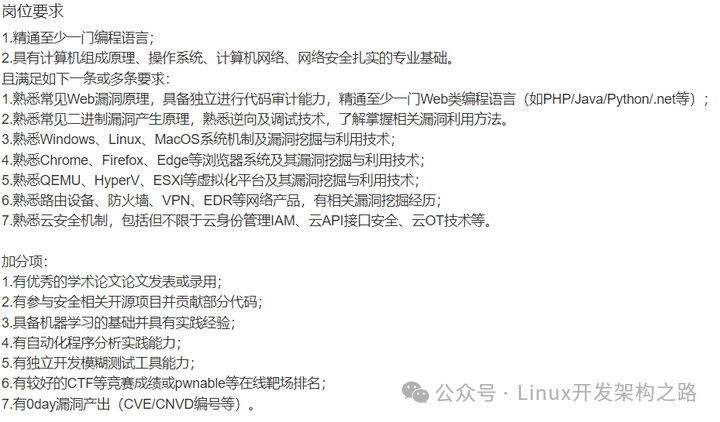
Let’s analyze the specific requirements for a certain security company’s position, which focuses on vulnerabilities. In fact, I have seen that some companies have high requirements for security development engineers, often requiring a 985 or 211 degree or even a master’s degree… which is quite normal.
Looking at the requirements for this position, you can see that regardless of the position, programming languages, computer organization principles, computer networks, and operating systems are all required!!!
In modern terms, these are the default knowledge that development engineers must understand.
This security development position focusing on vulnerabilities has many technical requirements, and it is clear that a graduate-level education is often necessary, as undergraduate students typically do not have such detailed technical knowledge to study.
Having additional skills is always a plus, regardless of the position.
So, to succeed, one must be well-prepared!
3.4.6 IoT/Embedded Development Engineer
This direction has become increasingly popular in recent years, with IoT and embedded systems divided into software and hardware; the scope is broad, leading to many specialized directions. IoT is an industry category, while embedded systems are a technical category, both requiring an understanding of both software and hardware.
In embedded systems, the focus is primarily on microcontroller software development. Students in computer science and technology and electronic information-related majors have likely worked with these systems in school, along with Linux software development, driver development, and embedded system software development, which are relatively closer to low-level development, thus requiring the use of C language. In addition to software learning, hardware knowledge is also necessary, including understanding timing diagrams, circuit diagrams, and assembly language, as these may be used during debugging when C language disassembly is involved. FPGA and DSP software development are relatively higher-level hardware specialties, along with other industrial control software development.
Compared to other software development, embedded employment directions are broader and deeper, with better job opportunities and entry-level salaries than ordinary software engineers.
[Embedded Application Development]
-
Good programming foundation, proficient in C/C++;
-
Mastery of operating systems, data structures, and other essential software development knowledge;
-
Strong communication and understanding skills, along with good teamwork awareness;
-
Experience in Linux/Android system platform development is preferred.
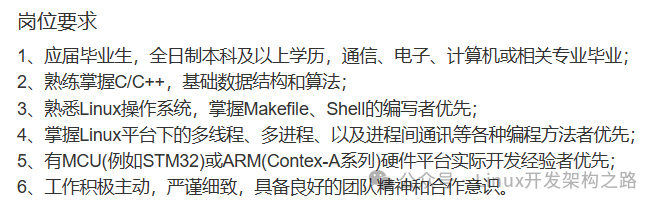
The above requirements for embedded development positions are clear and detailed.
As mentioned earlier, embedded systems primarily use C/C++, along with common data structures and algorithms. If you are fortunate enough to read this far, I encourage you to check out the previous summaries of data structures and algorithms, which will be very helpful for students preparing for campus recruitment or those with 1-3 years of experience.
Linux systems are also essential, as this type of development generally does not occur on Windows. Therefore, on Linux systems, knowledge of Shell is necessary, and efficient compilation often requires Makefile.
Later, multi-process and multi-thread programming will be discussed in detail in previous chapters. You can learn at any time, and there will be ways to obtain the corresponding PDFs.
Finally, knowledge of MCU-related topics is important, but as a campus recruit, if you lack experience in this area, it is still acceptable if you have a solid foundation.
Overall, embedded systems are a very hot direction in recent years, and for those looking to enter this field, the prospects are very friendly, with quite good salary packages.
3.4.7 Audio/Video/Streaming/SDK
Let’s first talk about audio and video, which essentially aim to fully utilize hardware terminals in extremely complex network environments to provide users with an exceptional auditory and visual experience. Therefore, the development process for audio and video is one that pursues the ultimate experience.
[Audio/Video Codec]
-
Master’s degree or above in computer science, signal processing, mathematics, information, or related fields;
-
Solid foundation in video coding/decoding, familiar with common standards like HEVC or H264, and a good foundation in digital signal processing;
-
Proficient in C/C++, strong coding ability, familiarity with at least one assembly language is a plus;
-
Strong ability to read English literature;
-
Strong learning ability, teamwork spirit, and good stress resistance.
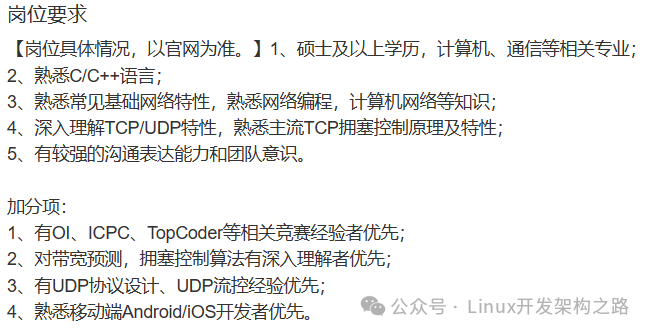
This is a position in the audio and video direction at a certain company, but to be honest, there are educational requirements. Positions with educational requirements often mean that if you only have a bachelor’s degree, you may not be considered, as certain companies have strict requirements in this regard.
As a master’s student, not only is your research direction important, but your foundational knowledge in languages, operating systems, and computer principles will also be assessed.
Additional skills are indeed valuable, and you can refer to the previous sections for more specific skills that are beneficial.
Audio and video learning path: https://www.bilibili.com/video/BV138DoY7E74/
3.4.8 Computer Vision/Machine Learning
Computer vision is a field of artificial intelligence (AI) that enables computers and systems to extract meaningful information from images, videos, and other visual inputs, and to act or provide suggestions based on that information. If AI gives computers the ability to think, computer vision gives them the ability to discover, observe, and understand.
However, these positions generally require a master’s degree, and undergraduates rarely enter these fields unless they are exceptionally talented. Therefore, ordinary undergraduate students should avoid this direction, while master’s students should definitely consider learning in this area.
Why mention this direction? Because most of the work in these areas is still done using C++, while Python is also a very good choice.
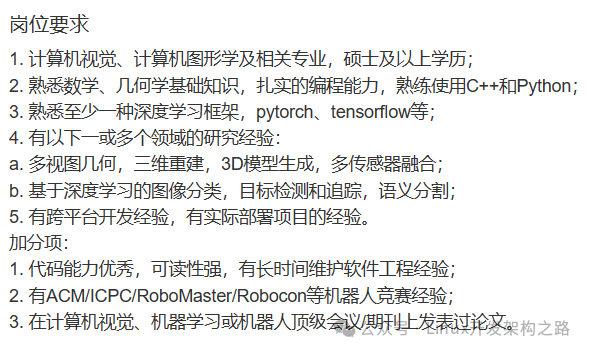
[Computer Vision Research]
-
Computer science, applied mathematics, pattern recognition, artificial intelligence, control, statistics, operations research, bioinformatics, physics/quantum computing, neuroscience, sociology/psychology, and related fields, with research directions in image processing, pattern recognition, and machine learning, bachelor’s degree or above, with a PhD preferred;
-
Proficient in basic algorithms and applications related to computer vision and image processing;
-
Strong algorithm implementation ability, proficient in C/C++ programming, familiar with at least one programming language such as Shell/Python/Matlab;
-
Publications in academic conferences or journals related to computer vision, pattern recognition, or awards in relevant international competitions, and patents are preferred.
3.5 Good Career Prospects
-
Relatively low competition: Although languages like Java and Python have gained popularity in recent years, with many universities adopting them as mainstream teaching languages, C++ has a higher learning difficulty, resulting in fewer developers who truly master it. This leads to relatively low competition for C++ developers in the job market, providing more job opportunities. Many companies find it challenging to find suitable candidates when hiring C++ developers, which offers a broad employment space for C++ developers.
-
Generous salary: Due to C++’s irreplaceable role in high-performance fields, companies are willing to offer higher salaries to developers proficient in C++. Under equal technical levels, C++ programmers generally earn more than those in other languages. Moreover, as experience and skills increase, the salary ceiling for senior C++ programmers far exceeds that of programmers in other languages. For instance, in large internet companies and financial institutions, senior C++ development engineers can earn annual salaries reaching hundreds of thousands or even more.
In summary, C++ stands out as a programming language worth delving into due to its outstanding performance, powerful language features, abundant learning resources, wide application fields, and good career prospects. Whether you are interested in system development, game development, network programming, or wish to enhance your programming skills and career competitiveness, learning C++ will bring you unexpected rewards. If you are still hesitating about whether to learn C++, now is the best time to take that step.