In today’s rapidly advancing technology landscape, embedded technology has permeated every aspect of life, from smart wristbands and smart home controllers to automotive electronics and industrial control devices, all relying on embedded development support. However, many people wonder: Is there a high educational requirement for embedded development? To answer this question, we must first understand the essence of embedded technology and then analyze it in conjunction with learning needs and curriculum characteristics.
1. Understanding Embedded Systems: Definitions, Technologies, and Differences
(1) Why is it called “Embedded”?
The core of embedded systems is “embedding”—it is not a general-purpose computing device like a computer or smartphone, but rather embedded within specific hardware devices to fulfill dedicated functions. For example, the control module in a smart refrigerator needs to monitor temperature in real-time and control the refrigeration system; this module is a typical embedded system that is “hidden” inside the refrigerator, solely to accomplish the core control tasks of the refrigerator, which is also the origin of the term “embedded”.
(2) Core Technologies Used in Embedded Systems
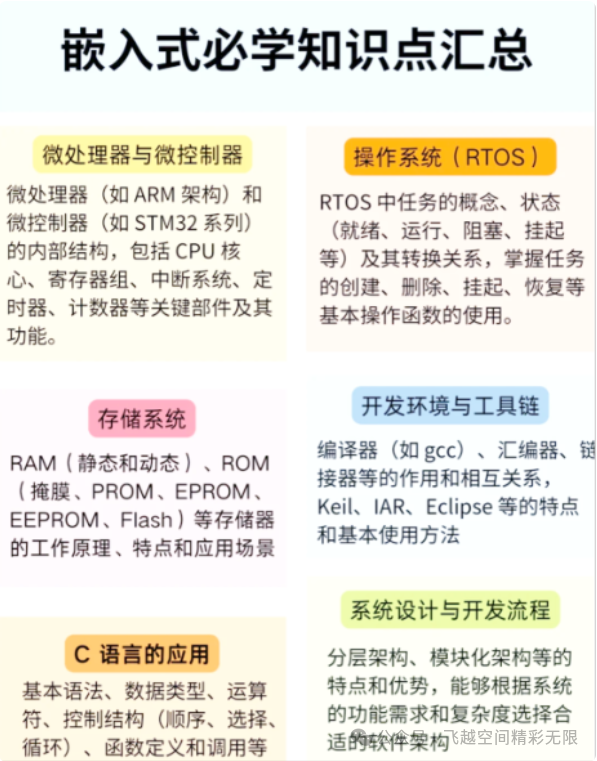
Embedded development is a field that combines software and hardware, with core technologies divided into two main areas: hardware and software:
Hardware Technology: Centered around microcontrollers (MCUs) and embedded processors (such as ARM architecture chips), it involves circuit design, component selection, hardware debugging, etc., such as designing control circuit boards based on STM32 chips;
Software Technology: Based on C/C++ programming languages, it requires knowledge of real-time operating systems (RTOS, such as FreeRTOS, UCOS), embedded Linux system development, driver programming, etc., and familiarity with hardware interface protocols (such as I2C, SPI, UART) to achieve software control over hardware.
(3) Key Differences from Other Technologies
Embedded development has clear differences from general software development and pure hardware technology:
Comparisonwith General Software Development (such as Java backend, frontend development): General development focuses on the software layer and does not require in-depth understanding of hardware principles; while embedded development must “understand hardware,” software code must adapt to specific chips and circuits, for example, when writing driver programs, one must be clear about the configuration logic of hardware registers;
Comparisonwith Pure Hardware Technology (such as electronic circuit design): Pure hardware focuses on circuit design and signal analysis, with less emphasis on software logic; while embedded development requires “programming skills” to flexibly control hardware functions through software, such as using code to upload sensor data to the cloud in real-time.
2. Skills and Employment Landscape in Embedded Development
(1) Courses and Skills to Master
To excel in embedded development, one must systematically learn a series of courses and skills, which can be divided into foundational, core, and application layers:
Foundational Layer: Electronic and electrical technology (circuit principles, analog electronics, digital electronics), advanced mathematics (to lay the foundation for signal processing and algorithm optimization), C language programming (the core programming language for embedded development);
Core Layer: Microcontroller principles and applications (such as 51 microcontroller, STM32), embedded operating systems (RTOS/Linux), circuit board design (using tools like Altium Designer, from schematic drawing to PCB layout), driver development (Linux device drivers, hardware interface drivers);
Application Layer: IoT protocols (MQTT, CoAP, adapted for IoT scenarios), embedded software debugging (using tools like JTAG, oscilloscopes to troubleshoot issues), industry-specific development (such as CAN bus protocol for automotive electronics, PLC interaction for industrial control).
(2) Broad Employment Opportunities
The employment landscape for embedded development covers multiple high-demand fields, with strong job stability and high salary levels:
Consumer Electronics: Development of smart wearable devices and smart home controllers;
Automotive Electronics: Development of in-vehicle systems (such as navigation, vehicle interaction) and autonomous driving assistance modules;
Industrial Control: Development of PLC alternatives and industrial sensor data acquisition systems;
Medical Devices: Development of portable testing devices (such as blood glucose meters) and control modules for medical instruments.
3. Embedded Systems and IoT: The Binding of Core Development Technologies
With the widespread adoption of IoT technology, embedded development is the “core engine” of IoT applications. In the three-layer architecture of IoT (perception layer, network layer, application layer), the development of the perception layer (sensors, controllers) and application layer (device functionality implementation) entirely relies on embedded technology: for example, in smart agriculture, soil moisture monitoring devices need to implement the complete process of “sensor data collection → local data processing → instruction sending (such as controlling irrigation)” through embedded development; similarly, smart security cameras require embedded technology to achieve “video capture → local encoding → network transmission” functionality. It can be said that without embedded development, the “interconnection of things” in IoT would lose its technical support at the device level.
4. Educational Requirements: Technical Proficiency Takes Precedence, Curriculum Affects Adaptability
(1) Overall Educational Requirements: Technical Mastery Over Educational Level
From a technical perspective, embedded development does not have a high “hard threshold” for educational requirements—it places more emphasis on whether developers can proficiently master practical skills such as electronics, circuit board design, and embedded programming. When hiring, companies focus more on whether candidates can independently complete hardware design, write driver programs, and solve debugging issues, rather than solely looking at educational certificates. Even candidates with a diploma can gain recognition from companies if they can present a complete embedded project (such as a self-designed smart car or environmental monitoring device).
(2) Differences in Curriculum: Why Bachelor’s Degrees Are More Adaptable, While Diplomas May Struggle?
Although there is no strict educational threshold, embedded development requires extensive and diverse learning (covering both software and hardware), which demands a significant amount of learning time—this is the core reason why diploma students may find it challenging to learn embedded systems, rather than simply due to lower educational levels:
Diploma programs last 3 years, with nearly 1 year spent on internships, leaving only about 2 years for professional study, making it difficult to systematically master the complete knowledge chain of “electronics → microcontrollers → embedded Linux → driver development”; often, they can only grasp basic microcontroller development and cannot delve into core technologies;
Bachelor’s programs last 4 years, without the pressure of long-term internships, allowing sufficient time to transition from foundational courses (electronics, C language) to core skills (circuit board design, embedded operating systems), and also enabling the completion of complete projects through course design and graduation projects, forming a systematic technical capability.
(3) Pathways for Diploma Students: Learning Has No Limits
If diploma students are interested in embedded systems, there are still various pathways to master the technology after graduation:
Upgrading to Bachelor’s Degree: Entering a bachelor’s institution to supplement learning time and systematically improve the knowledge system;
Professional Training: Choosing training courses focused on practical embedded skills (such as Linux driver development, IoT embedded practice) to quickly fill knowledge gaps through intensive learning (usually 3-6 months);
Self-study + Project Practice: Self-learning through open-source projects (such as practical projects based on Raspberry Pi, STM32), online courses (such as MOOCs, Bilibili embedded tutorials), while also engaging in hands-on projects to accumulate practical experience.
Conclusion
Embedded development is not an “exclusive domain for high-educated individuals”; its core threshold lies in technical practical ability. However, due to the extensive soft and hard knowledge required and the time-consuming nature of learning, a 4-year bachelor’s program better supports systematic learning, while diploma programs may face time constraints due to their limited duration. Nevertheless, education level and curriculum are merely “starting conditions” for learning, not “end restrictions”—whether through upgrading to a bachelor’s degree, training, or self-study, as long as one persists in accumulating technical and project experience, individuals of any educational background can find development opportunities in the embedded field.