Source: Guoke
Bluetooth is a term we are all too familiar with. But what exactly is Bluetooth?This story begins with a Danish king.Bluetooth is actually a short-range wireless communication technology that enables short-range data exchange between fixed devices, mobile devices, and personal area networks (using UHF radio waves in the ISM band of 2.4-2.485GHz). Bluetooth can connect multiple devices and overcomes the challenges of data synchronization.But why is it called “Bluetooth”?This traces back to King Harald Bluetooth of Denmark in the 10th century. King Harald ruled Denmark from around 958 to 986, was a great warrior, ended the Viking era, and unified a large part of Northern Europe, including present-day Norway, Sweden, and Denmark. King Harald BluetoothThe Danish word “Blåtand” translates to “Bluetooth” in English, hence this king is also known as Harald Bluetooth.There are many versions regarding the origin of this name. One legend suggests that the king loved to eat blueberries, which stained his teeth blue; some historians speculate that one of his teeth decayed and appeared blue.In 1996, Ericsson, Nokia, Toshiba, IBM, and Intel planned to establish an industry association to jointly develop a short-range wireless connection technology. The development team hoped that this wireless communication technology could coordinate and unify work across different industrial fields, just like King Bluetooth.Thus, this technology was named Bluetooth. The Bluetooth logo is a combination of the ancient Nordic letters ᚼ and ᛒ, which represent the initials H and B of King Harald Bluetooth.Thanks to this magical logo, the story of this Danish king has truly become legendary.
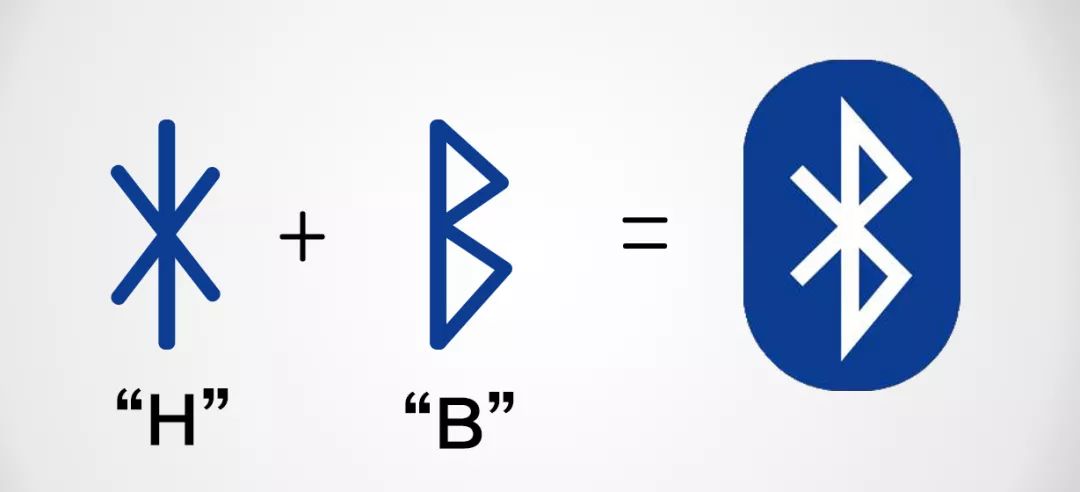 Meaning of the Bluetooth logoWith WiFi available, why still use Bluetooth?As both are short-range communication technologies, Bluetooth inevitably gets compared with WiFi. So, what are the differences between them?
 Bluetooth and WiFi are often comparedFirstly, in terms of usage, we often connect multiple devices to the same WiFi to access the internet, which is a one-to-many connection, whereas Bluetooth is a point-to-point connection method for data transfer between two devices. From this perspective, Bluetooth has a higher data security.Secondly, Bluetooth uses microstrip antennas, which are small and easy to integrate into devices, and the cost of Bluetooth modules is very low, leading to a high prevalence of Bluetooth devices; however, WiFi devices require separate network cards and routing devices, which are more expensive and consume more power.Does turning on Bluetooth consume power?But if you keep Bluetooth on while taking the subway, will it drain your phone’s battery quickly? To understand this issue, you need to know about the advancements in Bluetooth technology.Currently, there are two types of Bluetooth we use: traditional Bluetooth and BLE (Bluetooth Low Energy). Traditional Bluetooth uses a point-to-point communication method, which maintains a continuous connection, typically used in scenarios with larger data volumes, such as Bluetooth headsets and speakers.BLE is a low-energy Bluetooth technology. Compared to traditional Bluetooth, the biggest advantage of BLE is its fast search and connection speed and low power consumption. BLE can complete a connection (scanning devices, establishing connections, sending data, etc.) in about 3ms, and after the task is completed, it quickly switches to a “non-connected” state, minimizing power consumption.However, BLE has a physical bandwidth of only 1M, resulting in a lower data transfer rate, so BLE is generally used for devices that require high real-time performance but have very small data packets, such as keyboards and remote controls.
 Let’s also talk about the currently mainstream Bluetooth device using BLE5.0. In 2016, the Bluetooth Special Interest Group proposed a new Bluetooth technology standard—BLE5.0, mainly targeting low-power devices, featuring a wider coverage range and a speed increase of four times compared to the current version. Additionally, it introduced indoor positioning assistance, achieving indoor positioning accuracy of less than 1 meter when combined with Wi-Fi.In terms of speed, the maximum transmission speed of BLE5.0 is 24Mbps, which is twice that of the previous BLE4.2 version, and the transmission level reaches lossless quality. In terms of working distance, BLE5.0 can achieve an effective working distance of 300 meters, which is four times that of the previous BLE4.2 version. Furthermore, it added navigation functionality, enabling 1-meter indoor positioning. Finally, to meet the demands of mobile clients, BLE5.0 has lower power consumption and is compatible with older versions.Taking “Metro” as an example, this software uses BLE technology. When passengers pass through the gate, the software can quickly establish a connection and complete authentication with the gate via BLE, making this process almost imperceptible to passengers and not increasing their waiting time at the gate.Moreover, due to the use of BLE technology, Metro only needs to send a very small data packet to the gate, and after authentication is completed, Bluetooth quickly enters the “non-connected” state, greatly reducing power consumption, making the energy consumed negligible for the phone.

It just goes by in a flashWhether commuting to work, listening to music on the subway, or working wirelessly, the use of Bluetooth technology has made our lives more convenient.The next time you turn on Bluetooth, don’t forget to thank that Nordic engineering romance and the distant Danish king from the Viking era.