MedRobot updates the latest developments of global surgical robot companies daily, welcome to follow!
01
Technical Concept
From the perspective of technological development, as a “technology”, the initial concept of surgical robots is CAS.
Computer Assisted Surgery (CAS): represents a surgical concept and set of methods that use computer technology for preoperational planning and for guiding or performing surgical interventions. 计算机辅助外科手术,是使用计算机技术辅助术前规划、术中导航、手术治疗的概念和一系列方法。
Related concepts also include:
-
Computer aided surgery 计算机辅助外科
-
Computer assisted intervention 计算机辅助介入
-
Image guided surgery 图像引导手术
-
Surgical navigation 外科手术导航
The earliest authoritative textbook in this field is Computer-Integrated Surgery: Technology and Clinical Applications, Russell Taylor et al., MIT press, published in 1996.
(Russell Taylor is the director of LCSR at Johns Hopkins University and a top expert in global surgical robotics.)
Introduction to LCSR:22 cutting-edge directions! The world’s top medical robot laboratory LCSR
Russell Taylor has visited China:Professor Russell H. Taylor from Johns Hopkins University comprehensively analyzes medical robot technology, industry, and research)
Later, more discussions referred to robots rather than computers.
Robot Assisted Surgery (RAS), 机器人辅助手术
Robot Assisted Microsurgery (RAMS), 机器人辅助微创手术
Regarding the concept of robots (robot), it is as follows:
An automatic machine device that performs work. It can accept human commands, run pre-programmed scripts, and act based on principles established by artificial intelligence technology. Its task is to assist or replace human work.
When we mention surgeries assisted by surgical robots, we generally use the concept of RA (Robot Assisted).
For example: Robot Assisted Laparoscopic Prostatectomy, 机器人辅助腹腔镜前列腺切除术.
02
Concept of Surgical Robots in Medical Devices:
Classification Directory
In the latest version of the Medical Device Classification Directory, surgical robots refer to a category of products within “01 Active Surgical Instruments” under “07 Surgical Navigation and Control Systems”, which includes two product categories (both belong to Class III registration). As follows:
Surgical Navigation System
Product Description: Usually consists of a host, tracking positioning device, functional software, positioning framework, adapters, markers, and accessories. It is divided into optical and electromagnetic navigation. Some navigation systems come with robotic arms.
Intended Use: To assist surgical navigation in conjunction with generated surgical planning or to formulate surgical planning. Navigation systems with robotic arms can be used in minimally invasive surgeries to support more precise and refined surgical skills and operations.
Example Product Names: Surgical Navigation System, Surgical Navigation System, Navigation Positioning System, Infrared Navigation System
Management Category: Class III
Surgical Control System
Product Description: Usually consists of a physician control console, patient surgical platform, stereoscopic endoscope system, and imaging processing platform dedicated instruments.
Intended Use: Equipment used to help precisely control surgical operations during cavity surgeries.
Example Product Names: Endoscopic Surgical Instrument Control System, Overall Operating Room Control System III
Management Category: Class III
03
Concept of Surgical Robots in Medical Devices:
Industry Standards
According to the 2021 Medical Device National Standard List, the standards adopted for robots are:
“People’s Republic of China Pharmaceutical Industry Standard: Auxiliary Surgical Devices and Auxiliary Surgical Systems Using Robot Technology YY/T 1712-2021”
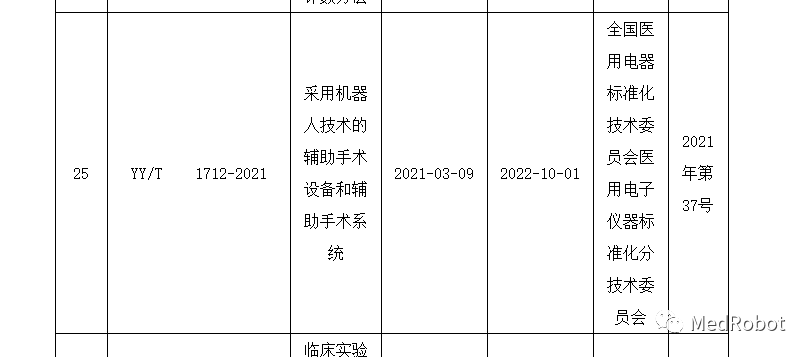
Link to the original standard list:
https://www.nifdc.org.cn//nifdc/bshff/ylqxbzhgl/qxxxgk/biaozh/202201191616034785.html
The formulation of the standard is overseen by the China National Institute for Food and Drug Control, which will solicit opinions, such as:
Must-read for orthopedics! The National Institute of Health solicits opinions on surgical robot standards
Solicitation of opinions | Technical review guidelines for laparoscopic surgical systems
In the standard, the understanding of surgical robots is as follows:
This standard applies to auxiliary surgical devices and auxiliary surgical systems that use robot technology, referred to as “RA devices”, commonly known as medical surgical robots, etc. However, the term “robot” is used ambiguously, with no universally accepted definition. Therefore, inspired by the terminology used by the FDA and international standards, and consistent with the terminology standard “Medical Electrical Equipment Using Robot Technology”, this standard is named “Auxiliary Surgical Devices and Auxiliary Surgical Systems Using Robot Technology”, which does not serve as a generic name for such devices but clarifies the subject of such devices while distinguishing their technical characteristics from other medical electrical devices. For devices with different intended uses, the generic name is specifically determined based on the naming rules.
At the same time, due to the continuous development of applications and technologies in this field, the technical characteristics and test methods specified in this standard can only be defined and designed based on existing products. New technologies and methods adopted after careful consideration of risks should not be restricted by this standard. In such cases, the content of this standard should serve as beneficial guidance and reference rather than be used as mandatory specifications.
04
Currently Marketed Surgical Robots,
What Are Their “Scientific Names”?
Here MedRobot refers to “scientific names” as the names on medical device registration certificates.
Examples are as follows:
(1) Intuitive Surgical’s Da Vinci Surgical Robot (Laparoscopy):Endoscopic Surgical Control System
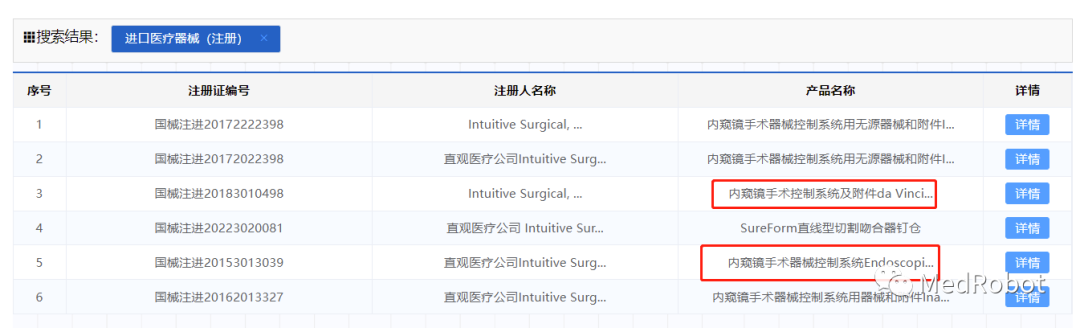
(2) Stryker’s MAKO surgical robot (joint replacement):Orthopedic Surgical Navigation System
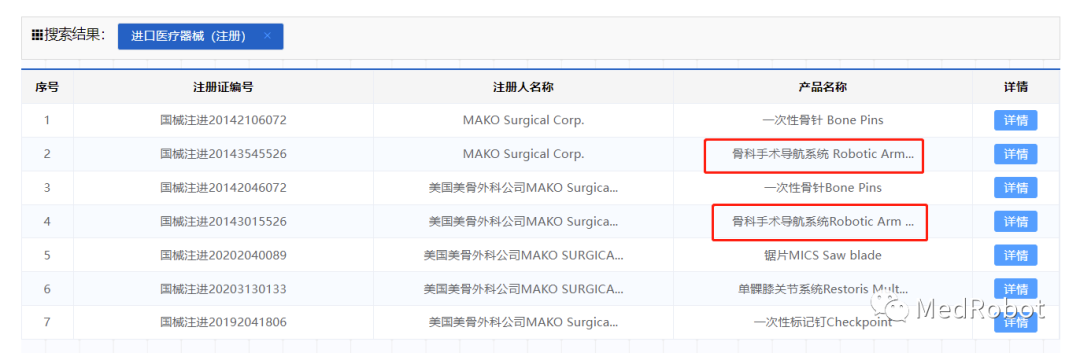
(3) Tianzhihang’s Tianji surgical robot (spine):Orthopedic Surgical Navigation Positioning System
 (4) Baihui Weikang’s neurosurgery robot, oral robot:Neurosurgical Navigation Positioning System, Oral Implant Surgical Navigation Positioning System.
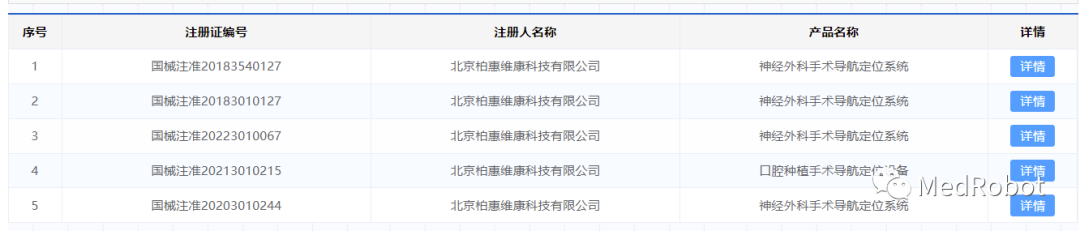
——To Be Continued——
Appendix
Other Reference Materials
To understand surgical robots, you can read technical review principles and approval reports, such as the link below:
Official | Technical Review Report for Laparoscopic Surgical Robots.
Solicitation of opinions | Technical review guidelines for laparoscopic surgical systemsContinuously updated: MedRobot’s series on surgical robot companies:
MedRobot overseas review series
Germany’s surgical robot hidden champion Brainlab | Leading Review 01Non-invasive ultrasound ablation surgical robot company Theraclion | Review 02South Korean medical robot company Curexo | Review 03Italian microsurgery robot company MMI | Review 04Ultrasound treatment robot company HistoSonics | Review 05AI-assisted radiotherapy robot CyberKnife | Review 06Exoskeleton robot Ekso Bionics | Review 07Accelus-1 year to build a robot company: equipment + consumables + registration certificate | Review 08“Water knife” robot PROCEPT | Review 09“On-demand” laparoscopic surgical robot from Switzerland | Review 10French vascular intervention robot company Robocath | Review 11Minimally invasive investment Singapore robot company | Review 12Annual revenue of 6.4 billion orthopedic robot company | Review 13Financing 6.5 billion laparoscopic surgical robot, completed 5000 surgeries | Review 14Star startup lung cancer biopsy robot Galaxy | Review 23A comprehensive review of Johnson & Johnson’s surgical robot layout | Review 24Surgical volume increased by 34%, but revenue decreased by 10%, this surgical robot company released quarterly report | Review 25Disrupting Da Vinci’s design concept! India’s 5-arm surgical robot is here| Review 26MedRobot domestic review seriesSurgical robot overview | Beijing EditionSurgical robot overview | Shenzhen EditionSurgical robot overview | Shanghai EditionA comprehensive review of Shanghai Jiaotong University’s medical robotsA comprehensive review of Beihang University’s medical robots