Introduction: On November 19, NVIDIA released an earnings report for the third quarter that exceeded expectations. However, amidst the enthusiastic optimism from various institutions, the stock price experienced an unprecedented “high dive” the next day, plummeting nearly 9% throughout the day! There was no negative news behind this; who is the calm and precise “behind-the-scenes operator”? Observations by external expert Caparella reveal a shocking truth for all financial practitioners:This is a historical moment where artificial intelligence efficiently analyzes, re-prices, and ends the dominance of human analysts.
01 Undercurrents Beneath the Beautiful Earnings Report
On the surface, NVIDIA’s third-quarter performance is nothing short of perfect. Revenue reached $57 billion, with earnings per share of $1.30, far exceeding expectations. Institutions were optimistic, and the stock price surged in after-hours trading, creating a positive market sentiment.
But beneath this flourishing facade, the AI system has conducted a deep analysis of the quarterly report and identified three fatal accounting anomalies, concluding that NVIDIA is entering a systemic crisis.
02 Three Anomalous Signals Discovered by AI
Anomaly One: Accelerating Deterioration of Accounts Receivable Turnover
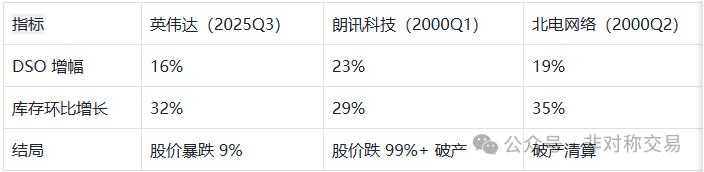
In the current quarter, NVIDIA’s revenue was $57 billion, but accounts receivable reached $33 billion. The AI system calculated the Days Sales Outstanding (DSO) to be 53.3 days, an increase of 16% compared to the historical average of 46 days.
Even more concerning is that the DSO for the previous two quarters was 48.2 and 50.7 days—the data is not only extending but deteriorating at an accelerating rate.
Extended DSO means that NVIDIA’s customers may be facing financial difficulties and are unable to make timely payments, effectively financing downstream customers through accounts receivable. This data is considered an outlier in the bottom 76% of the semiconductor industry.
For every additional day of DSO, $626 million in cash cannot be settled on time, with a cumulative delayed fund scale of up to $13.2 billion over three quarters.
Anomaly Two: Contradiction Between Inventory Growth and Declining Demand
NVIDIA’s CEO Jensen Huang and CFO Colette Kress repeatedly emphasized that the company’s products are “in short supply,” yet the inventory in the third quarter reached $19.8 billion, an increase of $4.8 billion quarter-over-quarter, a growth rate of 32%.
If there truly is a supply shortage, both raw materials and finished goods inventory should decrease, not increase.Significant inventory growth indicates a mismatch between production supply and actual demand, which contradicts the management’s description.
Anomaly Three: Spot Price Collapse Reflecting Demand
The rental price of H100 GPUs in the GPU computing market plummeted from $3.30 per hour in August to around $2.00 by November 21, a 40% drop in three months.
This indicates thatmarket supply has exceeded demand, significantly diverging from the management’s description of “supply shortage”.
03 The Ghost of Historical Cases Reappears
The AI system subsequently retrieved historical similar cases and discovered chillingly similar patterns.
Lucent Technologies—once the largest telecommunications equipment manufacturer in the U.S., also provided accounts receivable financing to operators and lent to downstream customers to repurchase its own equipment.
Lucent’s DSO extended from 52 days in Q4 1999 to 64 days in Q2 2000. At that time, management also repeatedly expressed that “equipment is in short supply,” yet inventory increased by 29% quarter-over-quarter in Q1 2000.
Just six months later, telecommunications operators could not repay their accounts receivable, forcing Lucent to write down $8.7 billion in revenue due to bad debts, with the stock price crashing from $84 to $0.55, ultimately leading to bankruptcy reorganization and a merger with Alcatel.
The same story also occurred withSun Microsystems andNortel. These two companies experienced rapid DSO extension, surging accounts receivable, and inventory piling during the 2008 financial crisis and the 2000 internet bubble, resulting in one filing for bankruptcy and the other being acquired at a low price.
NVIDIA’s current DSO, accounts receivable, and inventory situation are strikingly similar to these companies.
04 How AI Executes Trades
According to market observations, on the morning of November 20, NVIDIA’s sell orders were primarily executed in multiples of 47,000 shares. This type of trading unit, which includes both whole and fractional shares, typically only occurs in quantitative investment strategies based on target volatility and portfolio risk budgets.
These orders were executed almost simultaneously across multiple exchanges—NYSE, NASDAQ, and other regional exchanges.This cross-regional concentrated time trading has exceeded the capabilities of human traders.
Bloomberg data shows that on that morning, quantitative hedge funds and proprietary trading firms using natural language processing systems accounted for 62% of the total trading volume. Traditional long-only institutions and retail brokers only accounted for 23%. It wasn’t until after noon that human-led sell orders began to significantly increase.
The sell orders clearly exhibited characteristics of system-generated orders, with AI completing the entire process from analysis, pricing to trading.
05 Efficiency Determines Victory, Paradigm Shift Has Arrived
Over the past 200 years, human financial analysts needed several quarters to reach a consensus on a company’s potential risks, while AI only requires a moment. This dramatic drop in NVIDIA’s stock price is a microcosm of a paradigm shift in the field of financial analysis and trading:
-
Information Processing Efficiency: AI can process information more efficiently and deeply, enabling precise re-pricing.
-
End of Dominance: AI is ending the dominance of human brains in determining company value and market pricing.
The future is here, and the challenge for financial practitioners is no longer about who is smarter, but about who has stronger computing power and who can acquire and process data faster and more accurately.
How quickly do you think this “AI versus human brain” financial revolution will spread? Feel free to leave your comments for discussion!
Disclaimer: This article is for knowledge sharing only and does not constitute any investment advice. The market has risks, and investments should be made cautiously.
(Feel free to share your trading plans, insights, or confusions in the comments! Like and save to avoid getting lost in trading! 🌞)
If you find this article enlightening, please like, follow, and share it with more people in need.Follow me: Focused on macro perspective analysis, trading system building, and trading strategy sharing. The road of trading can be lonely, but together we can avoid some detours.