 Source | Motor Research Institute
Precise, efficient, and powerful, micro motors enable the flexible movement of robots
In our daily lives, from smart vacuum robots to mechanical arms in factories, the flexible movements of these machines rely on their ‘joints’—the motors. But did you know? The motors used in robot joints are not ordinary motors; they need to possess extremely high torque, precise control, and compact size. Today, let us explore the source of power for robot joints.
The ‘Invisible Muscles’ of Machines
Almost everything that moves around us hides ‘invisible muscles’—the motors! From the vibrations of an electric toothbrush to rocket launches, it is all powered by motors working silently in the background. Motors are responsible for converting electrical energy into rotational or linear movements that you can feel as ‘actions.’
A motor is essentially a device that converts electrical energy into mechanical energy, driving machines to perform various tasks through rotational or linear motion.Different types of motors have different characteristics and applicable scenarios.
Examining Motors through Household Appliances
Hair dryers commonly use brushless DC motors, which have no carbon brush friction, resulting in a longer lifespan, higher speeds, and greater airflow output.
Printers often use stepper motors, which move one step for each electrical pulse signal received, ensuring precise ink placement on paper, relying on‘counting steps’ for accurate positioning, but moving too fast can lead to‘counting errors’.
Electric toothbrushes typically usebrushed DC motors, which are powered by the friction between carbon brushes and copper plates, compact in size, and provide significant power at startup.
Smart home electric fans often useDC variable frequency motors, which can provide multiple speed adjustments and support intelligent ecological interactions.
Choosing Motors Like Ordering Bubble Tea
The selection of motors is usually linked to the application scenario, including load characteristics, power and drive methods, efficiency and energy consumption, environmental conditions, size, and cost.Here are some recommended motor selection strategies:
● Cost-effective and durable options often choose brushed motors;
● Efficient and long-lasting options often choose brushless motors;
● Precision control options often choose stepper motors;
● Quick response with precision options often choose servo motors;
The Key Supporting Role of Robot Joints
Before understanding which motors are used in robot joints, we need to recognize akey supporting role—the reducer. It is responsible for converting the high-speed rotation of the motor into the low-speed, high-torque motion required for work. Reducers are also hidden in electric toy cars and juicers.
The reducer plays a major role as a primary transmission component in automated equipment, with main functions including reducing speed and increasing torque (converting the motor’s high-speed rotation into the low-speed motion required by the equipment while amplifying torque), precise control (achieving high-precision adjustments of speed and position through high-precision gear meshing or servo motor coordination), and adjusting motion direction (changing the input and output shaft motion direction through gears, worm gears, etc.).
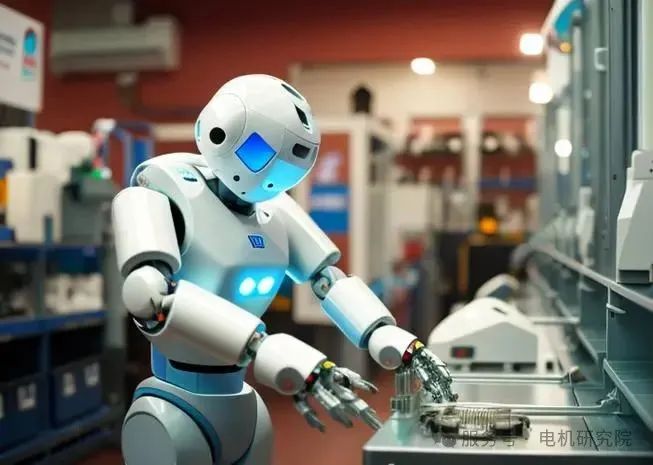
However, the motors used in robot joints are not simply about ‘turning’ or ‘blowing air’; their characteristics need to mimic human-like movements,such as quickly dodging obstacles or gently holding an egg without breaking it… A standard reducer + motor separate structure with screws can loosen and cannot withstand high-intensity twisting.
Why Special Motors are Needed?
In robot joints, considerations also include compact size, low energy loss, high efficiency… To fit into joints the size of an arm, the motor, reducer, and controller need to be packed into a‘small can’, forming a joint module.
All movements of intelligent robots are realized through micro motors, with the core components of robot power being the controller and motor. The rigid requirements for micro motors in intelligent robots are high torque, low speed, and compact size, thus requiring the use of micro reduction motors.
For industrial robot joint drive motors, requirements include maximum power-to-weight ratio and torque inertia ratio, high starting torque, low inertia, and a wide and smooth speed regulation range. Especially for robot end effectors (grippers), motors should be as small and light as possible, particularly when quick response is required; servo motors must have high reliability and stability, along with a large short-term overload capacity.
What Type of Motors are Commonly Used in Robot Joints?
Based on the above characteristics, robot joints commonly use reducers paired with high-torque servo motors, which feature high precision positioning (knowing where the robot is and reporting back to the brain), quick response (frequent start-stop), strong overload capacity (emergency stops), and low-speed stability (supporting smooth walking).
Common types of micro motors include brushless DC motors, brushed DC motors, and stepper motors.
Brushed DC motors are the most representative among micro DC motors, offering high cost-performance, smooth operation, easy speed regulation, and low cost. However, compared to other types of micro motors, they have lower efficiency and shorter lifespan, generally used in household robots such as vacuum robots, educational robots, and toy robots.
Stepper motors may face issues of large size and low torque, leading to missed steps in small robot applications, and are not used in small robot joints.
Brushless DC motors are small, lightweight, efficient, and have a long lifespan, commonly used in small intelligent robots, but they are costly and complex to control. If cost is a concern, brushed DC motors can be chosen.
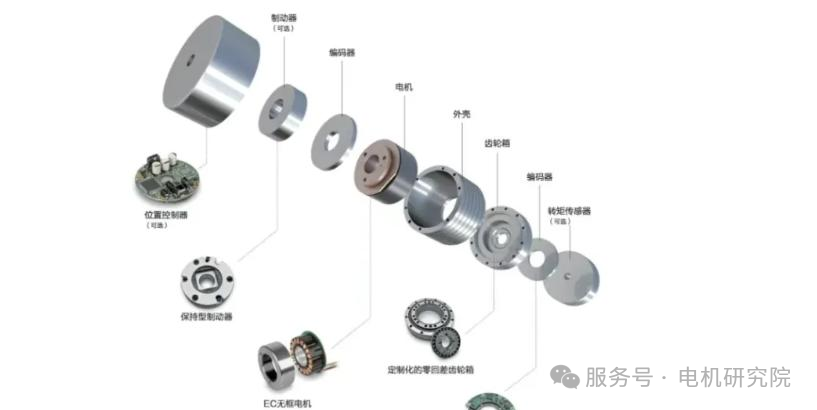
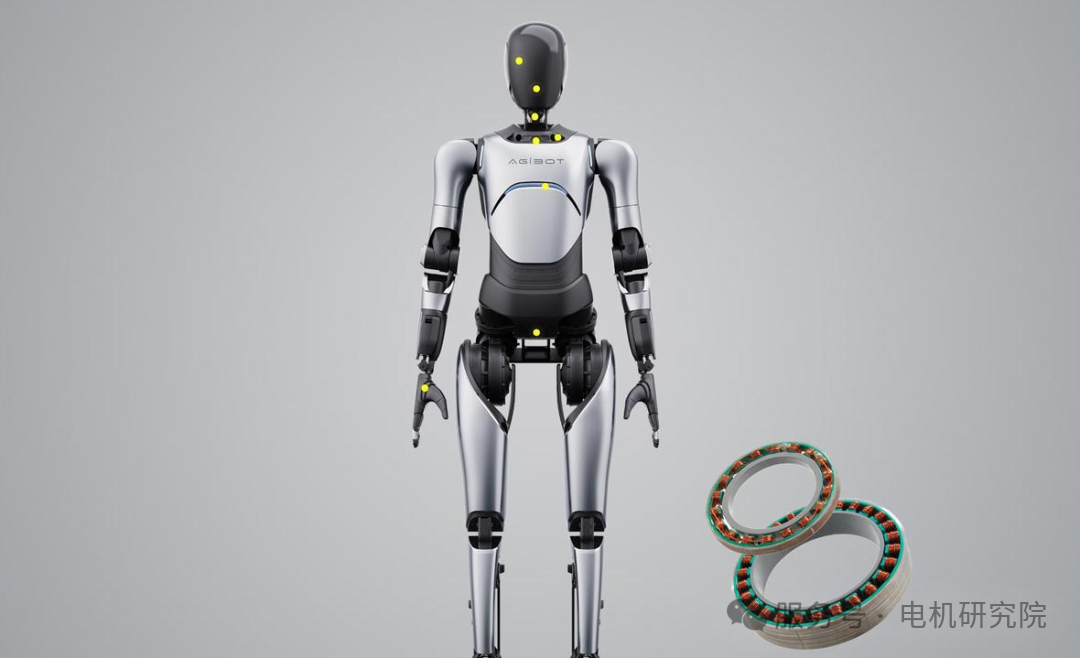
In recent years, frameless torque motors have become the mainstream solution for robot joints. They consist only of rotor and stator, without bearings or shells, allowing for direct integration into joint actuators, occupying less space.
Robot Joint Modules
Robot joint modules, also known as actuators, are responsible for driving and controlling the movements of various joints and components of robots, divided into two main categories: rotary actuators and linear actuators.
Rotary actuators consist of frameless torque motors, reducers, torque sensors, encoders, and bearings. They convert the high-speed low-torque output of the motor into low-speed high-torque motion,primarily used for shoulders, hips, wrists, and heads.
Linear actuators consist of frameless torque motors, ball screws, torque sensors, encoders, and bearings. They convert the rotational motion of the motor into telescopic linear motion,primarily used for wrists, elbows, hips, knees, and ankles.
In terms of value, actuators account for more than half of the value of humanoid robot components.
Harmonic reducers are one of the core components of rotary actuators, featuring a small size, simple structure, high reduction ratio, and high transmission accuracy. The global market is highly concentrated, with Japan’s Harmonic Drive dominating, holding about 80% of the global market share. Domestic manufacturers include Green Harmonic and Hanyu Group.
High Integration and Intelligence
With the continuous development of robot technology, the motors for robot joints are also evolving towards high integration and intelligence.
A highly integrated electric drive joint is designed by treating the motor, reducer, and driver as a single structural unit, achieving efficient use of limited space and a highly integrated joint configuration, solving traditional joint issues of low load capacity, excessive size, low precision, and unstable motion.
This highly integrated design allows electric drive joints to have compact structure, strong versatility, and rapid reconfiguration advantages.
New motor technologies, such as axial flux motors, are also being applied in robot joints, effectively utilizing the structural gaps at the center of the rotor, allowing for integrated designs of first-stage reducers and cooling blades,greatly improving integration and power density.
The Precise World of Robot Joint Motors
The selection of motors for robot joints is a comprehensive consideration of torque, speed, precision, size, cost, and reliability. From brushed motors to brushless motors, from stepper motors to servo motors, from separate designs to highly integrated joint modules, technological advancements continuously drive the improvement of robot performance.
With the application of new materials, new processes, and intelligent control algorithms, future robot joint motors will become more precise, efficient, and intelligent, providing robots with more flexible and precise movement capabilities, allowing them to replace humans in more fields to complete complex tasks.
Whether for industrial robots or service robots, the technological advancements in joint motors will open up a whole new world of automation, and we look forward to more amazing developments!
[Disclaimer] The article reflects the author’s personal views and does not represent the position of Xiji Electric Drive. If there are issues regarding the content, copyright, etc., please contact the administrator within 30 days of this article for deletion or copyright negotiation.