 Produced by Zhien Smart Chip
As Bluetooth Low Energy (LE) technology continues to develop, throughput has become an important metric for evaluating the performance of Bluetooth devices.
This article discusses the factors influencing Bluetooth LE throughput and compares the performance of two Bluetooth LE MCUs (including the author’s company and competitor N) under different environments.
By conducting a series of rigorous tests under various real-world conditions, the root causes of throughput differences are analyzed, and it demonstrates how devices can enhance performance through strategies such as optimizing connection intervals and reducing interference under different modulation schemes.
The CYW20829 performs well in terms of throughput and connection stability, especially in real-world environments, where its stronger signal reception capability and adaptive frequency hopping algorithm significantly enhance the connection quality and data transmission speed between devices.
Part 1
Technical Analysis of Bluetooth LE Throughput
● The Physical Layer and Protocol Overhead of Bluetooth LE
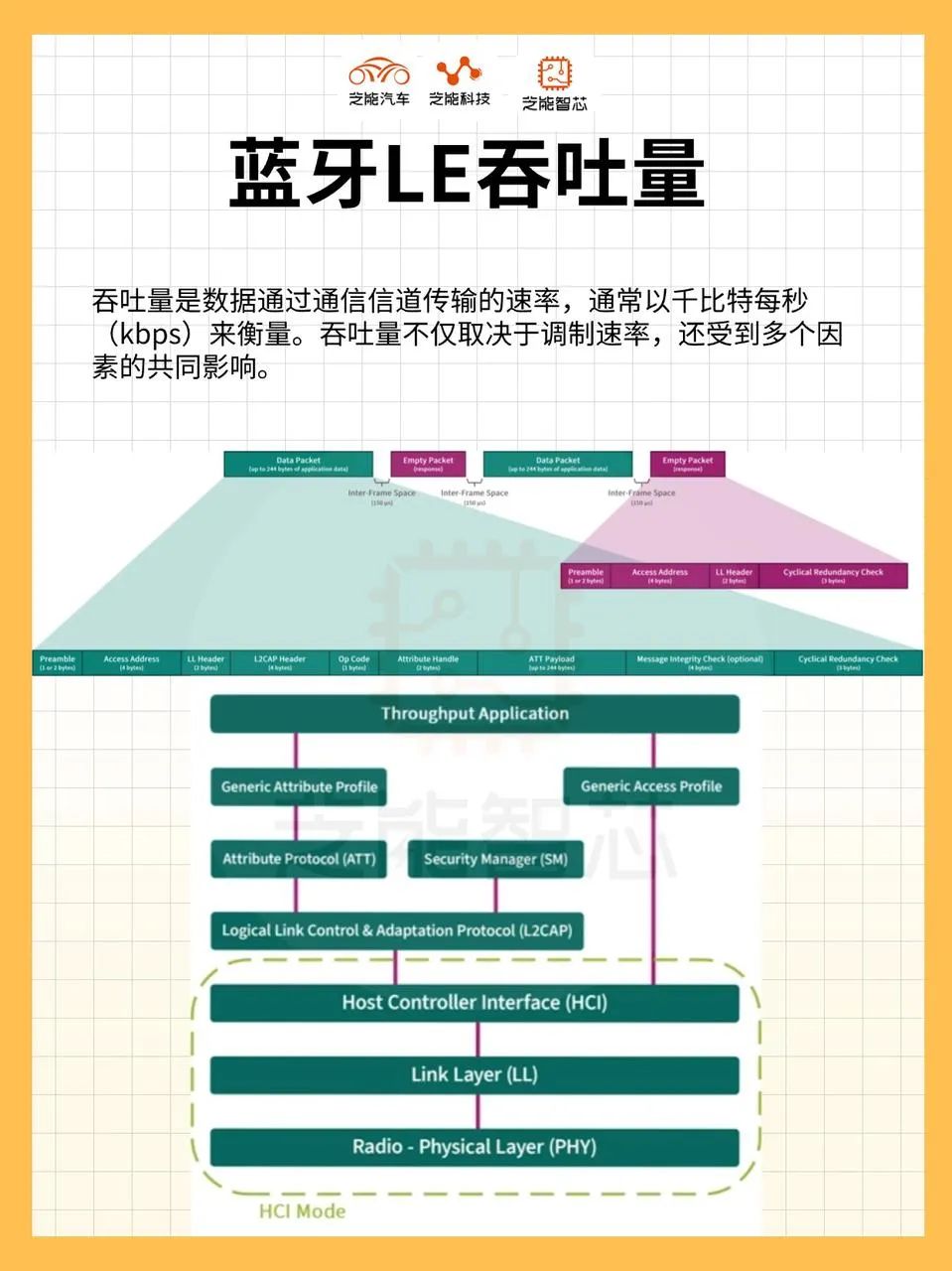
The throughput of Bluetooth Low Energy (BLE) is defined by the combined result of the physical layer (PHY) transmission rate and the protocol stack overhead.
LE 1M modulation transmits data at a rate of 1Mbps over the 2.4GHz band, while LE 2M modulation uses a wider spectrum (2.4GHz±70MHz) to support a rate of 2Mbps. The actual effective throughput must deduct the fixed overhead generated by the protocol stack:
◎ Packet header overhead: Each BLE packet contains fixed-length address fields, control information, and checksums, accounting for about 20% of the total transmission time.
◎ Inter-frame spacing: The LE protocol stipulates a quiet period of 150μs between packets, further reducing spectral efficiency.
◎ Response mechanism: Each packet requires an acknowledgment (ACK) from the receiver, and even empty packets incur at least 10 bytes of overhead.
Theoretical models show that the maximum effective throughput for LE 1M is 790kbps (approximately 80% of the physical layer bandwidth), while for LE 2M it is 1400kbps (approximately 70% bandwidth utilization), with the difference stemming from the higher modulation complexity of LE 2M leading to increased synchronization overhead.
● Key Parameters Affecting Throughput
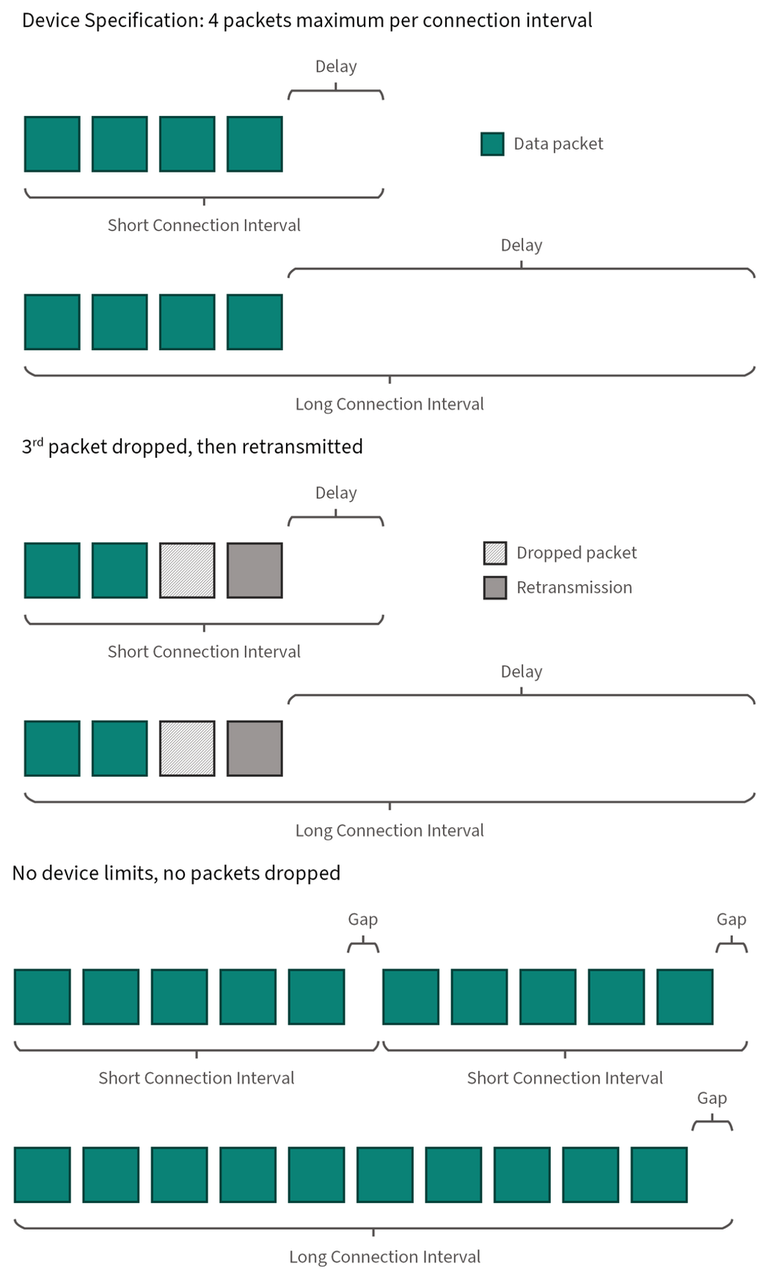
The connection interval is the duration of periodic connection events established by Bluetooth devices, directly affecting the frequency of data transmission. Assuming a single connection event can transmit n packets, the throughput can be approximated as: Throughput=Connection Intervaln×Payload Size.
◎ Short intervals (<100ms): Suitable for low-latency scenarios but vulnerable to retransmission delays after packet loss.
◎ Long intervals (>1s): Reduces the number of connections, lowering power consumption but sacrificing real-time performance.
In tests, both sides used a 400ms connection interval to balance connection stability and transmission efficiency.
LE 2M increases rate by extending bandwidth but is more susceptible to narrowband interference in densely populated device scenarios. Experiments show that within the 2.4GHz band, LE 1M exhibits better robustness than LE 2M under channel congestion.
Bluetooth LE employs adaptive frequency hopping (AFH) technology to avoid channel congestion, but its effectiveness depends on the chip’s RF design and algorithm optimization.
Receiver sensitivity (e.g., CYW20829’s -98dBm@LE 1M) directly affects weak signal capture capability, while transmission power (e.g., 10dBm vs. 8dBm) determines transmission distance and interference margin.
Part 2
Field Testing and Performance Comparison
In the actual testing of throughput, to ensure fairness in testing conditions, environmental variables were strictly controlled, and devices’ performance was repeatedly tested under various modes.
● The experimental design follows these principles:
◎ Hardware equivalence: Using the same development board, antenna, and power supply scheme, only changing the main control chip.
◎ Dynamic scene coverage: Moving the testing terminal within a 200㎡ office area to simulate a real interference environment (including microwaves, Wi-Fi routers, etc.).
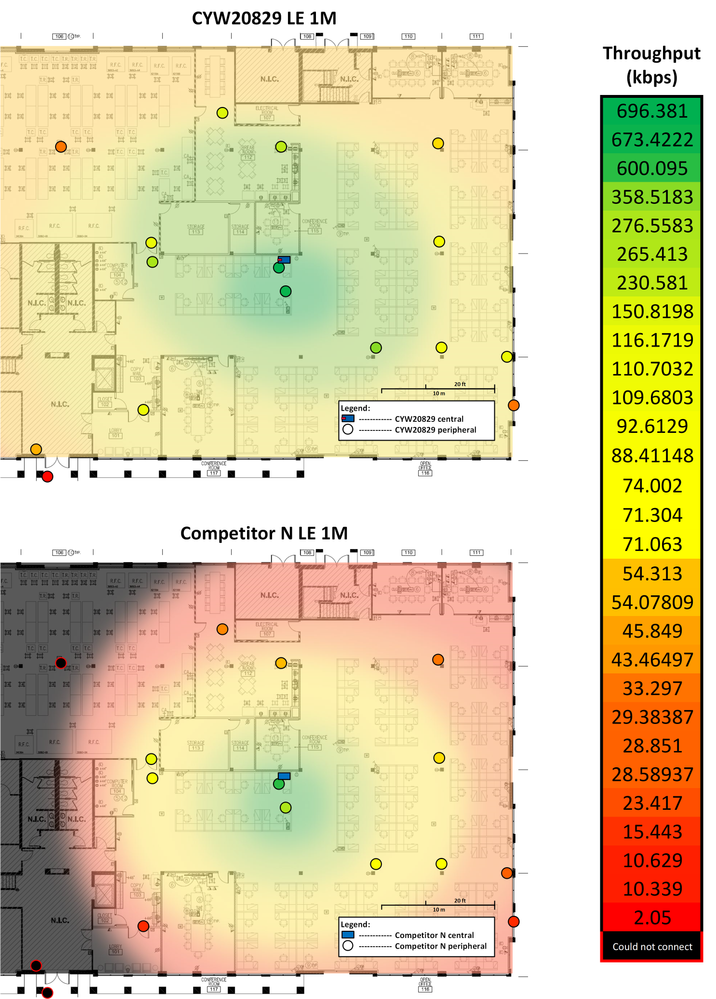
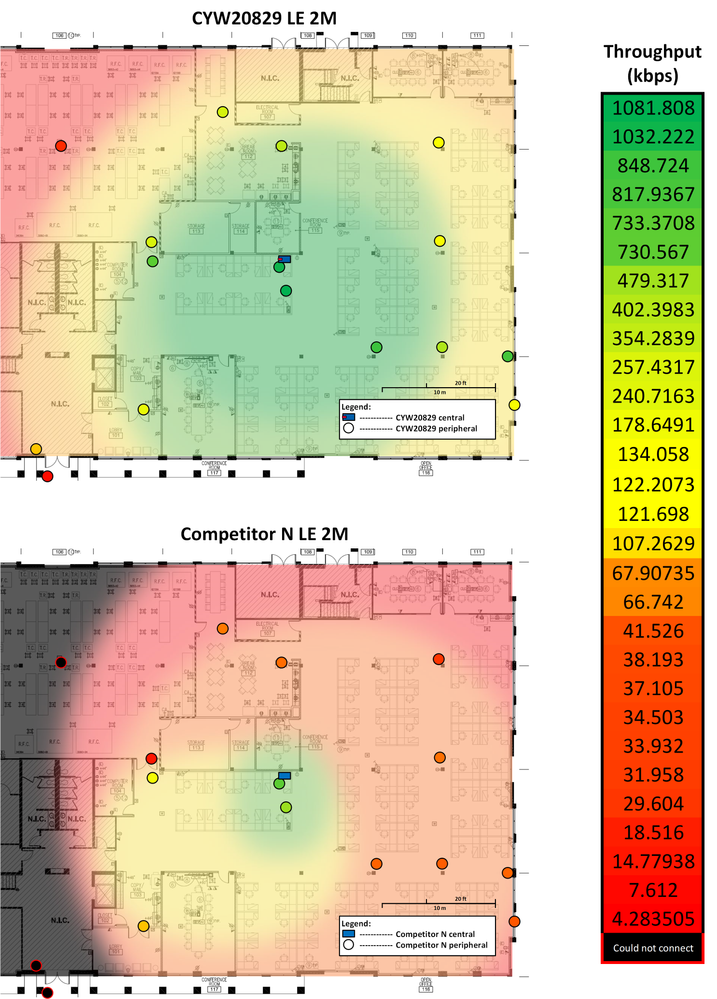
◎ Dual-device synchronous measurement: Collecting throughput heat map data from both central and peripheral devices placed side by side.
● In LE 1M mode, the maximum throughput of CYW20829 reached 696.38kbps, while competitor N was only 10.34kbps (Figure 8). The difference between the two is mainly caused by the following factors:
◎ Signal coverage range: CYW20829’s 10dBm transmission power extends its effective communication distance to about 23 meters, while competitor N frequently disconnects in the edge area due to 8dBm power.
◎ Anti-interference capability: CYW20829’s AFH algorithm dynamically skips busy channels, reducing retransmission occurrences; competitor N’s throughput drops to zero when the microwave is turned on (2.45GHz band interference).
In LE 2M mode, CYW20829 still maintains a significant advantage in throughput, but the performance degradation when far from the base station is less than that of competitor N. This is because the high rate of LE 2M relies on stricter channel quality requirements, while CYW20829’s -95dBm receiver sensitivity allows it to maintain connections under weak signal conditions.
● At a 400ms connection interval, packet loss can cause transmission to pause until the next connection event. Test data shows:
◎ CYW20829’s retransmission delay averages 28ms (due to its short connection interval), while competitor N experiences delays of up to 400ms under the same configuration.
◎ In areas where signal strength is below -90dBm, competitor N’s packet loss rate exceeds 40%, while CYW20829 controls the packet loss rate to below 10% through its high sensitivity antenna.
● CYW20829 excels in Bluetooth LE throughput performance, with technical advantages reflected in three aspects:
◎ RF design: Higher transmission power and receiver sensitivity extend the effective communication range, especially performing well in densely interfered scenarios.
◎ Protocol optimization: Efficient AFH algorithm reduces retransmissions caused by channel competition, enhancing spectral efficiency.
◎ Engineering adaptability: Supports flexible connection parameter configurations (such as short interval mode), meeting the dual demands of low latency and high throughput.
Conclusion
Throughput, as an important metric for measuring Bluetooth LE performance, is influenced not only by the hardware itself but also closely related to connection parameters and environmental factors.
In future Bluetooth LE applications, how to balance throughput and connection quality, especially in complex wireless environments, will become an important direction for optimizing Bluetooth device design.