RS232 communication, RS485 communication, TTL communication, and CAN communication are commonly used serial communication interface standards, differing in electrical characteristics, communication modes, transmission distances, transmission rates, and application scenarios.
-
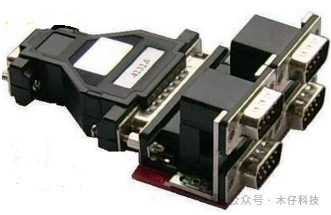
RS232 Communication:
•RS232 is one of the earliest serial communication standards, established by EIA (Electronic Industries Alliance), primarily used for point-to-point communication between early computers and peripheral devices.
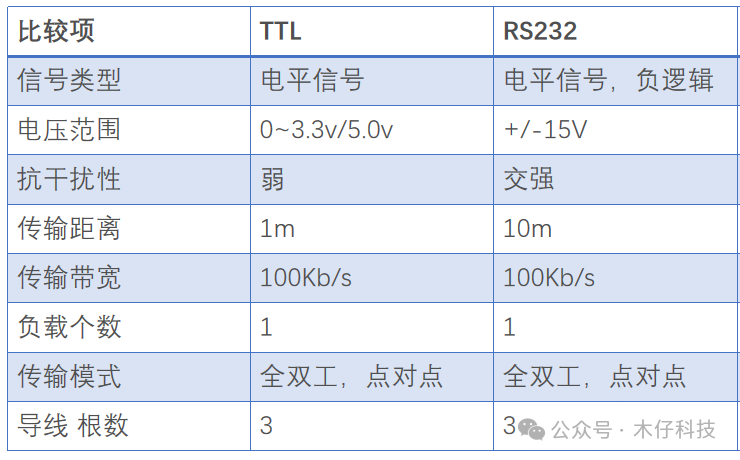
•Electrical Characteristics: RS232 uses unbalanced transmission, with signal levels ranging from ±5V to ±15V; logic “1” corresponds to a negative voltage (typically -3V to -15V), and logic “0” corresponds to a positive voltage (typically +3V to +15V).
•Communication Mode: Supports point-to-point communication, with a pair of cables typically used for full-duplex communication (independent sending and receiving).
•Transmission Distance: Theoretically, the transmission distance is limited, generally not exceeding 50 meters; amplifiers are often used in practical applications to extend this distance.
•Application Scenarios: Early computer serial connections to printers, modems, and other devices; now less used in new designs, but still applicable in some older devices and specific scenarios.
2. RS485 Communication:
•The RS485 standard is jointly established by EIA/TIA, based on differential signal transmission, supporting multipoint, long-distance communication.
•Electrical Characteristics: Uses balanced transmission, with signal levels of +2V to +6V for logic “1” and -2V to -6V for logic “0”, offering stronger anti-interference capabilities.
•Communication Mode: Supports multipoint interconnection, allowing up to 32 devices to connect for network communication, with half-duplex or full-duplex modes available.
•Transmission Distance: Theoretically, the maximum transmission distance exceeds 1200 meters, depending on specific environments and cable quality, suitable for establishing large industrial networks.
•Application Scenarios: Widely used in industrial automation, building automation, security monitoring, etc., particularly suitable for scenarios requiring long-distance transmission and multiple devices networking.
3. TTL Communication (Transistor-Transistor Logic):
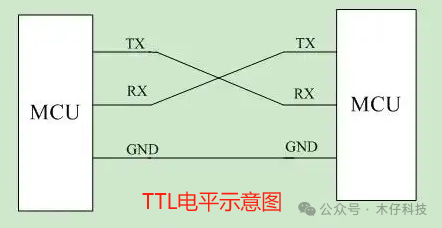
•TTL is not a communication standard but refers to a logic level standard, typically used for short-distance communication within integrated circuits or between integrated circuits.
•Electrical Characteristics: TTL level signals are typically defined as logic “1” being about +5V (typical value) and logic “0” being close to 0V, with relatively small signal amplitudes.
•Communication Mode: TTL levels are primarily used for chip-level interfaces, such as UART, SPI, I²C, etc.
•Transmission Distance: Due to rapid signal attenuation, TTL level signals are not suitable for long-distance transmission, generally within a range of a few centimeters to a few meters.
•Application Scenarios: TTL levels are very common in internal communication within embedded systems and between integrated circuits on computer motherboards.
4. CAN Communication (Controller Area Network):
•CAN is a vehicle network communication protocol introduced by Bosch in the 1980s, widely used in automotive and industrial control fields.
•Electrical Characteristics: CAN also uses differential signal transmission, with a voltage difference of about 2V between the two wires (CAN_H and CAN_L) in the logic “dominant” (logic “1”) state, and nearly 0V in the logic “recessive” (logic “0”) state.
•Communication Mode: Supports a multi-master/slave structure for multipoint communication, employing an arbitration mechanism to handle bus conflicts, supporting both high-speed (CAN High Speed) and low-speed (CAN Low Speed) modes.
•Transmission Distance: Under proper wiring conditions, the CAN bus transmission distance can reach 10 kilometers (high-speed CAN) or several kilometers (low-speed CAN).
•Application Scenarios: Mainly used in vehicle electronic systems, industrial automation control systems, building automation, and other scenarios requiring multiple nodes to share information.
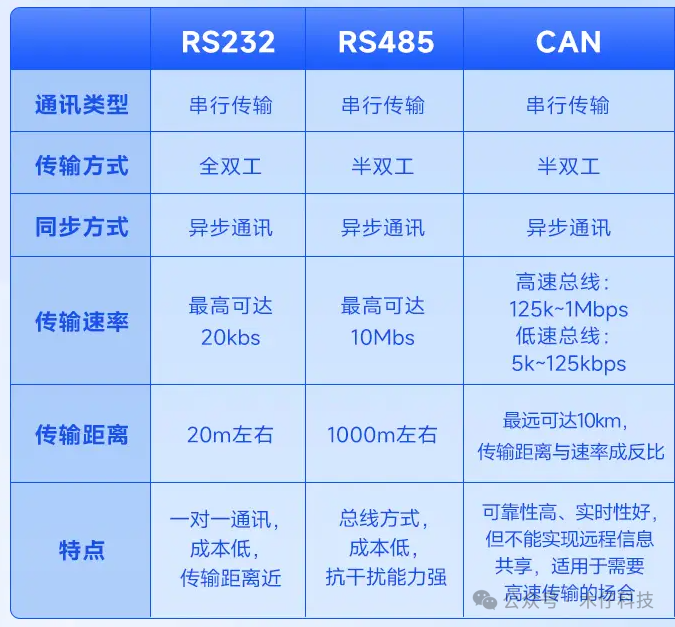
In summary, RS232 and RS485 are more about physical layer and link layer communication standards, while TTL levels are a common logic level standard for internal communication in integrated circuits, and CAN is a complete network communication protocol stack that includes concepts of physical layer, data link layer, and application layer. In practical applications, these communication methods are often used in combination; for example, in system design, TTL levels may be used internally within integrated circuits, and then RS232, RS485, or CAN bus may be used to communicate with other devices.