
Abstract
To clarify the source of metallogenic materials and the mineralization mechanism (focusing on late-stage antimony mineralization) of the Zhaxikang polymetallic deposit in southern Tibet, the study employed methods such as laser analysis of trace elements in stibnite, in-situ testing of sulfur-lead isotopes, and principal component statistical analysis. The research found that stibnite exhibits elemental solid solution and specific coupled substitution patterns. Sulfur mainly originates from the leaching of sedimentary rocks, while metals come from the Precambrian metamorphic basement and Mesozoic sedimentary rocks. Moreover, the sources of early lead-zinc and late-stage antimony mineralization materials are similar and are related to contemporaneous granitic magmatic activity. By utilizing principal component analysis of trace element data from stibnite, it is confirmed that it can serve as an indicator to determine the type of metal assemblage in antimony ore districts (single antimony or polymetallic), providing guidance for mineral exploration.
Written by|Wang Lijuan
Edited by|Li Juan
Citation|Jinchao Wu, Degao Zhai, Zhi Zhang et al. Genesis of the Zhaxikang Pb-Zn-Sb-Ag-Au deposit, southern Tibet: insights from stibnite trace elements and S-Pb isotopes[J]. MINERALIUM DEPOSITA, 2025.
Note|Click the “mini program code” at the end of the article to access the original materials
→This is the 188th article of “Mineral Research Prospects”
01
Full Interpretation
In the youngest continental collision tectonic belt on Earth—the Himalayan orogenic belt, the North Himalayan Metallogenic Belt (NHMB) is like a natural “mineral treasure trove,” nurturing diverse mineral resources such as lead, zinc, antimony, silver, and gold. Among them, the Zhaxikang Pb-Zn-Sb-Ag-Au deposit located in southern Tibet, with its astonishing reserves (proven lead-zinc of 2.07 million tons, antimony of 240,000 tons, silver of 2,660 tons, etc.), has become the “star deposit” of this metallogenic belt. However, for a long time, the metallogenic mystery of this “treasure trove” has remained a key knowledge gap: how do elements “occupy positions” (substitution mechanisms) in stibnite during the late-stage antimony mineralization process? Where do the metals actually come from? A recent study systematically addresses these issues for the first time, providing key clues for understanding the complex metallogenic laws of orogenic belts and guiding mineral exploration.
The Zhaxikang deposit has undergone two stages of mineralization: “early lead-zinc and late-stage antimony.” Stibnite is the core ore mineral of late-stage antimony mineralization. However, past studies on the “occurrence forms” of elements in stibnite (which elements substitute for antimony or sulfur, and in what manner) have been very limited, with existing reports on substitution mechanisms confined to a few cases. At the same time, the source of metals in antimony mineralization has always been a mystery: some scholars believe that metals come from basic rocks of the Early Cretaceous, while others point to contemporaneous acidic magmas, and some advocate that it is a mixed product of sedimentary and igneous rocks. The lack of key empirical evidence has led to ongoing disputes among various viewpoints.
More critically, stibnite, as a widely distributed sulfide in hydrothermal metallogenic systems, could serve as a “natural indicator” for interpreting the metallogenic process—its trace elements can record information about the source of metals, temperature, pressure, etc., during mineralization. However, due to the scarcity of trace element data for stibnite, related studies have had to rely on simple binary discrimination diagrams (such as arsenic-mercury relationship diagrams), making it difficult to uncover the deeper connections behind the data. These knowledge gaps not only leave the metallogenic “story” of Zhaxikang incomplete but also limit the potential for using stibnite to guide mineral exploration.
To unravel the mystery, the research team focused on the mining area of Zhaxikang at an altitude of 4,800 meters, systematically collecting over 20 fresh, unoxidized stibnite samples (to ensure that the analytical data is not affected by later alteration), and then initiated “multidimensional detection”:
- Laser ablation-inductively coupled plasma mass spectrometry (LA-ICP-MS): high-precision determination of over 20 trace elements in stibnite (including magnesium, aluminum, sulfur, copper, zinc, etc.), analyzing the “concentration code” of elements;
- In-situ sulfur and lead isotope analysis: using laser ablation-multi-collector inductively coupled plasma mass spectrometry (MC-ICP-MS), directly determining the isotopic composition in the “micron-level” regions of minerals, tracing the “material origin” of sulfur and lead (determining whether they originate from sedimentary rocks, igneous rocks, or metamorphic rocks);
- Principal component analysis (PCA): performing “dimensionality reduction” on high-dimensional trace element data to uncover hidden correlations between elements and assess the potential of stibnite as a “mineral exploration indicator.”
Trace element analysis shows that Zhaxikang stibnite is generally enriched in copper, arsenic, and lead, but poor in cobalt, nickel, and tellurium, with most elements existing in the form of “solid solutions” (atomically embedded in the stibnite crystal). More importantly, the team has clarified two types of coupled substitution mechanisms for the first time:
– Mechanism 1:
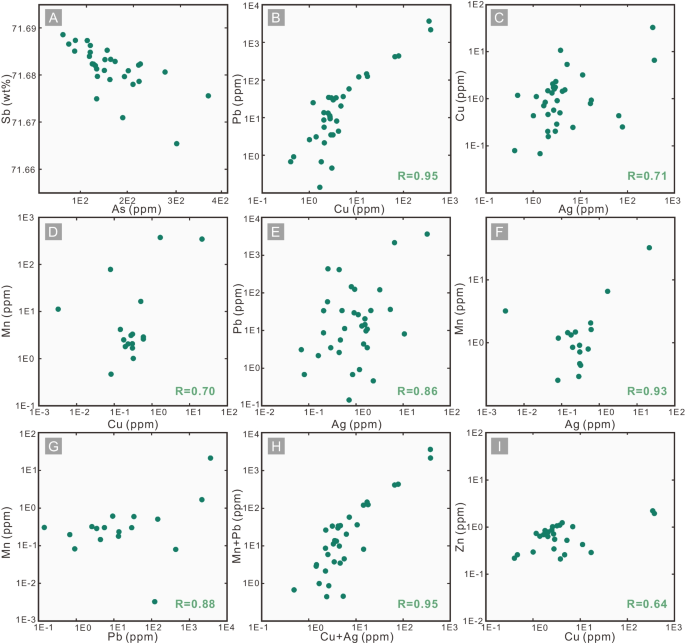
(Cu+ + Ag+) + (Mn2+ + Pb2+) <=> 2Sb3+ + 2□ (“□” represents crystal vacancies) — one-valent copper and silver team up with two-valent manganese and lead to replace two trivalent antimony while generating crystal vacancies;
– Mechanism 2: Cu+ + Zn2+ <=> Sb3+ + □ — one-valent copper and two-valent zinc jointly replace one trivalent antimony and form vacancies.
These mechanisms elucidate the “stable existence modes of trace elements in stibnite,” filling the gap in the crystallographic chemistry research of stibnite and providing theoretical support for subsequent reverse inference of metallogenic conditions through trace elements in stibnite.
Sulfur isotope data (δ34S = 4.2 – 6.2‰, average 5.7‰) release a clear signal: sulfur mainly originates from sedimentary rocks — the metallogenic fluid leached sulfur from the “Lidang Formation” slate and limestone in the mining area, extracting it to the deposit.
Lead isotope data (^{206}Pb/^{204}Pb = 19.55 – 19.83, etc.) reveal a “dual source” of metals: Precambrian metamorphic basement rocks and Mesozoic sedimentary rocks jointly provide a large amount of metal for antimony mineralization. Combined with previous studies on lead-zinc mineralization, the team further confirms that early lead-zinc and late-stage antimony mineralization share the metal supply source of “sedimentary rocks + basement rocks”, only forming lead-zinc and antimony mineralization in different tectonic contexts of “compression-extension” linked to contemporaneous acidic magmatic events.
This conclusion ends the long-standing debate over the “source of metals” — metals are neither solely contributed by basic rocks or acidic magmas, nor are they simply mixed products, but rather a “dual supply” from sedimentary rocks and basement rocks, providing a key anchor point for understanding the material cycle of multi-stage mineralization in the Himalayan orogenic belt.
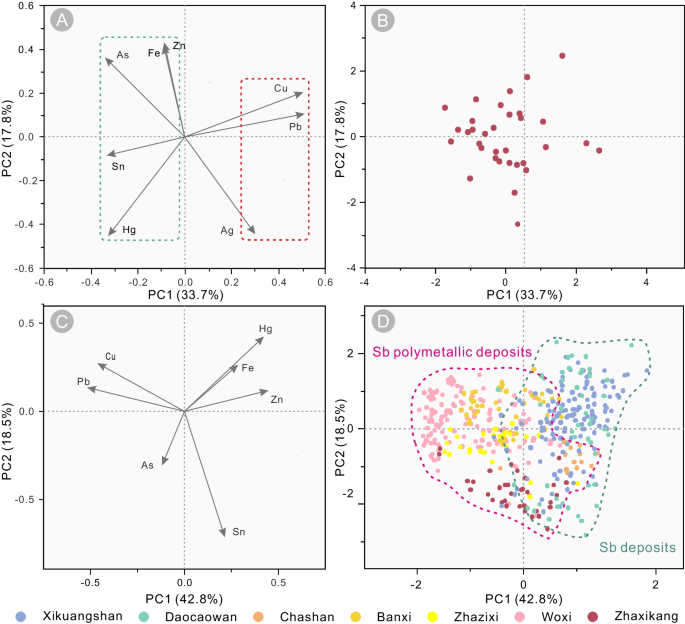
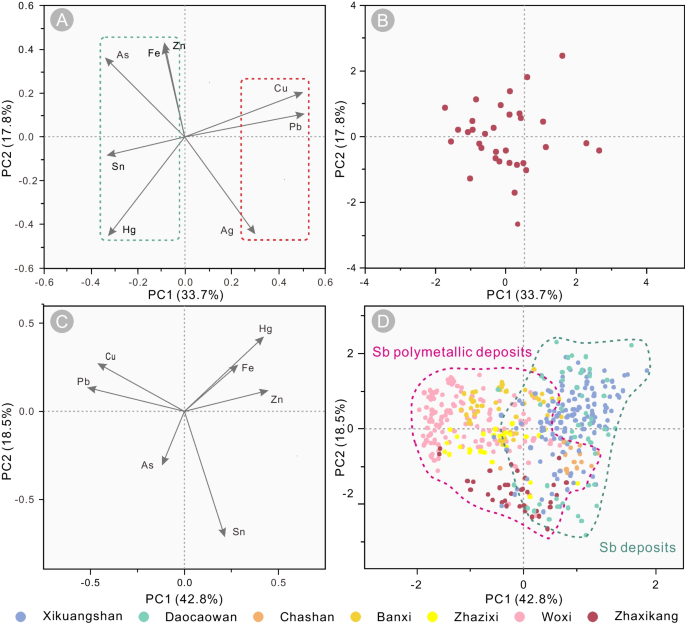
The application of principal component analysis (PCA) makes the “exploration value” of stibnite increasingly clear: by analyzing the characteristics of trace element combinations, it can predict whether the antimony ore district is associated with other metals (such as lead, zinc, silver). In simple terms, the trace element “fingerprint” of stibnite can distinguish between “single antimony ore” and “polymetallic antimony ore.” This means that in future explorations, analyzing the trace elements of stibnite alone can quickly assess the resource potential of the mining area — stibnite upgrades from a “mineral product” to a “mineral exploration vanguard.”
For geological researchers, it fills the research gap regarding the behavior of elements in stibnite and the source of metals in Zhaxikang, reconstructing the “material-structure” model of polymetallic mineralization in the Himalayan orogenic belt; for mineral explorers, it provides a practical tool for “using trace elements in stibnite to find polymetallic ores,” shifting exploration from “experience-driven” to “data-driven”; for the general reader, it demonstrates how “microscopic mineral analysis can solve macro metallogenic puzzles” — the small stibnite hides the secrets of billions of years of evolution in the orogenic belt and contains key clues for future resource exploration.
From laboratory laser ablation technology to the mining area deep in the Himalayas, this research transforms “abstract metallogenic theories” into “practical mineral exploration methods,” adding a crucial chapter to the metallogenic narrative of the Himalayan orogenic belt. Whether you want to understand the material cycle deep within the Earth or focus on the cutting-edge directions of resource exploration, this paper offers a cognitive leap from “micro to macro.”
02
Table of Contents
1IntroductionPART ONE
- Detailed introduction to the background of the article
2Regional geologyPART TWO
- Introduction to the geology of the metallogenic belt in the region
3Deposit geologyPART THREE
- Analysis of the characteristics and geology of the ore body
4Samples and analytical methodsPART FOUR
- Explanation of sample collection and analysis methods
5ResultsPART FIVE
- Presentation of the analytical results of the deposit study
6DiscussionPART SIX
- Discussion of the mechanisms and associations of deposit mineralization
7ConclusionsPART SEVEN
- Summary of the full content of the article
03
HIGHLIGHT Images
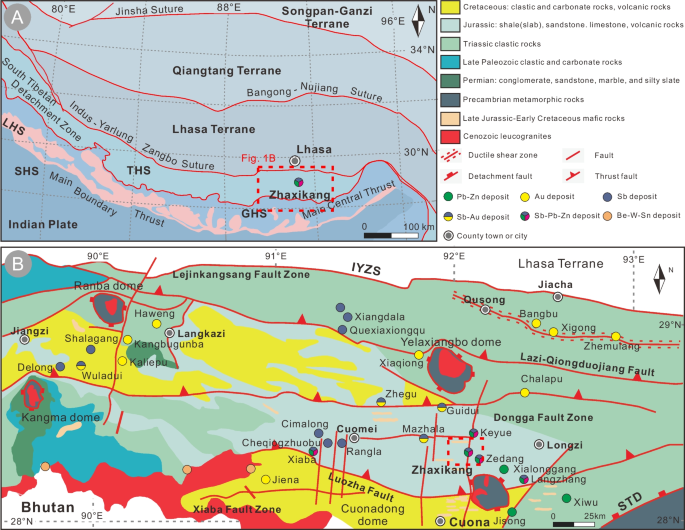
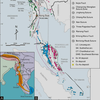
The regional geology of the Zhaxikang Pb-Zn-Sb-Ag-Au deposit in southern Tibet. A Tectonic subdivisions of the Tibetan Plateau (modified from Hou et al. 2023; Zhu et al. 2023). B A geological map of the eastern Himalaya showing the locations of major ore deposits (modified from Sun et al. 2018; Lan et al. 2023)
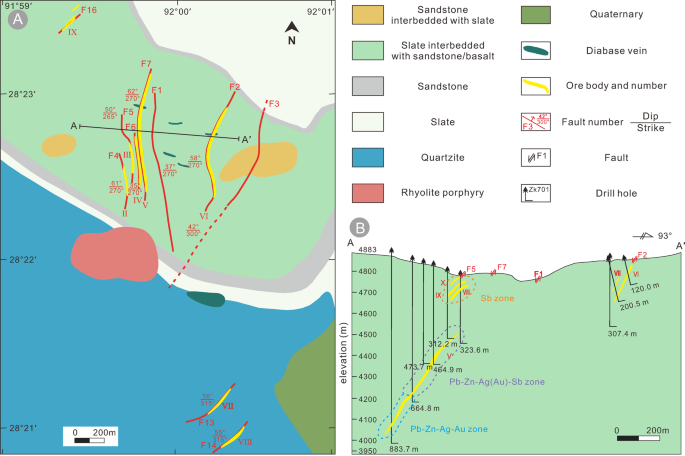
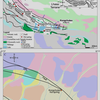
A A geological map of the Zhaxikang deposit (modified from Sun et al. 2018; Li et al. 2020). B Representative cross-sections showing the Zhaxikang ore bodies (modified from Wang et al. 2017, 2022; Sun et al. 2024)
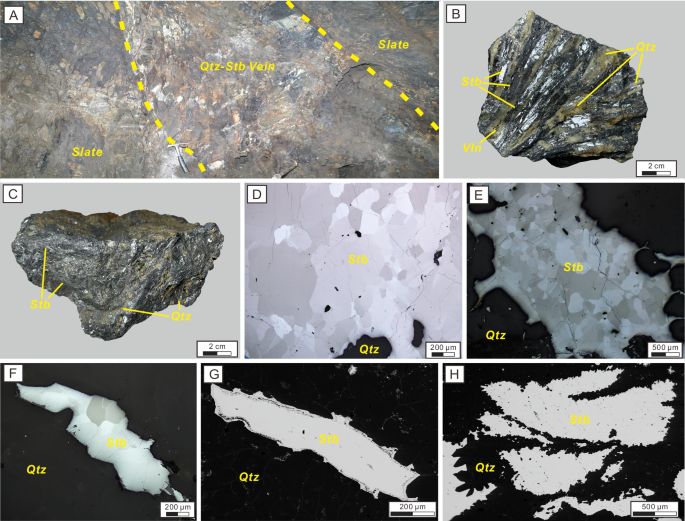
Field and hand specimen photographs, photomicrographs, and BSE images showing the characteristics of Sb ores from the Zhaxikang deposit. A Qtz-Stb vein within slate. B Hand specimen of radial stibnite in the Qtz-Stb vein. C Hand specimen of massive Qtz-Stb ore. D-F Reflected light microphotographs of typical stibnite. G-H BSE images showing the occurrence of stibnite and euhedral quartz with a jigsaw texture. Abbreviations: Qtz-quartz, Stb-stibnite, Vln-valentinite
Summary of the paragenetic sequence of the Zhaxikang Pb-Zn-Sb-Ag-Au mineralization
Correlation plots of trace elements in stibnite. A As vs. Sb, B Cu vs. Pb, C Ag vs. Cu, D Cu vs. Mn, E Ag vs. Pb, F Ag vs. Mn, G Pb vs. Mn, H (Cu + Ag) vs. (Mn + Pb), I Cu vs. Zn. Note: R = correlation coefficient
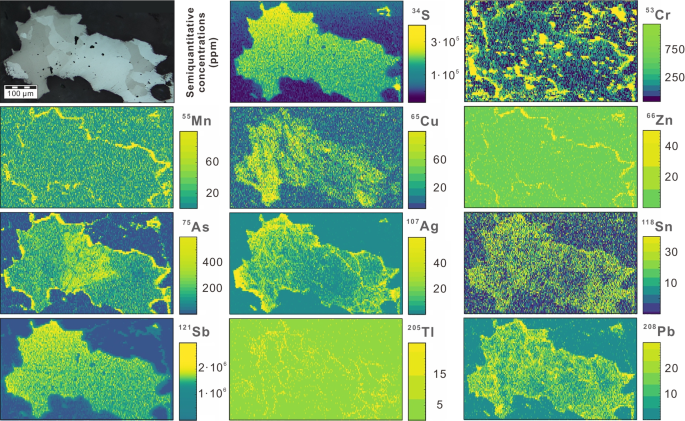
LA-ICP-MS element maps of the representative stibnite grain A
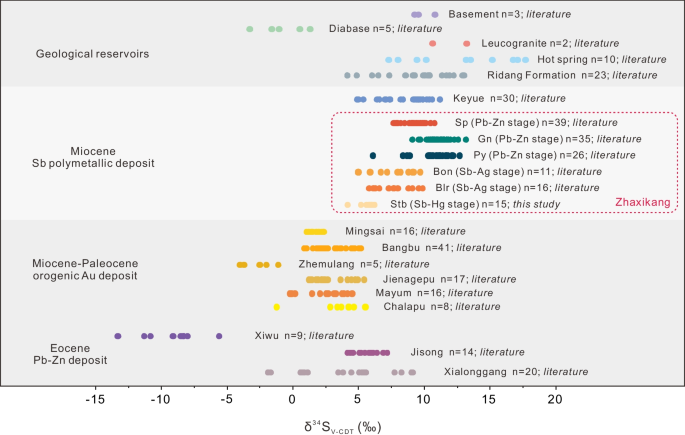
Sulfur isotope compositions of the Zhaxikang sulfides. A Histogram of sulfur isotopic compositions for sulfides from the Zhaxikang deposit. B Comparison of sulfur isotope compositions of the Zhaxikang sulfides with other representative deposits in southern Tibet. Published data and literature are listed in Table S5. Abbreviations: Bon-bournonite; Blr-boulangerite; Gn-galena; Py-pyrite; Sp-sphalerite; Stb-stibnite
Comparisons of lead isotope compositions of sulfides from the Zhaxikang Pb-Zn-Sb-Ag-Au deposit, local Precambrian basement, Mesozoic sedimentary rocks, Eocene leucogranites, and Mesozoic mafic rocks. A 206Pb/204Pb vs. 207Pb/204Pb plot; B 206Pb/204Pb vs. 208Pb/.204Pb plot. The lead isotope curves for the mantle, orogen, and crust were obtained from Zartman and Doe (1981). Published data and literature are listed in Table S6
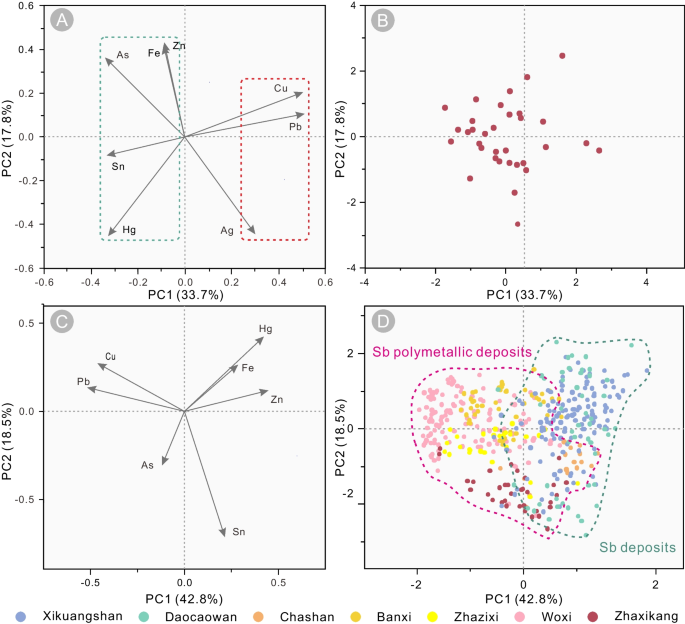
Principal components analysis (PCA) of the stibnite compositions. A The log-transformed stibnite data of the Zhaxikang deposit in PC1 vs. PC2 plane. B PCA loading plot for element vectors (as variables) of stibnite from the Zhaxikang deposit in the corresponding plane. C The log-transformed published stibnite data in PC1 vs. PC2 plane. Dashed outlines in (A) highlight element clusters. Published data and literature are listed in Table S4. D PCA loading plot for element vectors (as variables) of published stibnite data from other deposits in the corresponding plane. Dashed outlines in A highlight element clusters
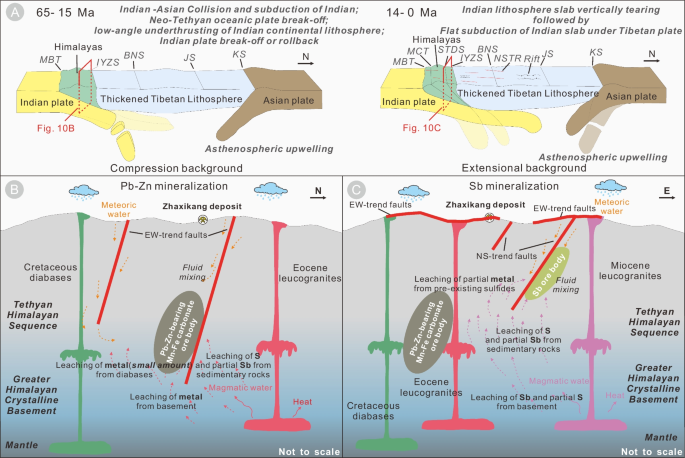
Schematic diagram for the genesis of the Zhaxikang Pb-Zn-Sb-Ag-Au deposit. A Cenozoic tectonic evolution model for the Himalayan region; B Schematic representation of the early Pb-Zn mineralization at Zhaxikang; C Schematic representation for the late Sb mineralization at Zhaxikang
Disclaimer: This article is for academic exchange and dissemination only
ENDClick the QR code below to join the industry group of thousands

 Click the mini program code below to access the original materials

Previous Recommendations
The mystery of the genesis of sphalerite? Analysis of mineral zoning controlled by ancient groundwater levels
Citation: Zhuang et al. Nonsulfide Zn–Pb mineralization and vertical zoning in the world-class Angouran deposit, NW Iran: linked to water table-controlled supergene processes[J]. MINERALIUM DEPOSITA, (1432-1866).
Click to read
Is there a relationship between porphyry-hydrothermal deposits? Chronological constraints of the Bangpu polymetallic system
Citation: Zuo et al. Geology and geochronology of the Bangpu porphyry‒skarn‒epithermal Mo‒Cu‒Zn‒Pb‒Ag deposit in the Gangdese metallogenic belt, Tibet[J]. MINERALIUM DEPOSITA, (1432-1866).
Click to read
How do magmatic-hydrothermal fluids drive tin precipitation? Boron isotope tracing of the fluid mixing mechanism in deposits
Citation: Yang et al. Constraints of in-situ elemental and B isotopic compositions of tourmaline on the origin of the Nong Sua Sn deposit, Thailand[J]. MINERALIUM DEPOSITA, (1432-1866).
Click to read
How does helium exploration in China break the resource bottleneck? Enrichment patterns and favorable area predictions
Citation: Xiong et al. Current Status of Helium Resource Research and Prediction of Favorable Areas for Helium Reservoir in China[J]. ENERGIES, 2024, 17 1530.
Click to read
Why is helium enriched in subduction zones? Analysis of the genesis of the helium belt along the 1,200-kilometer Tibetan Plateau
Citation: Yinleihao et al. Discovery and genesis of helium-rich geothermal fluids along the India–Asia continental convergent margin[J]. GEOCHIMICA ET COSMOCHIMICA ACTA, 2023, 360.
Click to read
How do helium-rich geothermal fields form? Cretaceous granite genesis mechanisms and exploration markers
Citation: Li et al. Multi-isotopes (H, O, Sr, and Li) and element geochemistry constrain the formation of Kongchutso helium-rich geothermal field in western Tibet, China[J]. GEOTHERMICS, 2024, 120.
Click to read
How has geothermal gas research evolved? A bibliometric analysis of fifty years reveals the path
Citation: Wang et al. Progress in geothermal gas research in the last 50 years: a bibliometric review[J]. EARTH SCIENCE INFORMATICS, 2025, 18.
Click to read
How is natural hydrogen stored underground? Decoding the fracture density of mafic rocks in the Maribraque field
Citation: Maiga et al. Trapping processes of large volumes of natural hydrogen in the subsurface: The emblematic case of the Bourakebougou H2 field in Mali[J]. INTERNATIONAL JOURNAL OF HYDROGEN ENERGY, 2024,50.
Click to read
How is natural hydrogen explored in the Liaoning Basin? Pore structure dominates the hydrogen absorption mechanism
Citation: Wang et al. The occurrence pattern of natural hydrogen in the Songliao Basin, P.R. China: Insights on natural hydrogen exploration[J]. INTERNATIONAL JOURNAL OF HYDROGEN ENERGY, 2024,.
Click to read
What are the opportunities and challenges in deep hydrogeological research?
Click to read
What is the contribution of magmatic activity to hydrothermal deposit formation?
Click to read
Research on the three-dimensional geothermal geological model method in the Xiong’an New Area
Click to read
Geothermal geological conditions and resource formation factors in the South China Sea Basin
Click to read
Geochemical characteristics, accumulation patterns, and prospects of helium
Click to read
Recharge and circulation of geothermal water sources on the southeast slope of Taihang Mountain
Click to read
Deep electromagnetic sounding reveals the characteristics of thermal reservoirs in the central Hebei depression
Click to read