Understanding Semiconductor Product Classification

Classification of Semiconductor Products

Understanding Semiconductor Product Classification
Semiconductors have conductivity properties that lie between conductors and insulators. Although semiconductors were recognized by academia only in the 1930s, with the rapid advancements in science and technology, they are now closely related to our lives, such as in computers, mobile phones, lighting, refrigerators, air conditioners, and power converters, all of which have core components closely associated with semiconductors. Today, we will discuss how semiconductor products are classified.
Understanding Semiconductor Product Classification

01

According to International Semiconductor Product Standards
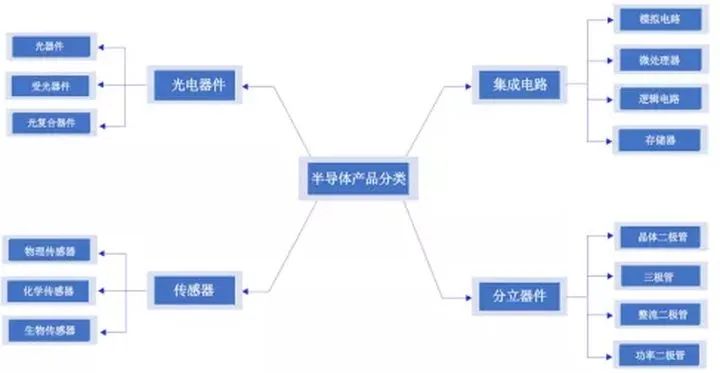
Semiconductors can be categorized into four types: integrated circuits, discrete devices, sensors, and optoelectronic devices, collectively referred to as semiconductor components. Among them, integrated circuits have long accounted for over 80% of the total sales of semiconductors, making them the core of the semiconductor industry and the largest consumer sector within it.

Understanding Semiconductor Product Classification

02

According to Signal Processing Classification
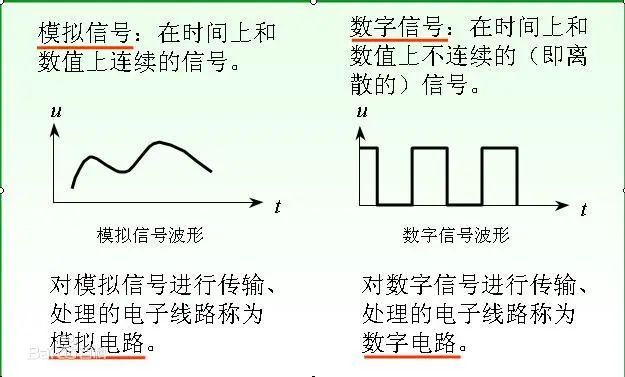
Semiconductors can also be divided into analog chips and digital chips. As the names imply, chips that process analog signals are called analog chips, while those that process digital signals are called digital chips.
Understanding Semiconductor Product Classification
Analog Chips come in various types, commonly including integrated operational amplifiers, digital-to-analog converters, multipliers, integrated voltage regulators, timers, signal generators, comparators, etc. Each product type can have different series based on customer performance requirements.
Digital Chips are the most widely used and rapidly developing type of IC in recent years, which can be divided into general-purpose digital ICs and application-specific digital ICs. General-purpose ICs refer to those with a large user base, widely used, and standard circuits, such as memory (DRAM, Flash, etc.), micro components (microprocessor MPU, microcontroller MCU, digital signal processor DSP, etc.), and logic circuits (gate arrays, display drivers, etc.), reflecting the current state and level of digital ICs. Application-specific ICs (ASIC) are circuits designed for specific users and purposes.

03

According to Manufacturing Process Classification
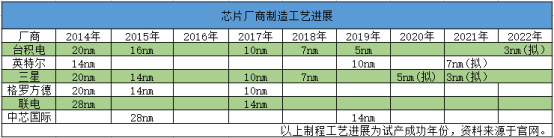
This classification is the most common. At major smartphone launches, phones are described as having 14nm chips, 7nm chips, etc. The 7nm and 14nm refer to the minimum line width of the transistor gate inside the chip (referred to as gate width). Based on the current development of manufacturing processes, it is generally distinguished by 28nm as the threshold between advanced and traditional processes, with processes smaller than 28nm referred to as advanced processes. The more advanced the manufacturing process, the higher the chip’s performance, but the manufacturing cost is also higher. Typically, the design and development investment for a 28nm chip is about 100-200 million yuan, while for a 14nm chip, it is about 200-300 million yuan, with a development cycle of about 1-2 years. Currently, the development of manufacturing processes is approaching its limits; considering the balance between cost and performance, a more advanced process is not always better; rather, it’s better to choose the appropriate one.

Understanding Semiconductor Product Classification

04

According to Functional Classification
This classification is the most commonly used method for classifying semiconductor components.
● Computational Function: These chips are mainly used for computational analysis, similar to the human brain, and are divided into main control chips and auxiliary chips. Main control chips include CPU, SoC, FPGA, MCU, while auxiliary chips include GPU for graphics and image processing and AI chips for artificial intelligence computation.
● Data Storage Function: DRAM, SDRAM, ROM, NAND, etc., are primarily used for data storage.
● Sensing Function: Mainly for sensors, such as MEMS, fingerprint chips, CIS, etc., which are primarily used to sense the external world.
● Transmission Function: Bluetooth, WIFI, NB-IOT, broadband, USB interfaces, Ethernet interfaces, HDMI interfaces, drive control, etc., used for data transmission.
● Energy Supply Function: Power chips, DC-AC, LDO, etc., used for energy supply.
Understanding Semiconductor Product Classification

05

According to Design Method Classification

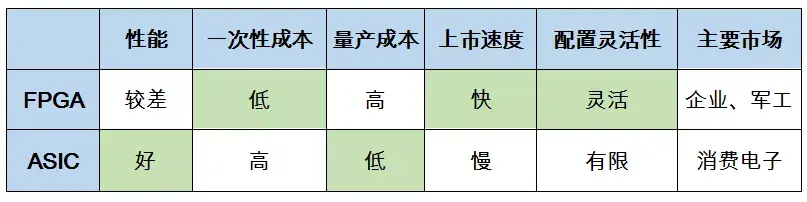
Today, semiconductor design has two major camps: FPGA and ASIC. FPGA development came first and is still the mainstream application; it is a general-purpose programmable logic chip that can be DIY programmed to implement various digital circuits; ASIC refers to the application-specific digital chips mentioned above, where the digital circuit is designed, and the produced chip cannot be modified. The former is characterized by the ability to reconfigure the chip’s functionality, offering strong flexibility; the latter has strong specificity, usually custom-developed for a particular application. FPGA excels in market release speed, one-time testing costs, and configurability; while ASIC far surpasses FPGA in computational performance and mass production costs. However, ASIC is a fixed circuit, and if the design is updated, the new generation of chips must be redesigned, retested, and manufactured.
Understanding Semiconductor Product Classification

Thus, it can be seen that semiconductor products have different positioning based on different classification methods. When describing a semiconductor product, we can adopt different classification methods as needed, or use several classification methods to describe the same semiconductor product.

Summary

Is the classification of semiconductor products clear to everyone now? It is important to note that the various classifications are mutually independent. Semiconductor products have different positioning based on different classification methods. When describing a semiconductor product, one can adopt different classification methods according to the needs of the scenario or use multiple classification methods to simultaneously describe a chip. For instance, regarding the latest 5G Kirin 985 processor from HiSilicon, we can say it is a chip (product standard), also a 7nm (process) consumer-grade (application area) main control (function) chip.
Understanding Semiconductor Product Classification

Understanding Semiconductor Product Classification

Leave a Comment