Introduction: As one of the important components of the 2024 Service Trade Fair, the National Health Commission’s People’s Health Channel (CHTV) is scheduled to hold the “Parallel Forum of the 2024 Capital International Medical Conference – Smart Medical and Medical Artificial Intelligence Innovation Forum” on September 13 in Beijing. CHTV & Medical Forum Network will bring you a series of reports on AI empowering healthcare.
On June 7, 2024, Professor Zhang Xu, an academician of the Chinese Academy of Sciences and director of the Urology Department of the Third Medical Center of the PLA General Hospital, led a team to participate in the European Laparoscopic and Robotic Surgery Challenge Conference in Rome, Italy. They successfully completed and demonstrated the world’s longest distance remote prostate cancer radical surgery using a domestically produced remote surgical robot.
At the upcoming “Parallel Forum of the 2024 Capital International Medical Conference – Smart Medical and Medical Artificial Intelligence Innovation Forum” in September, Academician Zhang Xu will deliver a keynote report titled “New Advances in Remote Urology Surgery and Artificial Intelligence“. Before the forum, let us understand robotic surgery and Academician Zhang Xu’s achievements in the field of robotic surgery. We will explain in three phases, with this issue focusing on robotic-assisted radical prostatectomy.
01
▼
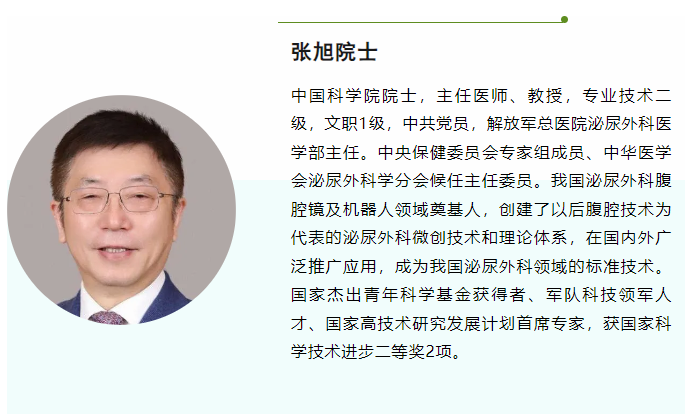
Introduction of Academician Zhang Xu
Prostate cancer is one of the main threats to men’s health, and its treatment relates to subsequent quality of life. Since the 1990s, minimally invasive surgical techniques have begun to be applied in urology, and the development of robotic surgery technology has brought revolutionary changes to the surgical treatment of prostate cancer[1].
Why use robots for radical prostatectomy in clinical practice? We choose to use robots for radical prostatectomy mainly because it brings several significant advantages. Firstly, robotic surgery offers a minimally invasive surgical option, operating through smaller incisions, reducing damage to surrounding tissues, thereby alleviating postoperative pain and accelerating recovery. Secondly, the high-definition 3D vision system equipped with the robotic surgical system provides doctors with a clear surgical view, making the surgical operation more precise and accurate. In addition, the robotic surgical system’s mechanical arms have high flexibility and stability, capable of performing complex operations in narrow surgical spaces, which is particularly important for the meticulous protection of nerves and blood vessels during radical prostatectomy (Figure 1).
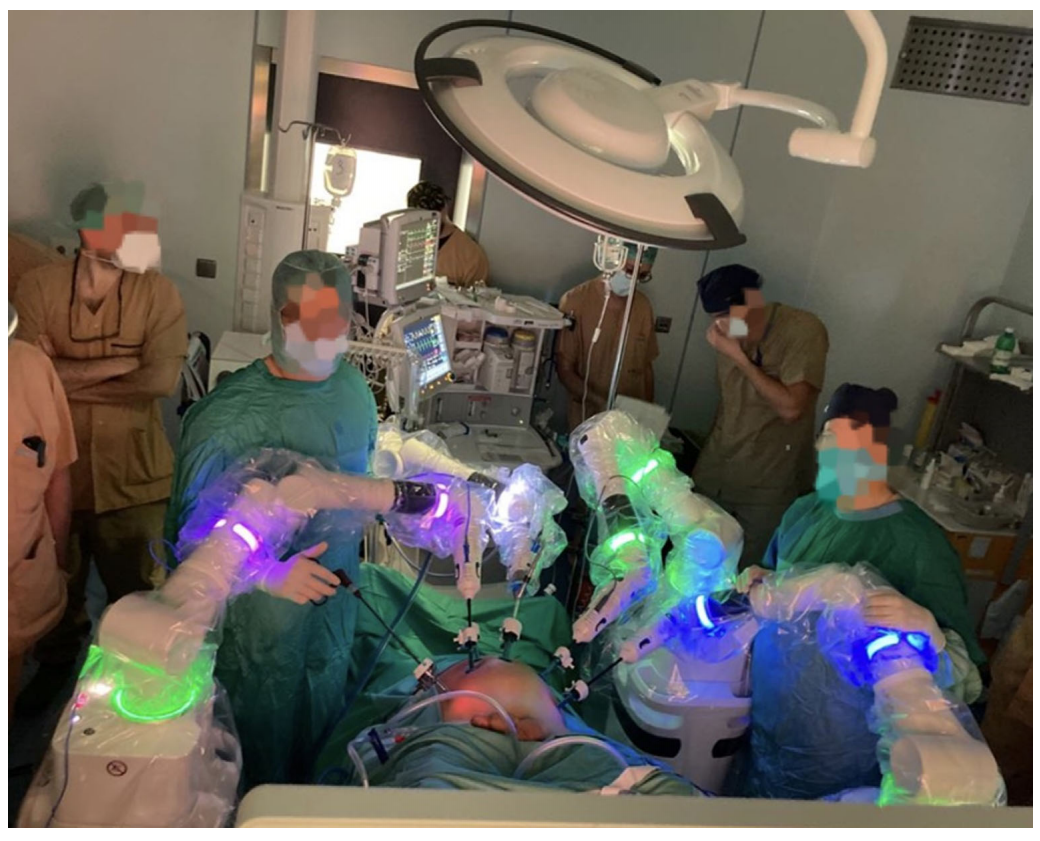 Figure 1 Surgical operation
Robotic surgery also improves the consistency and precision of operations, reducing the impact of human tremors, making cutting and suturing smoother and more consistent. This precision is crucial for improving surgical quality and reducing postoperative complications. At the same time, the use of robotic surgical systems also helps improve patients’ psychological health experience, alleviating their anxiety and fear about the surgery.
In terms of education and training, the recording and playback functions of robotic surgery provide doctors with opportunities to learn and improve surgical skills, which positively impacts the training of a new generation of surgeons. Moreover, robotic surgery promotes collaboration among multidisciplinary teams, enhancing the overall cooperation and efficiency of the medical team.
Although the initial investment in robotic surgical systems is relatively high, its potential economic benefits cannot be ignored. By shortening hospital stays and reducing complications, robotic surgery may reduce overall healthcare costs in the long run. With the development of artificial intelligence and machine learning technologies, robotic surgical systems are expected to integrate these advanced technologies, further enhancing the intelligence level of surgeries.
Are there differences between different robotic systems? The da Vinci Surgical System and the Versius Surgical System are both advanced robotic-assisted surgical platforms, each demonstrating its advantages and characteristics in radical prostatectomy.
The da Vinci system is one of the earliest robotic surgical systems to enter the market, with a long history of clinical application and a wealth of surgical case data. It is known for its 3D high-definition vision, highly flexible mechanical arms, and precise hand-eye coordination capabilities, providing doctors with the ability to perform complex surgeries in narrow spaces. The da Vinci system has already shown potential in improving tumor resection outcomes in early clinical applications, particularly in reducing positive surgical margins (PSMs)[1].
The Versius robotic surgical system, on the other hand, is a newer system that features a lightweight and modular design, offering more flexible surgical layout options. According to a study published in BJU Int titled “Versius Robotic Surgical System: Case Series of 18 Robot-Assisted Radical Prostatectomies”, the Versius system has demonstrated good surgical outcomes and safety in practical applications, with a median setup time of 8.5 minutes and a median console time of 201 minutes (Table 1), and no related complications or need for conversion to open surgery[2].
Table 1 Characteristics of Clinical and Pathological Patients
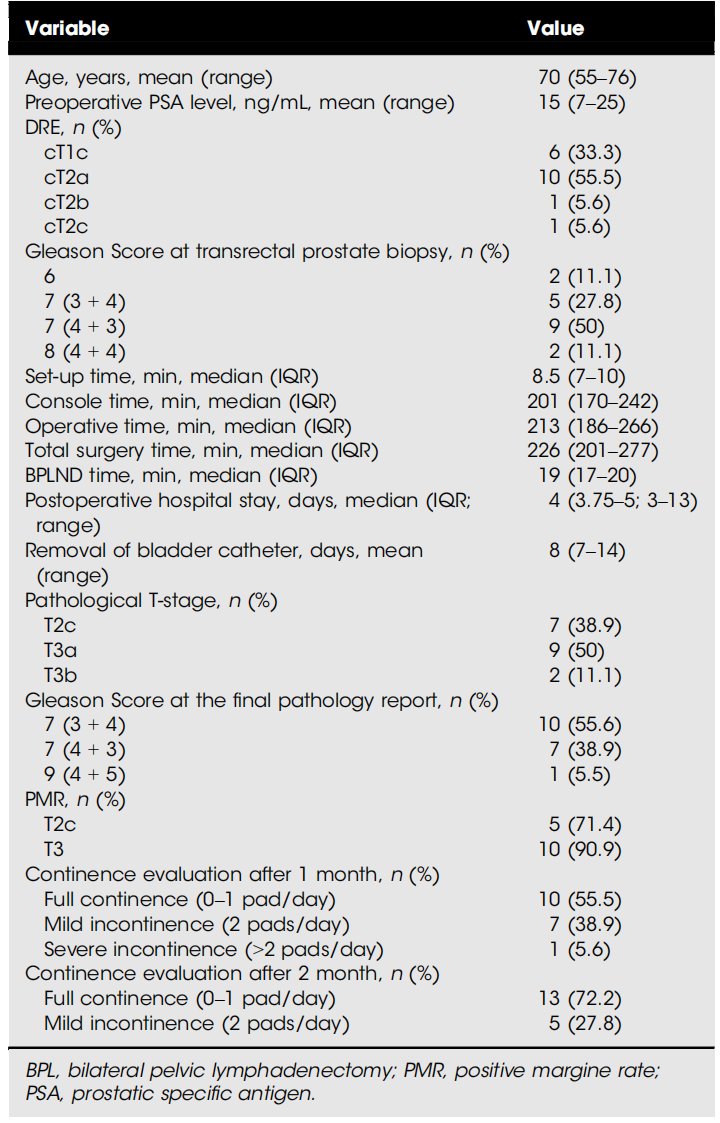
Many patients are more concerned about the surgical outcomes and postoperative quality of life. In the above study, researchers conducted robotic-assisted radical prostatectomy on 18 patients with localized prostate cancer, and the results showed that the surgery was safe and feasible, with no complications or restrictions related to the Versius system. In addition, the incidence of postoperative complications was low, and 72.2% of patients achieved complete control of urinary incontinence at one month follow-up[2]. Another analysis of 11,521 patients showed that although the da Vinci robotic surgical system had PSMs, no significant association was found between it and prostate cancer-specific mortality. The study also assessed postoperative erectile function recovery using standardized validated questionnaires, finding that robotic surgery, compared to open surgery, increased the likelihood of erectile function recovery by 25% for patients aged 60[1].
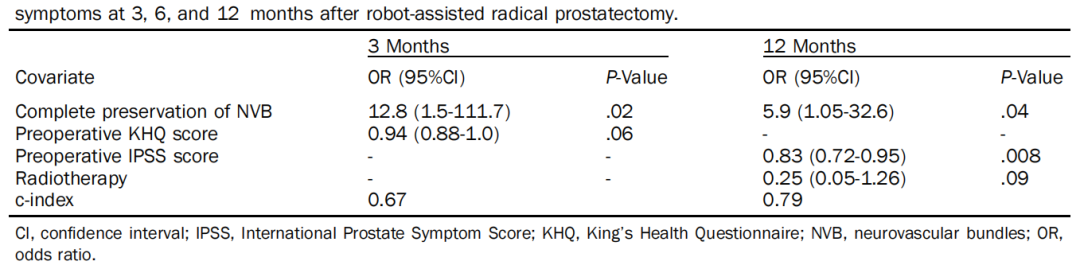
Furthermore, according to a study published in Urology, we can see some important data regarding postoperative quality of life. The study found that although there were issues of urinary incontinence after robotic-assisted radical prostatectomy, patients with larger prostates would experience a reduction in lower urinary tract symptoms within a year, further enhancing their quality of life. Specifically, the proportion of patients with moderate to severe urinary tract symptoms before surgery was 48%, which decreased to 40%, 34%, and 23% at 3 months, 6 months, and 12 months post-surgery, respectively. Additionally, by 6 months post-surgery, patients reached the same level of satisfaction as before surgery. The study also indicated that neurovascular bundle preservation was the only predictor of early postoperative urinary symptom recovery and sexual function improvement, with neurovascular bundle preservation being the only predictor of patient comfort at 3 months post-surgery (OR=12.8, 95%CI: 1.47–111.7, P =0.02, Table 2), and was related to the increase in the median IIEF-5 (International Index of Erectile Function) score post-surgery[3].
Table 2 Multivariable Analysis of Postoperative Recovery Factors
With the continuous development of technology and the accumulation of clinical application experience, robotic surgery will bring hope to more prostate cancer patients, realizing new possibilities for a healthy life.
02
▼
Conclusion
Academician Zhang Xu, director of the Urology Department of the Third Medical Center of the PLA General Hospital, established China’s earliest robotic technology team in urology, combining retroperitoneal laparoscopic techniques with robotic technology, forming a unique Chinese robotic technology. Let us look forward to Academician Zhang Xu’s wonderful speech at the Smart Medical and Medical Artificial Intelligence Innovation Forum.
References
[1] MÜLLER S, GRØNNING L E, NILSEN F S, et al. Robotic and minimal access surgery: technology and surgical outcomes of radical prostatectomy for prostate cancer[J]. Expert Rev Anticancer Ther, 2014, 14(11): 1317-1321. DOI: 10.1586/14737140.2014.965689.
[2] DE MARIA M, MENEGHETTI I, MOSILLO L, et al. Versius robotic surgical system: case series of 18 robot-assisted radical prostatectomies[J]. BJU Int, 2024, 133(2): 197-205. DOI: 10.1111/bju.16156.
[3] TOURINHO-BARBOSA R, SANCHEZ-SALAS R, SIVARAMAN A, et al. Urinary symptoms change and quality of life after robotic radical prostatectomy: a secondary analysis of a randomized controlled trial[J]. Urology, 2024, 185: 73-79. DOI: 10.1016/j.urology.2023.12.025.
Editor: Mint
Second Review: Stone
Third Review: Qingyang
Typesetting: Half Summer 1. Comprehensive, Full-Chain, Global Innovation Mapping of the Health Industry Blueprint!
2. How to Achieve Balance in Feeding? There Are Secrets
3. The National Health Commission Introduces Information on “Seasonal Solar Terms and Health” at a Press Conference (Text Record)