
During my classes with many beginners, I found that everyone is unfamiliar with the abbreviations and terms frequently used in IC design, making communication somewhat difficult, especially since some abbreviations and terms are hard to translate accurately into Chinese.
Below is a collection of 100 commonly used abbreviations or terms in digital IC design for your reference, providing a solid foundation for beginners’ learning. (Some explanations are directly sourced from the internet; please leave a message to contact if there are any issues.)
|
English Abbreviation |
Full English Name |
Chinese Explanation |
|
ADC |
Analog to Digital Converter |
Analog signal to digital signal conversion circuit |
|
AHB |
Advanced High Performance Bus |
A bus specification launched by ARM for high-performance modules (such as CPU, DMA, and DSP) connections |
|
APR |
Auto Place and Route |
Automatic layout and routing, a main process in digital backend layout implementation |
|
ARM |
Acorn RISC Machine |
The ARM company in the UK, commonly used in mobile chips or processors, now low-power designs generally adopt ARM CPU |
|
ASIC |
Application-Specific Integrated Circuit |
Application-specific integrated circuit, mainstream design process for chip design companies |
|
ATPG |
Auto Test Pattern Generator |
Test vector automatic generation tool, a common process in DFT |
|
AXI |
Advanced eXtensible Interface |
A bus specification launched by ARM |
|
BE |
Back End |
Backend, referring to the backend design process in IC design |
|
BIST |
Built-In Self-Test |
Built-in testing system, a common process in DFT |
|
CAD |
Computer-Aided Design |
Computer-aided design, also a department in IC design companies that specializes in providing software automation |
|
CDC |
Clock Domain Crossing |
Asynchronous clock timing checks, an important step in digital design |
|
COVERAGE |
Coverage |
A common term in digital verification, mainly including code coverage and functional coverage |
|
CPLD |
Complex Programmable Logic Device |
Complex programmable device, similar to FPGA |
|
CTS |
Clock Tree Synthesis |
Clock tree synthesis, an important process in digital backend implementation |
|
DAC |
Digital to Analog Converter |
Digital signal to analog signal conversion circuit |
|
DC |
Design Compiler |
A digital synthesis tool from Synopsys |
|
DFT |
Design for Test |
A design method adopted to enhance chip testability, an important step in the digital IC process |
|
DMA |
Direct Memory Access |
Direct memory access |
|
DRAM |
Dynamic Random Access Memory |
Dynamic random-access memory, the most common system memory |
|
DRC |
Design Rule Check |
Check whether the generated layout meets the design rules provided by the foundry, such as width, spacing, area, etc. |
|
DSP |
Digital Signal Processing |
Digital signal processing module, often used in algorithm implementation by IC design companies |
|
DUT |
Design Under Test |
Design module to be tested |
|
DUV |
Design Under Verification |
Similar meaning to DUT |
|
ECO |
Engineering Change Order |
In the later stages of a project, modifications to the chip design can only be made at the gate level |
|
EDA |
Electronic Design Automation |
Electronic design automation, many EDA tools are required in the IC design process |
|
EEPROM |
Electrically Erasable Programmable Read-Only Memory |
Electrically erasable read-only memory |
|
ERC |
Electronic Rule Check |
Check whether the IC design meets electrical rules after layout |
|
FE |
Front End |
Frontend, the frontend design process in digital IC design |
|
FLASH |
Flash EEPROM Memory |
Flash memory, which combines the fast data reading characteristics of RAM with the erasable and non-volatile nature of EEPROM. |
|
FM |
Formal |
Formal verification, comparing netlists with Verilog |
|
Foundry |
Refers to the foundry business of chip manufacturing, responsible for producing completed chip designs |
|
|
FPGA |
Field Programmable Gate Array |
Field-programmable gate array, corresponding to the ASIC process |
|
FSDB |
A common waveform file format in digital IC design |
|
|
FSM |
Finite State Machine |
Finite state machine in digital logic design |
|
FULLCHIP |
Fullchip Level |
Commonly used in digital frontend design and verification, referring to system-level and chip-level |
|
GDSII |
File format for layout |
|
|
GLS |
Gate Level Simulation |
Refers to gate-level simulation in digital verification |
|
GPIO |
General Purpose Input Output |
General input/output, bus expander |
|
HDMI |
High Definition Multimedia Interface |
High-definition multimedia interface, a digital video/audio interface technology specification |
|
I2C |
Inter-Integrated Circuit |
IIC is a commonly used multi-directional control bus, simple, with only two lines |
|
IC |
Integrated Circuit |
Integrated circuit |
|
ICC |
IC Compiler |
A software from Synopsys for automatic layout and routing, widely used by many companies |
|
IEEE |
Institute of Electrical and Electronics Engineers |
The Institute of Electrical and Electronics Engineers |
|
INNOVUS |
A digital layout implementation tool from Cadence |
|
|
IP |
Intellectual Property |
Intellectual property, in digital IC design, the smallest design module is generally referred to as IP |
|
JTAG |
Joint Test Action Group |
Joint Test Action Group, an international standard testing protocol, commonly used for chip testing |
|
Layout |
Layout, referring to the final layout generated for the chip, similar to design blueprints in the construction industry |
|
|
LPS |
Low Power Simulation |
Low power simulation, commonly used in low power design verification |
|
LSI |
Large-Scale Integrated Circuit |
Large-scale integrated circuit |
|
LUT |
Look Up Table |
Lookup table, used to store some data, essentially a RAM |
|
LVS |
Layout versus Schematic |
Check the consistency between the layout and the schematic after transforming to layout |
|
MCU |
Microcontroller Unit |
Microcontroller, main control module |
|
MIPI |
Mobile Industry Processor Interface |
Mobile industry processor interface, an open standard and specification for mobile application processors |
|
Modelsim |
A digital frontend simulation tool from Mentor, also known as QUESTASIM |
|
|
MPW |
Multiple Project Wafer |
Multi-project wafer, refers to placing different chips of the same process on the same wafer, an effective way for small companies to save costs |
|
MSB |
Most Significant Bit |
The most significant bit of a multi-bit data, corresponding concept is LSB |
|
NCSIM |
A digital frontend simulation tool from Cadence |
|
|
NDR |
Non-Default Route |
Non-default wiring rules, an important concept in layout implementation |
|
Netlist |
Gate-level netlist, generally a netlist file generated from RTL Code using synthesis tools |
|
|
NFC |
Near Field Communication |
A wireless communication technology for short distances |
|
OCP |
Open Core Protocol |
An efficient, bus-independent, configurable, and highly scalable interface protocol |
|
PAD |
Refers to the input/output ports of a chip |
|
|
PBA |
Path-Based Analyze |
Path-based timing analysis |
|
PCIe |
Peripheral Component Interconnect Express |
A standard for peripheral component interconnect, a common bus standard |
|
PD |
Physical Design |
Physical design, generally refers to the layout design of the digital backend |
|
PERL |
A commonly used scripting language in digital IC design, very suitable for text processing |
|
|
PLL |
Phase Locked Loop |
Phase-locked loop, commonly used in clock frequency multiplication circuits to generate clock clock |
|
PT |
Prime Time |
A static timing analysis tool from Synopsys |
|
PV |
Physical Verification |
Physical verification, necessary verification after digital layout implementation |
|
Python |
A commonly used scripting language, now widely used in artificial intelligence and very popular |
|
|
R&D |
Research and Design |
R&D center |
|
RAM |
Random Access Memory |
Random access memory |
|
REGRESSION |
Regression testing, simply put, running all test cases repeatedly until there are no errors for a period of time |
|
|
RF |
Radiation Frequency |
Transmission frequency, radio frequency circuit |
|
RISC |
Reduced Instruction Set Computer |
Used in CPU, a reduced instruction set |
|
ROM |
Read Only Memory |
Read-only memory with non-volatility. |
|
RTL |
Register Transfer Level |
Register transfer level, often refers to levels described using Verilog |
|
Shell |
A commonly used scripting language in digital IC design, closely integrated with Linux |
|
|
SI |
Signal Integrity |
Signal integrity |
|
signoff |
Acceptance mechanism, acceptance criteria |
|
|
SoC |
System on Chip |
System on chip, generally refers to larger chips, mostly containing CPU/MCU and others |
|
SPEC |
Specification |
Specification, every engineer in each position must write the corresponding spec |
|
SPI |
Serial Peripheral Interface |
A serial peripheral interface, a high-speed, full-duplex, synchronous communication bus |
|
SRAM |
Static Random Access Memory |
Static random-access memory |
|
STA |
Static Timing Analysis |
Static timing analysis, an important part of the digital IC design process |
|
SV |
SystemVerilog |
Mainstream digital verification language |
|
Tapout |
Tape Out |
Sending the final layout file to the foundry for production |
|
TCL |
Tool Command Language |
Tool command language. A commonly used scripting language in digital backend design |
|
tessent |
A DFT tool from Mentor, with a high market share |
|
|
Testbench |
Test platform, a platform used for testing in digital verification |
|
|
TTL |
Transistor-Transistor Logic |
TTL voltage standard, stipulates that +5V is equivalent to logic 1, and 0V is equivalent to logic 0 |
|
UART |
Universal Asynchronous Receiver/Transmitter |
A common IP module, a universal asynchronous transceiver |
|
USB |
Universal Serial Bus |
A high-speed bus protocol for connecting peripherals |
|
UVM |
Universal Verification Methodology |
A mainstream digital verification methodology based on SystemVerilog |
|
VCD |
Value Change Dump |
A common waveform file format, detailed information but larger file size |
|
VCS |
A digital frontend simulation tool from Synopsys |
|
|
Verdi |
A digital frontend debugging tool from Synopsys |
|
|
VHDL |
VHSIC (Very High Speed IC) Hardware Description Language |
A hardware description language, similar to Verilog, but now not many companies use it |
|
Vivado |
Vivado |
An integrated design environment released by Xilinx for FPGA in 2012 |
|
VLSI |
Very-Large-Scale Integrated Circuit |
Ultra-large-scale integrated circuit |
[IC Consulting/Free Trial]



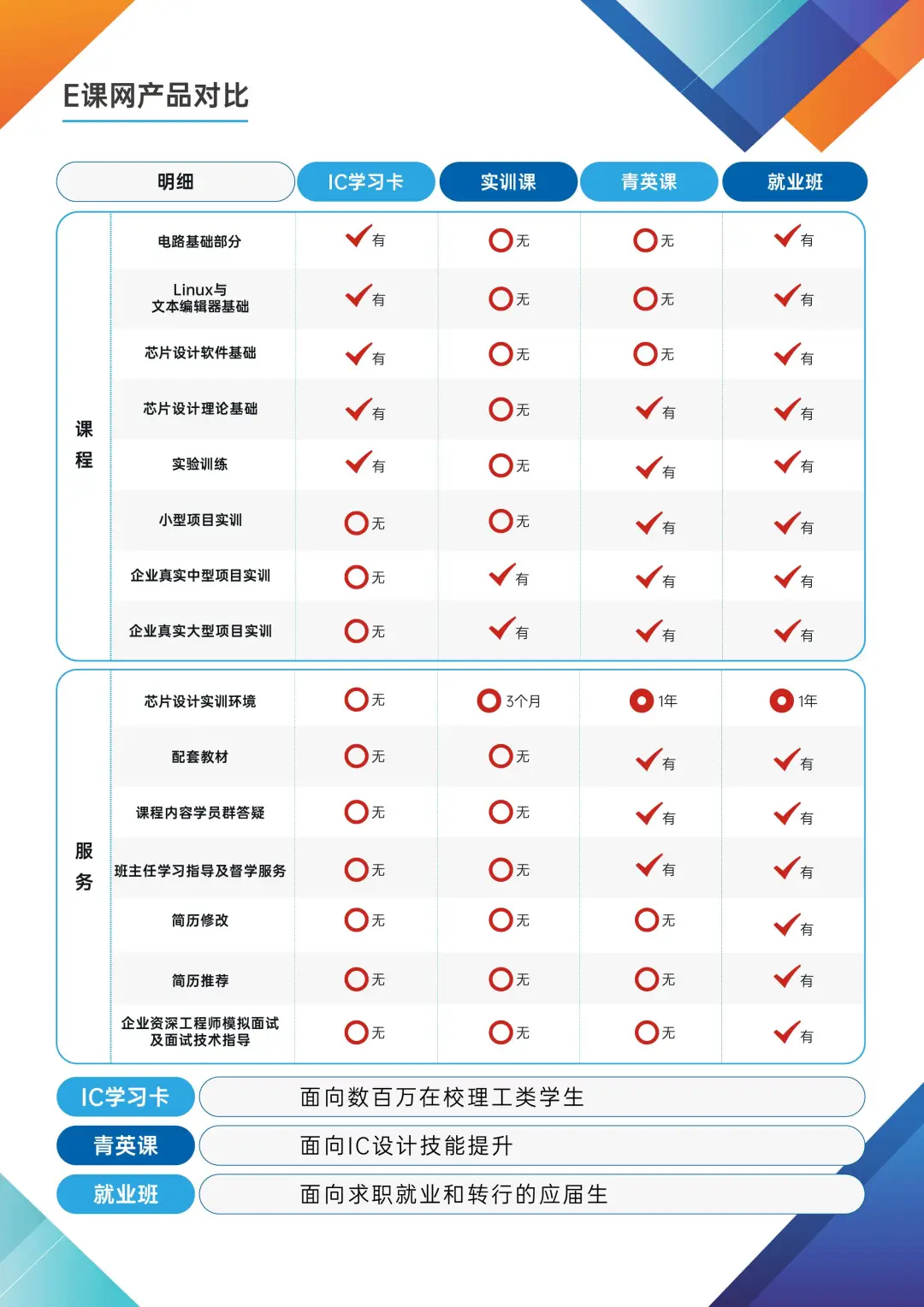
eCourse Network (www.eecourse.com) is a professional integrated circuit education platform under Moore Elite, dedicated to cultivating high-quality integrated circuit professionals in the semiconductor industry. The platform is oriented towards the job requirements of integrated circuit companies, providing a practical training platform that aligns with the corporate environment, quickly training students to meet corporate needs through both online and offline training methods.
Founded in 2015, eCourse Network has a mature training platform, complete course system, and strong teaching faculty, planning 168 high-quality semiconductor courses in China, covering the entire integrated circuit industry chain, and has 7 offline training bases. eCourse Network has a total of 517,000 fans online and has directly delivered 8,127 professional talents to the industry. It has established deep cooperative relationships with 85 universities and has held 240 corporate-specific IC training sessions.