Click the card below to follow Arm Technology Academy
This article is selected from the Jishu column “Arm Selection” and will list some information related to Arm v7, Arm v8, and Arm v9 architectures that people usually do not pay much attention to.
1. Although Arm v7 products are still frequently seen in the market and many students are learning Arm v7, it has been 15 years since Arm v7 was released, and Arm v8 has been out for 10 years.
2. Despite Arm’s popularity and its presence in various fields of the market, with many programmers closely related to Arm, there is still no comprehensive Chinese book on Arm v8 architecture (Note: In 2021, there was a book discussing architecture programming, which is somewhat related).
3. During the Arm v7 era, the entire Arm product line was divided into three branches: the Cortex-A for mobile, Cortex-M for embedded, and Cortex-R for real-time applications. It has been 15 years, and actually, not many R and M core IPs have been released; most of the focus has been on A.
4. In 2021, Cortex-A further branched into three categories: the high-performance super-large core X series, the mobile A series, and the server-oriented Neoverse series.
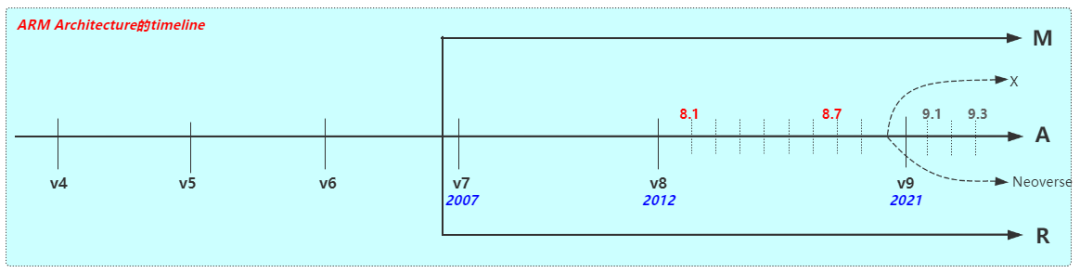
5. In addition to major version numbers like v7, v8, and v9, Arm also has minor version numbers like 8.1, 8.2, 9.0, 9.1, and 9.2. Starting from v8, a major version is expected every 10 years, with almost annual updates for minor versions since 2016.

6. Although Arm has many version numbers, not every version corresponds to a product. For versions 8.0-8.7, only 8.0 and 8.2 actually have products.
7. Starting from 2021, all new core IPs from Arm are 9.0, and it seems there will be no more core IPs for 8.0.
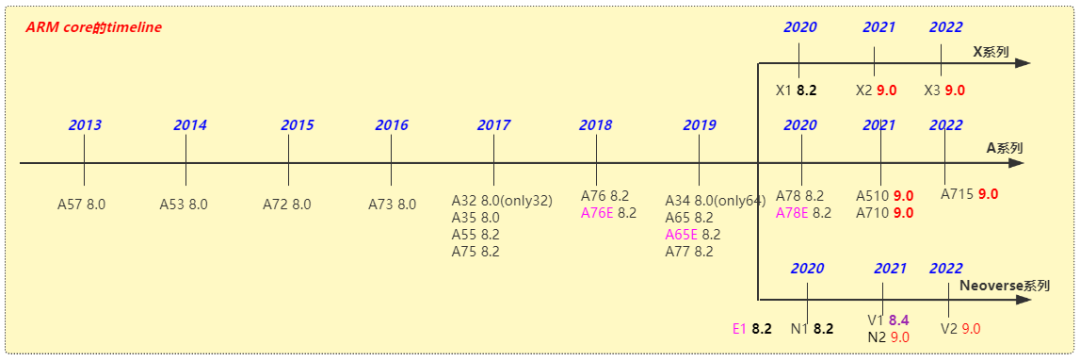
8. Arm v9 will completely eliminate aarch32 (32-bit). Although Arm v9 is forward compatible, EL0 still retains the capability of aarch32. The A710/A510 released in 2021 still supports aarch32, but starting from 2022, new cores will no longer support aarch32. It seems that there will be no more cores supporting aarch32 in the future.
9. Stop constantly talking about big.LITTLE and big.little cores; in fact, mainstream SoCs have long transitioned to the DynamIQ architecture.
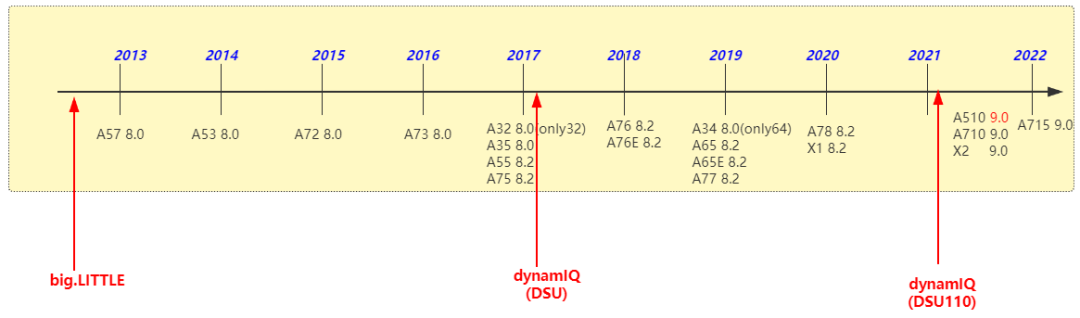
10. Most of the videos online discuss technologies from 10, 15, or even 20 years ago.
Recommended Reading
-
Arm’s Support for Device Passthrough in Virtualization
-
From Linux on Arm to Windows on Arm
-
Arm Series — Armv8-A
Follow Arm Technology Academy