 Introduction
ADC drugs are a class of highly promising anti-tumor drugs that are rapidly developing. Although 14 ADCs have been officially approved, the complex structure of ADCs poses significant challenges in the development and optimization of new ADC drugs. Studying the “structure-activity relationship” of ADC drugs and understanding the intrinsic connection between the efficacy/safety of ADC drugs and ADC modifications will help guide and accelerate the development of ADC drugs.
The tumor-associated antigen HER2 is highly expressed in nearly 30% of breast cancers and some solid tumors, making it an important target for tumor drug development. The HER2 monoclonal antibody trastuzumab (Tz) was first approved in 1998 and has been widely used in the development of HER2-targeted ADC drugs. Currently, three HER2-targeting ADC drugs have been approved by regulatory agencies in various countries, namely Kadcyla, Enhertu, and RC48, and several other HER2-targeted ADCs are in late-stage clinical development and have received FDA Fast Track/Breakthrough Therapy designation.
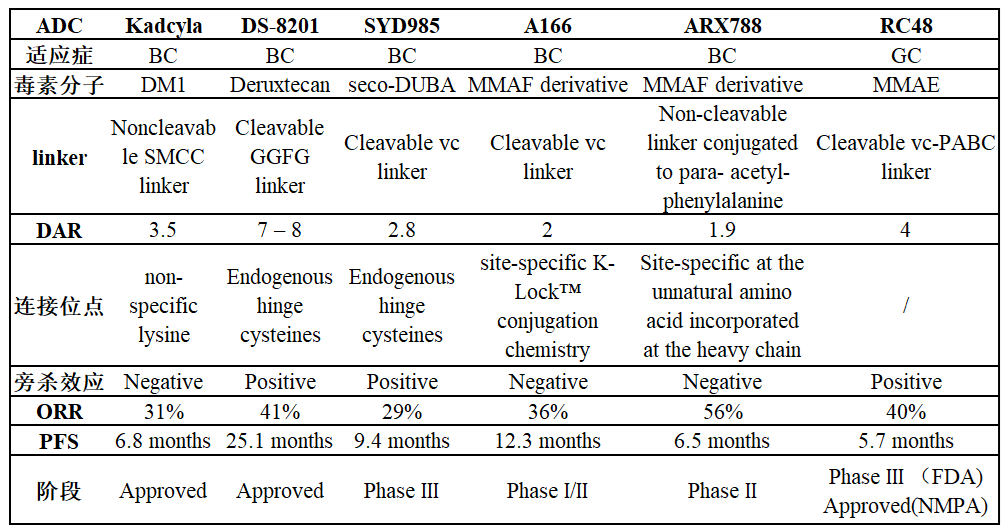 Progress of HER2-targeted ADC drugs at the FDA
In the development of small molecule drugs, effective structure-activity relationship (SAR) studies are often required to ultimately find preclinical candidate compounds. Similarly, in the development of ADC drugs, the structure-activity relationship specific to ADC drugs can also be identified to guide and accelerate their development. For ADCs, key factors that can affect the final efficacy include the properties of the toxin molecules (such as IC50, hydrophobicity, etc.), drug-antibody ratio DAR, and the properties of the linker (stability, cleavability, and connection sites).

Properties of Toxin Molecules
Influencing Tumor Penetration and Killing Ability
Toxin molecules play a core role in the tumor-killing effect of ADC drugs. The earliest developed ADC toxin molecules had relatively low potency (IC50 greater than 100 nM), leading to poor clinical efficacy. Later, the focus shifted to more toxic toxin molecules (IC50 in the nM to pM range) such as auristatin and maytansine, achieving better clinical efficacy and successful approval.
The hydrophobicity of toxin molecules can influence the strength of the bystander effect. Highly hydrophobic toxin molecules like MMAE (cLogP of 3.13) can passively diffuse into adjacent tumor cells after release within the cell, while MMAF (cLogP of 1.49), due to its carboxyl group, has difficulty diffusing through membranes to adjacent tumor cells. Therefore, the ADC of MMAE shows stronger efficacy in vitro, especially when applied to tumors with low antigen expression and high heterogeneity.
However, excessive hydrophobicity may also lead to ADC accumulation in the body, being engulfed, and causing non-specific binding. To reduce these issues, prodrug modifications can be made to highly hydrophobic toxin molecules to improve the PK/PD and systemic toxicity of ADCs while releasing the parent drug in the body to maintain its bystander effect.
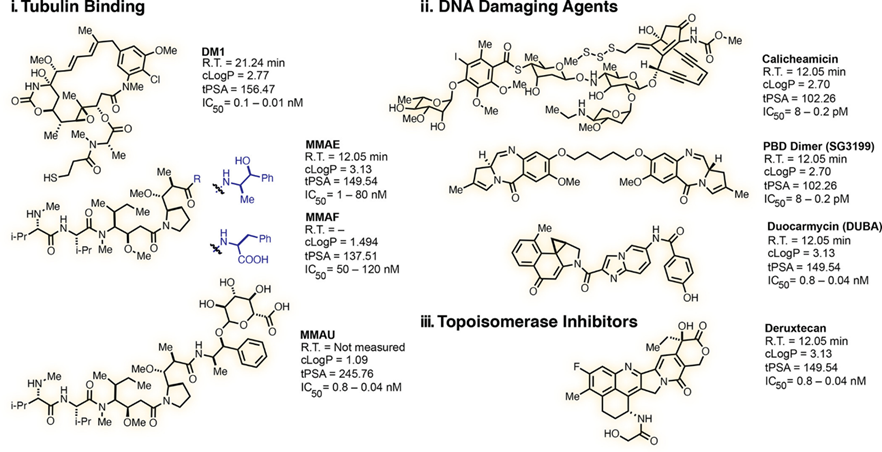
Biochemical Properties of Commonly Used Toxin Molecules in ADCs

DAR Influences Tumor Killing Ability and Safety
ADC drug efficacy mainly depends on the concentration of toxin molecules in tumor cells, so the drug-antibody conjugation ratio (DAR) is an important influencing factor for ADC drug efficacy. Increasing DAR can enhance the concentration of toxin molecules in tumor cells, thereby increasing tumor killing ability. In in vitro tests of Tz-MMAE, ADCs with DAR values of 1-4 had IC50 values of 0.12 nM, 0.07 nM, 0.05 nM, and 0.04 nM respectively, while the IC50 of free MMAE was 0.22 nM. In in vivo tests, DAR-dependent tumor suppression was observed, and at a DAR of 4, tumors could be completely eliminated.
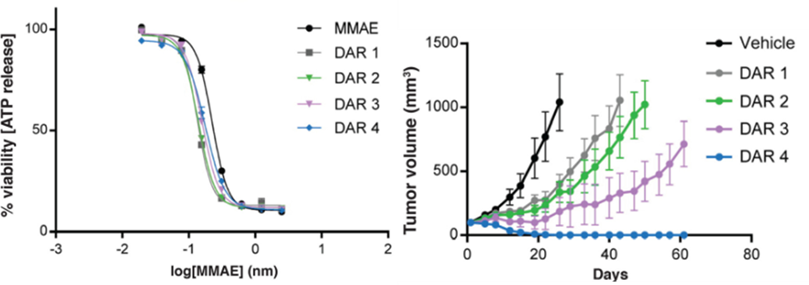
Comparison of Tz-MMAE Activity at Different DAR
However, increasing DAR may also lead to aggregation, increased toxicity to normal tissues, and accelerated clearance, especially when carrying highly hydrophobic toxin molecules. Analysis of Tz-MMAE found that at a DAR of 2, 0.7% of ADC aggregated after 2 weeks, while at a DAR of 4, the aggregation rate increased to 4.7%. As DAR further increases, the aggregation rate grows exponentially. Generally, the ideal DAR is between 2 and 4.

Linker Properties Affect Safety and Efficacy
Linkers not only connect toxin molecules to antibodies but can also be modified to optimize the PK/PD of ADCs. The ideal linker should remain stable in the bloodstream to reduce off-target toxicity. Non-cleavable linkers have strong plasma stability; in vitro tests showed that ADCs using non-cleavable SMCC linkers retained 75% integrity after 7 days, while ADCs using cleavable SPDP linkers were completely cleaved after 3 days. In vivo tests indicate that enhanced stability can improve ADC safety; compared to non-cleavable SMCC, cleavable SPDP linkers exhibited significant weight loss side effects in mice.
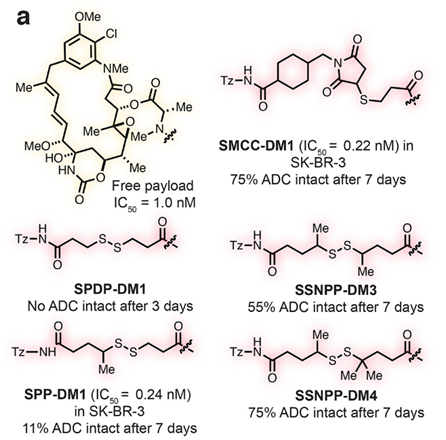
Using non-cleavable linkers in ADCs loses the bystander effect, weakening tumor killing ability; therefore, higher generations of ADCs often use cleavable linkers to enhance drug efficacy. Meanwhile, adjusting the specificity of the connection sites is necessary to achieve better uniformity in ADCs, enhancing safety. Traditional random conjugation methods result in high heterogeneity of ADC drugs, leading to significant differences in in vivo distribution and efficacy. Later, site-specific conjugation technology was developed, using genetic engineering to introduce amino acids with reactive groups into antibody molecules, achieving effective control over DAR and product uniformity through site-specific conjugation of toxin molecules at amino or thiol groups, which can be translated into improved in vivo efficacy and safety.
Conclusion
The in vitro efficacy of different ADCs based on trastuzumab in the breast cancer SK-BR-3 cell line is shown in the table below, with IC50 values increasing from top to bottom, indicating decreasing in vitro efficacy.
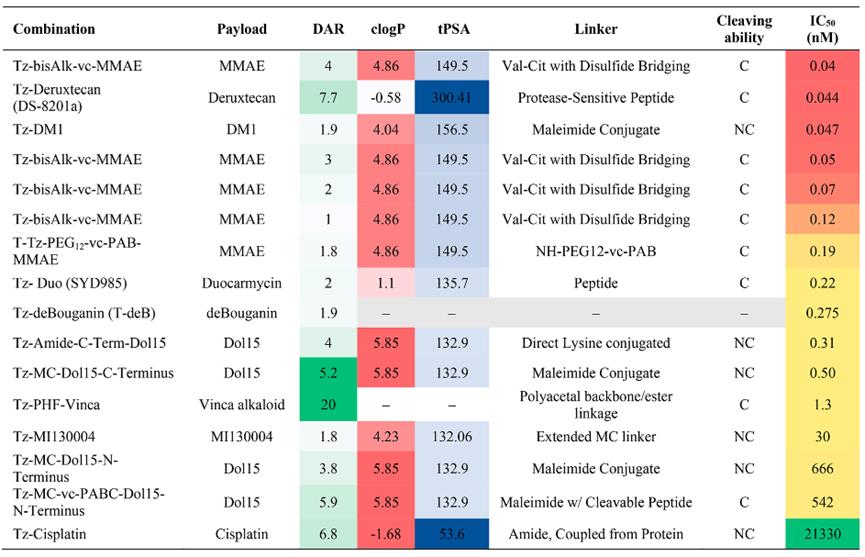
Comparing the results, it can be seen that ADCs with highly hydrophobic toxin molecules have poorer efficacy, especially at high DAR values. For instance, Tz-MMAE is significantly more effective than Tz-Do115, both of which are auristatin derivatives, but Dol15 has an order of magnitude higher hydrophobicity.
DS-8201 shows nearly the highest in vitro efficacy and is also effective in HER2 low-expressing populations, mainly due to its near 8 DAR, which increases the concentration of Deruxtecan in tumor cells, while the hydrophobicity of Deruxtecan is moderate, leading to less aggregation and non-specific binding.
In the upper half of the table, among the 8 ADCs with the best activity, 7 use cleavable linkers, reflecting the important role of bystander effects in tumor killing. All ADCs loaded with natural toxin molecules such as MMAE or DM1, even with smaller DAR, have superior activity compared to ADCs loaded with cisplatin, further emphasizing the importance of potent toxin molecules.
References:
[1] Matikonda SS, McLaughlin R, Shrestha P et al. Structure-Activity Relationships of Antibody-Drug Conjugates: A Systematic Review of Chemistry on the Trastuzumab Scaffold. Bioconjug Chem. 2022 Jul 20;33(7):1241-1253.
[2] Sheyi R, de la Torre BG, Albericio F. Linkers: An Assurance for Controlled Delivery of Antibody-Drug Conjugate.Pharmaceutics. 2022; 14(2):396.
Scan the QR code to add the editor of the Biopharmaceutical Circle. Qualified individuals can join the WeChat group for biopharmaceuticals!
Please indicate: Name + Research Direction!


Copyright StatementThis public account’s reprinted articles are for the purpose of conveying more information, and the sources and authors are clearly stated. If any media or individual does not wish to be reprinted, please contact us ([email protected]), and we will immediately delete it. All articles represent the authors’ opinions and do not represent the position of this site.