1
Introduction
Antibody-drug conjugates (ADC) are an emerging technology that selectively targets cancer cells to overcome the limitations of chemotherapy.ADC binds to antigens, especially those overexpressed on the surface of cancer cells, reducing side effects caused by nonspecific targeting and improving the therapeutic index. The idealADC efficacy relies entirely on several physicochemical factors, such as binding sites, molecular weight, linker length, steric hindrance, half-life, conjugation methods, etc. As ofFebruary 2023, a total of15ADC have been approved for marketing globally, with more than100ADC currently undergoing clinical trials. However, designing an idealADC remains a significant challenge. Therefore, a profound understanding of the key components and their characteristics ofADC will aid in developing ADCs with higher safety and therapeutic indices.
2
Key Components of ADC
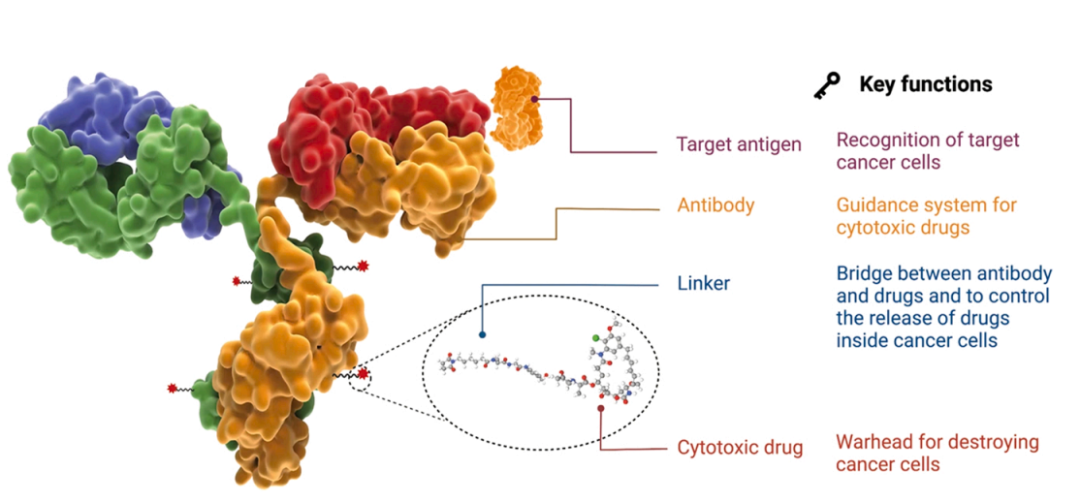
ADC consists of antibodies, linkers, and cytotoxic payloads, each playing a crucial role. An idealADC should effectively reach the target site without releasing any off-target payloads and should kill cancer cells without affecting normal healthy cells. To develop a successfulADC with maximum efficacy, all these components, such as the choice of antigen, antibody, toxic payload, and linker, should be considered.
Antigen Selection
The target antigen helps distinguish cancer cells from normal cells, thereby reducing off-target toxicity. Therefore, selecting the appropriate target antigen is the first step in developing an ideal ADC. The ideal antigen must possess certain characteristics, such as being overexpressed on cancer cells compared to healthy cells; secondly, the target antigen should not have a secreted form to avoid ADC binding outside the tumor; finally, the target antigen should possess internalization potency to bring in the ADC’s payload. Currently, among the approved and clinical trial ADCs, the most commonly used targets in hematological and solid tumors include CD33, CD30, CD22, BCMA, CD19, CD79b, HER2, Nectin-4, Trop-2, EGFR, TF, etc.
Antibody Selection
In an ideal ADC, the antibody is the key carrier that specifically binds to the target antigen, and it must have high affinity for the target antigen and low immunogenicity. Additionally, the antibody should maintain a longer plasma half-life and have the ability to internalize quickly. Due to its abundance of antibody types and ability to initiate immune effectors, IgG is the most common type of antibody used in ADC development. Moreover, among the different subclasses, IgG1 is the most commonly used antibody subclass in ADC development.
Internalization is another major factor affecting ADC efficacy, and the dissociation constant (Kd) is a key factor influencing ADC internalization into cancer cells. Ideally, Kd should be high to ensure effective penetration and uniform distribution throughout the tumor tissue. Furthermore, the molecular weight of the antibody is another critical factor affecting ADC penetration into tumor tissue. Due to the large molecular weight of IgG, it becomes a challenging task for ADCs to penetrate blood vessels and reach tumor sites. Therefore, smaller-sized antibody types may be considered for the development of ideal ADCs.
Linker
The linker acts as a bridge between the antibody and the payload, primarily contributing to the stability and efficacy of the ADC. Moreover, the release of the payload mainly depends on the type and nature of the linker. The ideal linker should be highly soluble in water, preventing the formation of aggregated ADCs and premature release of the payload in systemic circulation. Generally, all three components of ADCs, such as antibodies, linkers, and payloads, can be modified to obtain a stable and effective ADC. The three main factors influencing linker stability and payload release are binding sites, steric hindrance, and linker length.
Payload
The payload is the warhead of the ADC and is a drug with high cytotoxicity. The ideal ADC payload should have high potency, stability during metabolic or degradation processes in systemic circulation, and high solubility. Additionally, it should possess functional groups for conjugation and membrane permeability.
Due to the lysosomal barrier and the complexity of the tumor microenvironment, the amount of cytotoxic drug that can reach the target is very limited; therefore, low IC50 payloads should be selected. For instance, the IC50 of DNA-damaging agents is generally at the picomolar concentration level, while microtubule inhibitors are in the nanomolar range. In terms of stability, the payload should remain stable against any chemical reactions during systemic circulation and manufacturing processes. If the payload is unstable under lysosomal conditions, it should be separated before reaching the cell surface or entering the cell.
3
Conjugation Methods of ADC
The conjugation method and conjugation sites are also key factors in designing an idealADC. They can regulate the location and rate of payload release, which ultimately relates to the safety and efficacy of theADC.
Conjugation with Endogenous Amino Acids
One of the most common conjugation methods is utilizing the lysine residues of the antibody, where the nucleophilic NH2 group of the amino acid reacts with the electrophilic N-hydroxysuccinimide (NHS) group on the payload. Although the reaction is simple, the high abundance of lysine residues can lead to the formation of many ADCs with uneven mixtures due to random distribution.
Disulfide Rebridging Strategy
IgG antibodies contain four interchain disulfide bonds, two connecting the light and heavy chains, and two located in the hinge region connecting the two heavy chains, maintaining the integrity of the monoclonal antibody. Another classic bioconjugation pathway explores the role of these cysteines as payload connection points. The reduction of the four disulfide bonds typically generates eight thiol groups, which can react with maleimide linkers, resulting in ADCs with a DAR of 8.
Glycosylation Conjugation
As IgG is a glycoprotein, it contains an N-glycan at position N297 of each heavy chain in the Fc fragment, which can serve as an attachment point for linking the payload. The distant positioning of the glycan from the Fab region reduces the risk of damaging the antibody’s antigen-binding ability after conjugation; additionally, their different chemical composition compared to the antibody’s peptide chain allows for site-specific modifications, making them suitable conjugation sites.
Enzyme-Guided Modification
The attachment of the payload can be achieved very selectively by inserting specific amino acid tags into the antibody sequence. These tags are recognized by specific enzymes, such as formylglycine-generating enzyme (FGE), microbial transglutaminase (MTG), transpeptidase, or tyrosinase, enabling site-specific conjugation.
Cysteine Engineering: ThioMab Technology
ThioMab technology achieves selective and uniform modification at desired sites on the antibody by utilizing reactive cysteines that do not involve structural disulfide bonds. Generally, the design of cysteine mutations aims to facilitate the conjugation of cytotoxic payloads while maintaining the stability, affinity, and minimizing the aggregation of the monoclonal antibody. To determine the optimal positions for mutations, several techniques are typically employed, including computational modeling, model system screening, and high-throughput scanning.
Engineering Non-Natural Amino Acids
In addition to ThioMab technology, the incorporation of non-canonical amino acids (ncAA) provides another possibility for site-specific conjugation. This technique uses amino acids with unique chemical structures, allowing for the chemical-selective introduction of linker-payload complexes. This technique requires the re-engineering of the antibody sequence, utilizing tRNA and aminoacyl-tRNA synthetase (aaRS) that are orthogonal to all endogenoustRNAs and synthetases in the host cell, to respond to unassigned codons and introducencAA into the protein. Typically,ncAA is added to the culture medium during fermentation. Choosing non-natural amino acids is crucial, as they may elicit immunogenicity. Commonly usedncAA are analogs of natural amino acids with unique groups, such as ketones, azides, cyclopropenes, or dienes.
4
Challenges of ADC
The next-generation ADCs with improved strategies can achieve optimal stability, specificity, and relatively low off-target toxicity, thus enhancing the therapeutic index. Nevertheless, many challenges remain to be addressed, such as pharmacokinetics, targeted specific payload release, uniform distribution of anticancer drugs in tumor areas, adverse side effects, and drug resistance.
Complex Pharmacokinetic Characteristics
After ADC administration, there may be intact ADCs, naked antibodies, and free forms of cytotoxic payloads present in the serum. In the typical pharmacokinetic characteristics of ADCs, the concentrations of conjugated ADCs and naked antibodies continuously decrease with the internalization of ADCs and the clearance of antibodies. The two main factors affecting ADC clearance rates are the decoupling of the antibody’s cytotoxic payload and the FcRn-mediated recycling.
Free cytotoxic payloads are primarily metabolized in the liver and excreted through the kidneys (urine) or feces, which may lead to liver and kidney function impairment. All these factors, combined with high inter-patient variability, make it challenging to establish PK and PD models to describe the clinical characteristics of ADCs and assist in designing new ADCs.
Payload Release
Treating solid tumors is more complex than treating hematological cancers. Due to the high molecular weight of ADCs, it is challenging for them to penetrate tumor sites. Current studies indicate that only a small portion of ADCs administered to patients can reach tumor cells, necessitating consideration of payload potency in ADC design.
Inevitable Side Effects
The most critical factor associated with inevitable side effects is the premature release of the payload in systemic circulation; additionally, the antibodies of ADCs may produce immunogenic side effects in the body. Thrombocytopenia, anemia, neutropenia, leukopenia, and hepatotoxicity are the most common toxicities observed clinically. Furthermore, pulmonary toxicity, such as interstitial lung disease (ILD), has been observed in HER-2 specific ADCs. Therefore, careful optimization of next-generation ADCs is necessary to develop ADCs with minimal side effects.
Drug Resistance
Another major factor that cannot be overlooked is drug resistance. Current evidence suggests that tumors can develop ADC resistance in various ways, such as reducing antigen expression levels, altering intracellular transport pathways, and developing resistance to the payload.
5
Conclusion
ADC is an emerging cancer treatment technology with the potential to overcome the limitations of traditional therapies. However, the pharmacology of ADCs is very complex, and designing and synthesizing ideal ADCs still presents some challenges. Therefore, a deep understanding of the factors affecting ADC efficacy can guide the development of better and more efficient ADCs. By selecting appropriate antigens, antibodies, linkers, payloads, and conjugation technologies, ADC designs with stronger potency, safety, and stability can be achieved. With the continuous efforts of researchers in this field, it is not difficult to imagine that future ADCs will show more surprises in targeted cancer therapy.
References:1. Antibody drug conjugate: the “biological missile” for targeted cancer therapy. Signal Transduction and Targeted Therapy (2022) 7:932. A comprehensive review of key factors affecting the efficacy of antibody drug conjugate. Biomed Pharmacother. 2023 May;161:114408.3. The Chemistry Behind ADCs. Pharmaceuticals (Basel). 2021 May; 14(5): 442.Source: Xiao Yao Shuo Yao August 29, 2024