
Contact Author:Li Mingfeng, Hou Guangjin, Dai Weili.a School of Materials Science and Engineering, Nankai University, Key Laboratory of Advanced Energy Materials Chemistry, Ministry of Education.b Dalian Institute of Chemical Physics, Chinese Academy of Sciences, National Key Laboratory of Catalysis, Dalian National Laboratory for Clean Energy, Collaborative Innovation Center for Energy Materials Chemistryc Institute of Chemical Technology, University of Stuttgart, Germanyd Petrochemical Research Institute, China Petroleum & Chemical Corporation.
https://doi.org/10.1039/D5CS00220F
First published 16 Sep 2025
【Background Introduction】
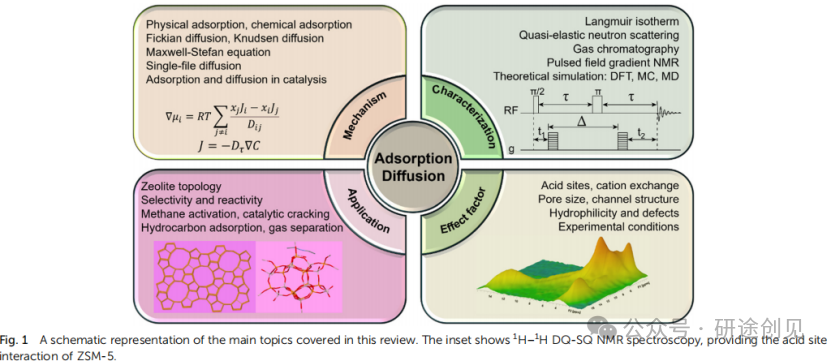
Zeolite materials are widely used in the catalytic field due to their highly ordered microporous framework, large specific surface area, tunable pore structure, and surface acidity. The adsorption and diffusion behavior within their channels directly determines the efficiency of reactant molecules contacting active sites, thereby affecting catalytic activity and selectivity (Figure7 shows the interactions of BAS, EFAl, and hydrogen bonds in the symbiotic structure of MFI/MEL, regulating the behavior of guest molecules). Adsorption can be divided into physical adsorption (weak intermolecular forces, reversible, suitable for small gaseous molecules) and chemical adsorption (formation of chemical bonds, lowering activation energy, serving as a pre-activation step for catalysis). Both mechanisms work together to form the reaction pre-activation mechanism, with adsorption selectivity influenced by pore size (Gugeler et al. unified molecular diameter and pore accessibility calculation standards), molecular shape (including reactants, products, and constrained transition states), and chemical composition. Diffusion can occur through Fickian diffusion (where pore size is much larger than the molecular mean free path, following Fick’s law), Knudsen diffusion (where pore size is comparable to the molecular mean free path, with molecular-wall collisions dominating), surface diffusion (migration along pore walls under low concentration/strong adsorption, showing non-monotonic temperature dependence), and configurational diffusion (where molecules are comparable to pore size and must overcome high energy barriers). In multi-component systems, diffusion is often described using Maxwell-Stefan theory, and the inhomogeneity of pore structures requires an extension of Fick’s second law analysis, with attention also needed for anomalous transport phenomena such as single-file diffusion.
Adsorption and diffusion are interdependent in zeolite catalysis; adsorption determines the efficiency of reactants entering the channels, while diffusion controls molecular migration and product desorption. Together, they influence catalytic efficiency: excessive adsorption can hinder molecular transport, and complex pore structures can lead to diffusion limitations. This can be quantitatively assessed through the Thiele modulus (φ) and Weisz-Prater criterion, which evaluate internal mass transfer limitations (when φ is large, pore connectivity needs optimization; when φ is small, adsorption performance needs optimization). Previous studies have summarized zeolite synthesis and adsorption applications, while Smit and Maesen have reviewed the progress of molecular simulations in adsorption and diffusion. Pe´rez-Ramı´rez et al. analyzed zeolite structure optimization strategies, and Sastre et al. focused on the separation performance of small-pore silicate zeolites. This review integrates zeolite microstructure, molecular transport dynamics, and catalytic activity, summarizing adsorption and diffusion mechanisms and advanced characterization methods (Figure1 includes ¹H-¹H DQ-SQ NMR spectra demonstrating the role of acid sites in ZSM-5), classifying zeolites by topological structure and summarizing their characteristics in methane activation, catalytic cracking, and other applications.
【Characterization Methods for Adsorption and Diffusion】
1、Adsorption Description Based on the Langmuir Model
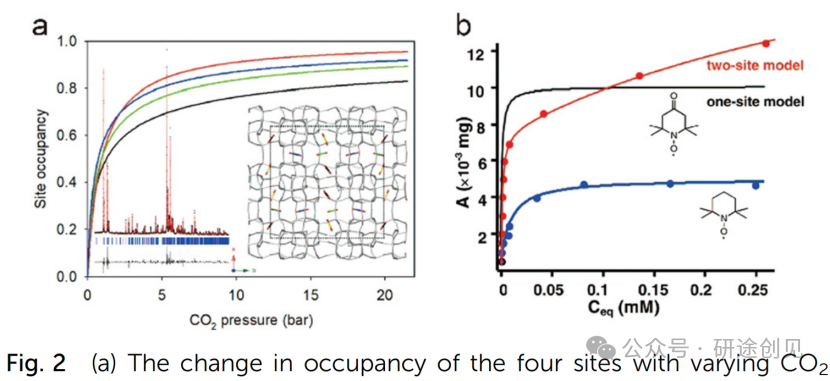
The Langmuir adsorption isotherm model is the fundamental theoretical framework for understanding zeolite adsorption, based on the assumptions of monolayer adsorption, equal energy of adsorption sites, and no lateral interactions (Equation2.1,q is the equilibrium adsorption amount,qmax is the maximum monolayer adsorption capacity,K is the adsorption constant,p is the equilibrium pressure/concentration), which can quantify the contribution of pore size to selective adsorption and clarify the role of acid sites in regulating adsorption strength. It is widely applied in gas separations such as CO₂/CH₄/N₂, and in graded zeolites, it can elucidate the adsorption-diffusion synergistic effect. However, this model has limitations: it cannot accommodate multilayer adsorption (requiring BET theory), is difficult to describe surface heterogeneity (requiring Freundlich isotherms, etc.), and in multi-component systems, the model needs to be extended. Under high pressure, multilayer adsorption and pore constraints can reduce predictive accuracy. In research examples, Lill et al. found that MFI zeolites with only straight channels conform to classical Langmuir behavior, while other sites require Toth isotherms (Figure2a shows the relationship between CO₂ pressure and site occupancy); Moscatelli et al. confirmed through Langmuir isotherms that MFI zeolites have two types of adsorption sites on their outer surface, with 4-oxido-TEMPO requiring a dual-site model fit (Figure2b shows its adsorption isotherm), while TEMPO fits only a single-site model, with parameters validated by EPR.
2、Quasi-Elastic Neutron Scattering (QENS) Technology for Studying Adsorption and Diffusion
QENS technology is sensitive to hydrogen atoms and has a wide temporal and spatial resolution, allowing precise acquisition of molecular diffusion, rotation, and vibration information in zeolites. By measuring the energy transfer between neutrons and atomic nuclei, data such as molecular residence time and self-diffusion coefficients (Ds) can be obtained. It can capture dynamics from picoseconds to hundreds of nanoseconds and detect displacements from 0.1 to 100 nm; by using coherent scattering (Equation2.2,Scoh(Q,ω) is the coherent scattering function,Dt is the transport diffusion coefficient) to determineDt, and using Einstein’s relation (Equation2.3,ri(t) is the molecular position) to deriveDs. Studies show that the self-diffusion coefficient of n-alkanes in silicalite-1 decreases with increasing chain length; Jobic et al. found that methanol has strong interactions with acidic sites in HY zeolites (Figure3a shows the hydrogen bond configuration), and the diffusion coefficient of methanol in HY is higher than in NaX and follows Arrhenius behavior; QENS spectra of catechol in β zeolites show significant elastic components (Figure3b), with molecular motion conforming to isotropic rotation; in NaY zeolites, the diffusion coefficient of methane shows non-monotonic changes with loading, peaking at 32 CH₄ per unit cell (Figure3c).
3、Gas Chromatography (GC) Technology for Studying Adsorption
GC separates and analyzes components based on the differences in distribution coefficients between zeolites (stationary phase) and the mobile phase. In zeolite adsorption studies, there are three core applications: breakthrough curve experiments generate curves by monitoring outlet gas concentrations to obtain parameters such as adsorption capacity and selectivity; adsorption isotherms can be constructed under controlled temperature and gas flow, combined with the Langmuir model to analyze the distribution of adsorption sites; commonly used detectors such as FID, FPD, TCD, and MS enable qualitative (retention time) and quantitative (peak height/area) analysis. The pulse injection method analyzes adsorption-diffusion behavior by monitoring changes in retention time and peak shape, combined with the Van Deemter equation (Equation2.4,H is the theoretical height of a mass transfer unit,A/B/C are the eddy/longitudinal/mass transfer terms,u is the carrier gas flow rate) to calculate the effective diffusion coefficient (Deff); the Zero Length Column (ZLC) method eliminates external diffusion resistance using extremely short chromatographic columns, calculating the internal diffusion coefficient (Dp) through the desorption curve formula (C(t)=C₀exp(-kt/(1+kβ))). In studies, Denayer et al. used pulse GC to find that the chain length of alkanes on SAPO-34 shows a non-monotonic relationship with adsorption strength (Figure4a shows the Henry adsorption constant); ZLC method studies show that the desorption rate of benzene from silicalite-1 accelerates with increasing temperature, while small crystals desorb more slowly due to surface pore blockage (Figure4b shows the ZLC desorption dynamics, Figure4c shows desorption curves of different particle sizes).
4、Pulsed Field Gradient Nuclear Magnetic Resonance (PFG NMR)
PFG NMR technology studies diffusion without destroying the sample, measuring molecular self-diffusion coefficients by introducing magnetic field gradient pulses into the NMR sequence, correlating nuclear spin phases with spatial positions, and calculating diffusion coefficients. It can distinguish between free and restricted diffusion and is widely used for measuring molecular diffusion in zeolites in the liquid phase (Figure5a shows the PGSE sequence). The diffusion coefficient is calculated using the Stejskal-Tanner equation (Equation2.6,S is the signal intensity,S₀ is the unattenuated intensity, γ is the gyromagnetic ratio, δ/Δ are the gradient pulse parameters) . In research examples, n-octane diffusion rates in USY zeolites decrease more rapidly (Figure5b shows the relationship between diffusion coefficient and mean square displacement); Hunger et al. found that the activation energy for ethylene diffusion in SAPO-34 is lower than that for ethane; Liu et al. determined that the methane diffusion coefficient in RHO zeolites is the highest, while LEV is the lowest. Additionally, ¹H PFG NMR and ¹²⁹Xe EXSY NMR show that DNL-6 (RHO) has higher methane diffusivity than SAPO-42 (LTA), and that DNL-6 shows a significant increase in diffusion coefficient with loading due to the “self-gating” mechanism (Figure5c-f shows the relevant data).
5、Theoretical Simulation Methods for Adsorption and Diffusion
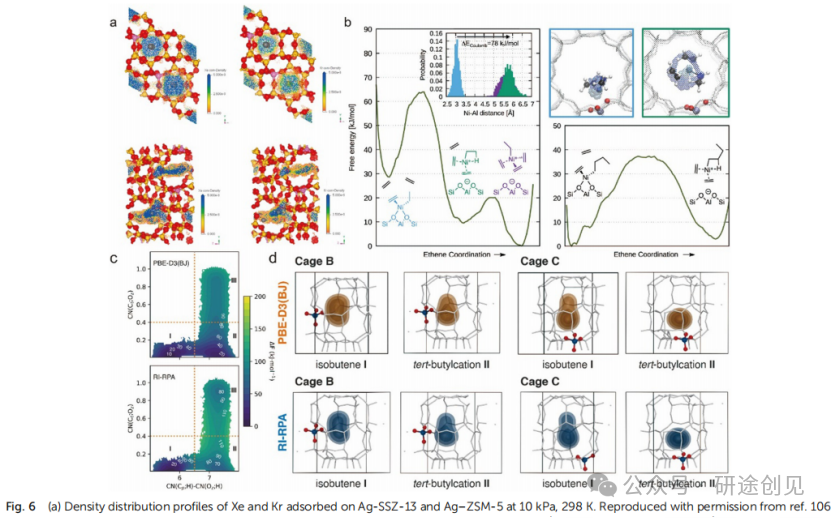
Theoretical simulations encompass DFT, MC, and MD: DFT solves electronic structures to obtain stable configurations of adsorbed molecules and adsorption energies (Equation2.7) and reaction energy barriers (Equation2.8); MC simulations (commonly GCMC) obtain equilibrium properties such as adsorption isotherms through random sampling (Equation2.9, θ is the adsorption amount,<N> is the average number of particles,Ntotal is the total number of adsorption sites); MD tracks molecular trajectories based on Newton’s equations to extract dynamic properties such as diffusion coefficients (diffusion coefficient calculation uses Equation2.3). In research, Ag-SSZ-13 shows that Ag⁺ enhances Xe adsorption, while Ag-ZSM-5 shows that Xe/Kr mainly adsorbs in 10-membered ring channels (Figure6a shows the density distribution); Brogaard et al. found that ethylene promotes Ni to leave the framework in Ni-SSZ-24, forming mobile complexes and lowering reaction energy barriers (Figure6b shows the free energy curve and configuration); Bocus et al. showed that ethylene coordination with Ni-ethyl is easier than with Ni-butyl, and that large pore AFI topology is more favorable for catalysis (Figure6c shows the free energy surface, Figure6d shows the density map).
【Performance of Zeolite Materials in Adsorption and Diffusion Applications】
1、FAU-Type Zeolites
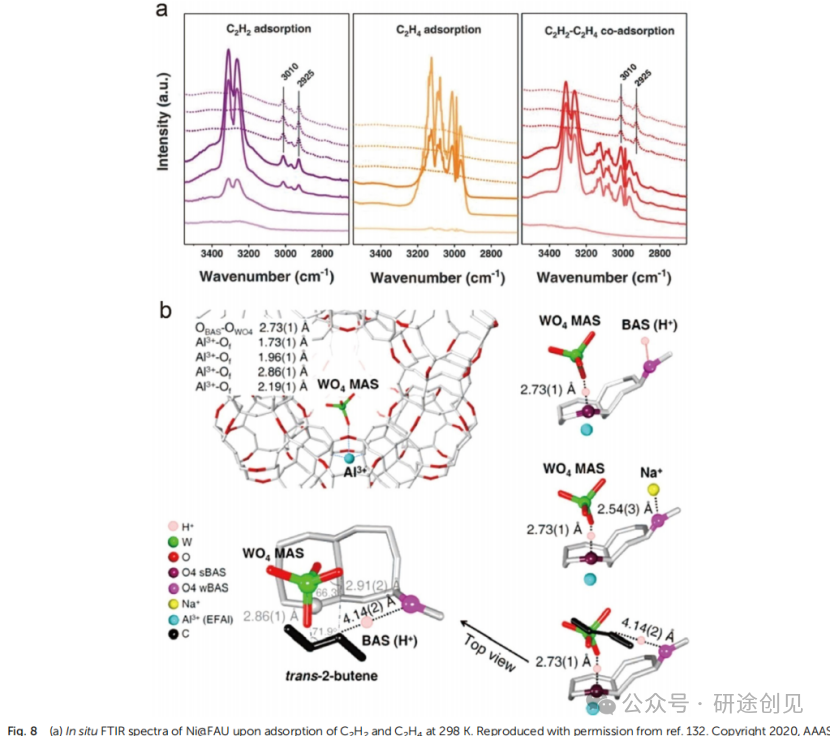
FAU topology contains 12-membered ring large pores and three-dimensional channels, with super cage structures suitable for large molecules, showing outstanding performance in the adsorption and catalysis of hydrocarbons, NOₓ/COₓ. In hydrocarbon adsorption, Re-doped Y zeolites (Re–O–H⁺ active pairs) achieve 90% selectivity for propylene and 79% conversion rate for 2-butene at 75℃; Ni@FAU shows an acetylene adsorption capacity of 3.48mmol·g⁻¹ at 298K and 1bar (far exceeding ethylene), achieving reversible adsorption through [Ni(alkyne)₃] (Figure8a shows in situ FTIR spectra); WOₓ/USY achieves 79% propylene yield at 200℃ and 1bar (Figure8b shows the crystallographic model).
In NOₓ/COₓ adsorption, Ba-FAU and Na-CHA show excellent N₂O adsorption performance even at low pressures of 0.05bar (Figure9a-g shows adsorption isotherms and selectivity); low Si/Al ratio X-type zeolites outperform Y-type zeolites in CO₂ separation, with Na-X showing a physical adsorption capacity for CO₂ eight times that of Cu-X (Figure9h-i shows selectivity and adsorption capacity). Additionally, NH₄F etching of FAU constructs hierarchical pores (FY series), significantly reducing the diffusion barrier for Xe, with FY60 showing higher conversion rates in n-C₈ hydrocracking (Figure10a-b shows NMR spectra and chemical shifts); H-FAU/Na-LTA dual-layer membrane reactors achieve 90.9% methanol conversion and nearly 100% DME selectivity at 310℃ (Figure10c shows a schematic).
2、CHA-Type Zeolites
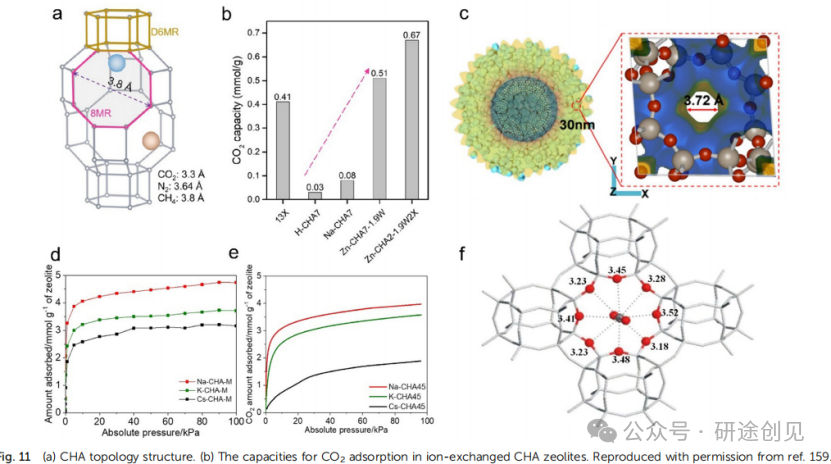
CHA is derived from FAU (d6r rearrangement), with 8-membered ring small windows suitable for small molecules, showing significant advantages in CO₂/NOₓ adsorption and MTO reactions. In CO₂ adsorption, Zn²⁺ modification of CHA achieves an adsorption capacity of 0.67mmol·g⁻¹ (Figure11a-b shows topology and adsorption capacity); sunflower-shaped CHA superstructures achieve a CO₂ adsorption capacity of 71.14cm³·g⁻¹ at 298K and 0.15bar (Figure11c shows structure); 45nm nano K-CHA shows selectivity of 108 for CO₂/N₂ and 78 for CO₂/CH₄ (Figure11d-e shows adsorption isotherms); Si-CHA’s 8-membered ring is the optimal adsorption site for CO₂ (Figure11f shows configuration).
In NOₓ adsorption, Pd²⁺ in SSZ-13 undergoes configurational changes under water/NO, affecting CO oxidation activity; Mn/CHA@Pd/CHA core-shell structures enhance NOₓ desorption efficiency by 35%. In MTO reactions, CHA restricts large molecular intermediates, enriching light olefins; at 250K, chemical adsorption of alkanes predominates, while at 350K, it shifts to physical adsorption; SAPO-34 shows non-monotonic changes in alkane adsorption strength with chain length; mesoporous In-SSZ-13(MP) enhances low-concentration CO₂ reduction performance; mesoporous SSZ-13-F-M25 shows faster adsorption rates for methanol and butanol (Figure12 shows adsorption curves).
3、MFI-Type Zeolites
MFI contains cross-linked 10-membered ring channels, widely used in gas adsorption, hydrogenation/hydrogen cracking, and methanol conversion. In gas adsorption, H-ZSM-5 shows two adsorption configurations for pyridine: vertical and horizontal; H-ZSM-5 shows strong adsorption for CO, enhancing C₂H₄ conversion rates. In hydrogenation/hydrogen cracking, Pd@S-1 shows selectivity for furan over 70%, while Pd@Na-ZSM-5 shows selectivity for furfural over 90%; the c-axis length of H-ZSM-5 affects C₄ olefin diffusion, with Z-cL diffusion activation energy at 20.3kJ·mol⁻¹ (lower than Z-cS) (Figure14 shows adsorption curves and diffusion coefficients); water can inhibit deep cracking of n-C₁₆ in Pt/MFI, while nanosheets of MFI show superior mass transfer. In methanol conversion, c-axis orientation in ZSM-5 hollow fibers shows excellent MTG reaction performance (Figure16a-c shows structure and performance); traditional MFI (250nm path) shows high ethylene selectivity, while self-supporting columnar MFI (1.5nm path) shows weak aromatic cycling (Figure16d shows conversion rates and selectivity); H-GaAl-ZSM-5 can synergistically activate methane and methanol.
4、MOR-Type Zeolites
MOR contains a 12-membered ring main channel and 8-membered ring side pockets, showing outstanding performance in olefin/alkane separation, carbonylation, and CO₂ adsorption. In olefin/alkane separation, MeOPh-modified MOR shows an ethylene adsorption capacity of 1.1mmol·g⁻¹ at 30℃ and 100kPa (ethylene 0.021mmol·g⁻¹), and propylene 0.58mmol·g⁻¹ (propane 0.028mmol·g⁻¹). In carbonylation, H-MOR with a Si/Al ratio of 13.8 achieves a methyl acetate generation rate of 7.2mmol·(h·g)⁻¹; oxalic acid treatment enhances pore accessibility; acetyl cations migrate under methanol, with a migration barrier of 38.8kJ·mol⁻¹ (Figure17a-d shows pore channels and free energy curves).
In CO₂ adsorption, Fe-MOR(0.25) shows excellent adsorption capacity and selectivity, with water stability (Figure17e-h shows performance data); HF etching of MOR-C reduces surface resistance; nano Ti-MOR shows a conversion rate of 94.4% for cyclohexanone (micron crystals 16.6%).
5、*BEA-Type Zeolites
*BEA contains 12-membered ring three-dimensional channels, showing excellent performance in nitroaromatic adsorption, sugar conversion, and epoxide ring-opening. In nitroaromatic adsorption, Pd@beta preferentially adsorbs nitroaromatics, with high selectivity for 4-nitrochlorobenzene hydrogenation (Figure18a shows model and performance). In sugar conversion, H-[B]-BEA shows high furan selectivity and stability, while H-[Al]-BEA shows high activity but is prone to deactivation (Figure18b shows electrostatic potential distribution); introducing methyl isobutyl ketone can enhance HMF selectivity. In epoxide ring-opening, Sn-beta shows an apparent activation energy of 34.8kJ·mol⁻¹ (lower than H-beta), with Lewis acidity ranking Sn-beta>Zr-beta>Ti-beta (Figure18c shows acid site density).
Additionally, high-defect Ti-BEA enhances 1-hexene epoxidation performance; B-C structure beta nanosheets (beta-NS) show diffusion efficiency 35 times that of traditional beta-C, with excellent n-heptane cracking performance (Figure18d shows diffusion time constants).
6、Other Types of Zeolites
In FER-type zeolites, n-alkane adsorption sites vary with chain length, while methanol diffusion in 8-membered rings conforms to Fick’s second law. In LTA-type zeolites, graded LTA shows fast xenon diffusion, while C₅-C₁₀ alkane adsorption occurs in two steps. In MER-type zeolites, low Si/Al ratios allow MER to adsorb CO₂ through a “cooperative cation-gated breathing mechanism,” with K-MER-2.3 showing optimal selectivity and capacity (Figure25c shows performance).
In MWW-type Al-SSZ-70, 94% Al is on the large pore surface, facilitating large molecule reactions. In SOV-type SCM-15, low-load p-xylene diffuses along the z-direction, while high-load diffuses along the x-direction. Additionally, the hydrophilicity of zeolite membranes and defects affects water transport, with high hydrophilicity promoting transport under high hydration, while defects increase resistance.
【Factors Affecting Adsorption and Diffusion of Zeolite Catalysts】
1、Influence of Acid Sites
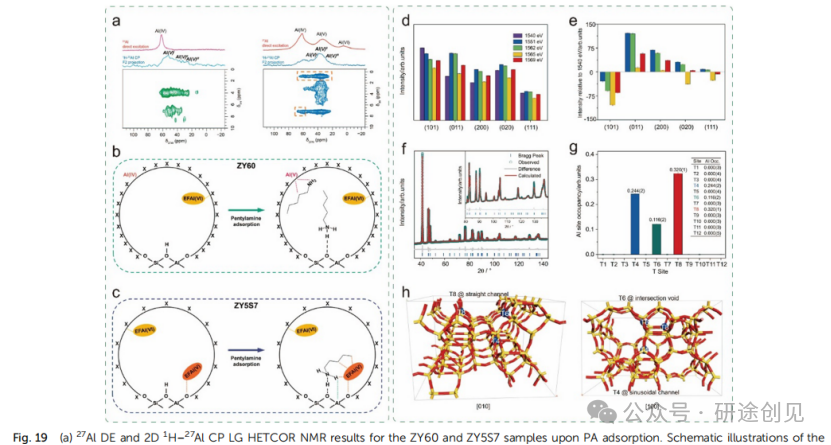
The strength of acid sites determines the adsorption energy of molecules and the difficulty of desorption. Strong acidic sites can enhance molecular capture efficiency, but excessive adsorption can increase mass transfer resistance. Framework aluminum (EFAl) can adjust the strength of Brønsted acid sites (BAS), such as in ZY5S7 (highEFAl) where phthalic acid (PA) interacts with Al⁴⁺, Al⁵⁺, and Al⁶⁺, enhancing catalytic cracking activity through the synergy of EFAl and BAS, while hydrogenation performance mainly relies on the quantity of BAS (Figure19a-c shows NMR results and action schematics).
Lewis acid sites (LAS) can synergistically catalyze, such as Sn-SPP’s Sn-O-Si-OH stabilizing the transition state of fructose etherification through hydrogen bonding. In H-ZSM-5, Al is non-randomly distributed among T4, T6, and T8 sites, with T6 and T4 forming Al pairs to promote bimolecular reactions (Figure19d-h shows diffraction intensity and Al site distribution).
Additionally, BAS can lower the diffusion energy barrier for olefins (at 600K, the diffusion energy barrier for ethylene decreases from 38 to 10kJ·mol⁻¹ with increasing BAS), but has no effect on alkane diffusion, due to π-H interactions between olefins and BAS (Figure20d-e shows diffusion free energy curves).
2、Influence of Pore Size, Channel Type, and Morphology
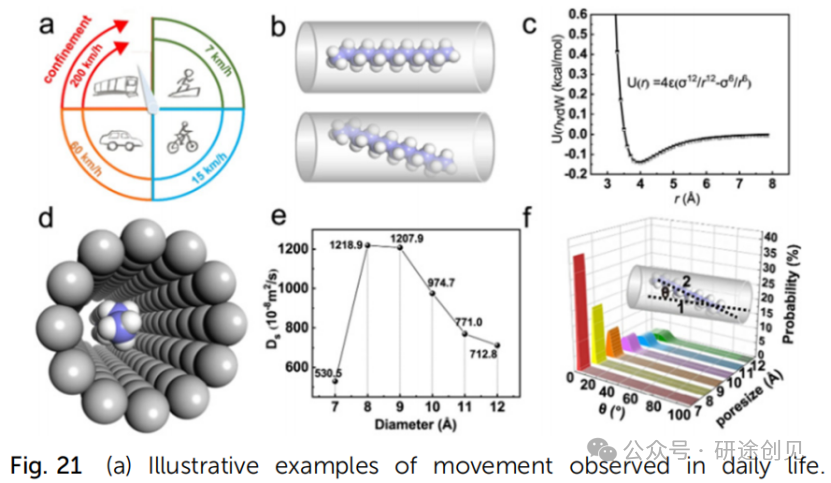
Pore size, channel type, and morphology regulate molecular transport pathways. The “superloop” model shows that in small channels, molecules diffuse linearly along the axis (fast rate), while in large channels, molecules are prone to deviating from the path (slow rate) (Figure21a-f shows the diffusion behavior of n-dodecane in different pore sizes). Channel structure determines diffusion characteristics: MFI shows a decrease in diffusion coefficient when pores are saturated, while LTA/DDR shows stepwise hopping (low rate), and FAU allows multiple molecules to pass (limited small) (Figure22a shows diffusion screening results).
Hierarchical mesoporous-microporous structures enhance mass transfer, as in MWW/MFI, where mesopores enhance large molecule accessibility to acid sites, while small molecule reactions are still controlled by micropores (Figure22b shows the Arrhenius curve for propane conversion). Pore size also affects reaction thermodynamics: MFI has low activation enthalpy but unfavorable entropy, while FAU is prone to entropy-driven reactions, with reaction rates in mesoporous environments enhanced by two orders of magnitude compared to aqueous phases (Figure22c shows data for the dehydration reaction of cyclohexanol).
Additionally, surface resistance cannot be ignored, as in SAPO-34, where enhanced surface acidity in small crystals increases resistance, while propane diffusion in AlPO-LTA is hindered by surface barriers (Figure23a-e shows IFM images, uptake curves, and diffusion concentration distributions).
3、Influence of Ex-framework Cations
Ex-framework cations regulate active sites and channel “gating” behavior: Pd cations preferentially occupy the 6-membered rings of CHA/BEA (with Al in the NNNN configuration being the most stable), while Pd⁺H⁺ shows stronger affinity for NO adsorption than Pd²⁺ (Figure24a-b shows formation energy and adsorption energy); Au-ZSM-5 shows lower activation energy for methane activation than Au⁺ ions. Some cations induce the “flap door effect,” such as in RHO, where CO₂ drives the rearrangement of Na⁺/K⁺/Cs⁺, while in Sr/K-HEU, Sr²⁺ only allows CO₂ to trigger pore opening (with CO₂/C₂H₂ selectivity of 48); in K⁺-ZSM-5, the migration barrier for pau-opr channels is the highest (1.13eV), being the rate-controlling step. In MER zeolites, low Si/Al ratios allow K-MER-2.3 to adsorb CO₂ through a “cooperative cation-gated breathing mechanism,” with optimal selectivity and capacity (Figure25a-c shows migration paths and separation performance).
4、Influence of Hydrophilicity and Framework Defects
Hydrophilicity is determined by the Si/Al ratio and structure: increased Si/Al ratio enhances hydrophobicity, while low Si/Al ratio increases hydrophilicity; silicalite-1 with silanol nest defects exhibits strong hydrophilicity. Framework defects (such as silanol nests) alter the adsorption energy landscape, with SAPO-34 surface Si-OH defects reducing the 8-membered ring pore size (11.1Å→10.2Å), increasing diffusion energy barriers. After acid etching, the Si/Al ratio decreases to 0.75, reducing surface diffusion activation energy (Figure26a-i shows STEM, AFM, NMR images, and adsorption energy calculations).
Hydrophilicity and defects can be regulated through modification, such as in Ti-beta, where increased Ti loading shifts the material from hydrophilic to hydrophobic, while amino functionalization of MFI enhances hydrophilicity (improving formic acid dehydrogenation activity).
5、Influence of Experimental Conditions
Water molecules affect reactant adsorption and diffusion, as in H-ZSM-5, where high water loading drives benzene to combine with surface methoxy species (SMS). (Figure27a-d shows NMR spectra and schematics). Temperature changes adsorption patterns and diffusion rates: in SAPO-34, increasing temperature shifts acetone adsorption from BAS to FLP, while in ZSM-5, the diffusion range of ethanol expands with increasing temperature. Pressure and loading affect diffusion mechanisms, with narrow-window cage-type zeolites showing changes in diffusion activation energy with loading; calcination temperature induces core-shell strain in ZSM-5, altering the distribution of adsorption sites. In multi-component systems, FAU/EMT shows both intra- and inter-crystalline diffusion of iso-octane at 289K, with high temperatures facilitating overcoming mass transfer barriers (Table2 summarizes zeolite adsorption-diffusion performance).
【Conclusion and Outlook】
This article summarizes the core content, emphasizing that adsorption and diffusion are key steps in zeolite catalytic processes. The combination of advanced characterization techniques and multi-scale simulations provides strong support for understanding related mechanisms. The characteristic differences of zeolites with different pore structures determine their application scenarios, and multiple factors jointly regulate the adsorption and diffusion behavior of zeolites. At the same time, current research faces challenges, such as complex behaviors in industrial multi-component systems, solvent effects under liquid or high-humidity gas phase conditions, etc. Future research directions include developing more refined spatiotemporal characterization techniques, exploring the adsorption and diffusion characteristics of zeolites under extreme conditions, and utilizing machine learning and high-throughput calculations to mine structure-performance relationships. It is believed that precise design of pore structures and active sites, along with a deep understanding of adsorption-diffusion mechanisms and dynamic optimization of operating conditions, will promote the development of the next generation of efficient zeolites and composite porous materials, laying the foundation for green and sustainable chemical and energy conversion processes.
【Statement】
1、Copyright: The content is for learning and sharing purposes only, with copyright belonging to the original authors and institutions. The content reflects the author’s personal views, and criticism and correction are welcome. If there is any infringement, please contact us for deletion or modification. Thank you for the recommendation.
2、Submissions: We warmly welcome all teachers and leaders to introduce the latest or classic achievements or applications of their research groups on the public account! Please contact us in the background.