|Author: Ji Yang
(Institute of Semiconductor, Chinese Academy of Sciences)
This article is excerpted from Physics, Issue 5, 2022
Current middle schools do not teach computation (addition, subtraction, multiplication, and division are excluded), and universities generally do not involve computation in the first two years. Many university students, including second-year students in science and engineering, do not understand the power of modern computation, nor do they comprehend why we emphasize qualitative and semi-quantitative analysis.
We have all heard of “Moore’s Law”—the information processing capacity doubles every two years (perhaps even faster), but many people do not truly understand how powerful this “exponential growth” is. Even science and engineering students, perhaps including graduate students, may not be aware of the power of modern computation.
Let’s illustrate with an example. The calculations involved in the atomic bomb were essentially done by a group of people using hand-cranked calculators, as there were no electronic computers at that time. The first general-purpose electronic computer, ENIAC, was put into operation in 1946 (see Figure 1). It used about 20,000 vacuum tubes, occupied a large room (167 m2), consumed 150 kW of power, and had a computational capacity of only 5,000 additions and subtractions per second (20-digit decimal numbers). This was already impressive; without it, the hydrogen bomb would have remained solely in Taylor’s mind and would have been completely impossible to realize.
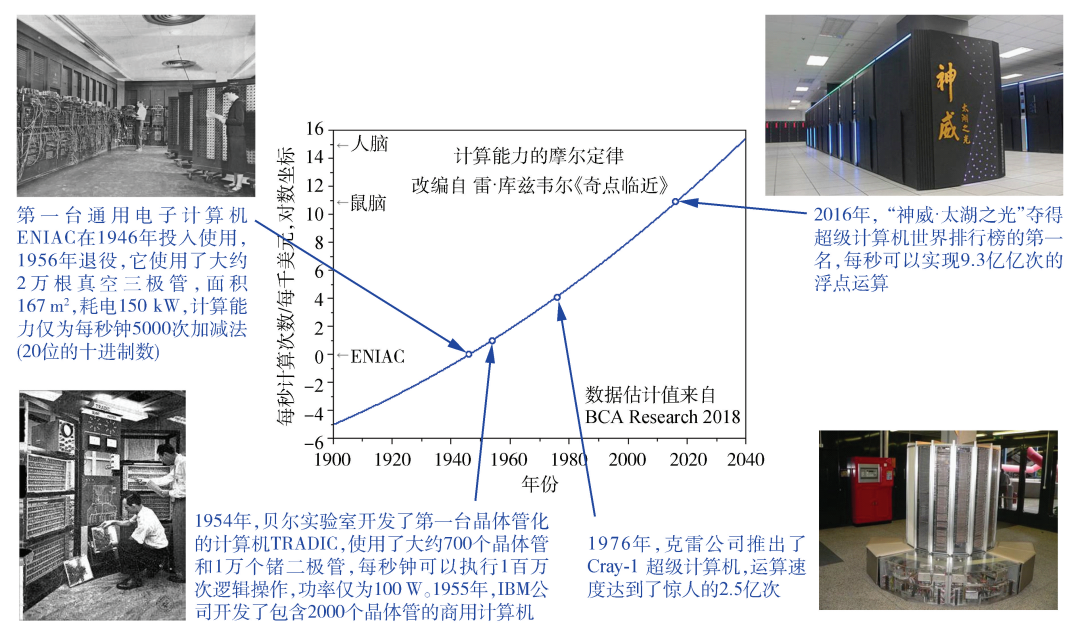
Figure 1. Computational power also follows Moore’s Law. From 1900 to 2020, the number of calculations per second (per thousand dollars cost) increased by about 20 orders of magnitude, taking the first general-purpose electronic computer ENIAC as a benchmark.
A few days ago, I saw an article introducing the contributions of “Father of the Hydrogen Bomb” Yu Min to China’s hydrogen bomb development[1]. A key moment was the “Hundred-Day Campaign” that started at the end of September 1965:
“In September 1965, the theory department decided that Deputy Director Yu Min would lead a portion of researchers from the 13th research office to Shanghai East China Computer Technology Research Institute on a business trip to utilize their J501 computer (operating speed of 50,000 calculations per second) to complete the optimization design task for the enhanced nuclear warhead. Director Deng Jiaxian required the personnel going to Shanghai to arrive before the National Day holiday to take advantage of all available computing time during the holiday period for concentrated efforts. More than 50 researchers and a few research assistants participated in this task. On September 27, the team arrived in Shanghai. The historic ‘Hundred-Day Campaign’ began.”
50,000 calculations per second, for a campaign lasting 100 days, totals less than 500 billion calculations at most. Considering necessary time for checks and corrections, it might only amount to 200-300 billion calculations. This was a very large amount of computation at that time and could only be completed in Shanghai. According to Yu Min’s recollections regarding usual work[2]:
“Compared to the Soviet Union and the United States, China’s hydrogen bomb can be considered a ‘poor man’s’ hydrogen bomb. At that time, there was only one computer, which was shared with the atomic bomb development department, and the weekly usage time was only about ten hours, mostly at night. Therefore, only complex problems would use the computer; usually, simple tools like abacuses and slide rules were used.”
500 billion calculations sound daunting, but looking back 60 years later, it is hardly significant. On my own computer, using SciLab software, I can perform 3 million calculations per second. I could complete the computational load of the Hundred-Day Campaign in just one or two days. My computer is mainly used for office work, and I usually just browse the internet, read articles, and write reports, and SciLab is not optimized for computation and can only utilize a small portion of the CPU. I asked a colleague, Professor Wu Xiaoguang, to try on his computer (Windows 10, CPU i7-9700, 3GHz, purchased in 2019). With a Fortran program, he could achieve 1.2 billion floating-point calculations per second—over 20,000 times faster than Yu Min’s computer. This means that the computational load of the “Hundred-Day Campaign” could now be completed in less than 7 minutes. Moreover, Professor Wu’s computer has 8 cores, but the program could only use 1 core. If fully utilized, it would take less than a minute.
Professor Wu’s computer is not very high-end, costing about 10,000 yuan. However, such a computer can complete the work of the “Hundred-Day Campaign” in just a few minutes. That’s not all. A blogger, Professor Liu Yang, showed me a computer he bought that uses a domestic CPU, capable of 0.8 T OPS (operations per second), which means 800 billion calculations per second—this does not include mathematical calculations (just operation counts; a mathematical calculation may involve several operations), but if converted to floating-point calculations, it should still amount to tens of billions or hundreds of billions. Such a processor (RADXA ROCK3 Model A, a 64-bit quad-core Cortex-A55 processor, as shown in Figure 2) costs only 245 yuan!
Figure 2. Affordable 64-bit quad-core microprocessor
But wait, this thing is still a bit expensive. Actually, you don’t have to buy it; you can completely rent one. Now there are many “supercomputers”, which are even more powerful and cheaper, and you don’t have to maintain them yourself. Simply put, a supercomputer is a combination of many CPUs (“cores”). Each core is more powerful than any of the cores in Professor Wu’s computer (at least stronger than any one of the 8 cores). Moreover, what’s even better is that the usage price is cheaper than Professor Liu’s computer.
How many such “cores” are there in each supercomputer? Not a thousand, not ten thousand, not even a million, but about a hundred million! Taking the “Sunway TaihuLight” as an example, when it won the supercomputer world championship in 2016, its computational capacity was 93 petaflops (9.3 billion billion calculations per second). Now, five years have passed; has it improved? The supercomputer world champion announced in 2021 is Japan’s “Fugaku”, capable of 450 petaflops (45 billion billion calculations per second). However, some large supercomputers did not compete (no data released). I saw on the WeChat public account “Voice of Wind and Cloud” that English media reported[3] that China’s “Sunway TaihuLight” and “Tianhe-3” have both reached exascale computing capabilities—100 billion billion calculations per second. What does this mean? The “Sunway TaihuLight” can provide 1 billion calculations per second for 1 billion Chinese people, meaning each person’s computational power is 20,000 times that of Yu Min’s computer! Compared to the first general-purpose electronic computer ENIAC, which was put into operation in 1946, our current computational capacity has increased by about 15 orders of magnitude at the same cost, which is a trillion trillion times!
Is using such supercomputers expensive? Actually, it’s not bad. Each “core hour” costs about 0.1 yuan, meaning using one core for one hour only costs 0.1 yuan. If you want to use it, you will find that this is basically the price of electricity. In other words, if you are satisfied with a speed 20,000 times faster than Yu Min’s computer, then the computational load of the “Hundred-Day Campaign” would only need 1 core for a few minutes, amounting to a cost of exactly 0.01 yuan. As the saying goes, a penny can defeat a hero! (Nowadays) a penny really can defeat (those) heroes of the past!
The advancement of technology has given us unprecedentedly powerful computational capabilities. However, that being said, the heroes of the past used (what now seems like pitiful) computers to calculate nuclear bombs, while our education still cannot fully utilize the advancements in computational power. Many people use (computers that were completely unimaginable back then) to play games online—what a contrast!
* This article was first published in the ScienceNet blog, titled “The Power of Modern Computing”, with additional modifications made during publication.
References
[1] Ying Yangjun, Li Shaomeng. Modern Physics Knowledge. 2014, 26(4): 39
[2] Yu Min recalls the development of the hydrogen bomb: only complex problems would use the computer, while simple calculations were done with abacuses and slide rules.https://www.163.com/dy/article/GDR9D6MU0-5373VK2.html
[3] Hemsoth N. China Has Already Reached Exascale On Two Separate Systems, 2021, 10, 26. https://www.nextplatform.com/2021/10/26/china-has-already-reachedexascale-on-two-separate-systems/
Physics is now available for purchase on Taobao and Weidian; scan the code to buy back issues and current issues.

 ▼Previous Highlights▼
1. New Directions Emerging in Interdisciplinary Science—Active Matter
2.Large-scale Computation Produces Huge Carbon Footprint
3.Poincaré’s Special Relativity Part II: The Symmetry of Physical Laws
4. Examples of Understanding Paths Related to the Theme of “Dynamics”
5. Various Derivations of the Black Body Radiation Formula and Its Significance in Constructing Modern Physics (VI)
6. Development and Application of High-Pressure Technology in Large Cavities
7.Topologically Protected Integrated Quantum Entangled Light Sources
8. What Exactly Is the Uncertainty Principle Saying?
9. This Common Black Stone, When Melted and Drawn into Threads, May Replace Materials We Are Familiar With | Liu Jiaqin—Science Forum
10. The Crisis of the Standard Model: Physicists Rethink the Nature of Reality