This year’s launch event for Intel’s 12th generation Core desktop processors (code name Alder Lake-S) was quite grand. In addition to the full-day launch event on October 28, there were actually pre-event communication meetings and demonstration activities for the media two days prior.
At the Intel Architecture Day two months ago, we thoroughly analyzed the two core architectures of this generation of Core CPUs: the performance-oriented P-core (code name Golden Cove) and the efficiency-oriented E-core (code name Gracemont). In our previous summary, we mentioned that both types of cores represent a significant architectural leap.
The P-core achieved a 19% IPC improvement compared to the previous generation (11th Gen Core Cypress Cove core), which is even greater than the improvement from Skylake to Sunny Cove; while the E-core, though only an “efficiency core,” still provides a single-thread performance improvement of up to 40% compared to Skylake (10th Gen Core) under the same power consumption, and a multi-thread performance improvement of up to 80%, with power consumption reduced by as much as 80%.
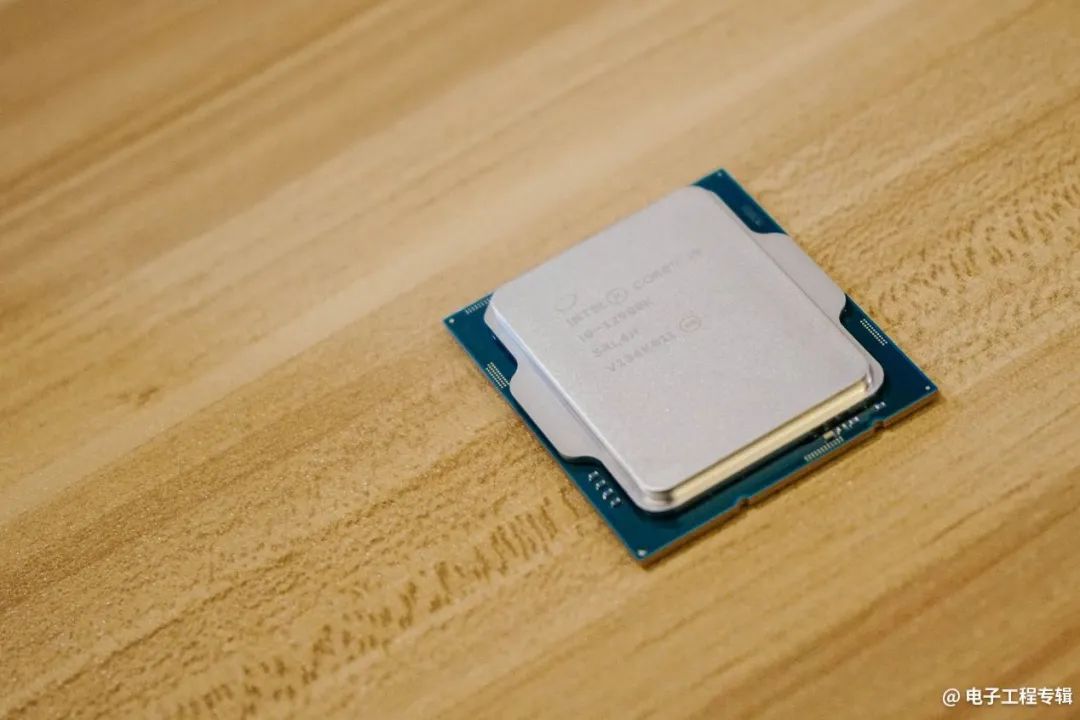
With the theoretical performance improvements at the core level, it should be easy to shake off AMD’s competition. Moreover, the 12th Gen Core is expected to surpass the recently hyped M1 Max in absolute performance, although it may still have some disadvantages in power consumption. Intel itself has high hopes for the 12th Gen Core, claiming it “redefines the performance of the x86 architecture,” and promoting the slogan “Heterogeneous Strong Cores, One Battle to Become a God,” referring to Alder Lake-S as “the world’s best gaming processor.”
Before reading this article, we recommend that interested readers first check out the article on the microarchitecture analysis of the 12th Gen Core P-core and E-core — in that article, we also discussed the Intel Thread Director technology that schedules this hybrid architecture. This article will discuss the 12th Gen Intel Core desktop processors from a more systematic perspective, along with more detailed information we heard during the launch event.
First Launch of Several Alder Lake-S New Products
Let’s first take a look at several new 12th Gen Core desktop processors launched by Intel, as shown in the figure below. This includes the high-end Core i9-12900K with 8 P-cores and 8 E-cores (24 threads); the Core i7 series generally has 8 P-cores and 4 E-cores (20 threads); and the i5 series has 6 P-cores and 4 E-cores (16 threads).
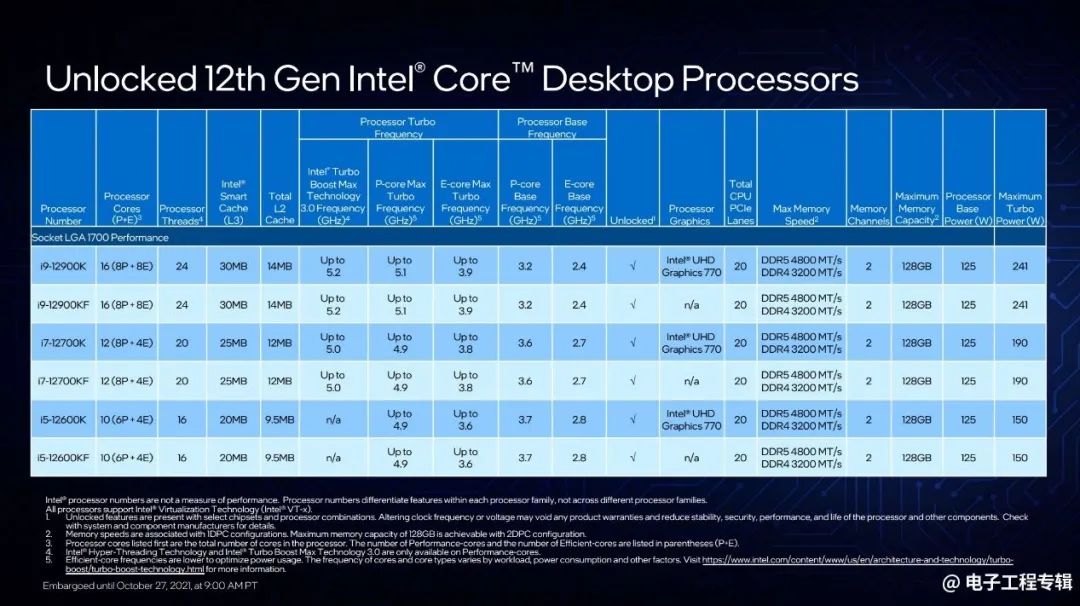
The main highlights of the I/O include support for DDR5 (4800 MT/s) and PCIe Gen 5 (16 lanes). Additional information regarding turbo frequency and cache is not elaborated here, as it can be seen in the image. It is worth noting that the power consumption section on the right side of the table is not marked with TDP as usual. This will be explained later.
Regarding cache, Intel stated that under the hybrid architecture, “the cache has been further enhanced. In addition to increasing the L2 cache of P-cores and the L2 cache per E-core, we have also enhanced and expanded the capacity of the shared L3 smart cache.” The L3 cache can go up to 30MB.
The integrated graphics this time is called UHD Graphics 770, which seems to be an improvement over last year’s 11th Gen Core (Graphics 750), although the specifics of the improvements are unclear. However, as an integrated graphics solution for desktop processors, the number of integrated Xe core units is likely to be limited.
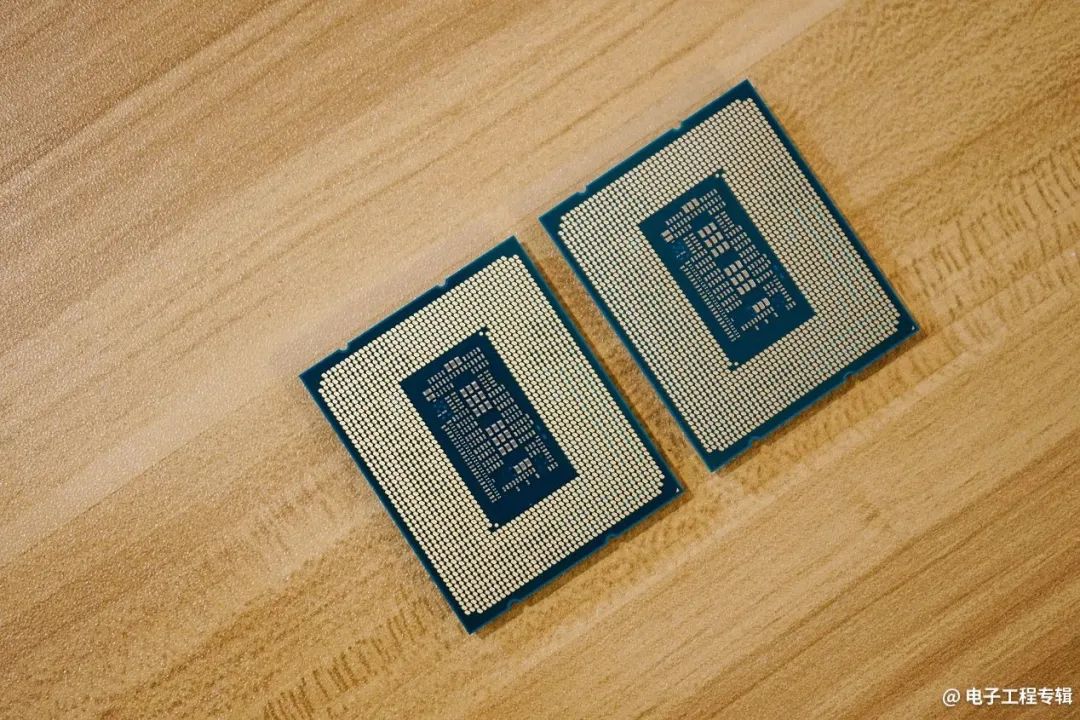
Other information about Alder Lake-S includes the use of Intel 7 manufacturing technology (formerly 10nm Enhanced SuperFin) and LGA1700 packaging, which means that old motherboards will not support Alder Lake-S. The new motherboards are paired with Intel’s 600 series chipsets. According to sales information from motherboard manufacturers on JD.com, Z690 chipset motherboards will be available in a few days. The relevant enhancements of the 600 series chipsets will be detailed later.
Brief Supplement on the Role of E-core
Although we have already used a considerable amount of space to discuss the two core architectures of Alder Lake and the supporting Intel Thread Director scheduling technology for this hybrid architecture, Intel still revealed some new information during this launch event. Before discussing specific products, let me share a brief overview.
Firstly, regarding the role of E-core in the system. Given the marketing from Arm, we usually refer to architectures that combine different cores as “big.LITTLE” designs. Therefore, most people view Intel’s push for a hybrid architecture with E-cores as adhering to the idea of “small cores.”
E-cores indeed have value in improving efficiency within the entire system, such as significantly saving power on laptop platforms. However, as mentioned in previous architectural analysis articles, E-cores have a core scale and width that far exceed Arm’s small cores (like Cortex-A55) and are standard out-of-order cores.
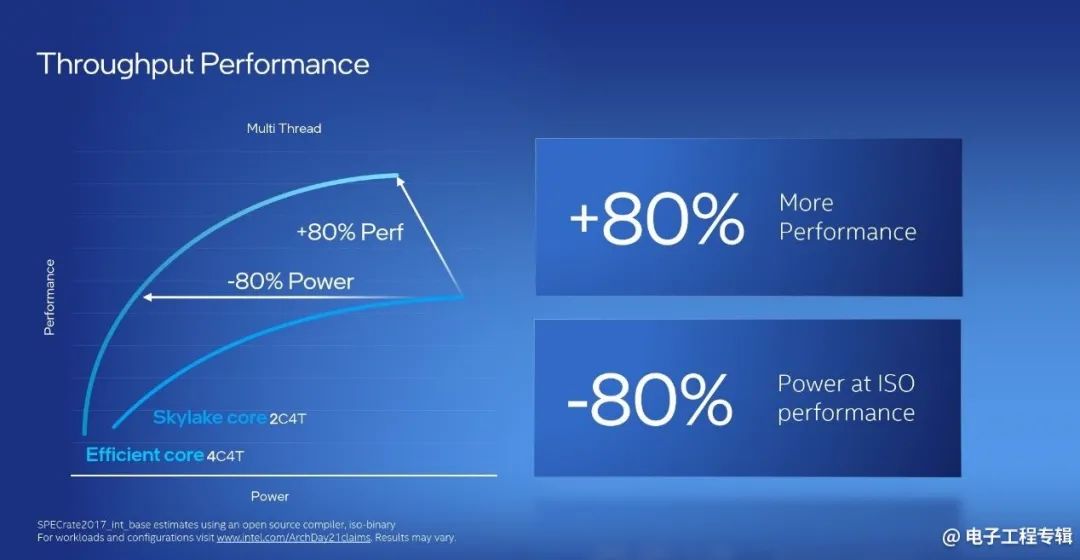
This generation of E-cores (Gracemont) has a single-thread performance (SPECint) that can improve by up to 40% compared to Skylake under the same power consumption, and multi-thread performance (4C4T) can improve by up to 80% (with power consumption reduced by 80% at the same performance). Of course, this comparison is based on specific frequencies and does not include floating-point performance. However, this also means that the 12th Gen Core, even with E-cores, is, in some respects, more powerful and energy-efficient than the 10th Gen Core’s “big cores.”
During this event, we asked Intel a question: since P-cores support hyper-threading, when a task requires processing 16 threads, will the 12th Gen Core processors prioritize filling 8 P-cores with 16 threads and enabling hyper-threading (8C16T), or will they prefer to allocate 8 threads to P-cores and the other 8 threads to E-cores (16C16T)?
Intel Fellow Guy Therien specifically mentioned in his response that hyper-threading usually brings a 30% performance boost, but E-cores can achieve an 80% additional performance. “So when filling the cores, we will first choose P-cores — because of their excellent performance, and then select E-cores. Only after they are all filled will we consider hyper-threading for P-cores.”
This answer significantly indicates that E-cores are not “small cores.” Intel seems to have been emphasizing the value of E-cores in enhancing multi-thread throughput. As we mentioned earlier, E-cores occupy a relatively small die area while achieving a relatively high multi-thread performance boost (four E-cores take up about the same area as one P-core), making them ideal for benchmark tests like Cinebench (no more worries about the chiplet-based core stacking tactics next door).
In the demo presentation, Intel also shared several interesting scenarios, including playing games while streaming on a platform — in which case E-cores will play a very good role, with game frame rates significantly improved compared to before. In the demonstration, Intel used “Mount & Blade” + streaming on Douyu platform — compared to competitors (AMD Ryzen 5950X), the game frame rate lead can reach about 40%; while without enabling E-cores, the lead is around 20%.
Another demonstration scenario involved using Premiere and Lightroom simultaneously — when Premiere was outputting video in the background, Lightroom was executing photo conversion work in the foreground, achieving a significant speed advantage. However, it seems that very few people actually use their computers this way.
Intel has preset some foreground and background or other multitasking work scenarios to illustrate the performance improvements achievable with the hybrid architecture, as shown in the figure above. This is also the reason why E-cores are used in desktop platforms; after all, they are not “small cores.” Intel mentioned in the sharing event that if one had to describe them, they should be referred to as “big cores” and “big big cores.”
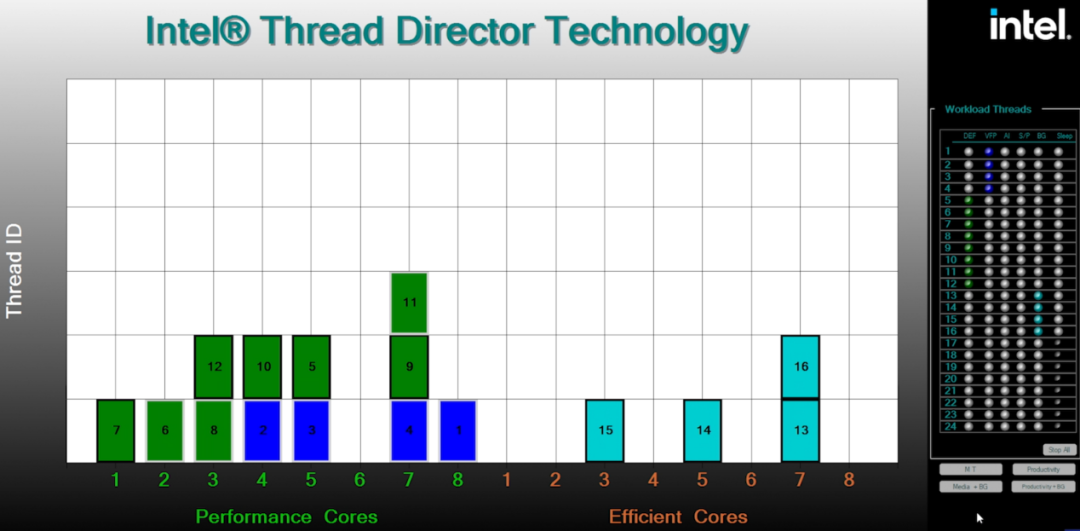
The question of how to utilize E-cores, P-cores, and hyper-threading is related to the scheduling mechanism. Intel Thread Director is a thread scheduling assistance technology designed for hybrid architectures. Since different cores compose the same processor, which threads run on P-cores, which run on E-cores, and when to migrate threads are all key factors affecting the user experience. Intel Thread Director can provide the operating system scheduler with more detailed hints to help it make scheduling decisions.
This technology was developed in collaboration with Microsoft Windows 11. We previously wrote a special article discussing this technology. The basic principles and some typical scheduling scenarios will not be detailed here.
Another noteworthy issue is that the 12th Gen Core does not support AVX-512 and AMX (Advanced Matrix Extensions, an AI acceleration unit). However, we know that Sapphire Rapids, used in data centers, supports these two features. This indicates that this generation of P-cores (Golden Cove) has the hardware foundation for AVX-512 and AMX in its design.
The primary reason the 12th Gen Core does not support these features is that E-cores do not include hardware implementations for AVX-512 and AMX. Generally, in a CPU, different architectures of cores must support the same instruction set, which is why the 12th Gen Core processor chip does not support AVX-512 and AMX.
So we asked Intel if there are plans to release a PC processor that only includes P-cores (without E-cores) in the future. Intel stated that they would need to wait for subsequent announcements. Regarding whether disabling E-cores would enable the AVX-512 and AMX features in P-cores, Intel’s response was “not possible.”
Performance Improvements of Alder Lake-S
The P-cores (Golden Cove) of this generation have a 19% IPC improvement over the 11th Gen Core cores (Cypress Cove), as previously discussed in the analysis of the P-core architecture. A 19% IPC improvement across generations is quite impressive: Golden Cove, as the microarchitecture foundation, should be extended in Intel’s subsequent processor products for a relatively long time. This is also the reason why the 12th Gen Core is considered revolutionary.
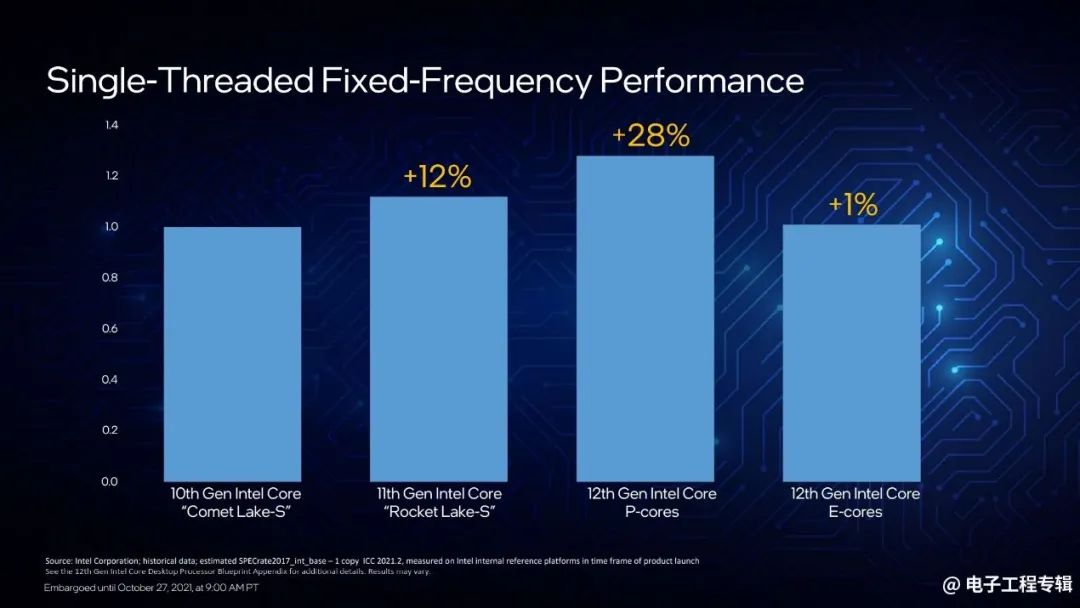
This time, Intel also provided more data; the above image shows the changes in integer performance (SPECrate2017_int_base) based on the 10th Gen Core (Comet Lake-S, Skylake core) as a benchmark. The P-cores (Golden Cove) of the 12th Gen Core show a 28% improvement. Notably, the E-cores (Gracemont) also have a 1% lead — this does not yet account for power consumption advantages.
This also highlights the significant changes in core performance in recent generations of Intel products.
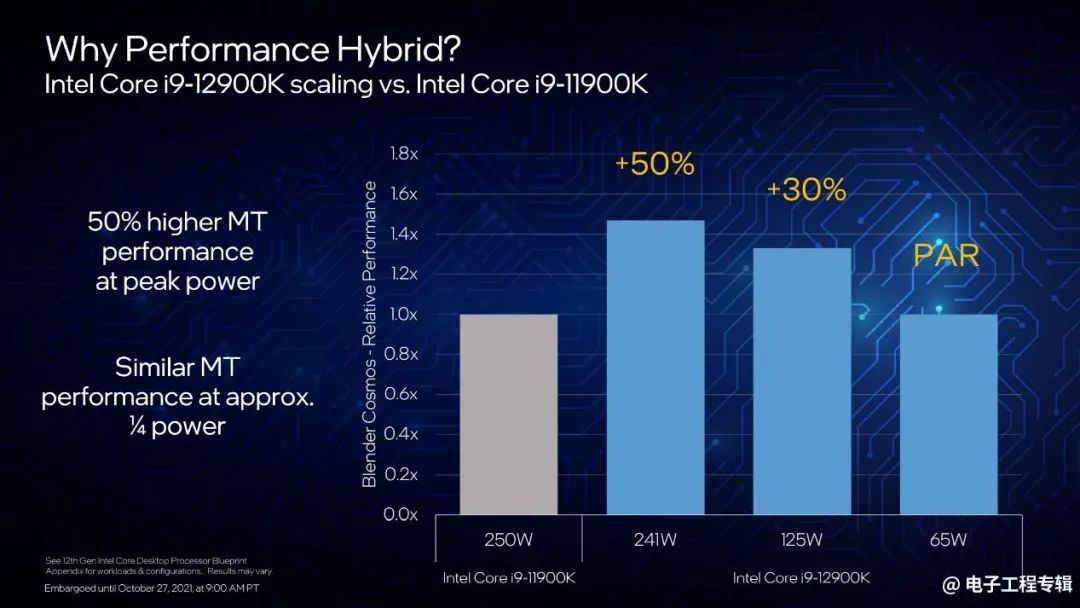
Combining both types of cores, the above image compares the Core i9-12900K with the previous generation i9-11900K. Using the performance achieved by the i9-11900K at a peak power consumption of 250W as a baseline, the multi-thread performance scores achievable by the i9-12900K at different power levels are shown in the image above.
This image highlights two points: first, at the peak power of 241W, the i9-11900K achieved a 50% improvement in multi-thread performance compared to the previous generation. More importantly, to achieve the same performance level as the previous generation, only 65W of power is needed, which is a quarter of the previous generation’s consumption. This means the 12th Gen Core should have more design flexibility for various models; it also makes us look forward to the mobile platform’s 12th Gen Core products.
Notably, in the product specifications table earlier, terms like “processor base power” and “maximum turbo power” first appeared. According to Intel’s explanation, base power refers to the power consumption under PL1 state; while maximum turbo power naturally refers to the power consumption under PL2 state.
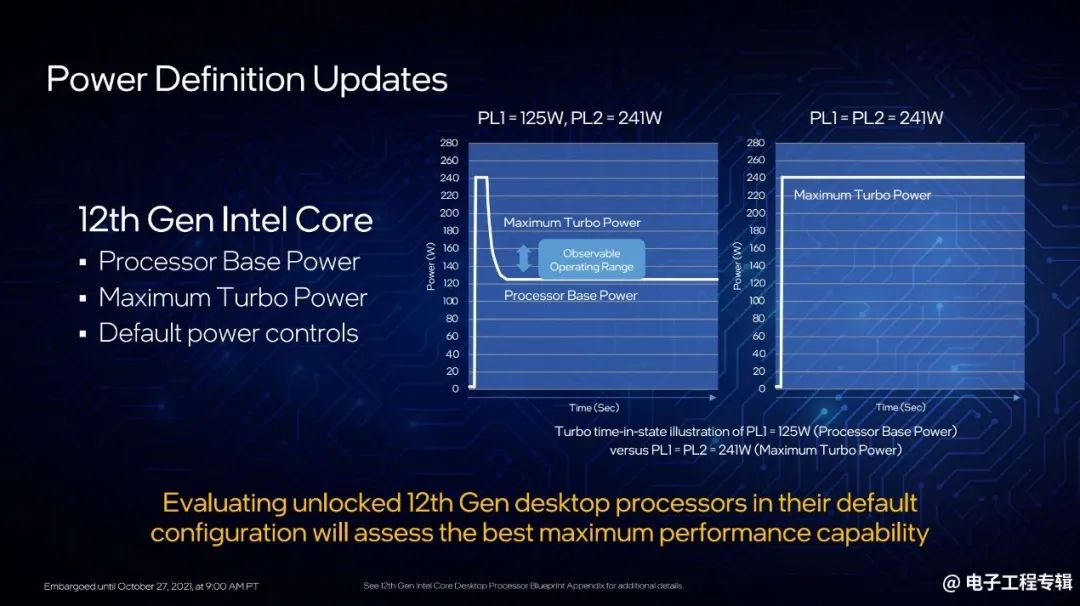
Those following PCs should be well aware that PL2 is a short-term turbo state: the processor can maintain this state for a short period to achieve a burst of performance; while PL1 is a relatively stable long-term turbo. The maximum turbo power for the highest configuration, the Core i9, is defined as 241W.
Intel stated that under ideal cooling conditions, PL1=PL2=241W can be set. This is because the chips can operate stably at 241W for a long time.
System Performance Compared to Previous Generations and Competitors
With this level of core performance improvement, although the manufacturing process will still lag behind competitors for a short time, AMD is unlikely to achieve a breakthrough in microarchitecture design with the upcoming Zen 4. Next, let’s discuss system performance, which is likely to be more concerning for many.
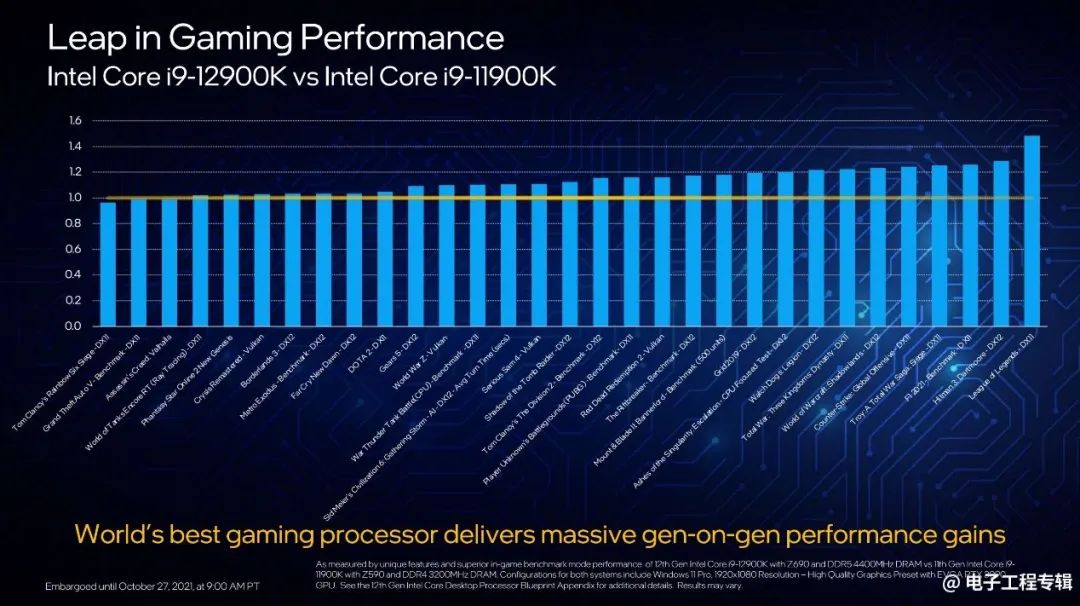
As a processor emphasizing gaming, the above image compares the performance of the i9-12900K with the previous generation i9-11900K across various games (other configurations include DDR5-4400 memory and Geforce RTX 3090 graphics card). Intel has tested a wide range of games, from “Rainbow Six” to “League of Legends.”
The overall performance improvement averages around 13% for the 12th Gen Core (Intel provided another set of data indicating an improvement of 13-28%, likely due to differences in testing environments and sample sizes). For games like “League of Legends,” the performance improvement is around 40%.
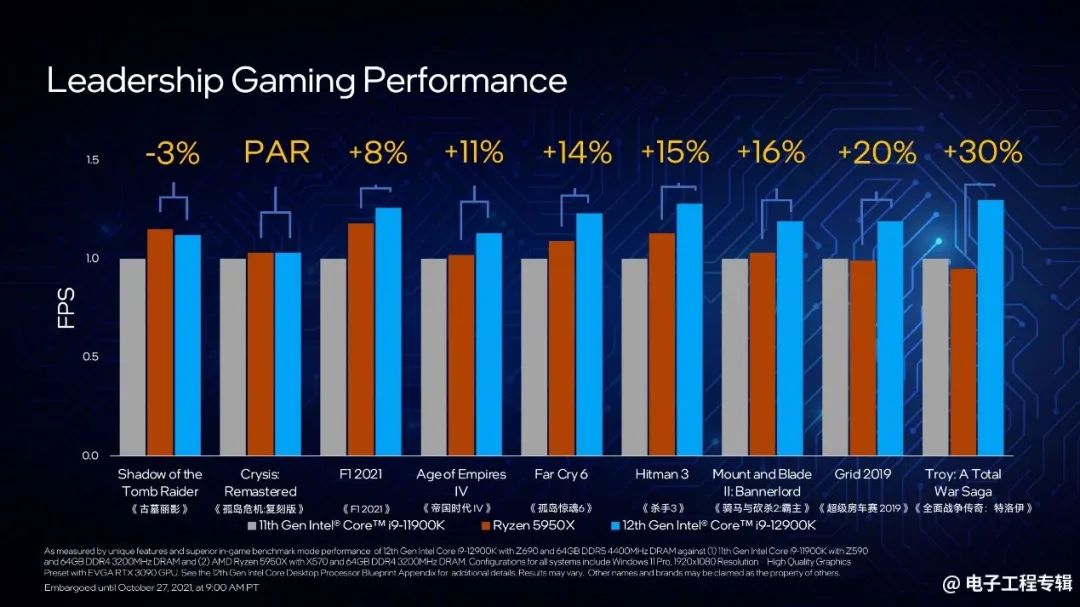
Comparing with AMD’s 5950X (finally, a comparison with the top-end 5950X). The table includes games such as “Tomb Raider,” “Crysis,” and “F1 Racing.” The Core i9-12900K outperforms AMD’s Threadripper in most games. However, this comparison does not showcase AMD’s advantage in system architecture by using its own GPU, as it is based on the Nvidia RTX 3090.
Additionally, the AMD Ryzen 5000 series does not support DDR5. In response, Intel stated that the 12th Gen Core also supports DDR4. “Similarly, we evaluated over 30 games on DDR4 and concluded that the performance is still higher than both competitors and the 11th Gen Core products.”
During yesterday’s experience event, Intel demonstrated the real-time frame rates, power consumption, and temperature differences between its products and AMD during gameplay. In games like “Super Racing,” significant performance differences can be observed; moreover, CPU temperatures are also significantly lower than AMD’s Threadripper. This is a tangible win for Intel’s new generation of products, even though the Intel 7 process will soon face TSMC N5.
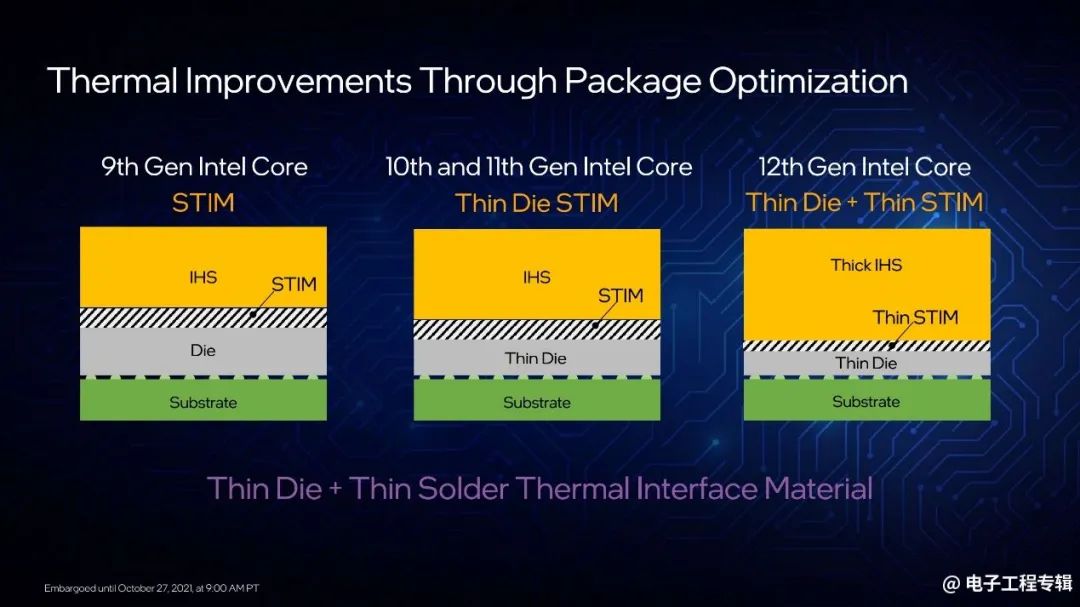
Regarding cooling, Intel also mentioned a detail during the conference. The packaging of this generation of Core processors has been optimized again. Previously, we knew that Intel improved cooling efficiency by making the die thinner while making the IHS (Integrated Heat Spreader) thicker. The IHS of the 12th Gen Core desktop processors has been further thickened, while the STIM (Solder Thermal Interface Material) has been thinned to enhance cooling efficiency.
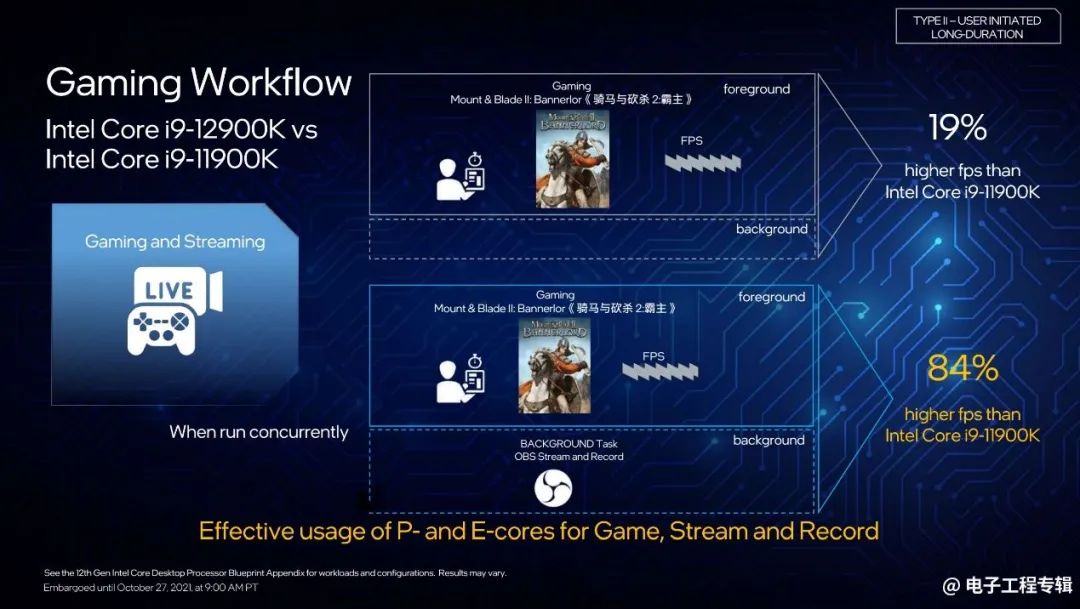
Additionally, it is worth mentioning the role of E-cores in gaming scenarios within the hybrid architecture. As previously mentioned, while playing “Mount & Blade 2: Bannerlord,” the E-cores can significantly assist with the streaming and recording tasks (OBS). The Core i9-12900K’s E-cores can help achieve an 84% increase in game frame rates; without E-cores, the improvement compared to the previous generation is around 19%.
It is noteworthy that Intel has specifically collaborated with game studios for titles including “Hitman 3,” “Counter-Strike: Global Offensive,” “Mount & Blade 2: Bannerlord,” and “Total War: Troy.” “Mount & Blade” is likely one of those games that can utilize multi-threading capabilities effectively, thus showcasing a greater performance advantage.
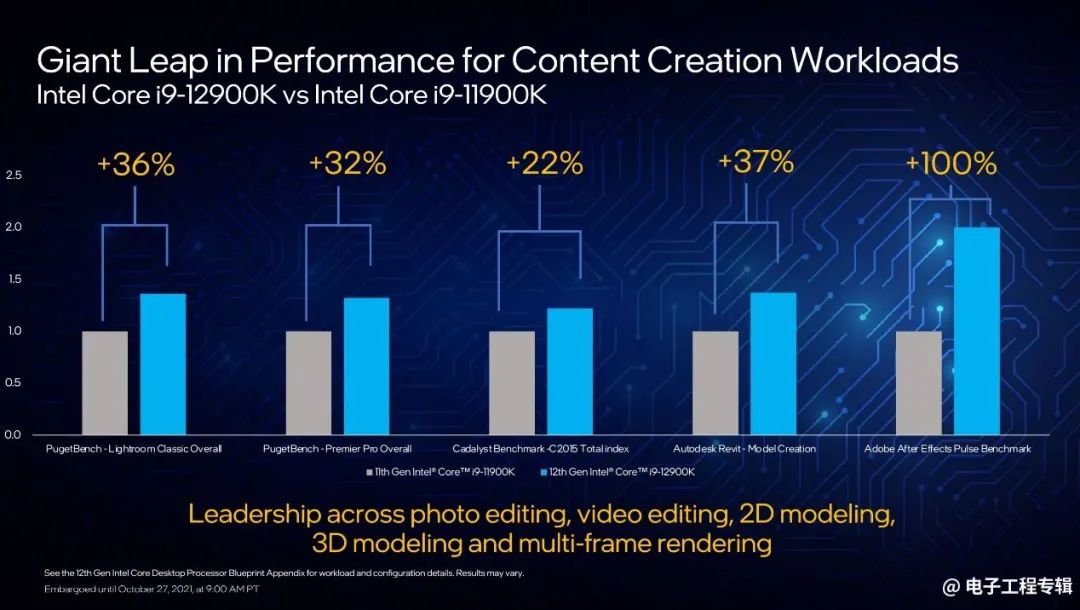
Having discussed gaming, we must also talk about content creation. The entire Adobe suite, including Lightroom, Premiere, After Effects, and various other tools, shows the performance changes of the 12th Gen Core compared to the previous generation as illustrated in the image above.
Here, the After Effects Plus Benchmark can fully utilize parallel computing resources for video processing, thus achieving performance improvements of up to double. E-cores also play a significant role in this. Among these content creation tools, Intel also has examples of ecosystem collaboration. Intel specifically mentioned VEGAS Pro, which has been utilizing the VNNI instruction set for quite some time. Such ecosystem collaborations always lead to higher hardware utilization.
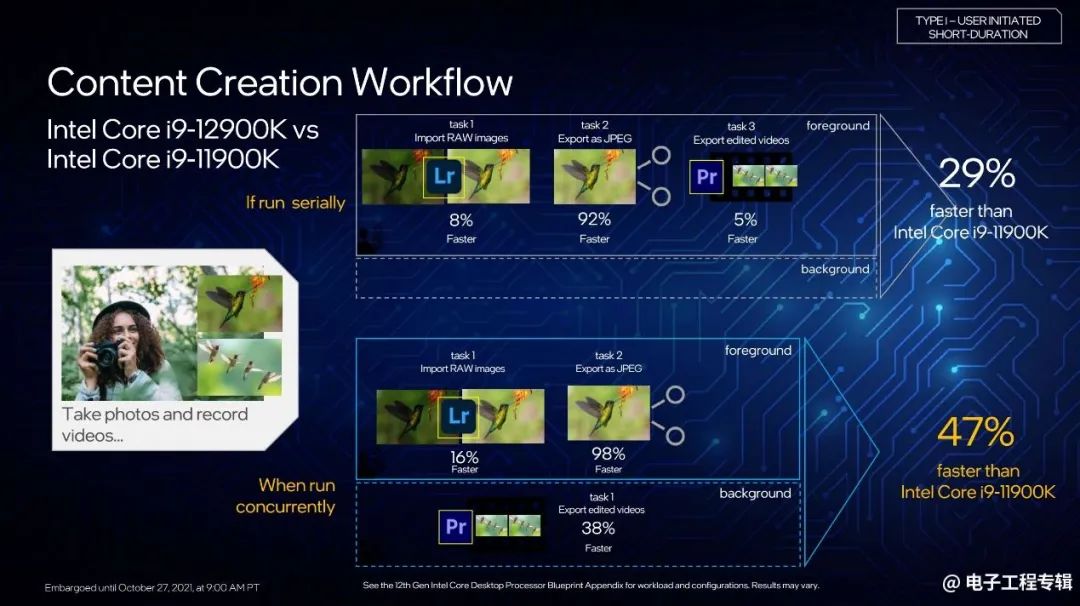
To demonstrate the advantages of its hybrid architecture, Intel listed a multitasking work scenario where one exports photos with Lightroom (RAW to JPG) while exporting videos with Premiere. With E-cores participating, parallel processing of these two tasks can achieve a speed improvement of 47% compared to the previous generation.
In this case, “photo editing is a short-term operation that will be assigned to P-cores, while video transcoding using Premiere will be moved to the background.” This is a typical scenario of how the two types of cores work together.
As previously mentioned, such work scenarios are relatively rare. However, there may indeed be photographers who have such work demands, editing videos while color grading photos — it seems photographers are also in a multi-core work state…
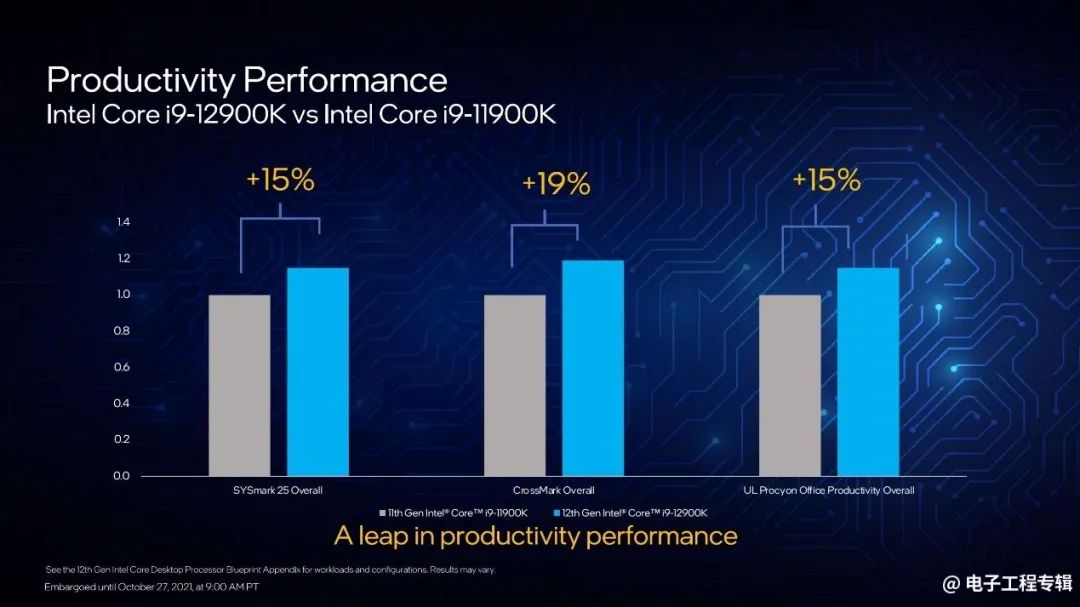
There is also a productivity performance scenario, including performance changes of some office tools, with the changes of the i9-12900K compared to the previous generation shown in the image above. However, for multimedia content creation and productivity, Intel did not provide comparative figures with AMD.
600 Series Chipset and Overclocking
Finally, let’s talk about the Intel 600 series chipsets (PCH) paired with the 12th Gen Core desktop processors and the official overclocking options — this is also a topic that must be mentioned in Intel’s launch events, as many who purchase desktop CPUs are enthusiasts.
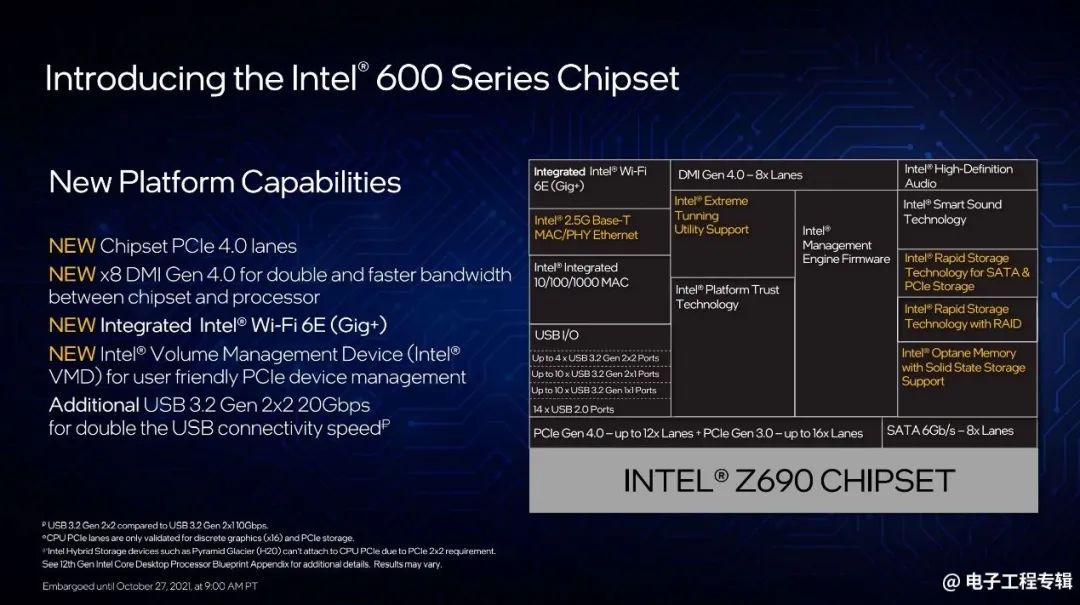
In fact, the highlights of the 600 series chipsets are not many; the high-end Z690 chipset supports PCIe 4.0, “combined with the existing PCIe 3.0, we have delivered a total of 28 PCIe connection interfaces on the chipset, greatly enriching peripheral connections.”
One highlight is that the total bus connecting the chipset and CPU has been upgraded to x8 DMI Gen 4.0 — while the specific specifications are unknown, it is expected to be similar to PCIe 4.0. Expanding peripherals and increasing the bandwidth of the chipset and CPU connection is a necessary step. In this regard, the future configurations of the 12th Gen Core mobile version should be more meaningful.
In addition, it integrates Wi-Fi 6E; and “through VMD (Volume Management Device), better device management under PCIe can be achieved, allowing flexible device combination management.”
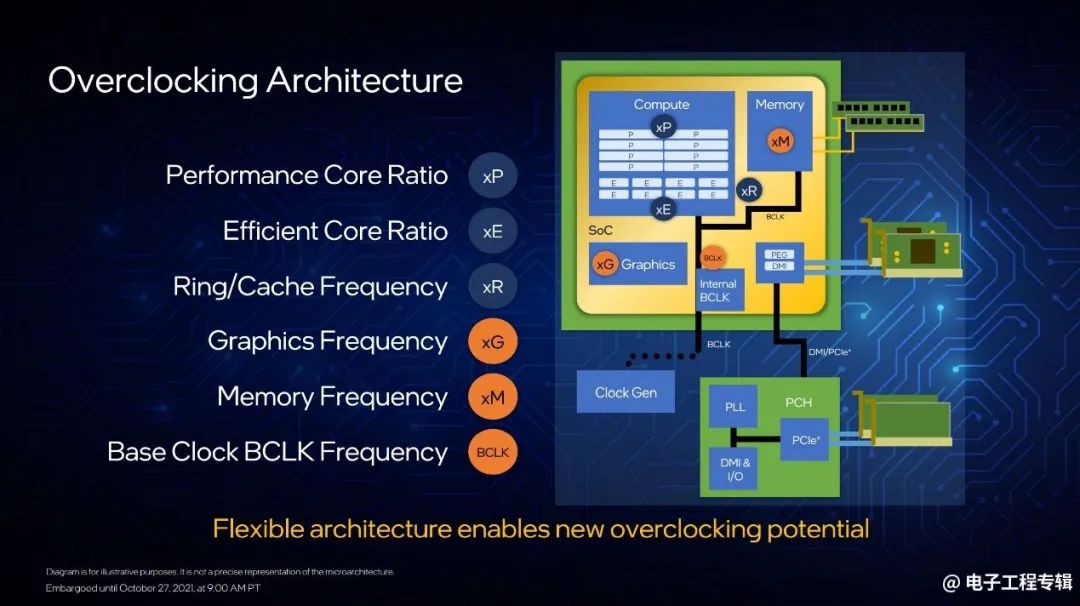
Regarding official overclocking options, there are several new overclocking features for users. First, E-cores can also be overclocked, and in the XTU tool, individual core overclocking settings can be made. The multipliers for P-cores and E-cores can be adjusted separately, as well as the Ring/Cache frequency and integrated graphics frequency.
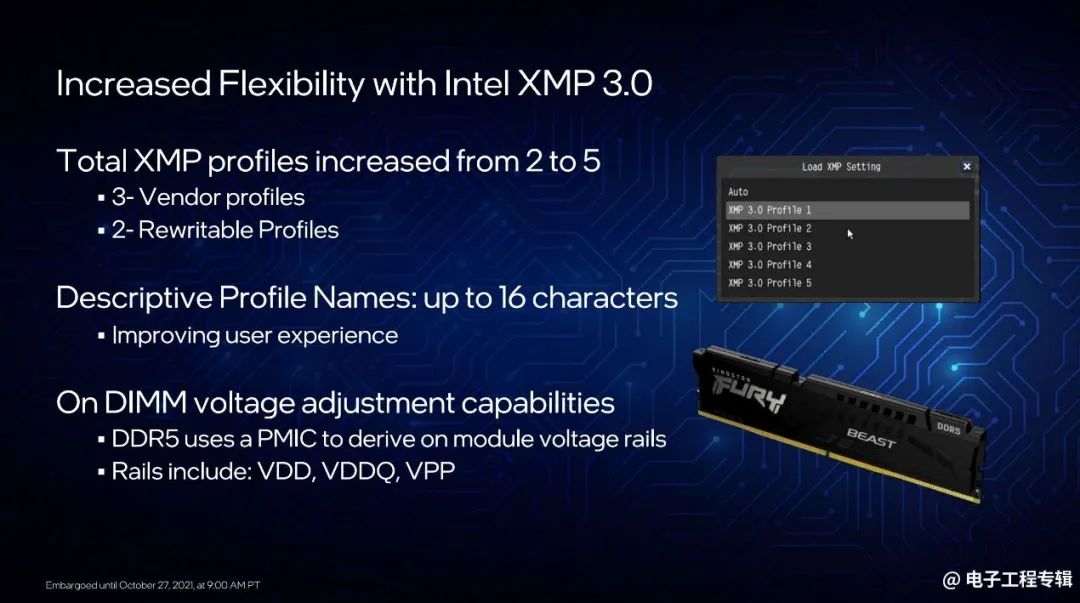
Secondly, with the DDR5 support, Intel has launched XMP 3.0. For users, XMP 3.0 has increased to 5 selectable profiles, with new voltage options; among them, 2 profiles can be manually modified by users for some timing characteristics — which was not possible in the past. The PMIC now follows DDR5, “with three voltages: VDD, VDDQ, and VPP, all regulated by JEDEC and Intel XMP standards.”… “Motherboard manufacturers do not need to recognize products from different vendors, as Intel will standardize the power-related ICs for overclocking.”
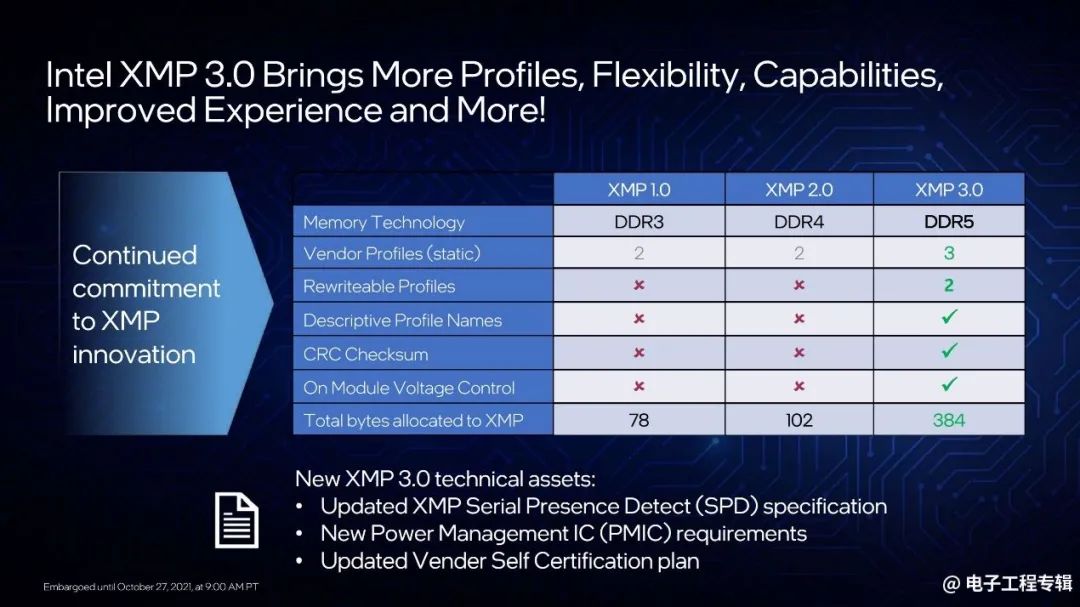
“We provide so many frequency, voltage, timing… the required space will be larger. Previously it was 78 bytes, now it is 384 bytes.” Intel stated, “These XMP specifications and the power management ICs and SPD specifications are interrelated and referenced. These specifications allow memory manufacturers to validate, and then submit their validation results to Intel. Once Intel confirms, they will be listed as Intel-approved DDR models.”
XMP 3.0 is certainly worth enthusiasts to study and play around with.
During yesterday’s demonstration, Intel showcased the ability to perform real-time memory overclocking directly within the operating system using the XTU tool, switching from 4800 MT/s to 5200 without needing to set it in the BIOS.
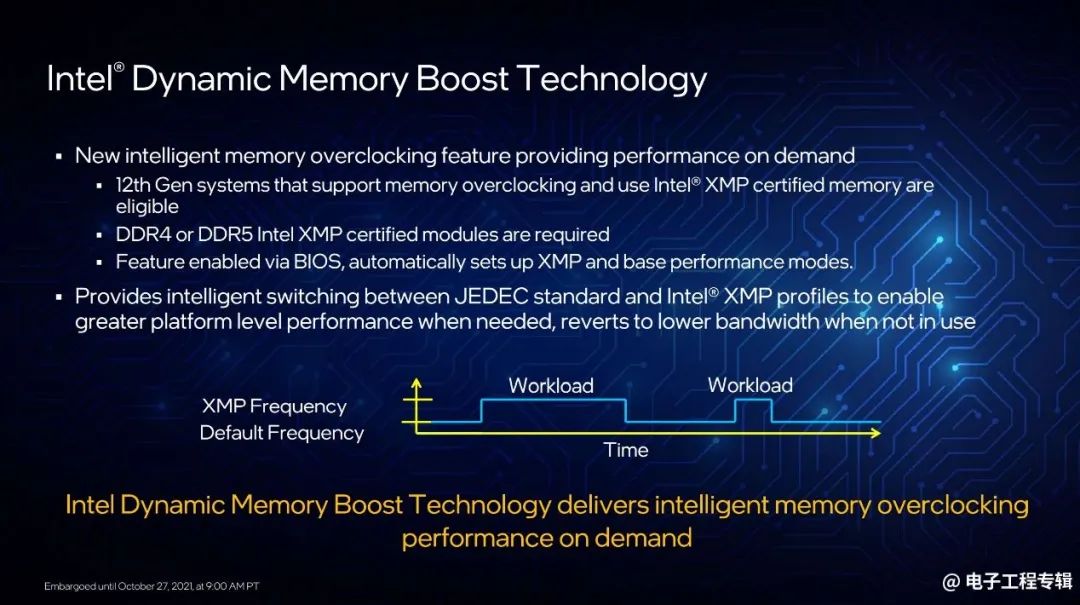
Thirdly, Intel has introduced a new feature called Dynamic Memory Boost for memory overclocking. This feature can automatically switch memory frequencies based on the current load, allowing it to return to default frequencies when not needed while achieving XMP set “overclocking” frequencies.
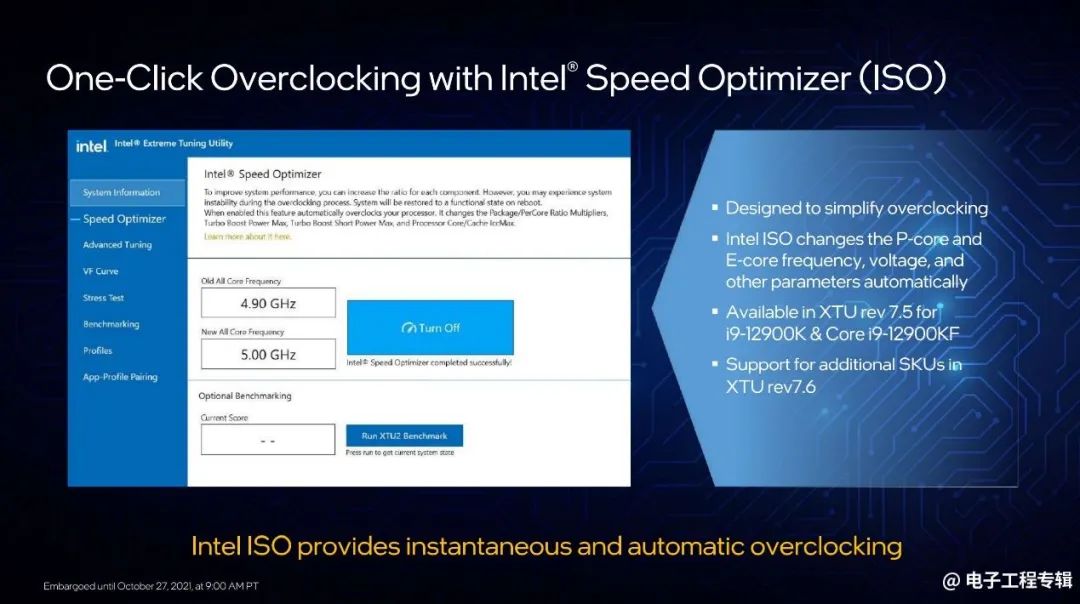
Finally, some enhanced features of the official overclocking tool XTU (Extreme Tuning Utility) in version 7.5 include the ability to set individual core overclocking and memory XMP overclocking, and Intel emphasized the addition of Intel Speed Optimizer, which achieves “one-click overclocking” for core frequencies. With the press of a button, it can boost to optimized higher frequencies — true “official overclocking.”
Conclusion: A Key Battle for Intel
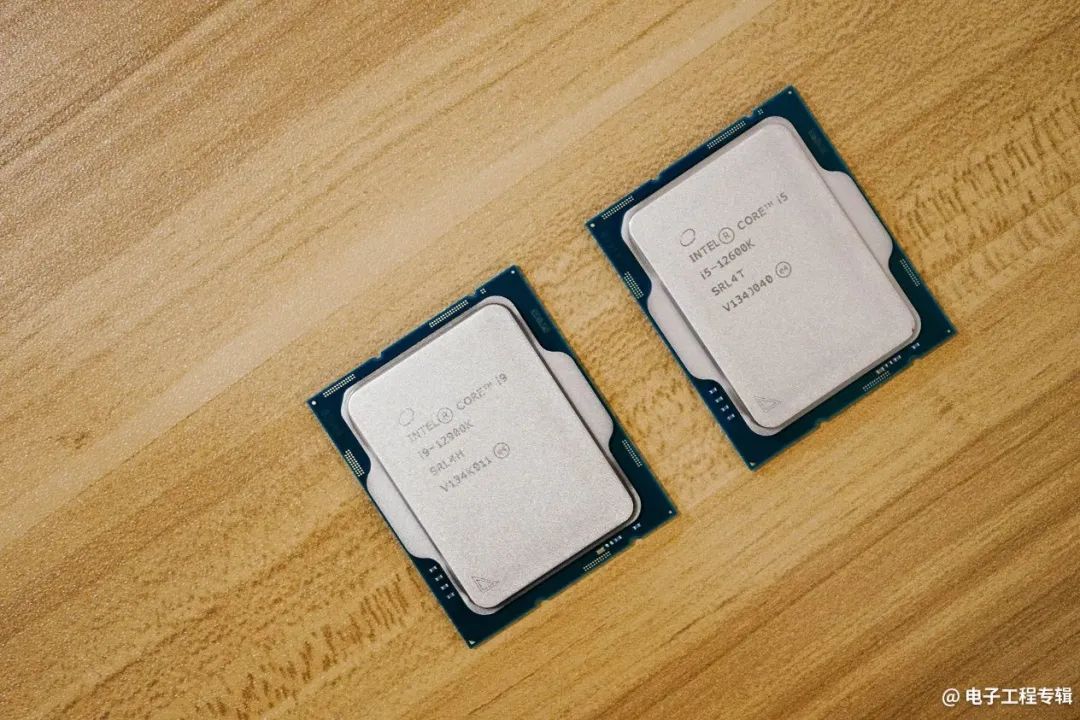
We have obtained the new Core i9-12900K and i5-12600K released by Intel, and will share performance and experiences from certain perspectives of these two chips in the future.
The 12th Gen Core processors (Alder Lake) are extremely important products for Intel. Based on previous architectural analyses and the data released this time, it should not be a problem to surpass AMD Zen 3 and even the upcoming Zen 4; leaked benchmark scores also indicate that its CPU performance is superior to Apple’s M1 Max — although due to manufacturing processes and operational modes, it may still not match in power consumption performance.
The hybrid architecture and the P-core (Golden Cove), which serves as the foundation for future Core product architecture upgrades, are the culmination of Intel’s efforts over the past two years. Given the current expansion of the Arm camp in the high-performance domain and AMD’s market performance over the past two years, Alder Lake is an exceptionally critical battle for both Intel and the x86 camp. This also makes us more eager for the upcoming Alder Lake mobile version.
The corresponding prices are as follows:
The i9-12900K is priced at $589, with a pre-sale price of 4999 yuan in China;
The i9-12900KF is priced at $564, with a pre-sale price of 4699 yuan in China;
The i7-12700K is priced at $409, with a pre-sale price of 3199 yuan in China;
The i7-12700KF is priced at $384, with a pre-sale price of 2999 yuan in China;
The i5-12600K is priced at $289, with a pre-sale price of 2299 yuan in China;
The i5-12600KF is priced at $264, with a pre-sale price of 2099 yuan in China.
These products are currently available for pre-order and are expected to officially go on sale on November 4, with more 12th Gen Core processor models expected to be released in early next year.
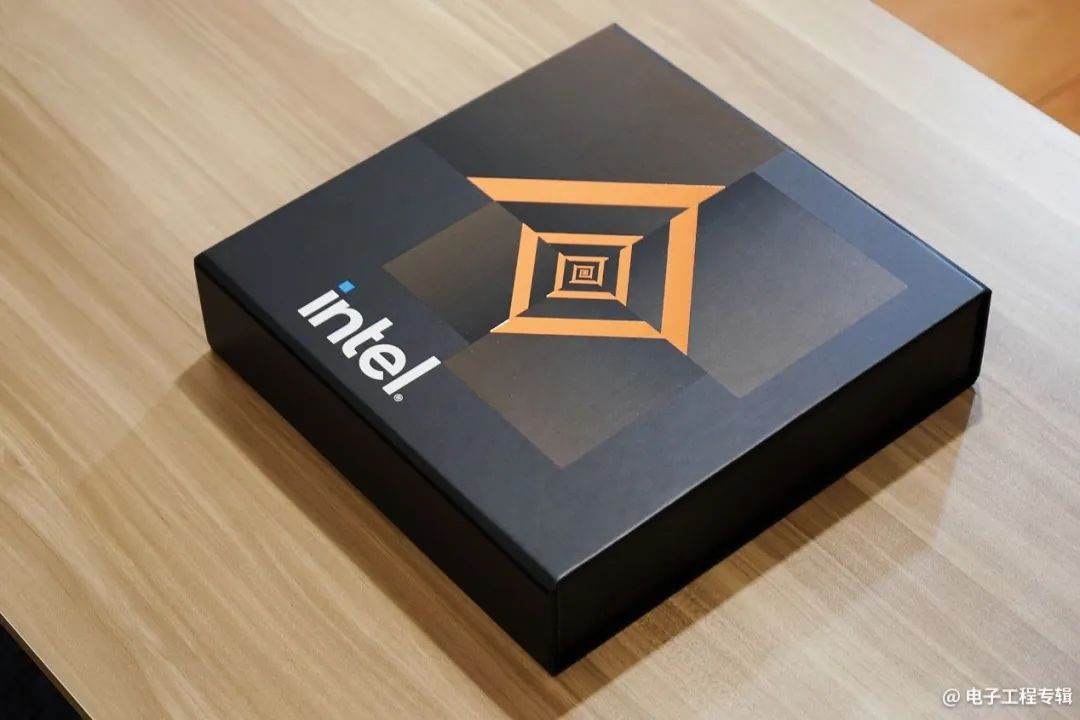
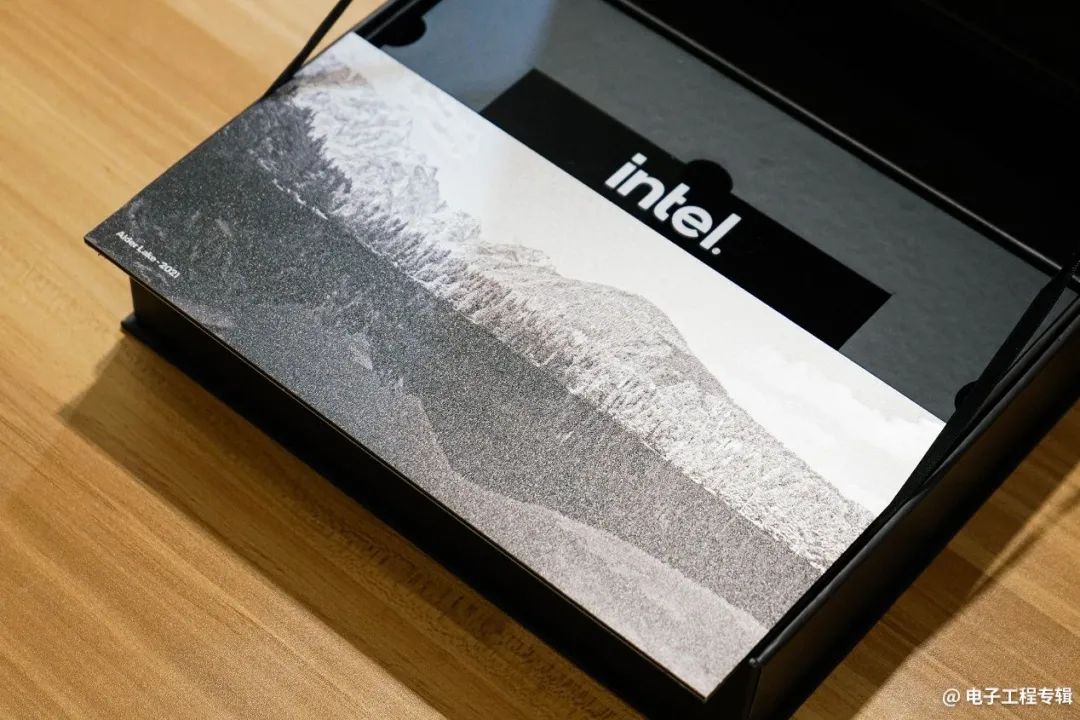
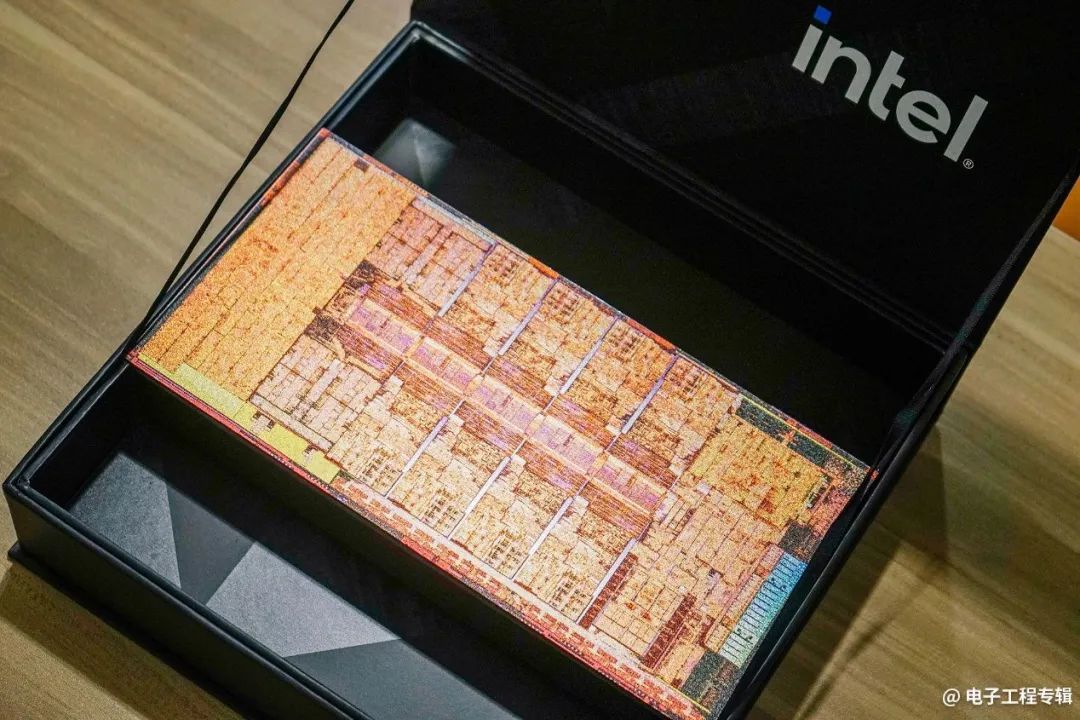
This is what Alder Lake in Washington State looks like.
Editor: Luffy Liu