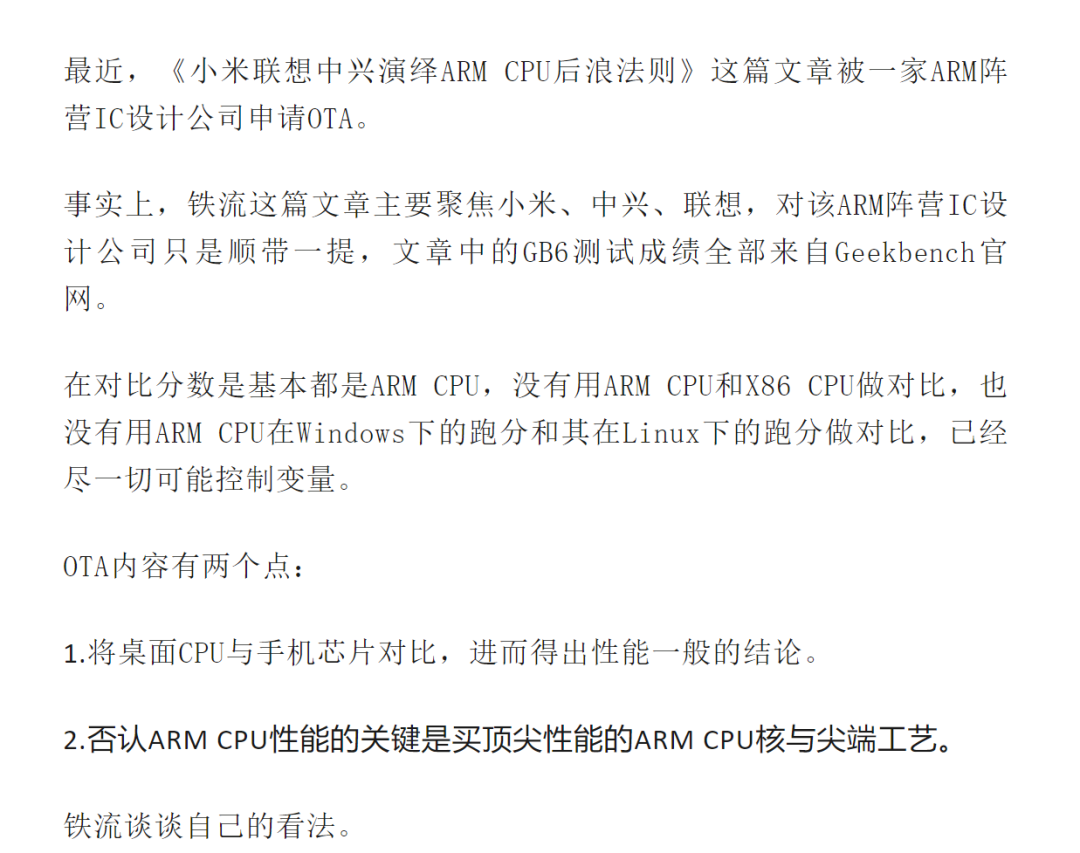
Comparison of mobile CPUs and desktop CPUs shows that mobile CPUs are at a disadvantage.
In the past, the performance of desktop CPUs from Intel and AMD significantly surpassed that of ARM mobile chips. Intel and AMD desktop CPUs have high performance but also high power consumption, while ARM mobile chips have lower performance compared to Intel and AMD, but also lower power consumption.
In this context, comparing desktop CPUs and mobile CPUs is inappropriate.
However, with the changing times, ARM’s high-performance CPU cores have become increasingly powerful, and TSMC has surpassed Intel in manufacturing processes. Many IC design companies in the ARM camp have begun to develop desktop and server CPUs based on ARM technology licensing and cutting-edge processes.
Years ago, some manufacturers developed two server CPUs based on ARM A57 and A72, claiming to be self-developed.
ARM’s A75, A76, and A77 can be used in mobile devices as well as in desktop and server applications.
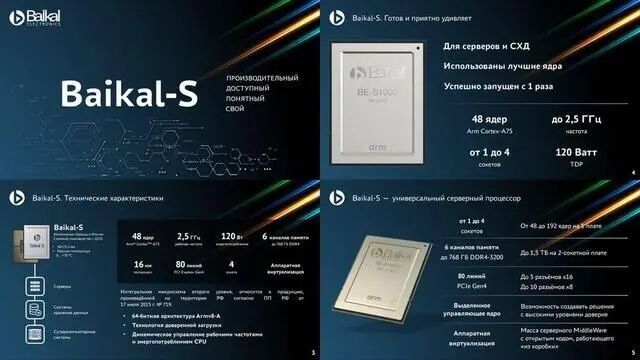
For example, Baikal Electronics in Russia has developed the Baikal-S server CPU, which uses ARM Cortex-A75, integrating 48 A75 cores, manufactured with a 16nm process, and has a clock speed of 2.5GHz.
Similarly, ARM’s high-performance CPU cores can be used in server and desktop CPUs, as well as in mobile chips.
In fact, as long as they are both ARM chips, comparing the performance of desktop CPUs and mobile CPUs is feasible.
Indeed, desktop CPUs often have larger caches, higher memory frequencies, and better cooling conditions, so the test results of chips developed based on the same ARM CPU core on desktop platforms will generally be slightly higher than those on mobile platforms.
Specifically, when the same ARM A77 is used in a desktop CPU, the test results will be higher than those of the A77 used in a mobile device.
Similarly, since server CPUs have larger caches, even when using the same CPU core, the single-core performance results will be better than those of the desktop CPU using the same CPU core.
In short, with the advancement of ARM CPUs, the performance of mobile chips and desktop chips can now be compared, and the test results of mobile CPUs will be slightly disadvantaged due to factors such as cache, memory, and cooling.
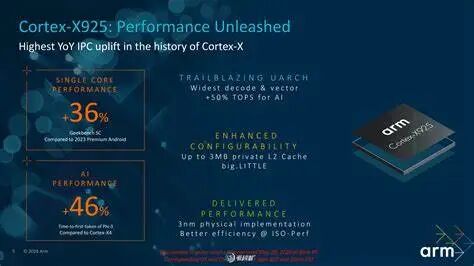
The performance of ARM CPUs depends on whether they can obtain top-notch technology licensing and cutting-edge processes.
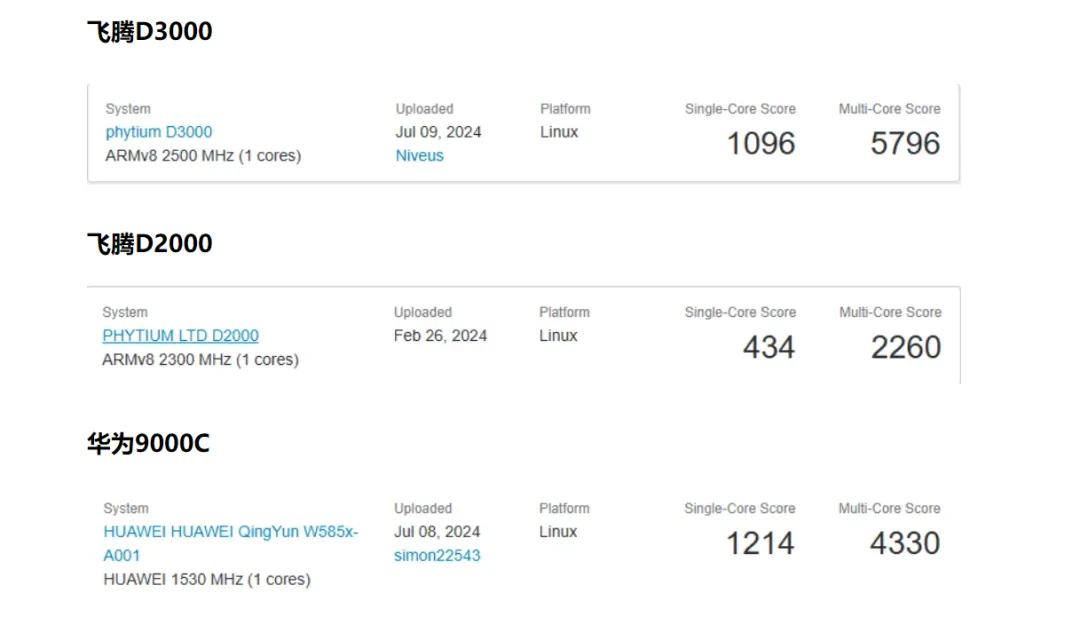
From the GB6 test results, both operating systems are Linux, both use the ARM instruction set, and the testing was conducted in the same year, making the GB6 scores of the D2000, D3000, and 9000C ARM chips comparable.
The single-core performance of the 9000C is the best.
The D3000 surpasses the 9000C in multi-core performance, primarily because the 9000C is a mobile chip that uses a big.LITTLE core design, where the four small cores drag down performance, resulting in weaker multi-core performance. In contrast, the D3000 has eight big cores, giving it an advantage in multi-core performance.
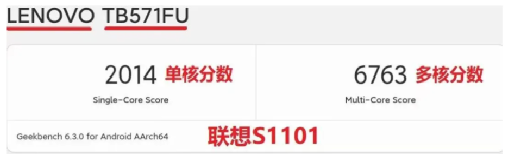
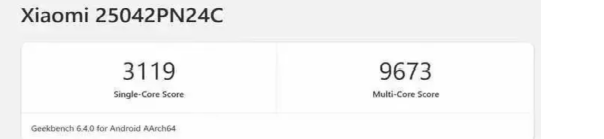
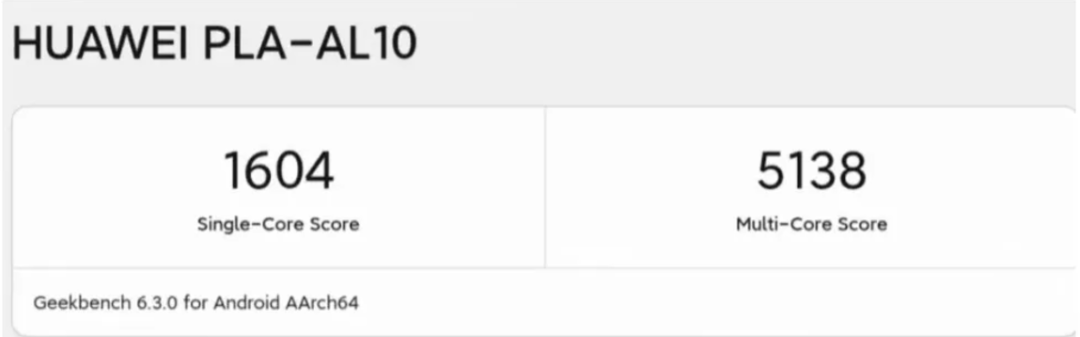
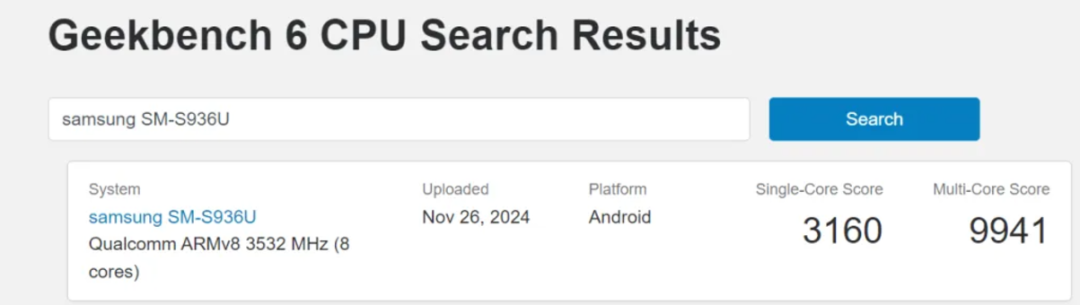
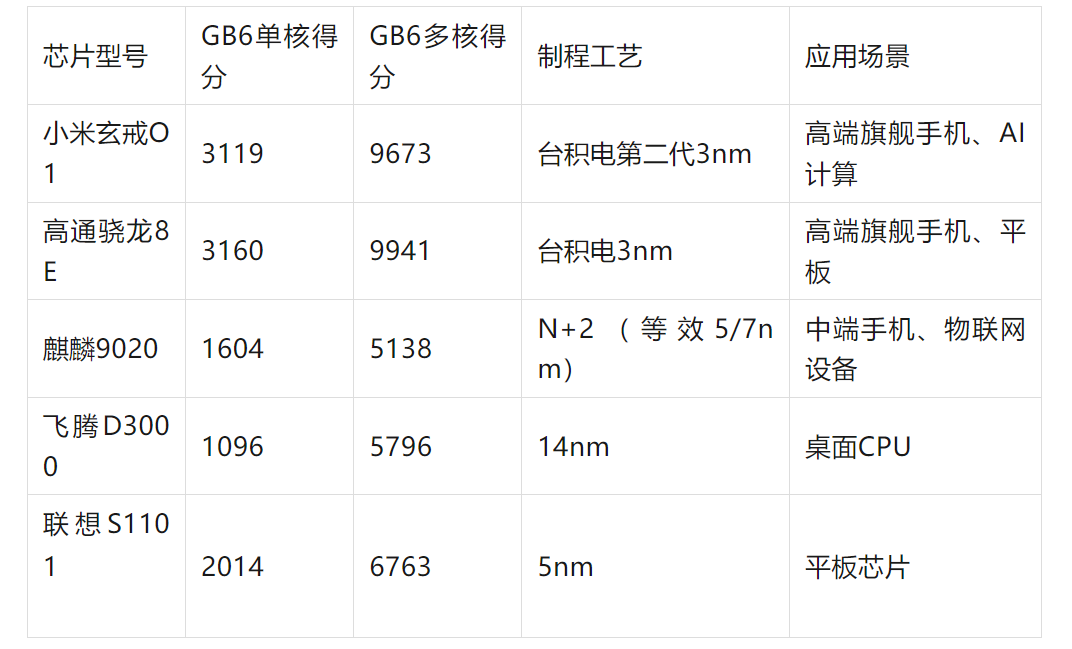
Next, let’s look at a set of GB6 test results for ARM CPUs, including Lenovo S1101, Xiaomi Xuanjie, Qualcomm Snapdragon 8e, and 9020, all of which are ARM chips.
The Lenovo S1101 has two big cores at 3.29GHz ARM Cortex X3, manufactured with a 5nm process, with a single-core score of 2014 and a multi-core score of 6763.
The Xuanjie has a big core at 3.9GHz ARM X925, manufactured with a 3nm process, with a single-core score of 3119 and a multi-core score of 9673.
The Snapdragon 8e, used by Samsung, has a big core clocked at 3.5GHz, manufactured with a 3nm process, with a single-core score of 3160 and a multi-core score of 9941.
The 9020 has a big core clocked at 2.5GHz, with a single-core score of 1604 and a multi-core score of 5138.
From this, it can be seen that the stronger the CPU core and the better the manufacturing process, the better the GB6 test results.
Comparing the 9006C and the Lenovo S1101, both have a 5nm manufacturing process, but since Lenovo uses ARM X3 and 9006C uses ARM A77, the GB6 single-core test score of the S1101 is 60% higher than that of the 9006C, due to the superiority of X3 over A77.
Currently, the ARM CPU development process is very mature and has become a game of capital.
The performance of ARM CPUs depends on whether the licenses purchased from ARM are advanced and whether the processes used are cutting-edge, which has been validated by practice.
Xiaomi, Lenovo, ZTE, and Alibaba have all proven this through practice.
The performance of desktop ARM CPUs is inferior to that of mobile ARM CPUs, indicating that desktop CPUs generally have average performance.
It has been previously stated that the same ARM CPUs can be compared between desktop CPUs and server CPUs, and desktop CPUs will have a certain advantage.
If in a controlled testing environment, the GB6 scores of mobile ARM CPUs significantly exceed those of desktop ARM CPUs, it indicates that the performance of that desktop ARM CPU is average.
One particular desktop ARM CPU is outperformed by mobile ARM CPUs like Xiaomi Xuanjie and Qualcomm Snapdragon 8e, with a GB6 single-core performance only 30% of that of Xuanjie, due to a significant gap in CPU cores and manufacturing processes.
Specifically, the performance of that desktop ARM CPU core is comparable to ARM A77, while Xuanjie uses ARM X925, and the manufacturing process of the desktop ARM CPU is 12/14nm, while Xuanjie’s is 3nm.
It is precisely the performance level difference between the A77 CPU core and the X925, along with the gap between 12/14nm and 3nm, that results in the GB6 single-core test score of that ARM desktop CPU being only 30% of Xuanjie’s.
This again serves as a vivid example, reaffirming the viewpoint that the performance of ARM CPUs depends on whether they can obtain top-notch technology licensing and cutting-edge processes.
When the GB6 test scores of desktop ARM CPUs are significantly inferior to those of mobile ARM CPUs, it can only indicate that the performance of that desktop ARM CPU is lagging behind, making it unable to stand in the commercial market, essentially a flower in a greenhouse, relying on the protection of the greenhouse to survive.
If Xiaomi learns from its competitors to promote ARM CPUs as self-developed, Xuanjie could essentially perform a dimensionality reduction attack, easily overwhelming those desktop ARM CPUs with GB6 single-core scores only 30%-50% of Xuanjie’s.