According to reports from Electronic Enthusiasts (Author: Wu Zipeng), automotive-grade real-time MCUs are crucial components in the development of smart connected vehicles. Within the automotive electronic control unit (ECU), they are responsible for coordinating and managing the computation and processing of various information inside the vehicle, covering applications in powertrains, body control systems, as well as advanced driving assistance and intelligent connectivity. In terms of automotive safety, automotive-grade real-time MCUs must meet several stringent functional safety certifications, such as the ASIL D level certification in the ISO 26262 standard, ensuring that the system can operate reliably under various extreme conditions, thereby safeguarding the lives of passengers.
At the 21st Shanghai International Automobile Industry Exhibition (referred to as the 2025 Shanghai Auto Show), Xu Wenkai, Deputy General Manager of the MCU product line at Unisoc’s automotive electronics division, pointed out that the Unisoc THA6 series is a high-end product in the domestic automotive-grade MCU camp. The THA6 Gen1 series has already achieved mass production applications in several mainstream automotive companies, while the THA6 Gen2 series is the first automotive-grade real-time MCU in China to innovatively adopt the Arm Cortex-R52+ core, placing it at the forefront of the industry and widely used in mass production projects.
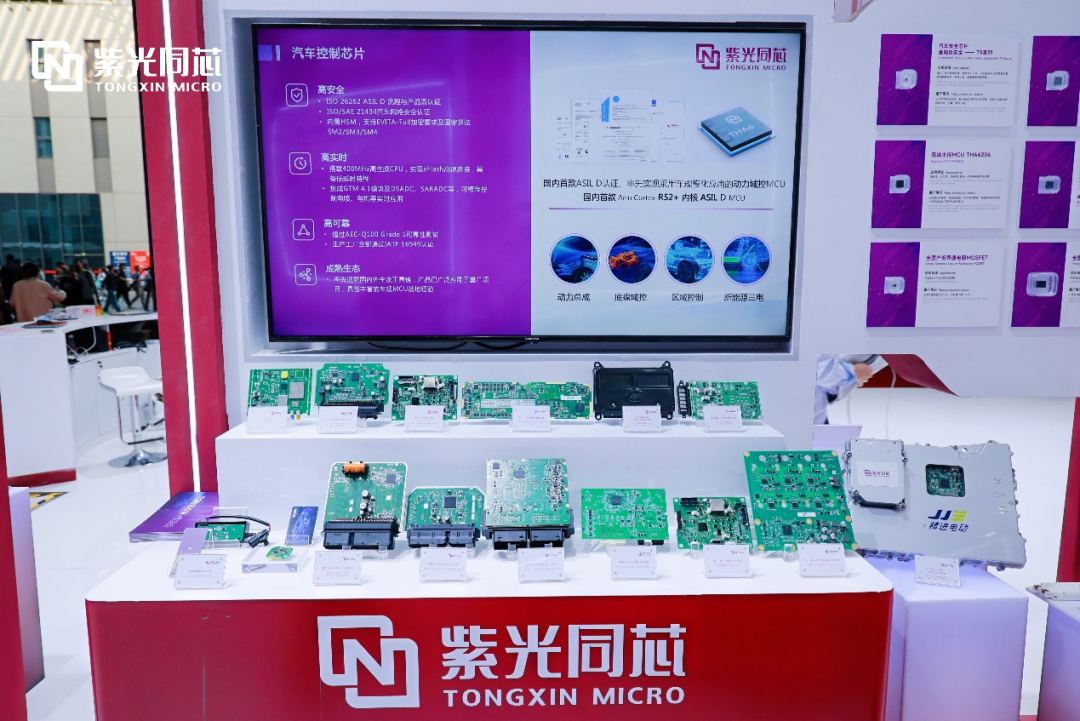
The THA6 Gen2 series, as the first Arm Cortex-R52+ core automotive MCU in China to obtain ASIL D product certification, boasts powerful performance. Its product frequency reaches up to 400MHz, utilizing the Armv8 architecture instruction set, integrating the latest version GTM 4.1, supporting high-precision PWM output, and featuring a built-in hardware RDC module. It also supports both software and hardware decoding methods for rotary signal processing, achieving dual certification for ISO 26262 ASIL D processes and products, as well as ISO/SAE 21434 automotive cybersecurity certification, with a built-in HSM that supports EVITA-Full encryption requirements and national cryptographic algorithms. These features provide a solid software and hardware foundation for automotive electronic and electrical architectures, fully meeting industry customers’ needs in power domains, chassis domains, body domains, and intelligent driving domains.
THA6 Series Automotive MCUs: Continuous Breakthroughs Leading the Industry
The first product of the THA6 Gen2 series, THA6206, was unveiled in July 2024 at the 2024 (16th) Semiconductor Market Annual Conference and New Unisoc Group Brand Launch hosted by the China Semiconductor Industry Association. This product is the first R52+ core automotive MCU in China to pass ASIL D product certification, supporting multiple application scenarios in new energy vehicles, including power, chassis, body, battery management, and overall vehicle control.
Subsequently, at the 2024 Unisoc Partner Conference held in August 2024, Unisoc launched the high-end flagship product THA6412 of the THA6 Gen2 series. This is another flagship R52+ core automotive MCU that has passed ASIL D certification following the THA6206. Yang Bin, Deputy General Manager of Unisoc’s automotive electronics division, stated that with the continuous upgrade of electronic and electrical architectures, the THA family will introduce more new products. The ongoing iteration of the THA6 series demonstrates that Unisoc has entered the first tier of domestic automotive-grade MCUs. Technological innovation is Unisoc’s core competitiveness, and the company will continue to increase R&D investment, continuously iterate technology, and enhance product competitiveness.
At the same time, Yang Bin emphasized that the THA6 Gen2 series is not only leading domestically but also competes with the flagship products of international giants like Infineon, surpassing many core parameters.
After the product launch, its ecosystem layout has progressed rapidly. Mainstream toolchains from both domestic and international companies, including Neusoft Ruichi, ETAS, Tasking, IAR, HighTec, PLS, and Lauterbach, fully support Unisoc’s THA6 Gen2 series. Developers can fully leverage the hardware performance of the Unisoc THA6 Gen2 series, enhancing system performance while meeting the stringent functional safety requirements of automotive electronics.
It is worth mentioning that in March 2025, the THA6412 completed full-stack technical verification with Neusoft Ruichi’s NeuSAR cCore basic software product. NeuSAR cCore is a domestically developed AUTOSAR CP solution by Neusoft Ruichi, based on the AUTOSAR standard, featuring a one-stop toolchain for the entire process, with its performance and reliability fully validated and highly recognized in the market.
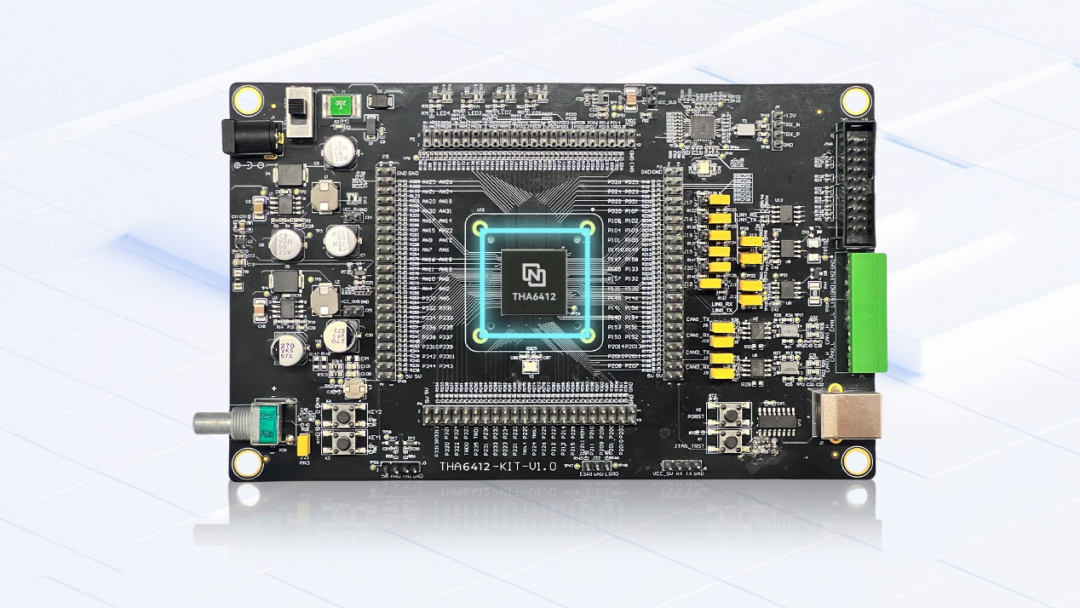
Xu Wenkai stated that in the field of automotive-grade real-time MCUs, Unisoc has built a relatively complete toolchain and ecosystem to accelerate customer solution development, effectively shortening the project implementation cycle for customers.
Using Technological Innovation to Break Through Market “Involution” Dilemma
Statistics show that the global automotive MCU market size is approximately $10.9 billion in 2024, with a year-on-year growth of 8.3%. However, due to the slowing growth of the terminal automotive market, “involution” has become a hot topic in the current automotive MCU market.
The “involution” in the automotive MCU market is a key focus in the current automotive semiconductor industry. In recent years, through the efforts of domestic chip manufacturers, the localization rate of body and sensor chips has significantly increased, but there are still obvious shortcomings in high-end core domain control chips, especially in areas involving high safety and high reliability such as power, chassis, and intelligent driving.
Yang Bin believes that the “involution” of high-end automotive MCUs manifests in two aspects: price “involution” and technology “involution”.
In terms of price “involution”, as the industry enters a phase of eliminating the false and retaining the true, prices will gradually return to rational levels.
On the other hand, technology “involution” is actually a form of healthy competition. For example, as automotive electronic and electrical architectures evolve towards centralized computing + regional control architectures, and applications such as autonomous driving and intelligent cockpits become increasingly rich, automotive MCUs need to handle large amounts of data and complex tasks, which requires continuous iteration of core indicators such as process, core, storage, and transmission in line with evolving demands. As Yang Bin stated, technology “involution” is precisely where Unisoc’s confidence lies, and the continuous iteration of the THA6 series automotive MCUs is strong evidence of this.
Conclusion
Driven by the wave of the automotive “new four modernizations”, the development path of Unisoc’s THA6 series automotive MCUs not only sets a technical benchmark for domestic chips in the high-end automotive MCU field but also proves through practical actions that only by breaking through technical barriers with hard-core innovation can we carve out a development path for “Chinese chips” in the fierce market competition. Currently, the THA6 series has gained wide recognition from OEMs and Tier 1 suppliers, and its future development prospects will be even broader.

Disclaimer: This article is original from Electronic Enthusiasts, please indicate the source when reprinting. For group discussions, please add WeChat elecfans999,for submission of interview requests, please send an email to [email protected].
Read More Hot Articles
-
AI Toys: Competing with Multiple Solutions Optimized for Multi-Turn Dialogue and Emotional Companionship
-
On-Site Coverage: Marathon Star “Tian Gong Robot”, Zhaowei Electromechanical’s Agile Hands, etc. are Highly Praised
-
Cadence Acquires Arm’s Basic IP Business, Who is the Winner?
-
Humanoid Robots Steal the Show at the Auto Show, Commercialization Inflection Point Accelerates Arrival
-
Direct Coverage of the 2025 Shanghai Auto Show, Supply Chain Giants Collectively Make Their Debut, Chinese Technology Rewrites Global Rules
Click to Follow and Bookmark Us