
Introduction: On August 16, it was reported that the laparoscopic surgical robot funded by Weijing Medical has officially entered mass production. It is reported that Weijing Medical has conquered and mastered core technologies such as structural design, control systems, core algorithms, intelligent control, and system integration for laparoscopic surgical robots. Currently, they have developed multiple product lines including three-arm, four-arm multi-port surgical robots and single-port surgical robots. In recent years, China’s laparoscopic surgical robots have developed rapidly under the guidance of various factors such as policy and capital, with several domestic companies’ products being approved for market entry to seize a market that has long been monopolized by foreign companies.
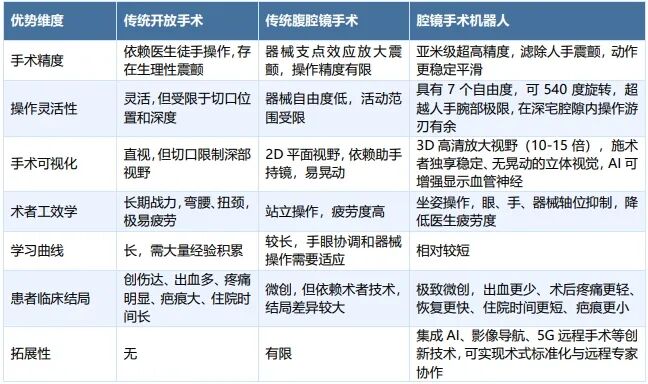
01 Laparoscopic Surgical RobotsLaparoscopic surgical robots are intelligent medical devices used for minimally invasive surgery. They assist surgeons in performing high-precision and complex surgical operations within narrow body cavities through robotic arms, high-definition 3D visual systems, and computer-aided control systems. Their core advantages lie in improving surgical precision, reducing tremors, and providing a 10-15 times magnified stereoscopic view, significantly reducing patient blood loss and recovery time. Compared to traditional laparoscopic surgery, robotic systems offer greater flexibility and a shorter learning curve, and are now widely used in urology, gynecology, and general surgery.The core advantage of laparoscopic surgical robots is their ability to achieve precision, minimally invasive, and intelligent transformations in surgical procedures through technological integration. This system reshapes surgical standards with three core advantages: first, precision control that surpasses human hands, with robotic arms capable of 7 degrees of freedom and filtering out physiological tremors, achieving sub-millimeter surgical precision, especially suitable for the dissection and suturing of delicate anatomical areas such as the prostate and neurovascular structures; second, immersive surgical vision, with a 3D high-definition imaging system providing a 10-15 times magnified view, combined with AI enhancement technology to mark important anatomical structures, significantly reducing the risk of intraoperative damage; finally, ergonomic optimization, allowing surgeons to operate in a seated position that conforms to ergonomic standards, significantly improving operator comfort and extending effective surgical time.For patients, robotic surgery means smaller surgical trauma, less intraoperative bleeding, and faster postoperative recovery, with an average hospital stay reduced by 30%-50%. For the healthcare system, although the initial investment in this system is high, it can standardize complex surgical operations, shorten the training cycle for surgeons, and enable the sharing of high-quality medical resources across regions through 5G remote surgery capabilities. With the deep integration of AI algorithms, laparoscopic surgical robots are evolving from auxiliary tools to intelligent surgical partners, expected to play a significant role in surgical planning, automated execution, and prognostic prediction in the future.
Figure 1: Core Advantage Features of Laparoscopic Surgical Robots
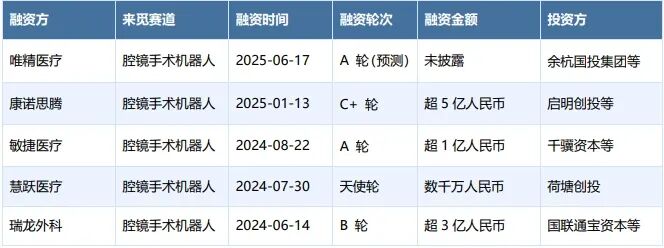
 Data Source: Rime DataIn recent years, the national government has continuously increased support for the medical equipment industry, especially in the “14th Five-Year Plan,” where surgical robots are listed as one of the key areas for achieving independent control of high-end medical equipment. From 2021 to 2025, the National Development and Reform Commission, in conjunction with multiple departments, released the “14th Five-Year Plan for the Medical Equipment Industry,” which clearly states that through technological innovation, improvement of the industrial chain, and promotion of clinical applications, the localization process of high-end medical equipment such as surgical robots will be advanced. This plan not only sets goals for technological research and development but also specifies phased tasks for industrialization and clinical application, aiming to break the long-standing market pattern dominated by foreign brands. Taking laparoscopic surgical robots as an example, they are the most mature and widely used subcategory of surgical robots, and have been included in the management category of Class B large medical devices, with a planned configuration of 559 units during the “14th Five-Year Plan” period. As of July 2025, over 400 units have been issued, indicating a gradual release of market demand driven by policy. Meanwhile, the National Health Commission, in June 2023, released the “14th Five-Year Plan for the Configuration of Large Medical Equipment,” further raising the configuration limit for laparoscopic surgical robots, bringing clear growth signals to the industry. It is worth noting that policies not only focus on the supply side of equipment but also emphasize the cultivation of demand, such as improving the clinical usage rate of surgical robots through the expansion of medical insurance coverage.02 Commercialization Progress of Laparoscopic Surgical RobotsThe global laparoscopic surgical robot market has long been dominated by Intuitive Surgical and its da Vinci system, which was first approved by the FDA for surgical treatment in 2000, marking the beginning of the global laparoscopic surgical robot era; in 2006, the second-generation da Vinci surgical robot introduced a 3D high-definition visual system approved by the FDA; in 2009, the third generation added dual consoles and a simulation controller; in 2014, the fourth generation upgraded the degrees of freedom of the robotic arms, imaging quality, energy platform integration, and surgical process optimization; in March 2024, the fifth generation was approved by the FDA, becoming the most stable and precise system developed to date.In the second quarter of 2025, the global installation of the da Vinci 5th generation (dV5) product reached 180 units, showing strong growth momentum. This generation of products has undergone technological upgrades in precision, 3D imaging, force feedback, and computing power compared to previous generations, for example, its force feedback technology can reduce tissue stress by 43%, thereby lowering surgical risks. These technological advancements not only enhance the clinical value of the product but also increase the irreplaceability of its consumables. Meanwhile, Intuitive Surgical has built a large demand pool for consumables through its global installation network. By the end of 2024, the cumulative global installation of the da Vinci surgical system has exceeded 10,000 units, supporting nearly 17 million minimally invasive surgeries.Intuitive Surgical has established a strong moat through its “equipment + consumables + services” business model, which opens the market through surgical robot equipment and then relies on high-margin consumables and value-added services to achieve long-term stable revenue. The initial sale of equipment is the first layer of income, with the bidding price for the imported da Vinci surgical system ranging from 18 million to 30 million yuan, while the bidding price for the domestic version is also as high as 18 million to 22 million yuan; high-margin consumables provide a continuous second layer of income and are an important guarantee for manufacturers’ profits. For example, for the da Vinci surgical system, the revenue from consumables such as surgical tips and electrodes accounted for over 60% in 2024; in addition, laparoscopic surgical robot equipment often requires professional regular maintenance, which is also a significant expense. Previously, it was reported that the maintenance cost for the da Vinci surgical robot purchased by Guangzhou First People’s Hospital was 3.76 million yuan over two years. The “equipment + consumables + services” business model not only enhances the profitability of enterprises but also increases customer stickiness, as once a hospital installs a surgical robot, subsequent consumable replacements and system maintenance often rely solely on the original manufacturer.The da Vinci system first entered China in 2006 and occupied nearly 100% of the market share for a long time. However, in recent years, China’s laparoscopic surgical robots have developed rapidly under the guidance of various factors such as policy and capital, currently entering a period of rapid development, while benefiting from the continuous optimization of the approval process for innovative medical devices, forming a significantly different green channel from traditional approval paths. In recent years, the National Medical Products Administration has established priority review procedures for high-tech, high-clinical-value medical devices such as surgical robots, significantly shortening the approval cycle. Since 2021, the Weigao “Miaoshou S” became the first domestically produced laparoscopic robot to be approved, and several domestic companies such as Micron Medical and Jingfeng Medical have successively had their products approved for market entry. Under the policies of the “14th Five-Year Plan” for large medical equipment configuration and “equipment updates,” according to data from Zhongcheng Shuke, the new installation of domestic laparoscopic surgical robots is expected to grow by 115.79% year-on-year in 2024, with a year-on-year growth of as high as 130% in the first quarter of 2025. The cumulative installation of domestic laparoscopic surgical robots has exceeded 100 units, covering more than 20 provinces.From a business model perspective, the “equipment + consumables + services” model has also been adopted by domestic companies. For example, Micron Robotics has implemented a similar business model, such as the Tumi laparoscopic surgical robot, which has achieved rapid deployment of equipment sales while leveraging consumables and services to build a long-term revenue source. In addition, the coverage of medical insurance has also provided payment guarantees for high-end medical equipment such as surgical robots. Since 2023, China has made substantial progress in the reform of the medical insurance payment mechanism for surgical robots, laying a system foundation for the rapid development of the industry. First-tier cities such as Beijing and Shanghai have taken the lead in including robotic surgery in the pilot scope of medical insurance, exploring a composite payment model of “equipment + consumables.” Since 2021, Beijing has fixed the usage fee for orthopedic surgical robots at 8,000 yuan, which can be fully covered by medical insurance, while the associated consumable costs can be partially reimbursed. This mechanism not only alleviates the financial burden on patients but also enhances the willingness of medical institutions to adopt surgical robots. With the gradual coverage of medical insurance in the field of surgical robots, it is expected to extend to laparoscopic surgical robots in the future.03 Capital DynamicsUnder the influence of policies, capital, and other factors, China’s laparoscopic surgical robot market is undergoing structural transformation, with local innovative forces rapidly rising to break the technological monopoly of foreign capital. From the dynamics of the primary market, as leading companies such as Micron Robotics and Jingfeng Medical have successively completed IPOs, the investment and financing heat in the laparoscopic surgical robot primary market has shifted from the early explosive period to a rational adjustment phase. The focus of investment has gradually shifted from chasing technical concepts to verifying commercialization capabilities. Capital may prefer companies that have successfully obtained product approvals, have hospital installation volumes, overseas market expansion capabilities, and clinical surgical volume data support, while being cautious towards projects still in the early research and development stage, with resources accelerating towards leading companies.According to data from Rime PEVC, after several leading companies have gone public, the overall investment and financing heat in the laparoscopic surgical robot sector has slowed down, with not many investment cases in 2024. Against the backdrop of domestic laparoscopic surgical robots successfully entering the market in batches to seize a market long monopolized by foreign capital, the sector is transitioning from a “storytelling” phase to a “performance-based” new stage, with capital focusing more on high-quality companies that have broken through technical barriers and proven their commercialization potential.Interested readers can log in to the Rime PEVC platform to access comprehensive financing cases, invested projects, and in-depth data analysis in the laparoscopic surgical robot sector.
Figure 2: Investment and Financing Situation in China’s Laparoscopic Surgical Robot Sector in 2024
 Data Source:Rime Data

Recent Hot Articles Recommended

-
Meta Re-enters the Market, Stirring the 100 Billion Smart Glasses Market
-
NVIDIA Jetson Thor Released, “Robot Brain” Leading a Trillion Market Transformation
-
From “Internet+” to “AI+”: An Industrial Transformation from “Connection” to “Empowerment”
-
On the Eve of the Explosion of Embodied Intelligence, the Humanoid Robot Industry Accelerates
-
Financial Support for New Industrialization, Basic Software Welcomes New Development Opportunities
-
Novartis Invests Heavily in Small RNA Liver Delivery
-
Energy Revolution and AI Reshape Demand, Power Semiconductor Investment and Financing Warm Up
-
Which Consumption Tracks Will Ignite Investment Enthusiasm with the Implementation of the “Double Subsidy” Policy?
-
AI-Driven, Cycle Warming! Simulation Chips Renew Their Image
-
Financial Support for New Industrialization, Medical Equipment Welcomes Good News
Copyright and Disclaimer:This content is written by Rime Research Institute, and its copyright belongs to Shenzhen Rime Data Information Technology Co., Ltd. (hereinafter referred to as Rime or Rime Data). Without permission or authorization from Rime Data, any unit or individual is prohibited from reprinting, quoting, publishing, modifying, or translating this content, and other commercial actions. When quoting or reprinting under permission or authorization, the source must be indicated as Rime or Rime Data. Any unauthorized use of this report for commercial purposes will violate the Copyright Law of the People’s Republic of China and other laws and regulations, as well as relevant international conventions, and Rime Data reserves the right to pursue related legal responsibilities.
This content is based on publicly available information or field research data that Rime Data considers reliable. We strive for objectivity and fairness in this content, but do not make any explicit or implied guarantees regarding the accuracy, reliability, timeliness, and completeness of the information, opinions, and data contained herein, nor do we bear relevant legal responsibilities. Due to limitations in research methods and data acquisition resources, all content of this report is for reference only and does not constitute any advice for anyone’s investment, business decisions, legal operations, etc. In any case, Rime Data shall not be liable for any impact and consequences caused by reference to this report.