The leading media in the industrial internet.Industry Home

From a broader perspective, the global computing allianceGCC-CloudDevice Professional Committee serves as an industrial ecological collaboration platform for the cloud terminal industry. It not only establishes a feasible and trustworthy product collaboration pathway among different roles but also comprehensively aligns the underlying technical capabilities of the entire cloud terminal industry chain.
This alignment is not solely based on the alignment of technology itself, such as network bandwidth, latency, and resolution, but also involves the standard definition of demand proposals and satisfaction models throughout the entire industrial chain.
Author|Mu Ren Pei
Produced by|Industry Home
When mentioningAAA blockbuster games, what comes to mind?
For many years, many people’s first impression may be tied to hardware thresholds. After all, these games, which feature exquisite graphics and vast content, often require powerful cooling fans and dedicated graphics cards in desktop computers or high-performance gaming laptops to run smoothly.
However, today, the “frontend devices” that support large-scale games have taken on different forms. Whether it is a simple office laptop, a television screen, or other home terminals, people can smoothly start a game on the screen, experiencing a quality that is on par with real machines.
This is the cloud terminal, which is widely praised in the market today.
The cloud terminal is not just a buzzword. Over the past several years, whether it is the early cloud computers or the frequently emerging cloud gaming, cloud phones, and cloudPAD devices, they have already appeared in people’s sight, providing users with more convenient, consistent, and diverse services through “cloud+terminal”. Beyond amplifying user-side services, it is also reconstructing the entire upstream and downstream of the industry from hardware to software.
In today’sAI era, this buzzword is mentioned even more frequently. “In the previous cloud terminal model, the role of ‘cloud’ was more about data storage and computation, which was static; but with the emergence of intelligent agents, in the future, ‘cloud’ can become a true data processing and application interaction center, becoming the core brain, while the terminal side becomes the small brain,” a representative from an embodied intelligence company told us.
It can be understood that with the arrival of the AI large model era, the cloud terminal market is undergoing a new paradigm shift, transitioning from the previous simple “cloud+terminal” to a more comprehensive “cloud-network-terminal-edge-core” collaborative form, providing sufficiently intelligent, interactive, and consistent product support for more segmented scenarios such as smart homes, intelligent vehicle systems, and embodied intelligence.
At this year’s Huawei All-Connect Conference2025, a significant industrial action regarding this cloud terminal was brought to the forefront—the official establishment of the global computing allianceGCC-CloudDevice Professional Committee, led by Huawei Cloud.
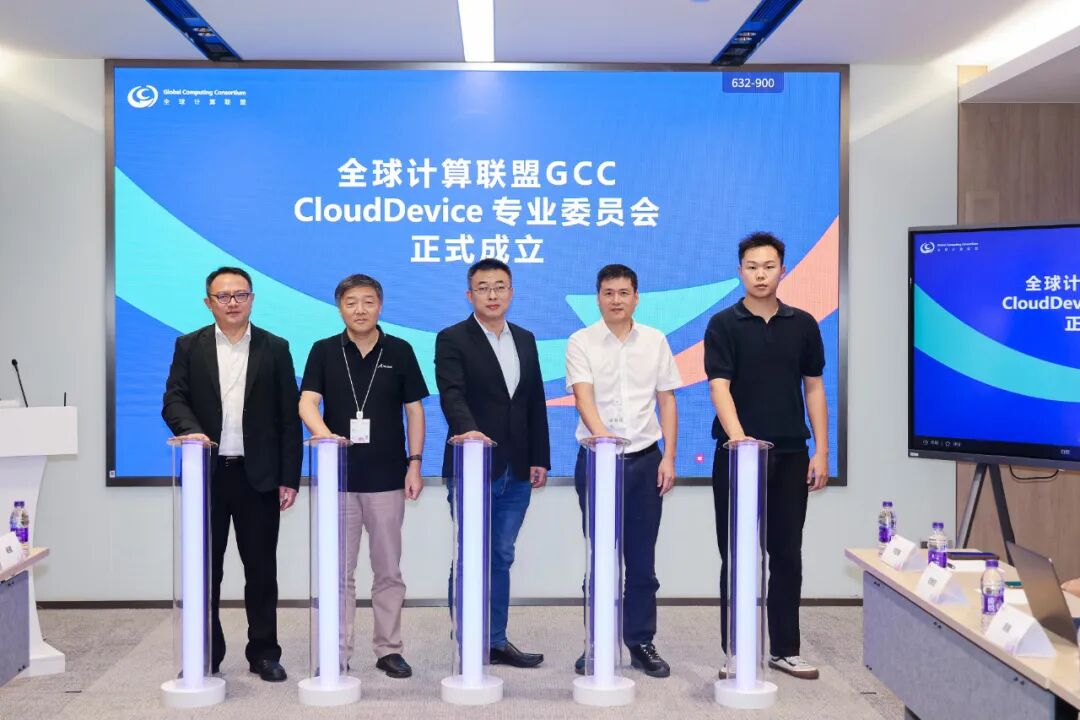
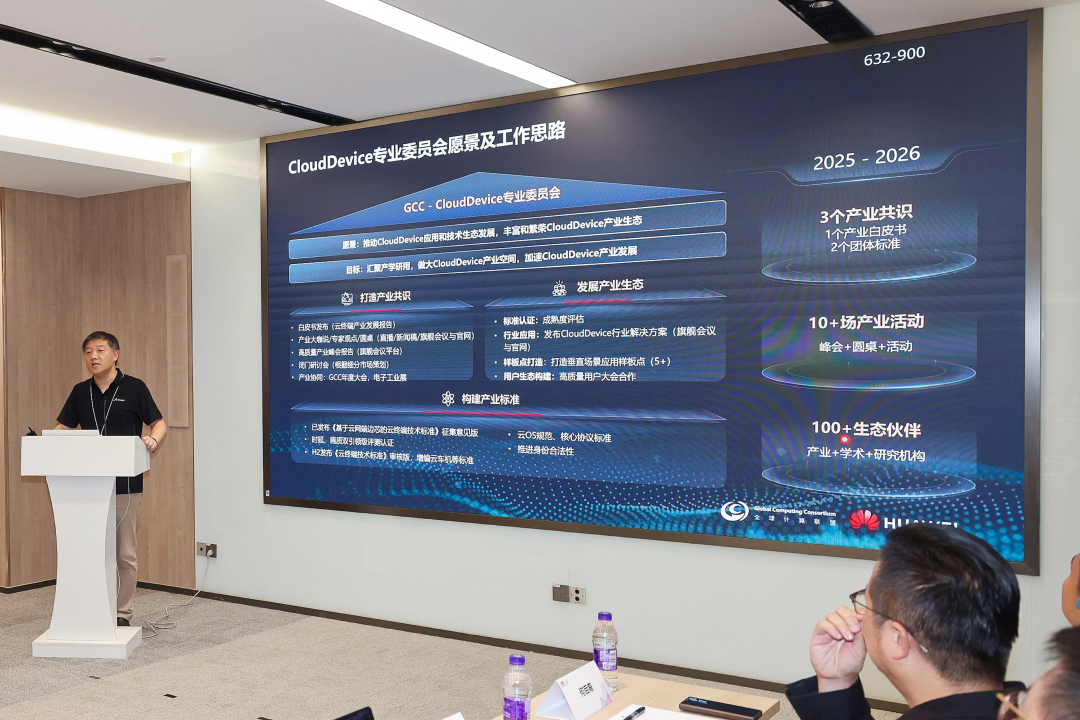
According to official information, the first batch of member units of the committee includes a total of21 units, with Huawei Cloud as the chair unit, and the deputy chair units being the China Academy of Information and Communications Technology, China Mobile Internet Company, and China Mobile (Hangzhou) Information Technology Co., Ltd. The core goal is to promote the development of the CloudDevice application and technology ecosystem, assisting in the enrichment and prosperity of its industrial ecosystem. As of now, the global computing allianceGCC-CloudDevice Professional Committee has led the implementation of multiple industrial initiatives: jointly releasing the “Cloud Terminal Industry Development Report” with the Chinese Academy of Sciences’ Strategic Consulting Research Institute, collaborating with the China Academy of Information and Communications Technology to formulate the “Cloud Terminal Technology Standards Based on Cloud-Network-Terminal-Edge-Core”; at the same time, in terms of industrial ecology, launching dual-leading evaluation certifications for latency and image quality, along with multiple supporting industrial standards.
In fact, the significance of the global computing allianceGCC-CloudDevice Professional Committee goes far beyond this. Currently, as technologies like AI large models bring greater market boundaries to the cloud terminal industry, they also introduce a series of new industrial challenges, such as compatibility between ecosystems, higher underlying technical requirements, and more detailed standards in the cloud terminal industry. These foundational infrastructures have become core elements affecting and restricting the further development of the cloud terminal industry.
This professional committee, led by Huawei Cloud and backed by the global computing allianceGCC, is precisely becoming such an infrastructure role, promoting the acceleration of engagement between the upstream and downstream of China’s cloud terminal industry from the bottom up and from a holistic industrial perspective.
“Because CloudDevice is particularly close to users across various industries, we hope to attract more people to join the GCC through this professional committee, not only to expand the CloudDevice industry but also to grow the computing industry further,” said Jin Hai, Chairman of the Global Computing Alliance and Professor at Huazhong University of Science and Technology, on site.
It can also be said that with the support of AI technologies and the global computing allianceGCC-CloudDevice Professional Committee, the cloud terminal is entering a new second half in 2025.
1
Backed by GCC, a new consensus on cloud terminals
Before understanding the real development status of cloud terminals, it is essential to first understand the global computing allianceGCC.
The global computing allianceGCC is the first registered and internationally operable industrial organization in the computing field by the Ministry of Civil Affairs in China, with members covering technology providers, manufacturers, system integrators, enterprise users, research institutions, and more, with over200 members to date.
From a functional perspective, its core business revolves around new ecosystems, new standards, and new architectures, aiming to develop a prosperous and diverse computing power equal computing industry ecosystem, establish a diverse computing power equal computing standard system, strengthen technological competitiveness, and promote AI-driven diverse computing power equal computing architecture industry consensus.
Specifically, its core tasks also include establishing compatibility and adaptation ecosystems for the upstream and downstream of the computing industry ecosystem, formulating more detailed and specific industrial technology and service standards, and aggregating different roles in the industry chain to form industry technology exchange groups to promote continuous communication and innovative breakthroughs in the industry.
The establishment of the global computing allianceGCC-CloudDevice Professional Committee is a microcosm of this. So, why is the cloud terminal industry the main focus of this industrial action, or why is the cloud terminal industry being brought to the forefront at this particular time?
The answer is not hard to find. The establishment corresponds to a complete industry consensus on the current cloud terminal industry.
According to data from Zhongyan Puhua, by the end of2024, the global cloud terminal market size will exceed28 billion USD, with a compound annual growth rate of18.5%, and China’s market share accounting for35%, leading globally.
Another set of data reports from Gartner and IDC also shows that by2030, the market space for cloud terminals will reach hundreds of billions, with the number of cloud-enabled terminals approaching one billion.
This impressive growth corresponds to the arrival of a qualitative change in the entire cloud terminal market.
In the “Cloud Terminal Industry Development Report” jointly released by Huawei CloudCloudDevice and the Chinese Academy of Sciences’ Technology Strategic Consulting Research Institute, cloud terminals are defined as a new type of terminal form centered on cloud computing, which migrates computing, storage, application, and AI capabilities from local terminals to the cloud through the network, presenting a streaming usage experience on terminal devices.
Strictly speaking, the entire information flow process needs to go through all nodes of the “cloud-network-terminal-edge-core”, but over the past several years, due to some links remaining in a state of technological stagnation and slow development, such as the difficulty in bridging different operating systems, limitations of terminal-side chips, and technical challenges like edge acceleration, the cloud terminal industry has been progressing slowly.
However, in 2025, these bottlenecks or links are entering a new phase.
For example, the diversification of terminal-side devices, if in the past years, people referred to cloud terminals more as cloud phones and cloudPAD, now a series of devices including service robots, industrial robots, and more home terminal devices are becoming new carriers for terminal-side scenarios, with greater market space and demand accelerating to emerge.
Moreover, the optimization and enhancement of computing power models on both sides of the cloud, whether it is the emergence of more new industry-customized terminals or innovations in terminal-side storage-computing separation architectures, are enabling more terminal-side scenarios and devices to connect with the cloud, validating the support of the cloud for the terminal and the cloud’s enhancement of the terminal.
Most importantly, the explosion of generativeAI technology, accompanied by a series of new paradigms such as intelligent agents and multi-agent interactions, is shifting the role of the “cloud” from a purely static storage role to a more high-performance processing and intelligent interaction role. A series of more complex rendering, reasoning, and other tasks can be placed in the cloud, empowering the terminal and breaking through the physical limitations of the terminal to express greater value.
It can be said that at this point in time, the cloud terminal industry is undergoing a full-chain upgrade and leap of the “cloud-network-terminal-edge-core”, with the quantitative changes at each node quietly constituting a qualitative change in the entire industrial collaboration, and a new aggregated potential of the industry is emerging.
However, this is not a simple matter. Several issues need to be brought to the forefront: how should the division of labor and cooperation among different roles be defined for this vast cloud-network-edge-core system project? What should a truly collaborative industrial system that can coordinate and allocate various components look like?
2
Behind the New Soil:
The Underlying “Alignment” of the Cloud Terminal Industry
In fact, this is another important significance of the establishment of the global computing allianceGCC-CloudDevice Professional Committee: to build a sufficiently solid underlying soil for the upcoming explosive new potential of the cloud terminal industry.
If we look back over the past few years, with the emergence of technologies likeAI, the cloud terminal industry is not only welcoming a new wave but also revealing some underlying issues beneath the surface.
For example, the most significant compatibility issues correspond to the different roles in the entire industrial chain, and at a specific node, there are different hardware or software service providers. However, currently, whether it is data interfaces or software and hardware compatibility, the experience is not smooth enough, and the data flow and information transmission between various industrial nodes are severely blocked, resulting in terminal devices having difficulty providing a smooth user experience.
Additionally, the infrastructure for computing power on the cloud is not well established. For the terminal side, if it wants to achieve a true cloud integration, there are specific requirements for both the terminal devices themselves and the cloud’s computing power management, such as needing more accurate and efficient computing power scheduling and collaboration mechanisms, as well as more compatible hardware architectures to enhance the efficiency of computing power transmission between the cloud and the terminal. Furthermore, for terminal enterprises, most underlying cloud service providers currently offer “packaged” computing power resource bundles, which cannot achieve elastic scheduling on the terminal side, resulting in overall high costs.
Moreover, beyond these, there is a more core industry market awareness. In the context of poor compatibility and inconsistent underlying technical standards, it is challenging for the cloud terminal industry to establish a complete user mindset and become the preferred device for users and industrial production.
This situation is becoming more apparent in 2025, when Agent and embodied intelligence become absolute hot topics. If the industry-level collaboration cannot be completed from the bottom up, whether based on the new positioning of cloud terminals or the new consensus on embodied intelligence, it will be difficult to implement.
The global computing allianceGCC-CloudDevice Professional Committee provides such an underlying model for industry alignment.
First, from the industry level, based on the support of the global computing allianceGCC-CloudDevice Professional Committee, a series of industry standards more aligned with China’s cloud terminal industry can be accelerated in formulation, and the adaptation between the upstream and downstream of the industrial chain can also be promoted more quickly under a trusted endorsement.
On the other hand, the overall technical level of the industry can be accelerated to align. With the support of the leading Huawei CloudCloudDevice, the global computing allianceGCC-CloudDevice Professional Committee can use the most advanced cloud terminal industry collaboration model in China as the foundation.
A brief introduction toCloudDevice is that it is the industry’s first innovative solution that enables cloud access through four forces (computing power/storage power/electric power/logistics power), achieving seamless connectivity across terminals, operating systems, and multiple scenarios based on cloud-network-terminal-edge-core collaborative technology.
For example, multi-terminal collaboration, based on cloudOS, can achieve multi-screen transfer and simultaneous viewing; as for the performance indicators mentioned earlier, such as network latency and image quality,CloudDevice can support ultra-low latency of up to60ms and ultra-high image quality of4K 90@FPS through network compression, codec optimization, edge deployment, and the powerful GPU rendering capabilities of the next-generation cloud server.
Moreover, based onAgent, the stronger value release on the cloud side supports multi-modal perception and “one-sentence” cloud machine task execution, allowing users to experience more capable and efficient intelligent agents on the terminal side through the cloud’s large computing power model. At the same time, through an intelligent computing power scheduling system, enterprises can enjoy higher resource utilization and lower costs, truly scheduling on demand.
From a broader perspective, the global computing allianceGCC-CloudDevice Professional Committee serves as an industrial ecological collaboration platform for the cloud terminal industry. It not only establishes a feasible and trustworthy product collaboration pathway among different roles but also comprehensively aligns the underlying technical capabilities of the entire cloud terminal industry chain.
This alignment is not solely based on the alignment of technology itself, such as network bandwidth, latency, and resolution, but also involves the standard definition of demand proposals and satisfaction models throughout the entire industrial chain, such as cloudOS specifications, core protocol standards, and so on.
3
The Cloud Terminal Industry,
the “Sunward Curve” under the New Aggregated Ecology
Disorder brings chaos, while order brings healthy development; this applies to enterprises and even more so to industries. To some extent, this is the greatest value of Huawei Cloud leading the establishment of the CloudDevice Professional Committee. In fact, the benefits of this ecosystem have already begun to take shape.
Today, Huawei CloudCloudDevice provides diversified cloud terminal scenario solutions covering personal, family, travel, office, and embodied intelligence, among others.
In the collaboration betweenCloudDevice cloud phones, cloud space, and domestic operators, a user base of860 million has been accumulated, with active users reaching60 million, helping operators effectively reduce the churn rate by89%, and core users’ monthly data usage reaching60-100G.
For example, in the cloud gaming scenario, it can now achieve end-to-end60ms ultra-low latency, and low-end devices are not limited by computing power or storage, allowing heavy mobile games to perform on par with real machines.
Several more evident data dimensions include, for instance, in cloud vehicle systems, based on Huawei CloudCloudDevice‘s solutions, low-spec chips can run heavy applications, with OTA upgrade times reduced by90% and computing power increased by20 times; and in the cloudPC side, rendering performance can now be improved by10 times, and efficiency increased by50%.
It can be seen that leveraging the advantages of terminal-cloud collaboration technology,CloudDevice can connect various industrial nodes with the optimal architecture at every stage, while building a foundational platform most suitable for the industry and information flow, fully utilizing the efficiency of each industrial link, ultimately constructing a truly usable and practical cloud terminal form.
A sufficiently certain fact is that in the next5 to10 years, the cloud terminal industry will face tremendous development opportunities, but it will also inevitably need to address challenges unlike any before, such as higher elastic computing power demands, more complex communication environments, and deeper, smarter collaboration between the cloud and the terminal.
However, it can be seen that with the establishment of the global computing allianceGCC-CloudDevice Professional Committee and the continuous efforts of enterprises like Huawei Cloud, the Chinese cloud terminal industry is solidifying its technological foundation, breaking through trust bottlenecks in the industrial chain, and continuously advancing towards the sun at high speed in the form of an industrial coalition.
Or it can be said that in 2025, the Chinese cloud terminal industry has officially entered the second half of industrial aggregation.
 Latest video content recommendations▼▼Industry AI Large Models“Financial Large Models, Where is the Industry Heading?”“The Boiling Large Models: Who is Becoming the Protagonist?”“Large Models Landing in the Financial Industry, Where is the Imagination? | Industry Feature”“Re-understanding Baidu Intelligent Cloud: Written in the 24 Hours After the Large Model Opened”“A Southern School, Encountering AI in 60 Days”“Kingdee, ‘Dancing’ in the Era of Large Models”Industry Digitalization“Under the Trend of Digitalization, the ‘Tightening Spell’ of Sci-Tech Innovation Board IPOs““透视京东,和隐藏起来的200个上升密码”“Cloud Management Behind the Car: Insights into Corporate Internal Skills in the Digital Age”“透视云测试:技术、产业、降本增效下的数字化之战”Industry SaaS“2021 SaaS Industry Eight Major Trends | Review”“Meituan and Alibaba’s Battle, Restaurant SaaS has No ‘Endgame'”
“Kingdee Teng ‘Cloud’, Industry Interconnection ‘Netting'”
“Tencent Leverages, SaaS Starts Team Battles”
Industry Supply Chain“In the Era of Industrial Internet, Who is Rewriting the Supply Chain?”“Hand in Hand with State-owned Assets, Looking at Suning’s Retail Industry Boundaries”Industry Hard Technology“Cloud from ‘Knocking on the Door’ of the Sci-Tech Innovation Board”“The Internet of Things, a Giant Battle for Cloud Access”“Huawei: Telling a New Story with HarmonyOS 2.0”“Domestic Chip Battlefield: Constraints, Determination, and a Visible Future for the Next Decade”© Previous Reviews▼
 Industry Home Network Newly Launched© THE END
 This article is produced byIndustry Home and is original. Please do not reprint without permission./Welcome to report▼Contact WeChat for Industry Home Reports: 15201450756