When technical challenges meet decision-making difficulties? The Open Technology Zone provides you with the optimal solution!
“Developing features with Python, but needing to check the underlying layers during debugging?”
“After looking at a bunch of driver codes, but can’t find application layer implementation examples?”
—— This is a real pain point for many IoT developers.
Quectel’s Open Technology Discussion Zone innovatively adopts a “dual engine” architecture:
QuecPython: The “fast lane” for application development
OpenC: The “foundation platform” for in-depth hardware development
Forum entrance:https://bbs.quectel.com.cn/
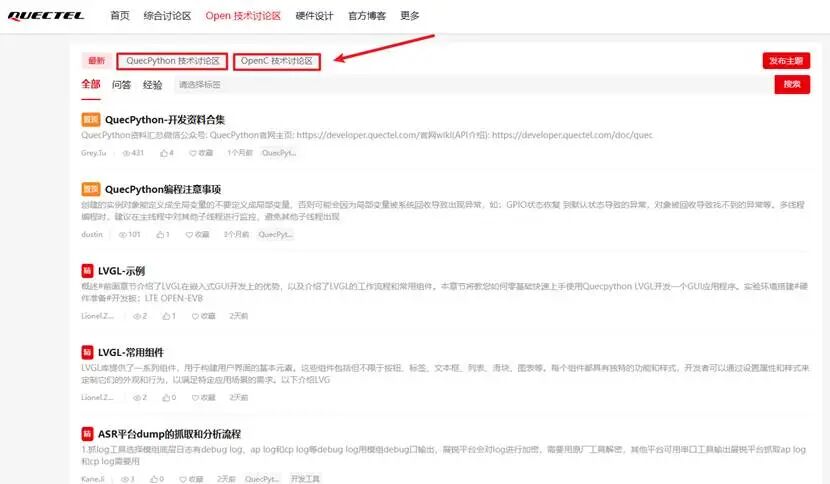
💡 Your decision logic should be:
👉 Want to quickly implement features? Rush to the QuecPython zone! 👉 Need to optimize underlying performance? Dive into the OpenC zone!
🔧 First Engine: OpenC — The “Foundation Construction Team” of IoT
Why is it called the “foundation”?
OpenC is a low-level development framework written in pure C language, directly communicating with hardware:
● Mastering the soul of hardware: GPIO/UART/SPI register-level operations
● Taming communication protocols: From AT command parsing to TCP/IP protocol stack optimization
● Building the system skeleton: RTOS task scheduling, memory management, interrupt control
🚨 Who is it suitable for?
● Embedded veterans, driver development engineers
● Geeks who need to “dissect” hardware
🐍 Second Engine: QuecPython — The “Rapid Assembly Line” of IoT
Why do developers love it?
Based on the capabilities of OpenC, but wrapped in Python syntax:
● Control GPIO with 1 line of code, no need to check the register manual
● Complete HTTP upload in 3 script lines, no need to study the protocol stack
● Achieve sensor data collection in 5 minutes, skipping driver development
🚨 Who is it suitable for?
● Makers, product managers, Python developers
● Efficiency seekers who want “prototype today, mass production tomorrow”
🎯 The “Three-Step Method” for Precisely Matching Technical Needs
1. Clarify the problem level
● Hardware drivers, extreme performance optimization, system stability, exploration of underlying mechanisms? → OpenC
● Feature implementation, API usage, business logic, network applications, rapid prototype development? → QuecPython
2. Make good use of tag combination searches
● High-frequency tags in the OpenC zone:
#Audio #MCU #RTOS #Watchdog #NPU etc.
● Popular tags in the QuecPython zone:
#QuecPython #FOAT #NetworkCommunication #IoT etc.
3. Cross-domain collaboration and deep optimization
● Top-down (QuecPython -> OpenC): When application layer methods are exhausted, delve into the underlying layers to understand their operating mechanisms and constraints, thus finding optimization directions or avoidance methods.
● Bottom-up (OpenC -> QuecPython): When performing low-level development or optimization, trace back to the upper layer application’s needs and implementations, ensuring that your low-level work can accurately solve the actual problems of the application layer and can be verified using QuecPython.
🌟 Remember
In the Open Technology Zone, every question you have has solutions in two dimensions —
Abstracting upwards saves time, digging downwards gains performance!
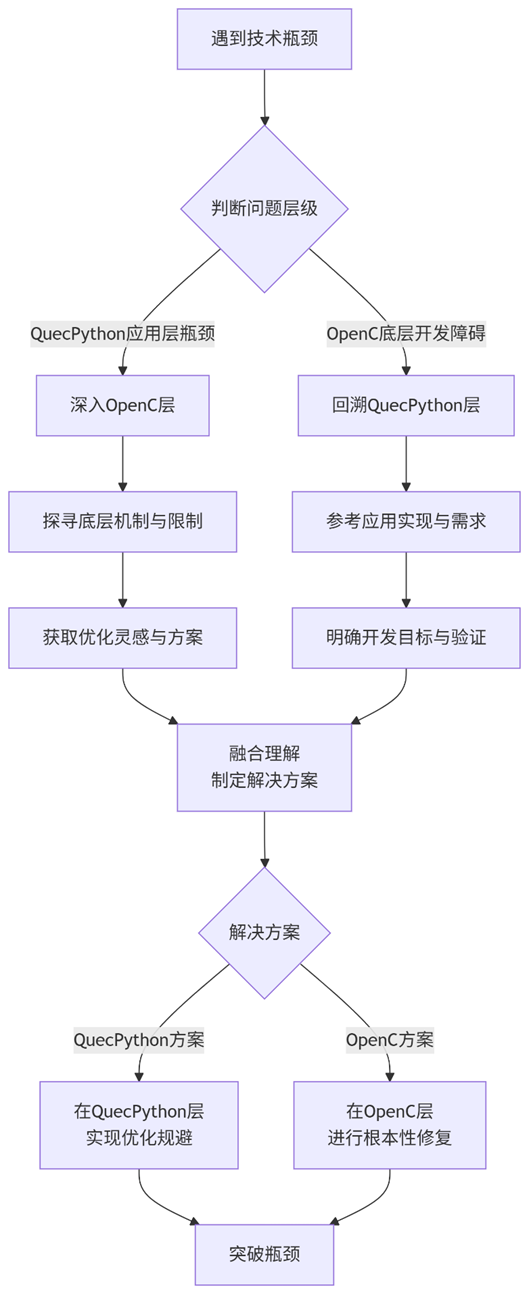
Whether you are a maker eager for rapid prototype validation or a senior engineer pursuing ultimate performance, Quectel has prepared two passes for you to the future of IoT:
QuecPython’s “Key to Efficiency” and OpenC’s “Blade of Depth”.
Choose your way, define your era.
[Like] [Collect] [Ask] ← Unlock hidden features with three interactions! Follow me, and you won’t get lost in future guides~