1.Invisible Eavesdropping Within 10 Meters: Real Scenarios of Bluetooth Headset Vulnerabilities
A user regularly uses a well-known brand of true wireless Bluetooth headset (equipped with the Airoha chipset) for commuting to listen to music and making calls, unaware that the device has a critical security vulnerability. An attacker exploited the systemic security flaw in the chipset to carry out a complete attack without physical contact:
Vulnerability Exploitation: The attacker carries a portable device equipped with a Bluetooth sniffing module within a 10-meter range (the Bluetooth communication coverage area) of the user, utilizing the high-risk vulnerability CVE-2025-20701 to bypass the pairing authentication process of the Bluetooth headset, establishing an illegal connection without user confirmation. This vulnerability allows classic Bluetooth connections to skip critical identity verification, akin to opening the device door with a “master key”;
Audio Eavesdropping: Through the CVE-2025-20702 vulnerability (CVSS score 9.6), the attacker can read and write the headset’s memory, extract the Bluetooth link key, hijack the trust relationship between the headset and the phone, and real-time steal music and podcast content being played, even listening to surrounding sounds through the headset microphone, clearly capturing conversations within 10 meters;
Privilege Hijacking: By modifying the headset’s flash memory through the vulnerability, malicious instructions can be implanted, remotely triggering the phone to activate the voice assistant, dial unfamiliar numbers, or even access sensitive information such as the phone’s contacts and call logs, while the user may only notice sudden disconnections or abnormal sound quality, making it difficult to detect the nature of the attack;
Risk Dissemination: This vulnerability affects over 29 devices, including Sony, Bose, and JBL, putting millions of users worldwide at risk of privacy breaches, with more than half of the devices having not received firmware updates for a long time, creating ongoing security hazards.
The core root of this series of risks is that Bluetooth headsets have design flaws in identity authentication, communication encryption, and firmware security. The EN18031 standard aims to eliminate such vulnerabilities through mandatory comprehensive security requirements from a technical perspective.
2.EN18031 Standard: The “Security Protection System” for Bluetooth Headsets
As a mandatory cybersecurity standard under the EU CE-RED directive (effective from August 1, 2025), EN18031 establishes layered protection requirements for core scenarios such as wireless communication, data transmission, and firmware updates for smart Bluetooth headsets, precisely blocking the aforementioned vulnerabilities:
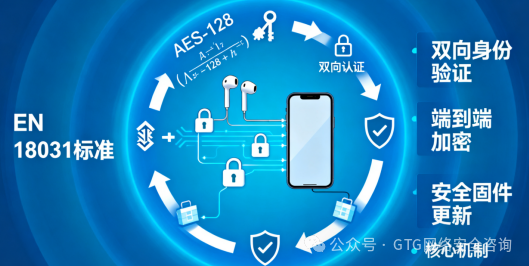
1. For “Bypassing Pairing Authentication”: Bidirectional Strong Identity Verification Mechanism
EN18031-1 clearly requires that Bluetooth headsets must use “bidirectional identity verification + encrypted pairing” instead of simple unidirectional confirmation:
During the pairing phase: When the headset connects to the phone, it must use the LESecureConnections protocol of Bluetooth 5.0 and above to execute a “challenge-response” process— the headset sends a random challenge code to the phone, which is then encrypted with a pre-shared key and fed back, while also verifying the headset’s digital certificate to confirm legitimacy bidirectionally;
Disabling Vulnerability Channels: Mandatory closure of manufacturer-reserved debugging interfaces (such as the RFCOMM channel that causes vulnerabilities) or setting independent passwords and permission controls for debugging functions to prevent attackers from bypassing authentication through reserved channels;
Rejecting Weak Authentication: Prohibiting password-less pairing, default password pairing, and other simplified modes, forcing users to set high-strength pairing passwords or use biometric verification (such as phone fingerprint verification) to confirm pairing, blocking illegal connections from the source.
2. For “Audio Eavesdropping/Data Leakage”: End-to-End Encryption Protection
EN18031-2 (Privacy Protection Substandard) imposes mandatory encryption requirements for audio transmission and data storage in Bluetooth headsets:
Transmission Encryption: All audio streams (music, calls, ambient sounds) must be encrypted for transmission using AES-128 or higher strength algorithms, and the communication link between the headset and the phone must enable encrypted channels, so that even if an attacker captures Bluetooth data packets, they cannot restore the plaintext content;
Storage Encryption: Sensitive data such as pairing keys and user preferences must be stored in a secure element (SE) and protected with AES-256 encryption to prevent attackers from stealing keys through memory read/write;
Data Minimization: If the headset is equipped with a voice assistant, it should only collect voice snippets necessary for operation, not store complete conversation records locally, and must obtain explicit user authorization before uploading to the cloud to avoid additional privacy breaches.
3. For “Firmware Tampering/Vulnerabilities Not Fixed”: Secure Update Mechanism
EN18031-1 mandates that Bluetooth headsets must have a complete firmware security update system (SUM):
Encrypted Verification: Firmware update packages must be verified through RSA-2048 digital signatures and can only be transmitted via encrypted channels such as HTTPS to prevent attackers from tampering with update packages to implant malicious programs;
Rollback Prevention Design: Prohibiting firmware downgrades to known vulnerable versions, automatically rolling back to a stable secure version in case of update failure to avoid exposing vulnerabilities due to abnormal updates;
Lifecycle Commitment: Manufacturers must provide at least 2 years of security patch support, promptly responding to zero-day vulnerabilities and pushing update reminders through apps to ensure devices continuously receive security fixes throughout their lifecycle.
4. For “Privilege Hijacking”: Secure Boot and Anomaly Monitoring
Secure Boot: The headset automatically verifies the digital signature of the system image during startup. If tampering is detected (such as an attacker implanting malicious code), the startup is immediately halted, and an alarm is triggered (flashing indicator light or app notification);
Anomaly Behavior Monitoring: Real-time monitoring of connection status (such as multiple abnormal pairing requests in a short time) and data transmission (such as capturing unconventional audio streams), automatically disconnecting and locking the device after triggering thresholds, requiring users to unlock through physical operation or the app;
Privilege Levels: Distinguishing between ordinary user and administrator privileges, requiring additional verification for sensitive operations (such as firmware updates and pairing management) to prevent attackers from altering device settings after gaining privileges.
3.Industry Impact and User Guidelines of EN18031
1. Industry Level: Establishing a Security Baseline for Market Access
EN18031 has become the “passport” for smart Bluetooth headsets entering the EU market, with products that do not pass certification being prohibited from sale. This requirement forces manufacturers to abandon the design philosophy of “heavy functionality, light security” and embed security mechanisms throughout the entire process from chip selection, protocol development to firmware updates— for example, using encryption chips certified by FIPS140-2, closing dangerous reserved interfaces, and establishing rapid vulnerability response mechanisms.
2. User Level: Practical Suggestions to Avoid Vulnerability Risks
Prioritize Certification When Purchasing: Choose Bluetooth headsets that clearly state “compliant with EN18031 standard,” “support AES-128 encryption,” and “have secure firmware updates” to avoid low-priced products with no security certification; prioritize brands that promise long-term firmware support (≥2 years);
Proactively Update Firmware: Regularly check for firmware updates through the headset control app and promptly install security patches, especially when manufacturers release vulnerability fix announcements; do not ignore update reminders;
Be Alert to Abnormal States: If the headset experiences unexplained disconnections, sudden changes in sound quality, or automatic pairing without operation, immediately disconnect from the phone, reset the headset, and change the pairing password to investigate potential attacks;
Use Caution in Sensitive Scenarios: Avoid using Bluetooth headsets with known vulnerabilities when handling sensitive conversations (such as work secrets or financial information); prioritize wired headsets or devices confirmed to be secure.
From the globally impacting Bluetooth chipset zero-day vulnerabilities to the comprehensive protection built by the EN18031 standard, it is evident that Bluetooth headsets, as “personal smart devices,” have their security directly related to personal privacy and information security. The value of the EN18031 standard lies not only in closing technical vulnerabilities through mandatory certification but also in promoting the industry to establish a “security-first” design philosophy—only by making security the default configuration of smart devices can users enjoy wireless convenience while eliminating concerns about “invisible eavesdropping.”


For inquiries, please scan the QR code to add the official WeChat
Phone|18188898539