Tactical edge processing and cloud computing technologies are reshaping intelligence, surveillance, and reconnaissance (ISR) operations and battlefield decision-making in unprecedented ways. Tactical edge computing not only enhances the synergy and efficiency of data analysis and military response but also saves lives in critical moments. Although this technology has received little attention in the public eye, it is recognized in the military domain as one of the most innovative and forward-looking data collection and analysis systems. When combined with artificial intelligence and augmented reality technologies, the real-time application scenarios are nearly limitless.
The core position of tactical edge computing in modern military strategy and decision-making is becoming increasingly prominent, with its application scale growing exponentially. It profoundly transforms commanders’ situational assessment and resource deployment models. This article will delve into the principles and applications of tactical edge computing, systematically elucidating its strategic value and key role in the 21st-century military system, using FlySight’s “OPENSIGHT Mission Control Console” and end-to-end augmented reality solutions as examples to explore the future evolution path of edge processing technology.
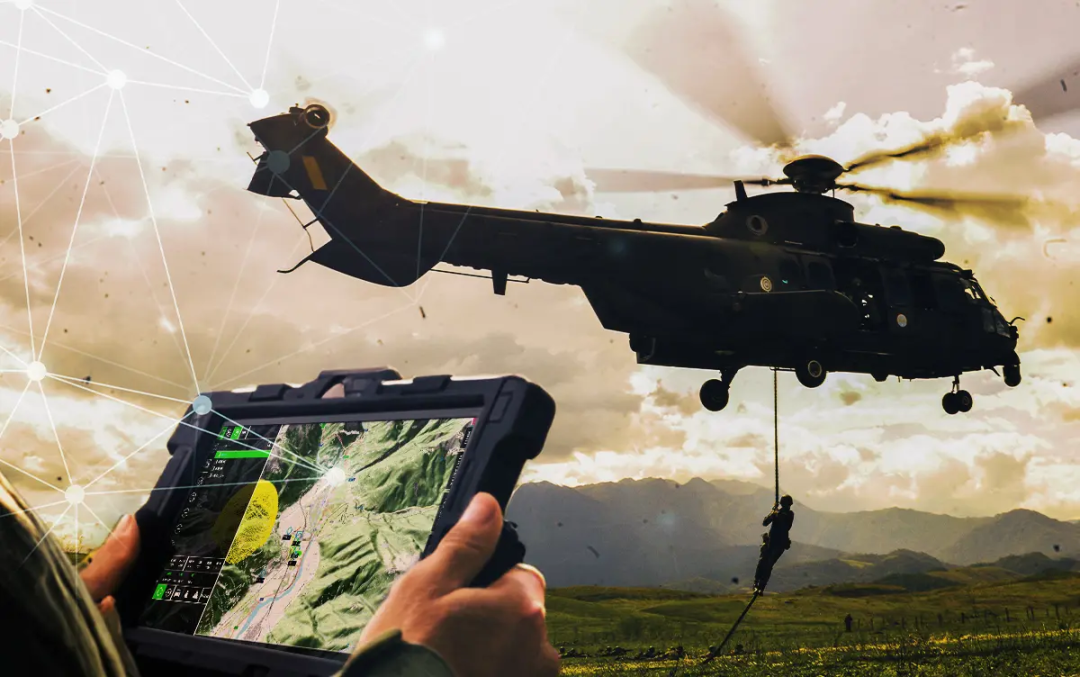
Understanding the Essence of Edge Computing
Edge computing technology refers to computing resources and processing capabilities deployed near the source of data generation, often located in remote or hostile areas. This technology is essentially positioned at the “tactical front line” of the operational area (land/sea/air battlefield), requiring compactness, high computing power, and adaptive characteristics to empower operators with real-time critical decision-making.
Real-time analysis of data from battlefield drones, sensors, and other devices, along with immediate comparison to cloud-stored information, can provide operators with significant tactical advantages. As a core component of the “battlefield Internet of Things,” it builds high-speed information channels to achieve analytical collaboration and action execution. Its “edge” deployment characteristics ensure faster, more efficient, and immediate implementation capabilities.
Differences from Traditional Cloud Computing
The core difference between edge processing and traditional cloud systems lies in the location and method of data processing:• Edge processing completes data collection and analysis at the “network edge” near the data source (drones/sensors, etc.)
• Cloud computing requires data to be transmitted to a central server far from the source for storage and processing
Adaptability to Tactical Environments
Edge computing is an ideal partner for tactical environments. Given the characteristics of remote, hostile, and resource-constrained battlefields, this technology enables data source analysis. Relying on real-time decision-making capabilities of drone-mounted sensors and cameras allows operators to break free from dependence on remote servers or cloud connections—this is particularly critical when stable connections cannot be guaranteed.
Tactical edge computing is especially suited for autonomous systems, empowering them to analyze real-time data streams and instantly identify threat targets. While it is necessary to retain human operators as the final decision node (as with all AI systems), it significantly reduces the ongoing communication demands between the system and command centers.
Core Advantages of Tactical Edge Computing
Low latency response: The system operates at the edge of the operational area (not at a distant separated location), accelerating data processing to support millisecond-level military decision-making.Streamlined processes: Real-time optimization of operational processes enhances resource allocation efficiency and reduces lengthy communication between frontline operators and command bases.Enhanced security: Reducing back-and-forth data transmission can enhance security and data sovereignty, while local processing of sensitive information lowers the risk of external hacking attacks.Resilience assurance: Continues to operate in disconnected environments (GPS denial/communication interruption) as it does not rely on long-distance connections.
Key Operational Application Scenarios
The shorter the information transmission distance and the fewer access nodes, the more efficient the secure utilization of mission-critical data and decision-making becomes. Reducing data latency directly enhances response speed and decision-making efficiency.
Tactical edge cloud computing not only benefits from proximity to the battlefield but also supports the integration of multi-source data (satellite/ground sensors/reconnaissance drones) through cloud connections, building a layered analytical system that empowers operators with more precise and in-depth battlefield awareness.
Innovative end-to-end solutions like FlySight’s OPENSIGHT mission control console (such as target capture systems and NATO STANAG 4607 ground target tracking enhancement systems) utilize AI-assisted programming to merge real-time collected data with existing information into a collaborative strategic roadmap.
Autonomous drones are becoming increasingly prevalent on the battlefield. While retaining human operator decision nodes, drones can dynamically adjust surveillance and target capture protocols based on machine learning and real-time location data updates, significantly enhancing operational effectiveness.
Cybersecurity Dimensions
The limited controllable characteristics of multi-access edge computing and the near-source processing mechanism provide higher-level cybersecurity protection. The longer the transmission distance of sensitive information and the more frequent the analysis and verification back-and-forth, the greater the risk of external attacks. Near-source data processing eliminates weak links in the chain, ensuring information security.
However, it is important to note: when edge computing systems connect to external cloud sources, the closed-loop system transitions to an open architecture, significantly increasing the risk of data leakage. Therefore, tactical edge cloud computing must be implemented within a strict security framework. Using task consoles like OPENSIGHT to access supplementary data is one of the most reliable ways to ensure the security of critical data obtained through edge computing.
Future Evolution Directions
Although it is already a cutting-edge system, tactical edge computing still has vast potential for evolution in operational applications.
Continuous technological advancements will lead to improved operational effectiveness, with the core focus on system integration into user-friendly hardware (such as intuitive operation in confined spaces like helicopter cockpits). Leveraging augmented reality foundations and deep machine learning capabilities, the OPENSIGHT platform demonstrates how systems can achieve collaborative customization for military operations, search and rescue (SAR), and surveillance tasks—by seamlessly and securely connecting to external data sources, breaking through the limitations of near-domain information.
For convenient viewing
Please followSpecial Knowledge Intelligent Defense public account (click the above to follow)
Welcome to scan the QR code to addSpecial Knowledge Assistant, for consulting services, Chinese materials, and report customization

 Click “Read the original text” to check more related content (www.zhuanzhi.ai)