1208 – Spiral Matrix
Program Development Approach
1. Problem Analysis
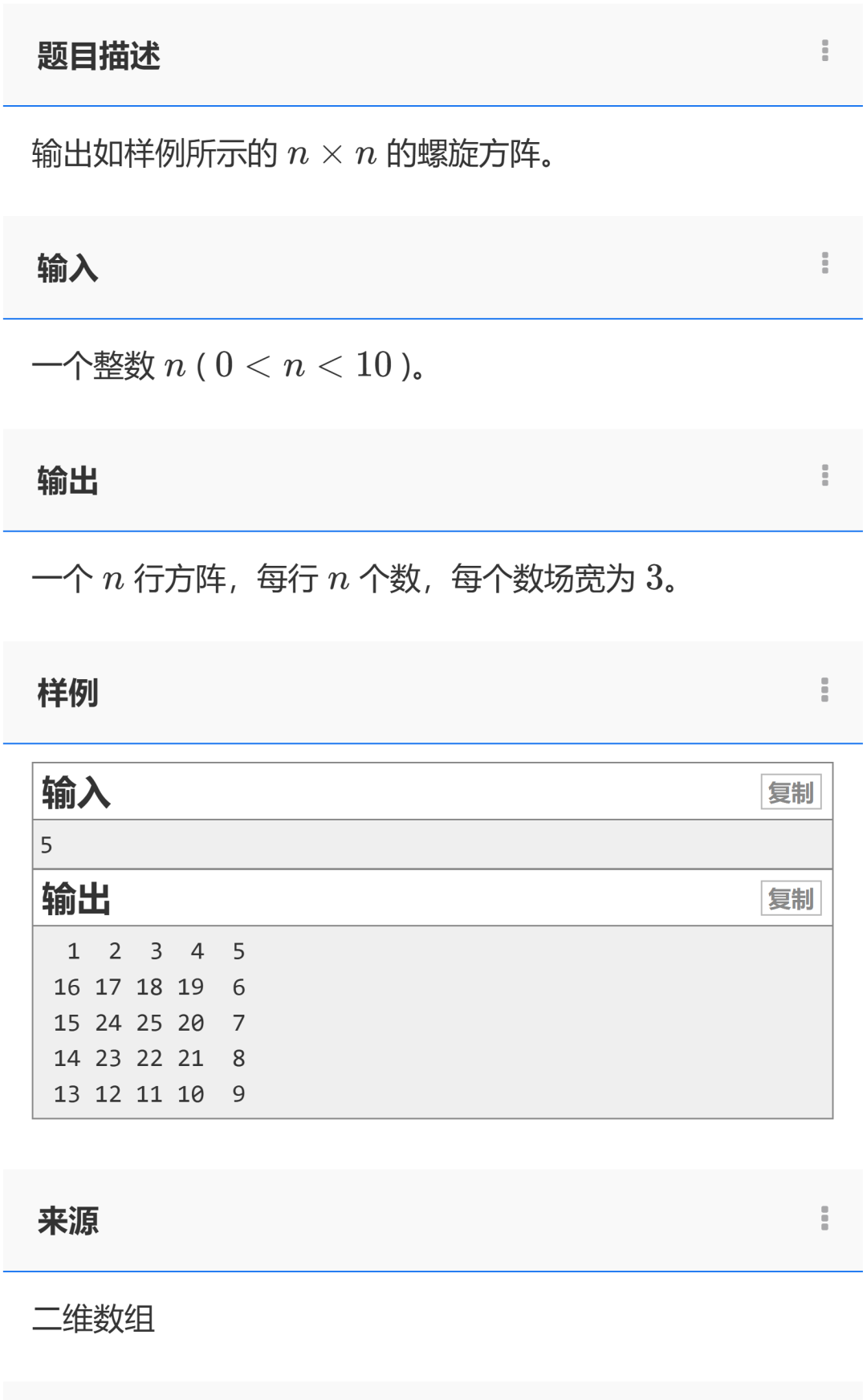
This program attempts to generate an n×n spiral matrix using a recursive method. The spiral matrix starts from the top-left corner (1,1) and fills numbers in a clockwise direction (right → down → left → up).
2. Algorithm Selection
The program uses a depth-first search (DFS) recursive method:
-
Start from the initial point (1,1) and move in the current direction
-
If the next position is unavailable (out of bounds or already filled), change direction
-
Recursively fill the next position, incrementing the number
-
When all positions are filled, the recursion ends
3. Implementation Details
-
Use a global variable i to record the current direction index
-
Use direction arrays dx and dy to control movement direction
-
The recursive function fun handles the filling of each position
-
Check the legality of the next position before the recursive call
-
Use setw(3) to control output format
Reference Code
#include<bits/stdc++.h>  // Include all standard library headers
using namespace std;
int q[20][20];  // Define a 20x20 2D array to store the spiral matrix
int dx[] = {0, 1, 0, -1};  // Define x direction changes: right, down, left, up
int dy[] = {1, 0, -1, 0};  // Define y direction changes: right, down, left, up
int n, i = 0;  // n is the size of the matrix, i is the direction index (initially 0, indicating right)

// Recursive function to generate the spiral matrix
// Parameters x: current row coordinate
// Parameters y: current column coordinate
// Parameters k: current number to fill
defun(int x, int y, int k){    // Check if the current position is within matrix bounds and not filled
    if(x > 0 && x <= n && y > 0 && y <= n && q[x][y] == 0)    {
        q[x][y] = k;  // Fill the current number k into the matrix at (x,y)
        int tx, ty;  // Define temporary variables to store the next position coordinates
        tx = x + dx[i], ty = y + dy[i];  // Calculate the next position after moving in the current direction
        // Check if the next position is out of bounds or already filled
        if(tx < 1 || tx > n || ty < 1 || ty > n || q[tx][ty])        {
            i = (i + 1) % 4;  // Change direction
            tx = x + dx[i], ty = y + dy[i];  // Recalculate the next position coordinates
        }
        fun(tx, ty, k+1);  // Recursive call to fill the next position, incrementing the number by 1    }}
int main(){    cin >> n;  // Input the size of the matrix n
    fun(1, 1, 1);  // Start recursive filling from position (1,1), starting number is 1
    // Output the spiral matrix    for(int i = 1; i <= n; i++)  // Iterate through each row (from 1 to n)    {
        for(int j = 1; j <= n; j++)  // Iterate through each column (from 1 to n)        {
            cout << setw(3) << q[i][j];  // Output each element, setting width to 3 for alignment        }
            cout << endl;  // New line after each row output    }
    return 8;  // Program ends, returns 8 (note: should typically return 0 to indicate success)}
Program Documentation
Program Functionality
This program attempts to generate an n×n spiral matrix, with numbers starting from 1 filled in a clockwise direction from the outside in.
Variable Explanation
-
<span>q[20][20]</span>: 2D array to store the spiral matrix -
<span>dx[]</span>and<span>dy[]</span>: Direction arrays controlling movement in right, down, left, and up -
<span>n</span>: User input for the size of the matrix -
<span>i</span>: Global variable to record the current direction index (0-right, 1-down, 2-left, 3-up) -
Function Parameters:
-
<span>x</span>: Current row coordinate -
<span>y</span>: Current column coordinate -
<span>k</span>: Current number to fill
Algorithm Flow
-
User inputs the size of the matrix n
-
Call the recursive function fun starting from position (1,1)
-
In the recursive function:
-
Check if the current position is valid (within bounds and not filled)
-
Fill the current number
-
Calculate the next position
-
If the next position is unavailable, change direction
-
Recursively call to handle the next position
Output the generated spiral matrix
Expected Output
If the input is 3 and the program is correct, it should output:
text
1 2 3 8 9 4 7 6 5Notes
-
The current code has multiple syntax errors and cannot run directly
-
The recursion lacks a clear termination condition, which may lead to stack overflow
-
The global variable i and the loop variable i in the main function have the same name, which may cause conflicts
-
The array index starts from 1 instead of the conventional 0 in C++
-
The program returns 8 instead of 0, which is not conventional
Learning Points
-
Application of recursive algorithms: Using recursion to implement spiral filling
-
Direction control: Using direction arrays to simplify handling of multi-directional movement
-
Boundary checking: Need to check for out-of-bounds or occupied positions when moving
-
Operations on 2D arrays: Filling a 2D array in a specific pattern
-
Output format control: Using setw to set output width