First Author: Ziwen Mei (Central South University)Corresponding Authors: Zhang Lin, Min Liu (Central South University)
Research BackgroundElectrochemical CO₂ reduction to CO serves as an important bridge connecting renewable electricity with chemical feedstocks. Acidic media can completely avoid carbonate precipitation, benefiting device longevity; however, the hydrogen evolution reaction (HER) dominates in strong acids. Although single-atom Ni−N₄ catalysts inherently suppress HER, their selectivity drops sharply under industrial-level currents (≥500 mA cm⁻²) due to weak *COOH adsorption and insufficient CO₂ activation. Achieving high activity, high selectivity, and high energy efficiency in a high proton concentration environment through dual tuning of “electronic structure-site microenvironment” is the core bottleneck for acidic CO₂RR to advance to industrial applications.
Research ObjectiveUtilizing defect engineering on carbon supports, we densely construct Ni−N₄ sites (NiSA/V-CNT) at the edges of carbon nanotubes, enhancing *COOH adsorption through d-band upshift, breaking through the performance ceiling of acidic high-current CO₂RR, achieving >90% CO selectivity and stable operation for several hours.
Experimental MethodsHNO₃ vapor etching introduces vacancies in CNT → High-temperature coordination anchors Ni single atoms → Obtain NiSA/V-CNT (high edge site ratio) and NiSA/CNT (comparison sample). DFT calculations of series of edge models (V1-V3) → In situ Raman, ATR-SEIRAS track *COOH/*CO intermediate → Flow cell three-electrode system evaluates activity, selectivity, energy efficiency, and 68 h stability.
Main Findings
-
Edge Ni−N₄ site d-band upshift of 0.5–1.1 eV, *COOH adsorption energy halvedDFT shows that as vacancies increase, the Ni 3d center rises from −2.57 eV to −1.50 eV; the free energy of *COOH formation drops from 1.55 eV to 0.50 eV, Ni−C bond length shortens, and −ICOHP increases, raising the theoretical CO₂RR-HER limiting potential difference from 0.16 V to 0.60 V.
-
Single-atom Ni is 100% located at the carbon edge, with richer electronic statesAC-HAADF-STEM reveals that Ni single atoms in NiSA/V-CNT are concentrated along the tube wall edges; XANES, XPS, KPFM confirm that Ni is slightly reduced (increased electron density), with a surface potential difference of 114.8 mV (vs 74.0 mV), providing ample electronic feedback for *COOH.
-
In situ spectroscopy directly captures enhanced *COOH signalsIn situ ATR-SEIRAS shows a characteristic peak at 1800 cm⁻¹ for *COOH and a C−O stretching redshift to 1388 cm⁻¹ (compared to 1398 cm⁻¹), while the Raman adsorbed CO₂ shows a redshift of 13 cm⁻¹, confirming that edge sites have stronger adsorption-activation for CO₂/*COOH.
-
Industrial-level current performance is comprehensively superiorIn a flow cell at pH=1, NiSA/V-CNT achieves FECO ≥ 94.5% at 800 mA cm⁻², with a cathode energy efficiency of 44.2%, both setting new highs for Ni single-atom acidic CO₂RR; 68 h at 300 mA cm⁻² with FECO > 90%, with no structural degradation, outperforming recent similar catalysts.
Figure Interpretation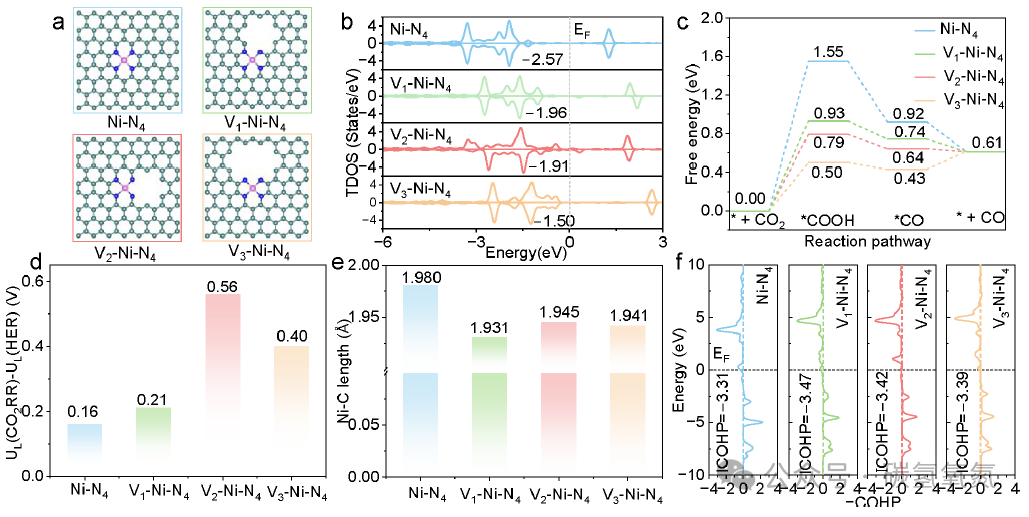
Figure 1 DFT Calculationsa) Four models: Ni−N₄, V1−V3−Ni−N₄, with more vacancies leading to richer edges.b) TDOS: Ni 3d center gradually shifts upward.c) Free energy diagram: The energy barrier for *COOH formation monotonically decreases.d) UL(CO₂RR)−UL(HER) difference: V3 model shows the best selectivity.e) Ni−C bond length: Edge site bond lengths shorten.f) −ICOHP: Bond strength quantification increases.
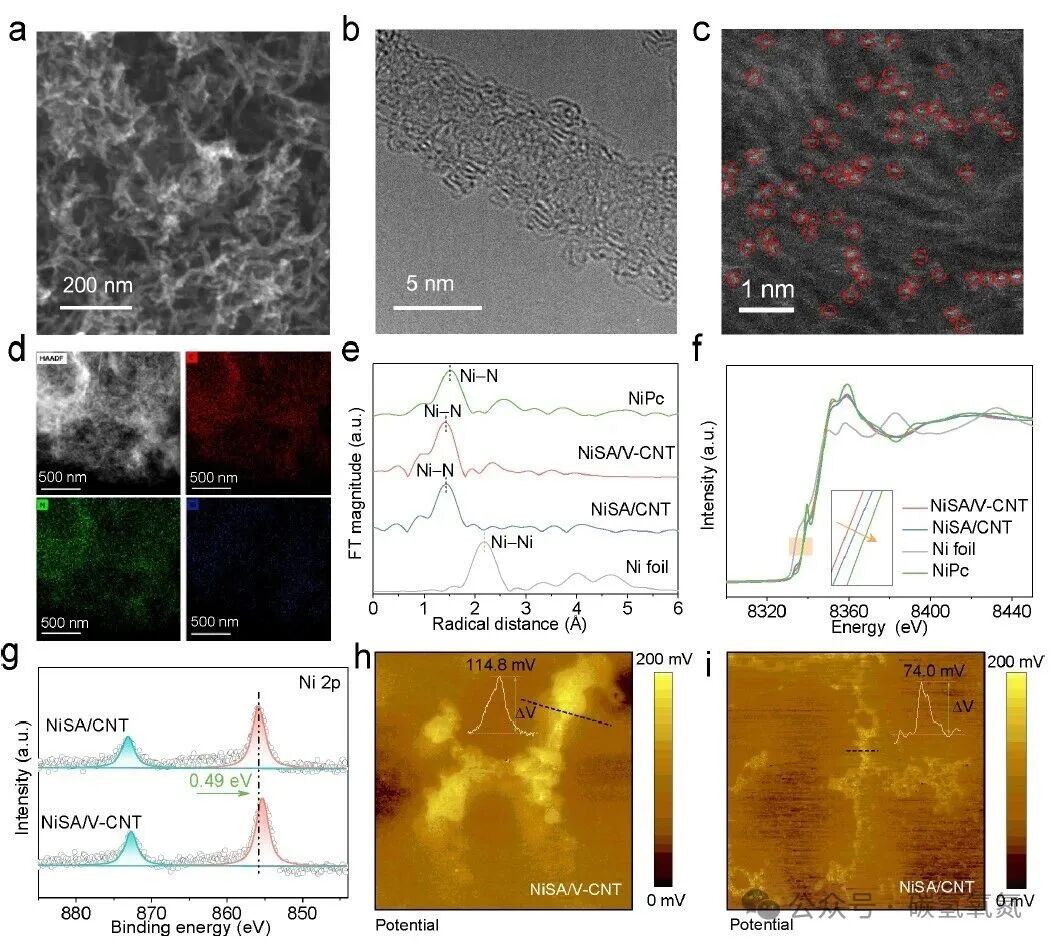
Figure 2 Structural Characterizationa) SEM: NiSA/V-CNT maintains tubular morphology.b) HR-TEM: Disordered lattice appears on the tube wall → rich edges.c) AC-HAADF-STEM: Ni single atoms are uniformly distributed along the edges.d) Element mapping: Ni, N, C are uniformly dispersed.e) FT-EXAFS: Only 1.4 Å Ni−N peak, no Ni−Ni.f) XANES: NiSA/V-CNT absorption edge energy decreases, Ni electron density increases.g) Ni 2p XPS: Binding energy shifts negatively by 0.49 eV.h-i) KPFM: Surface potential difference significantly increases, confirming charge redistribution.
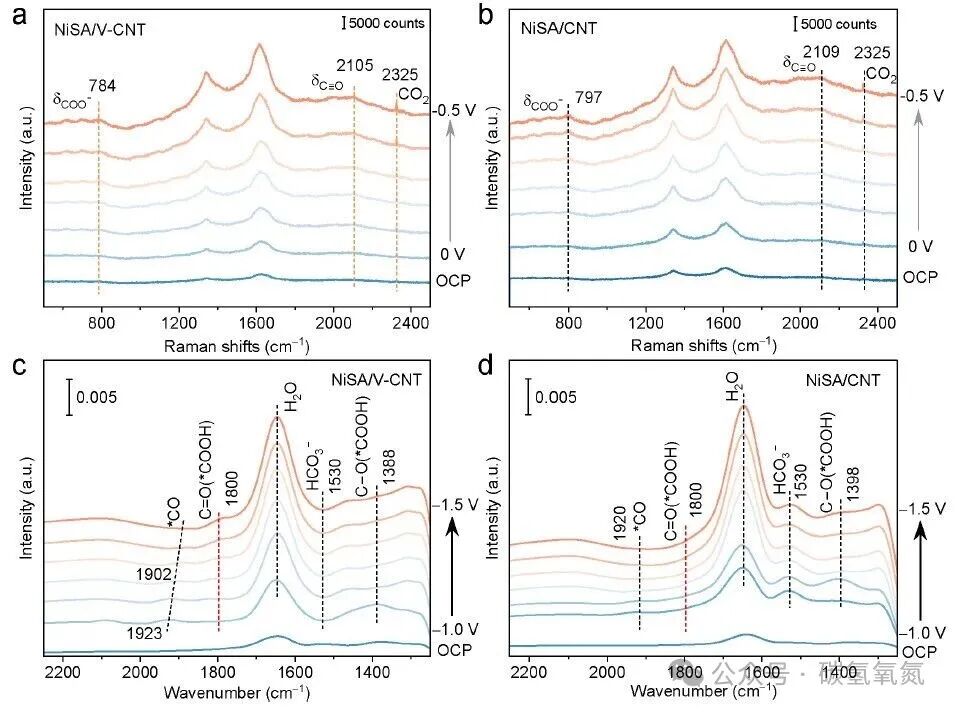
Figure 3 In Situ Spectroscopya-b) In situ Raman: NiSA/V-CNT *CO₂⁻ peak redshift, stronger signal.c-d) ATR-SEIRAS: NiSA/V-CNT shows a 1800 cm⁻¹ *COOH peak, C−O stretching peak redshift of 10 cm⁻¹, indicating stronger adsorption.
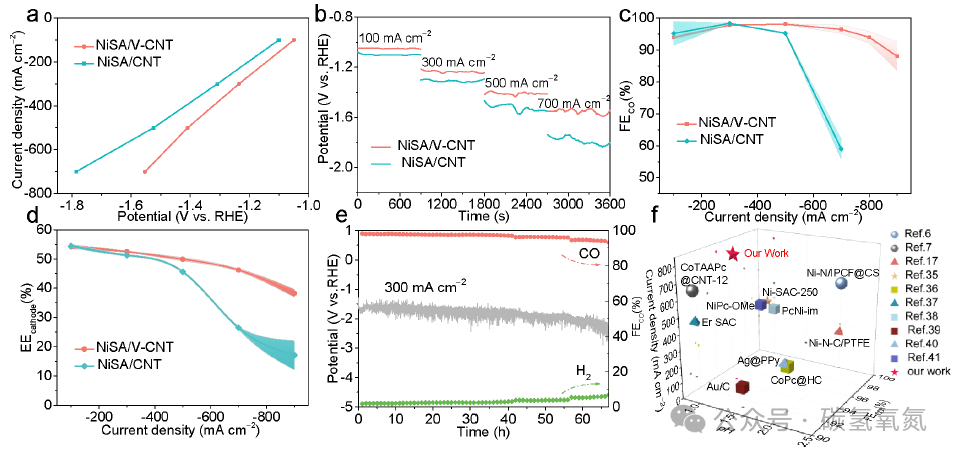
Figure 4 Electrochemical Performancea) I–V: NiSA/V-CNT current density is significantly higher than NiSA/CNT.b) I–t: Stepwise current increase shows no degradation, indicating excellent mass transfer and stability.c) FECO: >94.5% at 800 mA cm⁻².d) EEcathode: 44.2% @ 800 mA cm⁻², setting a new high for Ni SAC.e) 68 h stability: FECO > 90% at 300 mA cm⁻², with intact structure.f) Comparison radar chart: Activity, selectivity, and energy efficiency are all at the top of the acidic CO₂RR literature.
Conclusion and OutlookThis work proposes a “support vacancy-edge site” synergistic strategy, densely constructing Ni−N₄ single atoms at the edges of carbon nanotubes, utilizing d-band upshift to enhance *COOH adsorption, effectively addressing the triple challenge of “activity-selectivity-energy efficiency” in acidic high-current CO₂RR. NiSA/V-CNT maintains 94.5% CO selectivity and 44.2% cathode energy efficiency at 800 mA cm⁻², and operates stably for >68 h, providing a scalable catalyst design paradigm for industrial acidic CO₂ electrolyzers. Future work can extend to other single-atom metal-edge site systems to achieve multi-carbon products or membrane electrode stack large-scale applications.
Mei, Z., He, Y., Liu, K., Luo, W., Tan, Y., Chen, Q., Wang, H., Guo, X., Wu, Q., Ma, C., Fu, J., Lin, Z., & Liu, M. (2025). Enhanced *COOH adsorption over edge-rich Ni−N₄ sites for efficient acidic CO₂ electroreduction. Journal of the American Chemical Society. https://doi.org/10.1021/jacs.5c12583