Image Source: Dongtu Technology
Author | Shi Lincai
“
With the continuous integration of IT technologies such as cloud computing, machine learning, and big data with OT technologies in industrial control, the Industrial Internet and smart manufacturing have become the trend of future industrial production. The Industrial Internet and smart manufacturing grant greater flexibility to future manufacturing, making small-batch, diverse, and customizable production methods gradually possible. This also requires the core technology of modern manufacturing—industrial automation control systems to be more flexible and scalable.
”
As a result, a software-defined PLC control system has begun to attract attention and importance in the industry, even being hailed as the “next-generation control system of the Industrial Internet era.” So, what kind of control system is this? Why is it more suitable for the requirements of the Industrial Internet? What are the latest developments?
Recently, CONTROL ENGINEERING China interviewed Mr. Liu Shengfu, Executive Vice President of Dongtu Technology, a leading domestic software-defined control manufacturer, to gain an in-depth understanding of the software-defined PLC control system.
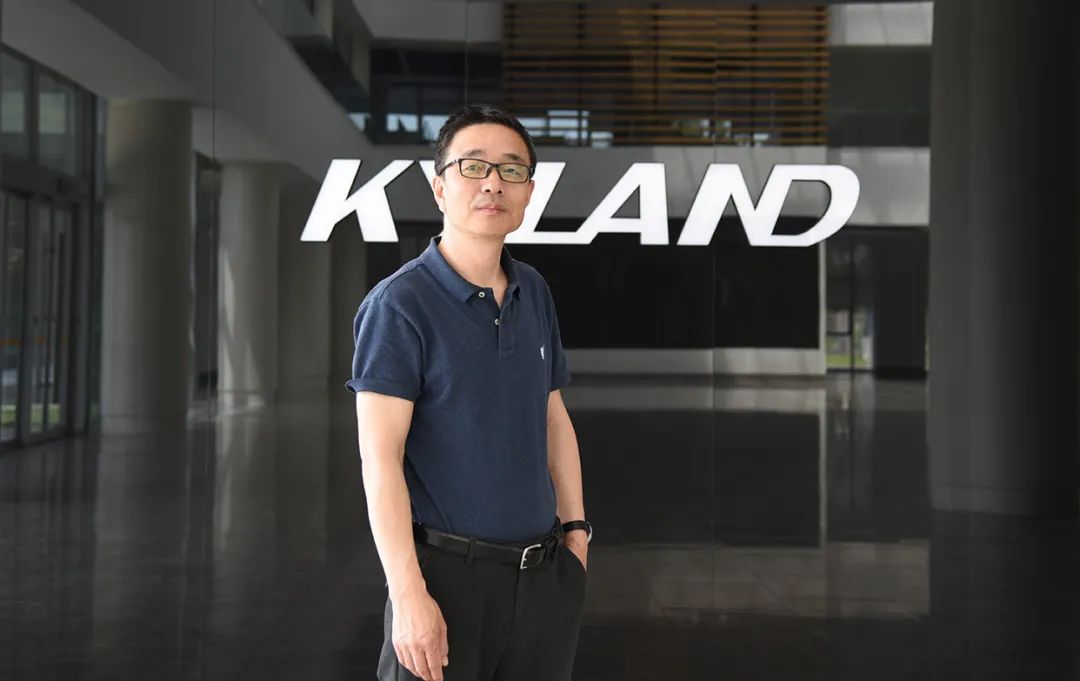
▎Liu Shengfu, Executive Vice President of Dongtu Technology
The Industrial Internet urgently needs more flexible control systems.
The intensifying market competition and technological advancements have led to frequent product updates, with product lifecycles becoming increasingly shorter. The manufacturing production model has undergone significant changes, making the Industrial Internet and smart manufacturing a necessary choice to shift from large-scale “rigid manufacturing” to small-batch “flexible manufacturing.”
The Industrial Internet enables production data to be centralized and stored on a large scale, achieving big data that was previously impossible, and utilizing the unprecedented computing power of cloud platforms to analyze, mine, and optimize production efficiency. Smart manufacturing makes field devices, machines, and factories “smarter,” capable of collecting various field data through industrial networks. However, in Liu Shengfu’s view, neither the Industrial Internet nor smart manufacturing has made any further technological innovations to the “brain” of industrial control systems, PLC/DCS. The inability of the core PLC to be flexibly expanded will undoubtedly weaken the flexibility and scalability of industrial control systems, failing to meet the needs for rapid reconfiguration of production resources under the conditions of the Industrial Internet.
At the same time, with the increasing demand for intelligence, traditional control systems represented by PLC/DCS have failed to meet the demands of industrial intelligence. On one hand, current control systems need to handle not only the traditional four sensor signals of temperature, pressure, flow, and level, but also signals that were previously unavailable, such as vision and voice, and must support wireless communication like 5G—capabilities that traditional PLCs cannot achieve. On the other hand, traditional PLC manufacturers each have their own communication protocols, which are not open, not extensible, and not compatible, making them unsuitable for the intelligent manufacturing of on-demand production in the future.
In contrast, software-defined PLCs inherently possess flexibility, allowing control capabilities to be expanded through software settings using virtualization technology, which is precisely what future manufacturing needs.
Software-defined PLC changes the architecture of industrial Internet systems.
Traditional industrial control systems are often referred to as a five-layer pyramid model, from the field sensor layer to the PLC/DCS control layer, then to the data acquisition and monitoring SCADA layer, production execution MES layer, and enterprise management ERP layer. With the application of the Industrial Internet, MES and ERP have begun to interconnect, integrate, and move to the cloud.
Current industrial Internet platforms operate in a way that is compatible with traditional architectures, collecting field data through real-time or historical databases or dedicated data acquisition gateways, and then uploading it to the platform for data processing, display, and using industrial apps for data applications, prediction, and optimization of production processes. However, to achieve the blueprint constructed by the Industrial Internet in a true sense, such an architecture does not meet the requirements. In the industrial production process, the final control process still needs to be managed by a PLC. MES, ERP, or industrial apps not only need to collect data directly from the PLC but also require the PLC to execute instructions directly from MES, ERP, or industrial apps, optimizing and adjusting PLC control programs according to the instructions to improve industrial production efficiency while avoiding cumbersome manual debugging processes.
However, existing industrial Internet platforms cannot achieve direct interoperability with PLCs, so only software-defined PLCs can directly connect with industrial Internet platforms. For example, they can easily connect PLCs to the internet, embedding apps and analytical results into machines and the cloud, achieving intelligence and self-perception, changing and upgrading PLCs without replacing hardware, and expanding industrial Internet platform applications through APIs and ecosystems.
“Software-defined PLC emphasizes a system, an implementation thought,” Liu Shengfu added, “The ultimate goal of the new generation of control systems for the Industrial Internet is to achieve precise control driven by big data, directly driven by ERP, MES, and industrial apps.”
The advantages of software-defined PLC are unprecedented.
Software-defined is not a new term. From the early concept of “software-defined networking” to “software-defined everything,” software-defined has already passed the conceptual verification stage and has become a mature technology in the IT field. However, in the industrial field, due to high reliability and real-time requirements, software-defined has not been widely applied.
“The software-defined PLC advocated by Dongtu is based on virtualization technology, decoupling the functions of traditional dedicated PLCs, and utilizing the implementation ideas of software-defined networking to achieve PLC logical control functions through applications,” Liu Shengfu explained, “The core of software-defined PLC is hardware resource virtualization and programmable management functions.”
Since software-defined PLCs achieve separation of hardware and software, they can configure hardware resources through software, so they possess advantages that traditional PLCs do not have.
First, software-defined PLCs typically have no hardware dependency, making it easy to migrate and reuse software. Users can flexibly choose different suppliers and allow users to replace or add components without affecting other parts of the system, easily achieving scalability and system modularization. This is not so easy, or even impossible, in traditional PLC control.
Second, software-defined PLCs use the latest processors, with CPU performance significantly stronger than that of PLCs. Moreover, one CPU can virtualize multiple PLCs, controlling more devices. Additionally, software-defined PLCs can process new data such as voice, vision, and future 5G, and even run various industry algorithms and industrial apps directly on PLCs, which is difficult to achieve on traditional PLCs.
Finally, Liu Shengfu emphasized that software-defined PLCs can also be programmed using high-level languages. Traditional PLCs typically use ladder diagrams, structured text, and other programming languages that require professional automation engineers. Writing many algorithms with these languages is quite cumbersome, while using high-level languages like C or C++ makes it much easier.
Implementation of software-defined PLC
——NEWPRE Industrial Server
Although the technology of software-defined control has matured, many manufacturers and institutions both domestically and internationally began research several years ago. However, Dongtu Technology took the lead in releasing the software-defined control industrial server NEWPRE at the Hannover Fair in April 2019.
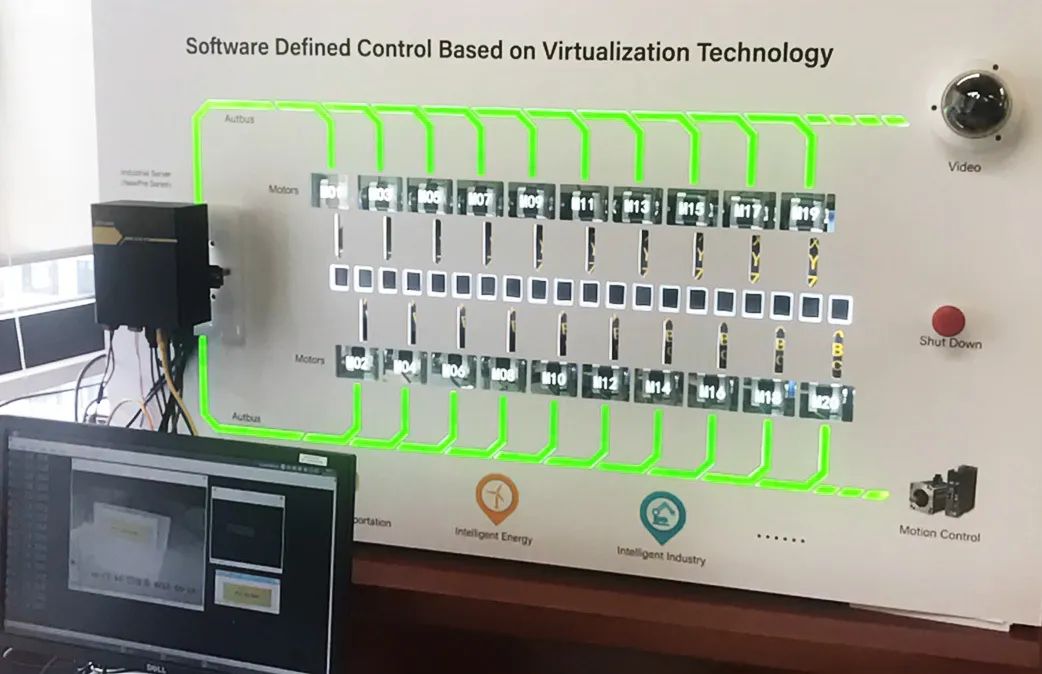
▎Hannover Fair DEMO: Utilizing software-defined technology to virtualize 4 physical cores of Intel i7 processor into 20 real-time cores, while integrating automation control, motion control, machine vision, and other functions.
“This NEWPRE industrial server is a representative work of software-defined PLC. It is based on an open x86 virtualization architecture, and through high real-time virtualization technology on Intel’s latest i7 processor, it can virtualize up to 20 software-defined real-time systems to replace PLC controllers,” Liu Shengfu explained with a demo presented at the Hannover Fair, saying that with NEWPRE, not only can logical control be performed, but various industrial apps can also be easily integrated, such as visualization, collaborative manufacturing, machine vision, and industrial big data analysis engines, truly achieving the integration of OT and IT technologies to meet the needs of the Industrial Internet and smart manufacturing.
Liu Shengfu stated that while such a system may seem similar to PC-BASE, it is fundamentally different. First, PC-BASE does not use virtualization technology, where each physical core of the processor corresponds to a PLC application, whereas NEWPRE can virtualize more virtual cores for PLC control. More importantly, PC-BASE typically relies on Windows or Linux desktop operating systems, where the desktop system and operating system are the same system. In contrast, NEWPRE not only runs Dongtu’s self-developed real-time operating system Intewell but can also run Windows or Linux systems, with both systems running in isolation. If the desktop system crashes, it does not affect the normal operation of the real-time system.
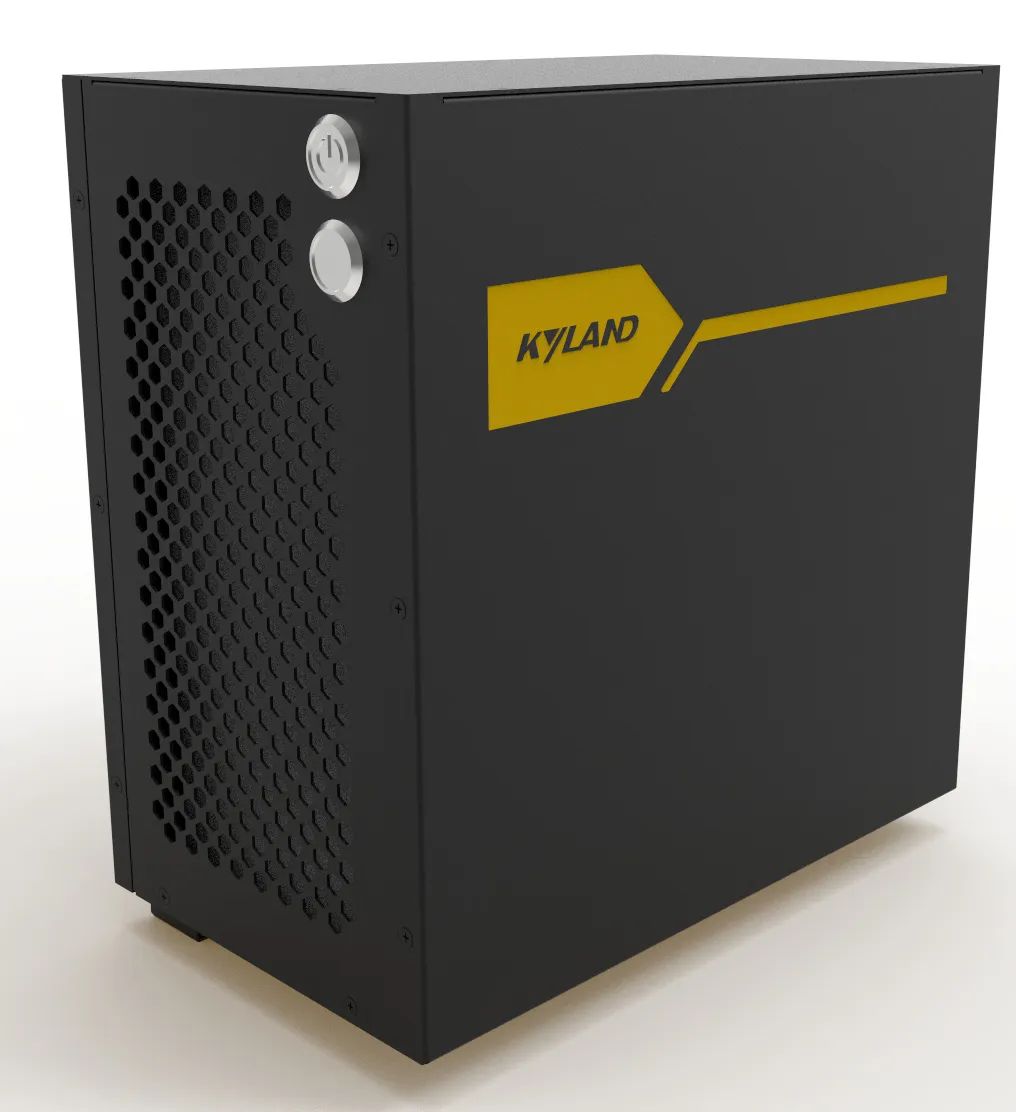
▎NewPre3100 Series Industrial Server
Currently, in terms of real-time performance, NEWPRE supports a minimum cycle time of 50us. In programming, it integrates Dongtu’s own industrial control programming platform MaVIEW, supporting both drag-and-drop graphical programming and IEC61131-3, as well as programming in C++, MatLab/Simulink, etc. Additionally, it has built-in protocol conversion for various protocols, supporting MQTT or OPC-UA connections to the cloud.
“NEWPRE can be said to integrate edge computing, process control, motion control, and machine vision into one, representing a new generation of control systems in the era of the Industrial Internet. It also won the first prize at the first Industrial Internet Competition in 2019,” Liu Shengfu concluded.
Numerous applications showcase the initial power of software-defined PLC.
Since the launch of NEWPRE in April last year, it has been applied in many fields, demonstrating the preliminary power of software-defined PLC.
According to Liu Shengfu, one typical application is in an electronic chip production line, where one NEWPRE has virtualized 13 PLCs to complete automatic control of 13 workstations, running for nearly a year without any issues. Another typical application is that Dongtu helped Fanuc improve its robot teaching system. Before using NEWPRE, one robot usually had to be shared among three students, requiring a separate industrial computer for each student to run their simulation model, plus a PLC to receive instructions from the industrial computer to control the robot—essentially, each robot needed three complete systems. Now, with just one NEWPRE, three desktop systems and one real-time system can be installed. The desktop systems support simulation, while the real-time system controls the robot’s movements, significantly reducing the complexity and cost of the system.
In terms of integrated machine vision advantages, NEWPRE has also been applied. Currently, Dongtu and its partners are jointly developing a new unmanned vehicle control system. Previously, unmanned vehicles typically used cameras to collect information for an industrial computer to calculate path planning algorithms, then controlled the vehicle’s direction through PLCs and inverters. Now, with NEWPRE, the industrial computer and PLC can be eliminated, saving hardware costs and greatly simplifying the control system architecture.
“In the past year, NEWPRE has also been applied in gas station control, oil tank level control, and engineering vehicle unmanned driving control, demonstrating that the advantages of software-defined PLC have exceeded our expectations in practical applications.” Of course, Liu Shengfu believes that these applications are just the beginning, “Currently, we are also collaborating with Northeast University’s National Key Laboratory of Process Industry Comprehensive Automation to develop more industry algorithm libraries to promote the application of software-defined PLC, and we hope more industry partners will join us to develop industry applications together.”
Just as the Industrial Internet is still in its early development stage, software-defined PLC is also clearly in a gradually maturing phase. Although traditional PLCs still hold an absolute dominant position and are evolving towards greater adaptability to the needs of the Industrial Internet, there is no doubt that software-defined PLC has opened up a different path to the future for traditional PLCs. Perhaps the day the Industrial Internet truly arrives is also the day when software-defined PLC shines.
– END –
Recommended Reading
Virtualization—The Development Direction of the New Generation Process Control System (DCS)
Is Making a Life-Saving Ventilator Too Difficult? Using This PLC+HMI Integrated Machine Makes It Half Successful!
The Five Major Technological Innovations in Motor Drive and Motion Control
The Future of Automation: Accelerating Innovation and Intelligence
Integration of Legacy Systems and Industrial Internet of Things (IIoT)

Good News!
We invite you to join the Industrial Automation Circle
Starting in 2020, to enhance communication between editors and readers, as well as among readers, we will establish various WeChat groups for professional readers focusing on industrial automation technology.
We plan to form the following technical category groups:
TSN Network Group
PLC Group
DCS Group
Machine Vision Group
Robot Group
Industrial Software Group
Human-Machine Interface Group
Motion Control Group
Sensor Group
Industrial Safety Group
Instrument Group
AI/AR Group

Scan the QR code on the right and send “Name + Technical Interest + City” to add the editor’s WeChat (cec_editor). After review, you will be invited to join the corresponding technical group.