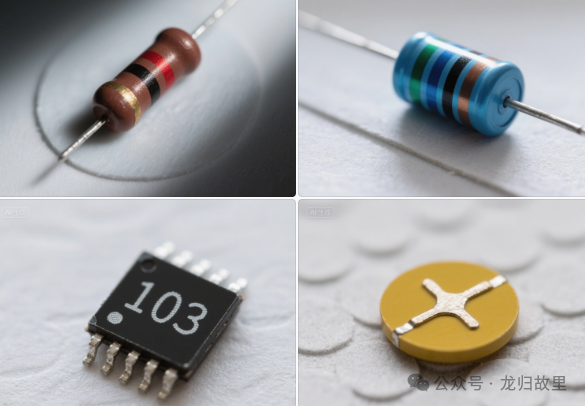
A resistor is one of the most fundamental and indispensable passive components in electronic circuits, whose core function is to achieve various circuit functionalities by impeding current flow. Below is a detailed introduction to the functions, classifications, and representation methods of resistors:
1. Basic Functions of Resistors
1.Current Limiting Protection
Resistors limit the amount of current in a circuit, protecting other sensitive components (such as LED, transistors, chips, etc.) from damage due to overcurrent. For example, in an LED circuit, a resistor with an appropriate resistance value is connected in series to keep the current within a safe range.
2.Voltage Division and Regulation
By using resistors in series for voltage division, the supply voltage can be distributed to the desired specific voltage value. For instance, when providing reference voltage to a microcontroller’s ADC module, two resistors are often used to form a voltage divider circuit; a potentiometer (variable resistor) can also be used for continuous voltage adjustment (such as volume control, brightness adjustment, etc.).
3.Signal Processing and Biasing
◦Bias Resistor: Provides a stable static operating point for transistors or operational amplifiers in amplification circuits, ensuring normal signal amplification.
◦Filtering and Impedance Matching: Combined with capacitors or inductors to form RC, RL filter circuits, filtering out noise or specific frequency signals; also used for impedance matching in signal transmission paths to reduce signal reflection.
◦Pull-up / Pull-down Resistors: Stabilize the default logic level (such as high or low) of GPIO pins in digital circuits, preventing signal interference or false triggering.
4.Energy Conversion and Thermal Management
According to Joule’s law (P = I^2R or P = V^2/R), resistors convert electrical energy into thermal energy, thus playing a role in circuits that need to dissipate excess power (such as load testing, power supply inrush current limiting). For example, PTC thermistors can limit inrush current at power supply startup, preventing component damage from surges.
5.Sensitive Detection and Protection
Special sensitive resistors can sense environmental changes and convert them into electrical signals:
◦Thermistors (NTC/PTC): NTC resistors decrease in resistance as temperature increases (used for temperature compensation or sensors), while PTC resistors increase sharply in resistance with rising temperature (overcurrent protection);
◦Photoresistors (LDR): Resistance decreases with increased light intensity, used for light control switches, automatic street lights, etc.;
◦Varistors (VDR): Resistance drops sharply when voltage exceeds a threshold, absorbing transient high-voltage pulses from the power grid, protecting devices from overvoltage damage.
2. Classification and Characteristics of Resistors
Based on structure, materials, resistance characteristics, and applications, resistors can be classified into the following main categories:
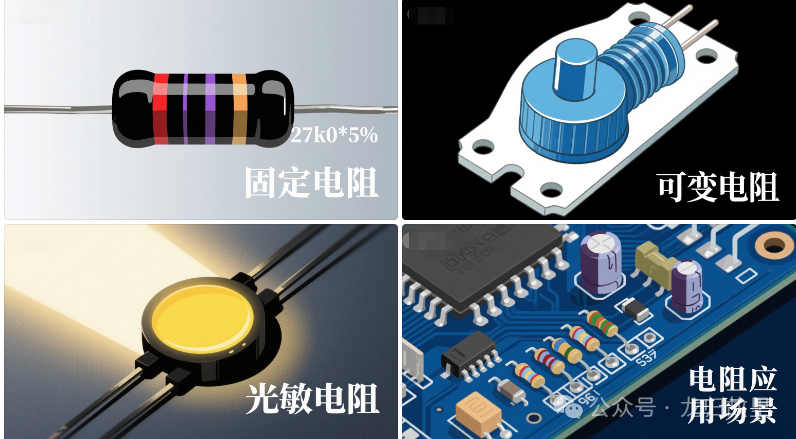
1. Fixed Resistors
Resistance value is not adjustable, and this is the most commonly used type:
•Carbon Film Resistors: Low cost, average stability (accuracy ±5%), suitable for general circuits.
•Metal Film Resistors: High accuracy (±1%), good temperature stability, commonly used in high-precision circuits or voltage divider networks.
•Wirewound Resistors: Made from resistance wire, high power (up to hundreds of watts), heat resistant, but poor high-frequency performance, suitable for high-power loads or power supply circuits.
•Surface Mount Resistors (SMD): Small size, suitable for high-density circuit boards (such as mobile phones, computer motherboards), installed using surface mount technology (SMT), saving space and improving production efficiency.
•Array Resistors: Integrate multiple resistors with the same parameters into a single package, used to simplify circuit board layout (such as pull-up resistor networks for bus interfaces).
2. Variable Resistors
Resistance value can be manually or electrically adjusted:
•Potentiometers: Change resistance value by rotating or sliding contacts, used for voltage division or signal amplitude adjustment (such as volume knobs, sensor calibration).
•Trimmer Resistors: Small precision potentiometers used for one-time calibration of circuit parameters (such as reference voltage, gain adjustment).
3. Sensitive Resistors (Special Resistors)
Resistance value changes with environmental conditions:
•Thermistors: Divided into NTC (negative temperature coefficient) and PTC (positive temperature coefficient), used for temperature detection, compensation, or overheat protection.
•Photoresistors (LDR): Made from materials like cadmium sulfide, resistance is controlled by light intensity, used for light control switches, sensors.
•Metal Oxide Varistors (MOV): Non-linear components that conduct rapidly during overvoltage to protect circuits from surge impacts (commonly found in power adapters, appliance input terminals).
•Magnetoresistors: Resistance changes with magnetic field strength, used for magnetic field detection (such as motor position sensors, current transformers).
3. Parameters and Representation Methods of Resistors
The main parameters of resistors include nominal resistance, tolerance (accuracy), rated power, temperature coefficient, etc. The identification methods vary based on type and packaging:
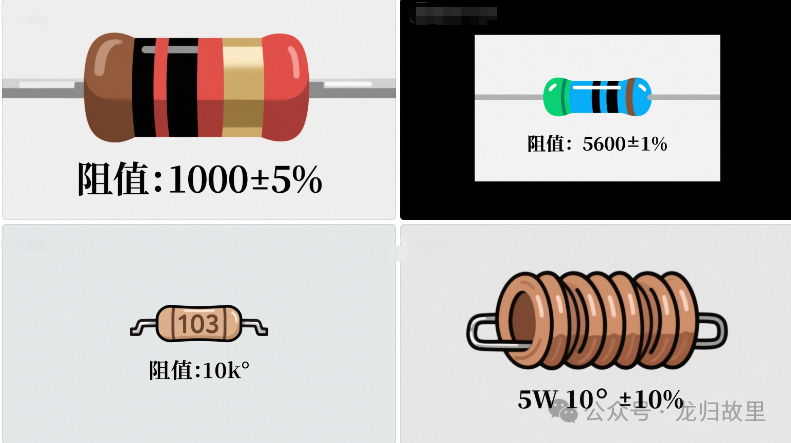
1. Color Code Identification (most common for through-hole resistors)
Resistance value and tolerance are represented by the color bands on the surface of the resistor:
•Four-Band Resistors (standard accuracy):
◦First Two Bands: Significant digits;
◦Third Band: Multiplier (10^n, n is the value corresponding to the color band);
◦Fourth Band: Tolerance (e.g., gold ±5%, silver ±10%).
Example: Yellow (4) – Purple (7) – Red (×10²) – Gold (±5%) → 47 × 100 = 4700Ω (4.7kΩ) ±5%.
•Five-Band Resistors (precision resistors):
◦First Three Bands: Significant digits;
◦Fourth Band: Multiplier;
◦Fifth Band: Tolerance (color corresponds to smaller error, such as brown ±1%, green ±0.5%).
Example: Brown (1) – Black (0) – Black (0) – Orange (×10³) – Brown (±1%) → 100 × 1000 = 100kΩ ±1%.
Color Code Value Table:
•Black (0), Brown (1), Red (2), Orange (3), Yellow (4), Green (5), Blue (6), Purple (7), Gray (8), White (9);
•Multiplier Band: Gold =×0.1, Silver =×0.01;
•Tolerance Band: No color (±20%), Gold (±5%), Silver (±10%), Brown (±1%) etc.
2. Direct Digital Marking Method
Directly printed on the surface of the resistor are the numerical and unit identifiers for parameters:
•Through-Hole Resistors: Clearly marked resistance value and tolerance (e.g., “220Ω ±5%”, “1kΩ”);
•Surface Mount Resistors (SMD): Use a three-digit code to represent resistance value:
◦First Two Digits: Significant digits;
◦Third Digit: Multiplier (10^n);
Example:“103” → 10 × 10³ = 10kΩ (default tolerance ±5%);“512” → 51 × 10² = 5.1kΩ; “0R05” or “0Ω” indicates zero ohm resistor (equivalent to a wire, but can be selected for continuity through soldering position).
◦If higher precision is required (such as ±1%), some surface mount resistors will add a fourth digit to indicate error level or use letter combinations to mark (e.g., “1002B” indicates 10kΩ±0.1%).
3. Other Representation Methods
•Numeric Method (Three-Digit Numbers): Similar to the three-digit code for surface mount resistors, used for plastic packages or small resistors, such as “104”=100kΩ, “503”=50kΩ.
•Model Coding (Vendor Defined): Some resistors are named using alphanumeric combinations based on materials, power, type, etc. (e.g., “RT11” indicates a standard carbon film resistor, “RJ” represents a metal film resistor), requiring reference to vendor manuals for specific meanings.
4. Selection and Usage Considerations
1.Matching Key Parameters: Select appropriate nominal resistance, tolerance (accuracy), rated power (allowing for margin to avoid overload burning), and temperature coefficient (in high-temperature environments, prioritize metal film or wirewound resistors).
2.Packaging and Installation Forms: Surface mount resistors are suitable for high-density SMT circuit boards, while through-hole resistors are easier for manual soldering or repairs; in high-frequency circuits, consider the effects of parasitic inductance and capacitance, prioritizing surface mount or non-inductive wirewound resistors.
3.Special Requirements for Sensitive Resistors: Thermistors / photoresistors / varistors need to pay attention to their response characteristics (such as temperature range, light wavelength, breakdown voltage threshold) and connect polarity correctly (if required).
4.Measurement and Testing: Use a multimeter to measure resistance after disconnecting the circuit, comparing with nominal values; continuity testing can determine if the resistor is damaged (a beeping sound indicates a short circuit or zero ohms).
5. Conclusion
As the “cornerstone” component of circuits, resistors ensure the stable operation of electronic systems through functions such as current limiting, voltage division, signal processing, energy conversion, and environmental sensing. Familiarity with the characteristics of various types of resistors (fixed / variable / sensitive) and their identification methods (color code, digital, model coding) is a fundamental skill in electronic design, maintenance, and debugging. In practical applications, it is essential to comprehensively select resistors based on circuit parameters, working environments, and cost requirements to ensure that resistor performance perfectly matches system needs. For further details on specific types of resistors or application cases, refer to vendor technical documents or professional circuit design materials.