
In the past two years, the smart speaker market has just been validated, and it is now on the eve of commercialization, potentially igniting a new battle.
Written by | Yu Yang
Li Yanhong’s affection for the Xiaodu smart speaker is evident.
At this year’s Baidu AI Developer Conference, Li Yanhong immediately focused on Xiaodu, showcasing its latest full-duplex wake-free capability.Last year at the Baidu World Conference, Xiaodu was also the first to make an appearance, where Li Yanhong demonstrated Xiaodu’s continuous dialogue capability.
In fact, from the moment Xiaodu smart speaker was born, Li Yanhong became its biggest “spokesperson”.In March 2018, when Xiaodu in-home video speaker was launched, Li Yanhong not only endorsed it but also directly “ordered” a price drop of 1000 yuan to promote Baidu’s aggressive entry into the smart speaker subsidy war.
Moreover, during the Two Sessions and major industry conferences, Li Yanhong has repeatedly endorsed his own smart speaker.But what exactly is the charm of Xiaodu smart speaker that he has high hopes for?
At this time, the smart speaker industry is also undergoing a significant change; on one hand, the industry is gradually moving from a barbaric competition stage to a mature stage, no longer relying solely on money to engage in price wars.On the other hand, the industry is on the eve of commercialization, where profitability will become a new competitive point, potentially igniting a new battle.
Interestingly, after the release of Xiaodu smart speaker Play on July 3, it faced skepticism from the official Weibo account of Alibaba’s Tmall Genie, questioning Xiaodu for potential plagiarism.Setting aside the incident itself, the intensity of competition between the two sides is evident.
The smart speaker market, which has just been validated over the past two years, is entering a new phase. Will it be Baidu’s next “handheld search”? Who will become the industry leader? A new change is about to unfold.
1
Two Years of Establishment
In July 2017, at Baidu’s first AI Developer Conference, Jing Kun officially launched the human-computer interaction platform DuerOS, which is known in Chinese as “Xiaodu Assistant”, establishing a complete set of voice interaction capabilities. Jing Kun also presented a vision to make DuerOS the operating system of the AI era.
Subsequently, in November of the same year, Baidu launched the benchmark product of DuerOS—the raven H smart speaker. Jing Kun compared it to Microsoft’s Surface laptop, creating a smart hardware product to fill the “gap” in the operating system.
Then from March to June 2018, Baidu launched two new products within three months: one was the Xiaodu in-home smart video speaker, and the other was the Xiaodu smart speaker (without a screen), both aimed at the mass market. Notably, the latter was priced at 89 yuan, marking Baidu’s full entry into the smart speaker price war.
From benchmark products to mass-market products, from high prices (the raven H was priced at 1699 yuan) to subsidies, this represents a shift in Baidu’s internal understanding of smart speakers, turning to the market for sales.Looking back, this decision was crucial; the implementation of AI technology is highly dependent on scenarios, and a certain volume of devices is essential for obtaining user feedback and optimizing Xiaodu’s interaction experience.
Under heavy subsidies, according to market research firm Canalys, Baidu’s smart speaker sales reached 3.6 million units in 2018, achieving a leap from 0 to 1, but still lagging behind Alibaba and Xiaomi, ranking third in the domestic market.
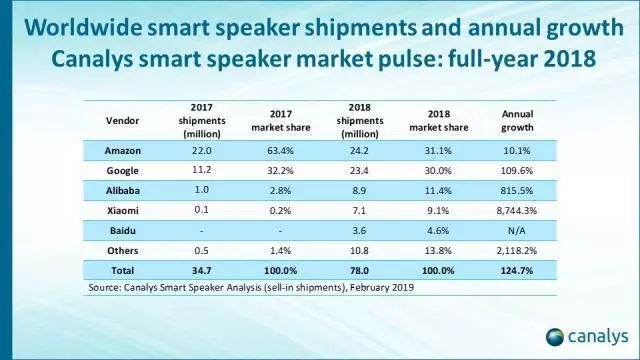 Data from Canalys
In 2019, Baidu demonstrated a strong determination to capture the smart speaker market. Insiders revealed to Machine Heart that Xiaodu received significant resource allocation from Baidu, with a target sales volume of over 10 million units this year.
Following this, Baidu secured exclusive cooperation for this year’s CCTV Spring Festival Gala, which also increased Xiaodu smart speaker’s recognition.With Baidu’s vigorous promotion, according to Canalys data, Baidu’s first-quarter shipment reached 3.3 million units, climbing to the top of the domestic market.
Machine Heart learned from various industry sources that in the first half of this year, Baidu’s smart speaker shipment was approximately 5 million units, already halfway to the above target.Moreover, the total sales of Baidu smart speakers have surpassed 8 million units, getting closer to the 10 million milestone.
Reflecting on this journey, when smart speakers first emerged, some called them “intellectually disabled”, others said they were toys for children, and some viewed them as a capital bubble.“In previous years, we mainly needed to verify whether this market was viable, whether users accepted the product, and whether it was a sufficiently large market,” Jing Kun stated, and now the answer is clear, “this category has established itself.”
Jing Kun’s confidence stems from two factors: one is the sinking market, and the other is the “smile curve”.
The diffusion curve of traditional hardware or products often starts from a group of enthusiasts, and expanding to a broader audience may encounter a bottleneck.However, Jing Kun stated, “We are pleased to find that the development of smart speakers in China has no ceiling; they can penetrate directly from first-tier and second-tier cities to fifth-tier and sixth-tier cities, and even in the sinking market, user activity and awareness are stronger.”
According to Canalys data from 2018, the global stock of smart speakers reached 114 million units, and the domestic market’s shipment also reached 21.9 million units, representing approximately a 15-fold growth compared to 2017, proving the “market’s” effectiveness and ample space.
On the other hand, Baidu sees a fascinating “smile curve” in smart speakers; users initially use them out of novelty and curiosity, and as the novelty wears off, usage rates decline. However, after some time, as users spend more time using them, the frequency of use actually increases, and daily usage duration also rises.This demonstrates the importance of user experience, which can create user stickiness.
It is precisely for these two reasons that Jing Kun firmly believes that the smart speaker category has withstood market scrutiny and has established a foothold.
2
The New Battlefield of the Future
2013 was a milestone in the history of mobile phone development, as smart phone sales surpassed feature phones, leading to an explosion of the entire mobile internet.
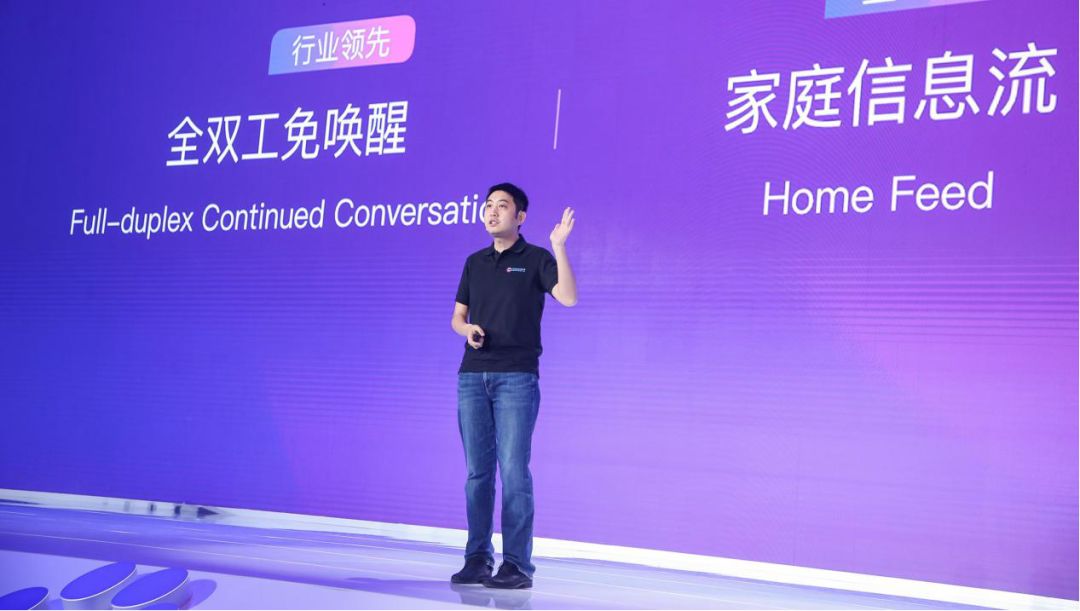
Baidu Vice President and General Manager of the Smart Life Group, Jing Kun
In Jing Kun’s view, the current development stage of smart speakers is akin to the early explosion of the mobile internet.As smart phone sales began to surpass feature phones, applications such as gaming, social networking, video, and e-commerce began to explode, and the third-party application ecosystem gradually surpassed basic functions like calling.Over the past year, the voice skills on Xiaodu smart speakers have grown eightfold, and the number of skill interactions has increased by approximately 2000 times.
Jing Kun states that “smart speakers are no longer just speakers” because on Xiaodu in-home, third-party skills have become the primary application, with usage surpassing music and long videos.Currently, Xiaodu has 33,000 developers and over 2400 skills.
As the user base expands and skill interaction numbers soar, Baidu sees new value in Xiaodu smart speakers—search and information flow as a family entry point.
“Consolidating mobile foundations, winning in the AI era” has been Baidu’s core strategy for the past two years, with mobile businesses represented by search and information flow being the core of Baidu’s current revenue, serving as the “appetizer”;while Xiaodu Assistant, autonomous driving, and Baidu Brain are the businesses Baidu is laying out for the future, serving as the “main course” that will determine Baidu’s future.
Although the Baidu APP has performed well under the leadership of new Vice President Shen Dou, the traffic dividend of the mobile internet has basically disappeared, and customer acquisition costs are rising daily.Finding new entry points and expanding new scenarios has become a challenge for all mobile internet companies.
The emergence of smart speakers, with a gradually growing user base, is poised to become a family entry point.The market scale brought by 400 million Chinese households, along with the extensive traffic and service demands it generates, undoubtedly holds immense potential.
As a part of the main course, Xiaodu smart speakers not only carry the implementation of Baidu AI but also play a key role in future family search and information flow.In May of this year, Li Yanhong stated that smart home devices represented by smart speakers are a new entry point for search in the AI era and a gateway for family information services. Through this entry point, Baidu’s long-established content ecosystem can have more practical applications.
Because of this, Xiaodu smart speakers have gained higher strategic synergy within Baidu, carrying the implementation of AI technology (Baidu Brain), extending the scenarios and users of search and information flow (mobile business), while also empowering in-vehicle systems (autonomous driving).
Jing Kun stated that Xiaodu is expanding new scenarios and finding new users, thus effectively collaborating with Baidu’s existing advantages, leading to high internal communication efficiency.
3
“Dating” with Users
Xiaodu smart speakers carry Baidu’s greater ambition in family scenarios, but both Baidu and the overall scale of the domestic market are still far from making smart speakers a family entry point.
Jing Kun admitted that the current market scale for smart speakers is still small and requires a golden development period, with the most important factors being “AI capabilities and user experience”.
On one hand, user feedback is increasingly guiding Baidu’s R&D direction.He cited an example where users have been continuously providing feedback over the past six months regarding a similar need: if there are multiple Xiaodu devices in the same room, calling “Xiaodu Xiaodu” can lead to simultaneous wake-up issues.In response, Baidu developed the full-duplex wake-free capability, allowing for continuous dialogue after a single wake-up, avoiding the disturbance of multiple wake-ups, thus solving interaction issues between multiple devices through technology.
Including in the “Geek Mode”, Li Yanhong demonstrated the ability to interact with the machine while speaking, showcasing this technology.A product director affirmed this functional experience but noted that it is more of an engineering trade-off issue and will be limited to a few scenarios like music.This indicates that user needs are also driving the optimization of technical experiences.
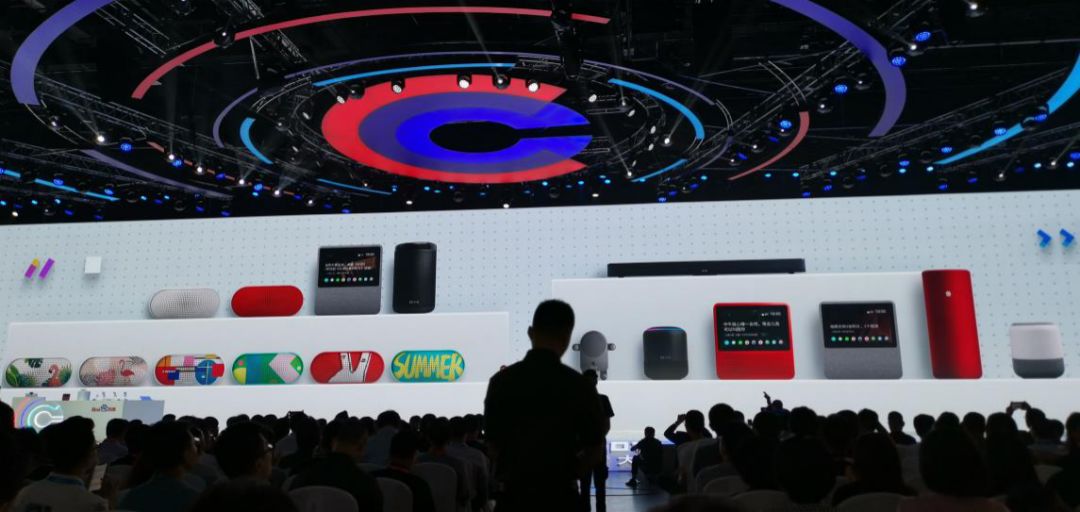
On the other hand, Baidu is also actively promoting the association of smart speakers with more scenarios to expand market space.For example, among the three new products released this time, the Xiaodu smart speaker “Big King Kong” focuses on being the family control hub and sound quality, while Xiaodu smart speaker Play targets the younger demographic, and Xiaodu in-home 1C 4G version emphasizes wireless and screen features.
Baidu has also collaborated with iQIYI to develop a DLNA screen-casting feature (DLNA is a standard media transmission protocol), allowing Xiaodu smart speakers to control TV boxes via voice without additional accessories, while also being compatible with DLNA-supported smart TVs, internet boxes, projectors, etc. This means that the screen-less smart speaker can be used in conjunction with large-screen TVs, further expanding Xiaodu’s application space.
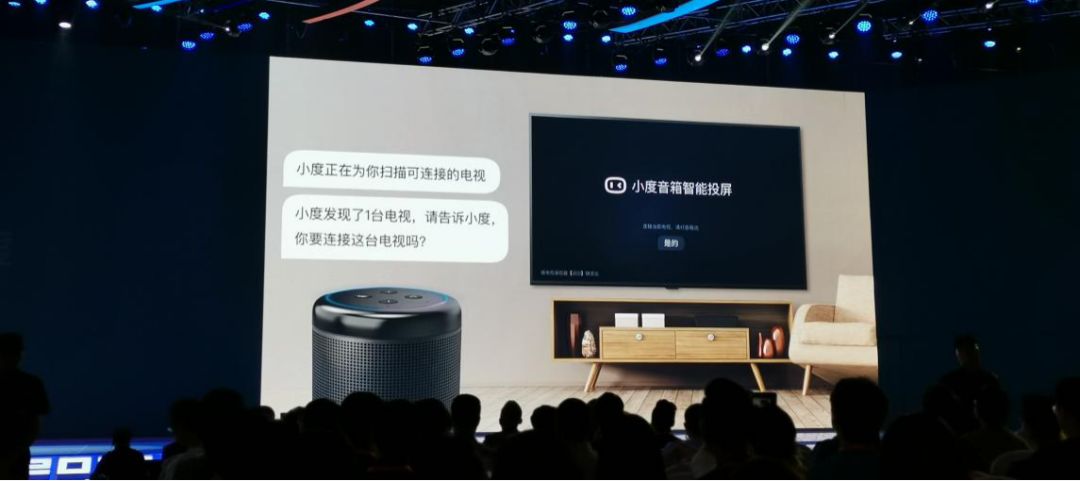
Jing Kun stated that this screen-casting technology took about 6 to 12 months to develop, and the difficulty arose because most mainstream smart speakers run on Linux systems, while mainstream video websites operate on Android and iOS systems. It is challenging to get content providers to embrace Linux systems, so they developed a complete set of screen-casting functionalities.
Moreover, due to the initial market subsidies, Baidu had to focus on optimizing user experience.Jing Kun stated that Xiaodu smart speakers differ fundamentally from traditional hardware; once traditional hardware is sold, the relationship with users essentially ends, which is the “selling logic”.However, since Baidu is subsidizing, if it cannot establish a closer relationship with users, the initial investment will be wasted.
“Therefore, when the product reaches the user’s hands, that is the moment when the relationship truly begins; we start to ‘date’,” Jing Kun said. This creates positive pressure, forcing Baidu to continuously provide better services to enhance user stickiness, leading to more purchases and other commercial behaviors.
He revealed that after entering households, Xiaodu smart speakers currently average 20-30 interactions per device per day, with an average usage duration of about 90-120 minutes.
Additionally, some quality skills have gained user favor, such as the “Electronic Pet” skill being activated 50 million times, “Baby Bus” played 30 million times, and the “Find Phone” skill activated 3 million times, with over 1 million users utilizing the “Snail Sleep” and other sleep-related skills.
4
Exploring the Edge of Commercialization
While expanding the application scenarios of Xiaodu smart speakers and refining user experience, Baidu has also taken an important step in the commercialization exploration of Xiaodu.
At this developer conference, Baidu unveiled three strategies for Xiaodu’s commercialization: Xiaodu Membership, Brand Skills, and Channel Expansion Plans.
Notably, Xiaodu Membership integrates some quality music, audio, and film resources to form Xiaodu Listening VIP, priced at 99 yuan/year.Additionally, Baidu has partnered with iQIYI to launch a joint membership priced at 198 yuan/year (iQIYI membership annual fee is 198 yuan), to attract users through promotional methods.
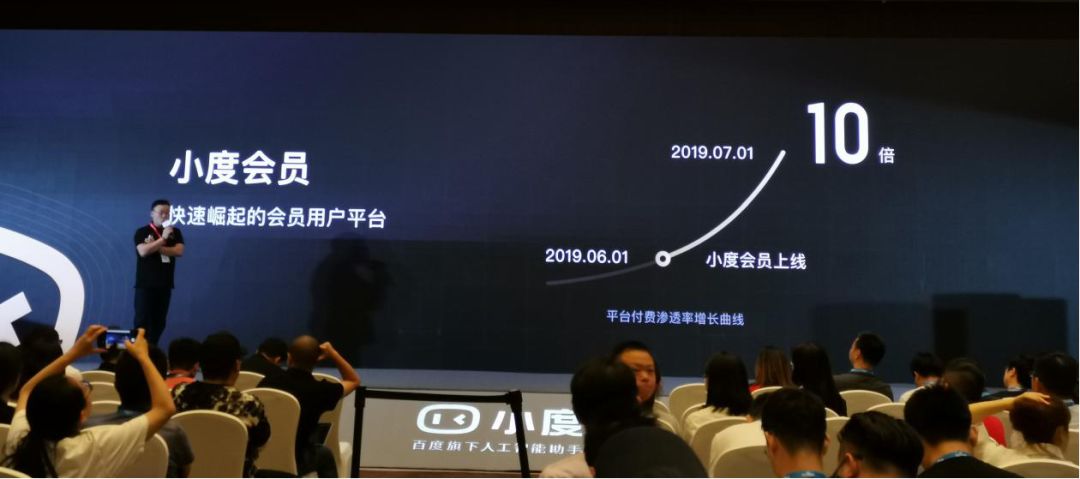
Baidu stated that within a month of launching Xiaodu Membership, the platform’s paid penetration rate increased tenfold, showing promising development momentum.
Jing Kun told Machine Heart that Xiaodu’s commercialization is still in the initial exploration phase, and there is still some time before large-scale commercialization.He affirmed the necessity of exploration, “Because we are subsidizing on hardware, we cannot continue to subsidize indefinitely; we hope it can become a new computing platform, attempting a commercialization direction similar to an application market.”
We have also learned from the industry that with the rapid development of smart speakers, the industry chain is maturing quickly, the comprehensive cost of hardware is continuously decreasing, and internet companies will soon encounter a bottleneck in hardware subsidies.At this point, relying solely on low-price barbaric competition is no longer feasible; the industry is moving towards a more mature stage, where competition will focus on content ecosystems, user experience, and commercialization.
A new battle may be about to begin, shifting from price wars to profitability competition.If Baidu does not engage in commercialization, even if its user base grows, it will mean higher costs and cloud service consumption, and the platform will not be profitable, leaving industry partners in a state of watchfulness.
Jing Kun also mentioned that commercialization is not the focus today, but Baidu needs to make some typical commercial explorations to instill confidence and methods in partners.
Shibei · GMIS 2019The Global Data Intelligence Summit will be held on July 19-20 in Jing’an District, Shanghai. This summit focuses on the theme of “Data Intelligence”, concentrating on cutting-edge research directions, while also paying more attention to the development of the data intelligence economy and its industrial ecosystem, providing references for the transition of technology from research to implementation.
This summit will feature keynote speeches, thematic presentations, an AI art exhibition, the release of the “AI00” data intelligence list, closed-door dinners, and the following confirmed guests:

We have prepared the highest discounts for student users, click Read the original text to register immediately.