
Introduction
In recent years, the automotive industry has faced severe product homogenization and increasingly fierce competition. Trends such as intelligence, connectivity, enhanced user experience, and personalization continue to challenge traditional automotive product development strategies. How to seize the forward-looking market and enhance product core competitiveness has become a focal point for many enterprises. China Automotive Data Co., Ltd. (hereinafter referred to as “China Automotive Data”) has based its research on configurations and comprehensively considered five major factors: policies and regulations, technological development levels, product value, user needs, and market prospects. It has selected the top ten essential forward-looking configurations for automotive products in 2021, providing a reference for product planning and strategy for enterprises.The top ten essential forward-looking configurations for automotive products in 2021 include: AR-HUD, facial recognition, fingerprint recognition, LCD key, Virtual Personal Assistant (VPA), driver monitoring, night vision capability, intelligent front lights, health cabin, and smart home connectivity.This issue will introduce five configurations: AR-HUD, facial recognition, fingerprint recognition, LCD key, and Virtual Personal Assistant (VPA).
Recommended Configuration No.1 – AR-HUD
AR-HUD (Augmented Reality Head-Up Display) technology overlays driving information in a reasonable and vivid manner within the driver’s line of sight, integrating it with actual traffic conditions. Through AR-HUD technology, drivers can expand and enhance their perception of the driving environment, reduce distractions, and improve safety. AR-HUD can also be deeply integrated with advanced driver assistance systems to achieve more advanced effects and functions.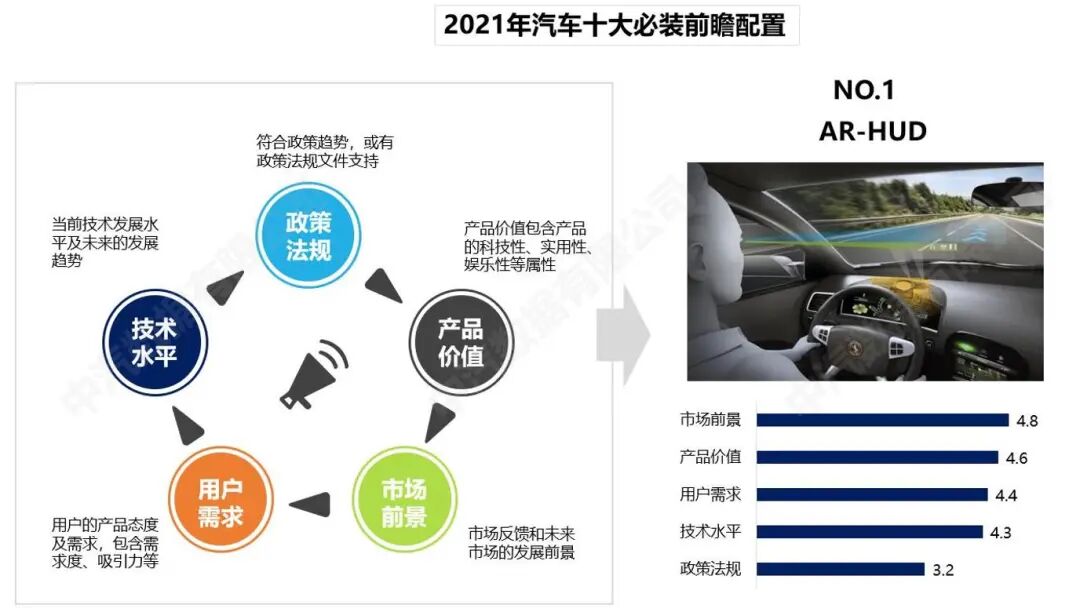 2021 Top Ten Essential Forward-Looking Configurations – No.1 AR-HUD
Consumer demand is shifting towards enhancing driver safety and effective navigation assistance, helping drivers focus on the road and avoid accidents. The configuration function of AR-HUD will meet these needs. Since Toyota released holographic projection in June 2018 and achieved mass production in the Mercedes-Benz S-Class in 2020, it has only taken two years, indicating that major manufacturers are paying considerable attention to the development of this technology, which has broad development prospects. Currently, the projection distance of AR-HUD is only 5-20 meters and is mostly equipped in high-end automotive products, truly meeting consumers’ actual driving needs, although there are still many technical challenges to overcome.
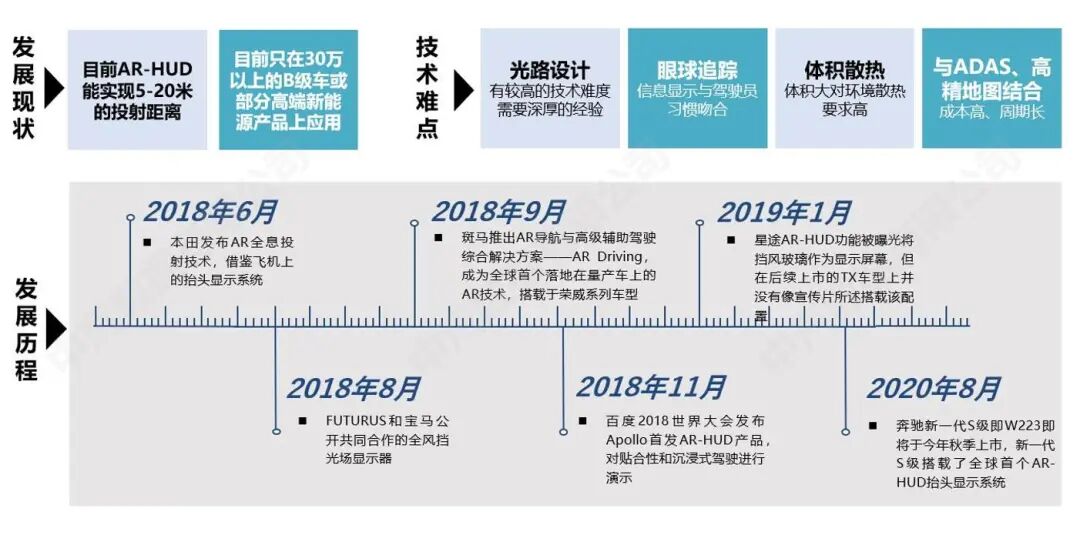 Current Development Status, Challenges, and History of AR-HUD ConfigurationCurrently, companies such as Continental, Human Horizons, Chela, Yanshi Technology, and Visteon are researching AR-HUD, but few mature products have achieved mass production. As the future direction of HUD, AR-HUD faces many challenges in supply and demand. However, with technological advancements, AR-HUD will continuously meet demands and become an essential configuration for human-machine interaction.
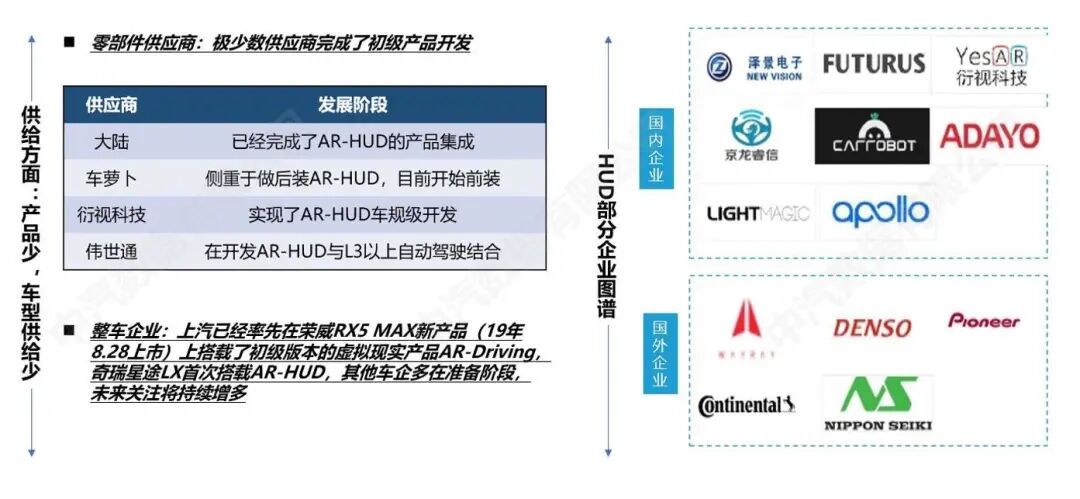 Suppliers, Companies, and Current Development Status of AR-HUD ConfigurationWith the continuous development of automotive intelligence and connectivity, existing HMI (Human-Machine Interface) systems urgently need upgrades. AR-HUD changes the isolated display of information on screens, integrating information with real scenes, transforming it into a guiding display that is more readable and aligns with consumer expectations for smart connected vehicles. At the same time, the deep integration of AR-HUD with the overall vehicle system is the future development trend and an important part of cockpit electronic solutions and ADAS overall solutions.Recommended Configuration No.2 – Facial RecognitionFacial recognition is a type of biometric identification that distinguishes different individuals based on facial features. It involves using cameras to capture images or video streams containing faces, automatically detecting and tracking faces during the capture process, and then performing facial recognition on the detected faces. As a rapidly developing human-machine interaction method in recent years, facial recognition technology provides a new interactive experience and has become one of the new applications of human-machine interaction in smart connected vehicles.
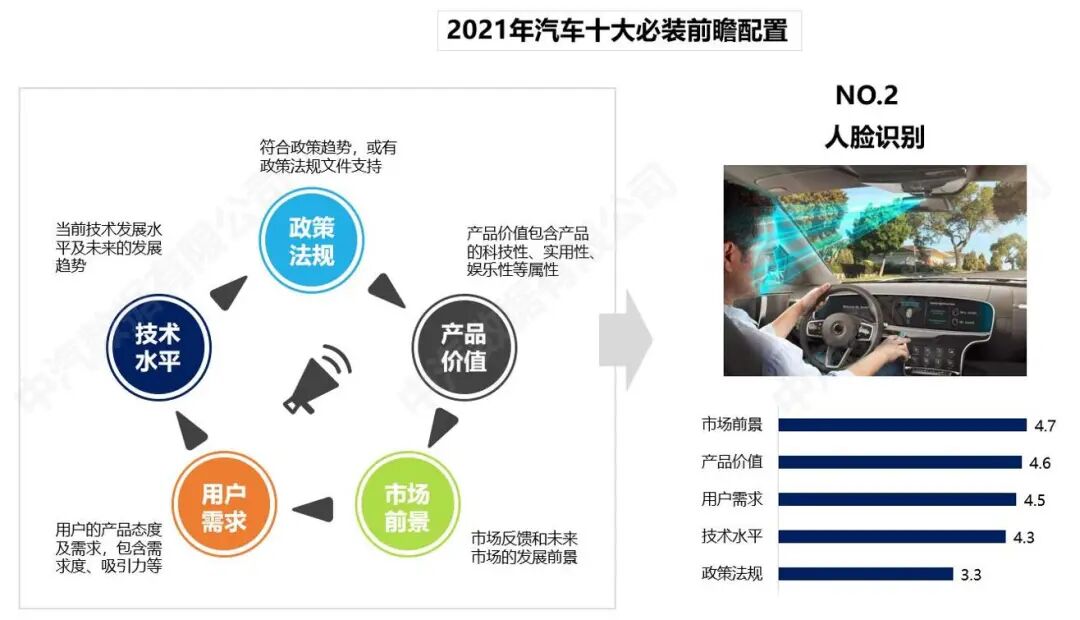 2021 Top Ten Essential Forward-Looking Configurations – No.2 Facial RecognitionCurrently, in-vehicle facial recognition technology can play a role in vehicle anti-theft and driving safety, with development trends mainly in two directions: identity verification and driver status monitoring, including six sub-functions: multi-layered security, personalized services, facial recognition payment, shared mobility, attention detection, and emotion recognition. From the perspective of consumer preferences, 65% of consumers recognize facial recognition and do not worry about its security, while about 23% of users do not recognize it, believing that facial recognition may not be more efficient than remote keys. As the level of automotive intelligence increases, the demand for personalization and safety in vehicles is becoming stronger, and the automotive industry’s attention to facial recognition technology will gradually rise.
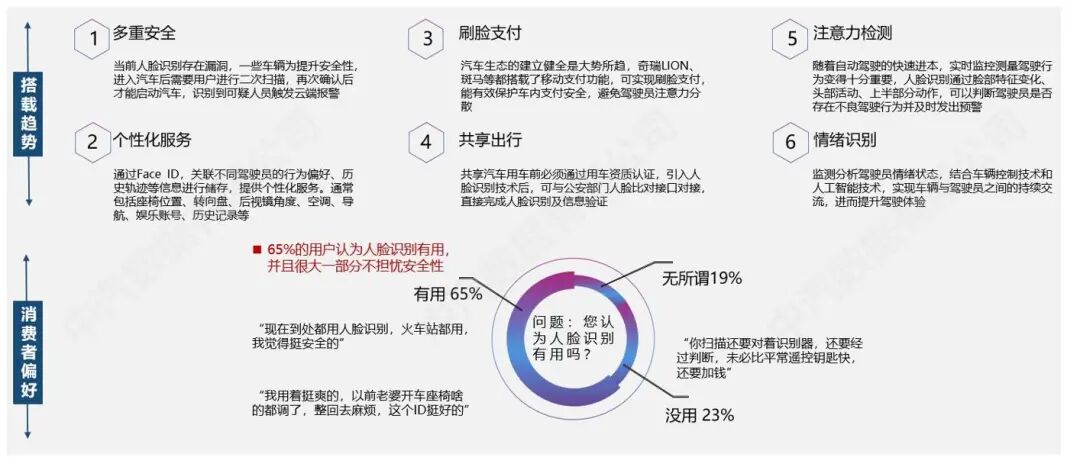 Trends in Facial Recognition Configuration Adoption and Consumer PreferencesAs a new type of human-machine interaction method, facial recognition technology has been applied in a few mass-produced models, such as the Arrizo GX, Tiggo 8, WM EX5, and XPeng G3. Apart from BAT, domestic facial recognition companies are largely absent from the upstream chip and algorithm development stages, with only a few having technological breakthroughs in the midstream, while most are concentrated in the downstream application layer. Overall, domestic suppliers are sufficient, providing an important foundation for the rapid improvement of facial recognition technology application maturity in the automotive industry.Current Adoption Status of Facial Recognition Configuration by Automotive Companies and Major Suppliers
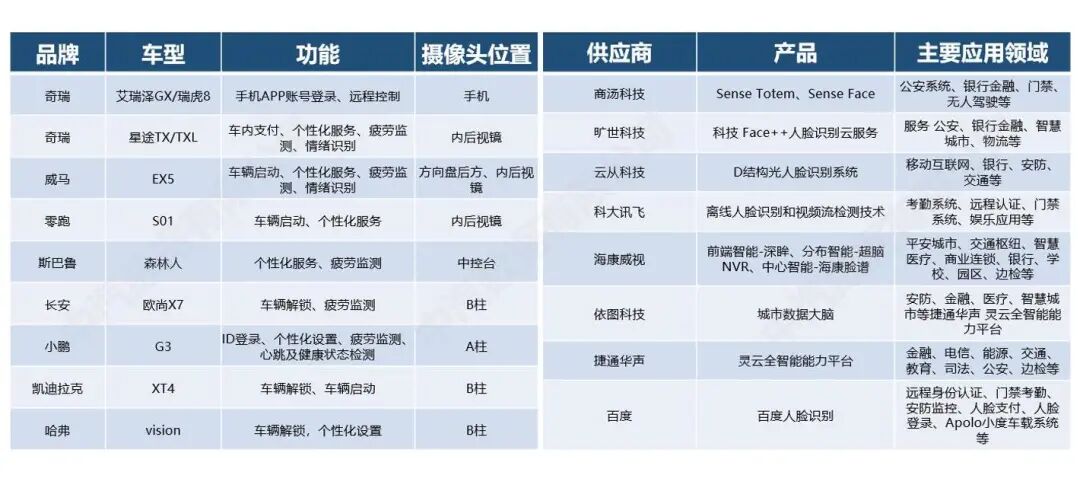
 Facial recognition is actually a “soft” technology, and automotive products are gradually transitioning from “hard” to “soft”. Software definition will become an important characteristic of vehicles. In terms of time, the application of facial recognition systems in the automotive industry is in its infancy, with a few new models gradually equipped with this system within three years. After 2023, it is expected to enter a rapid development phase, and this configuration will become one of the important features to enhance the technological feel of products, with more models adopting it; functionally, based on technological maturity, identity verification and driver attention monitoring based on facial recognition will be the first to be applied in vehicles.
 Recommended Configuration No.3 – Fingerprint RecognitionFingerprint recognition technology is one of many biometric recognition technologies, primarily used for personal identity recognition and authentication based on the patterns and details of human fingerprints. Thanks to the development of modern electronic manufacturing technology and pattern recognition, fingerprint recognition has entered our daily lives. Currently, automotive companies are taking a series of actions regarding fingerprint recognition technology, mainly focusing on safety and personal services in vehicles, enabling functions such as vehicle unlocking, starting, and personalized settings for the driving environment.
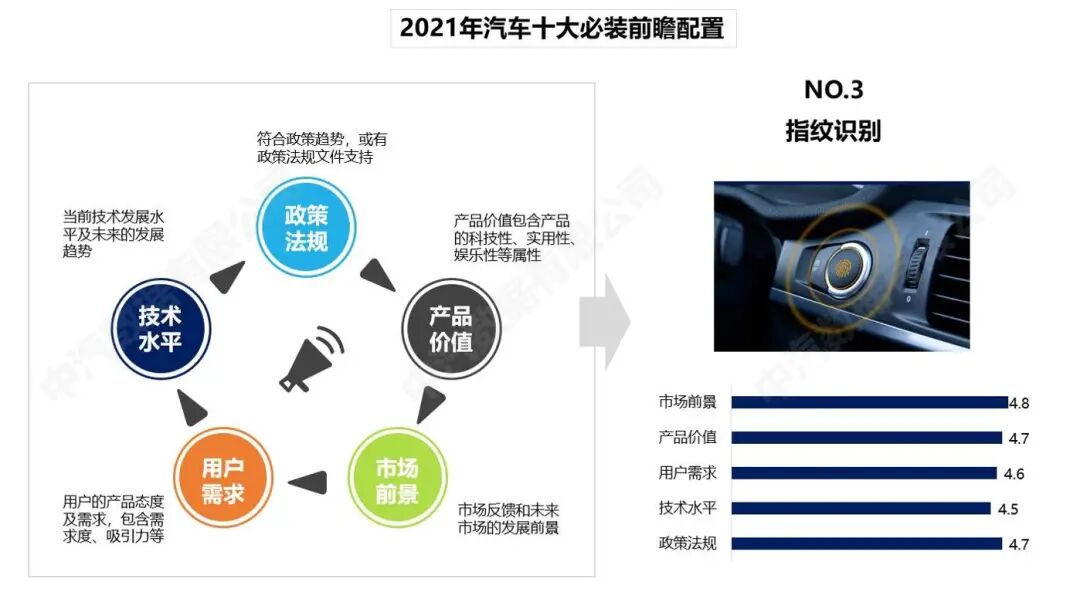 2021 Top Ten Essential Forward-Looking Configurations – No.3 Fingerprint Recognition
 As times change, the trends of intelligence and vehicle networking are inevitable. Consumers will pay more attention to intelligent configurations in vehicles. Fingerprint recognition will not only enhance the technological feel of vehicles but also provide many conveniences for users during their vehicle use. In the consumer survey conducted by China Automotive Data, fingerprint recognition is located in the attractive equipment area, with an attention rate of 63.1%. Consumers are mainly satisfied with functions such as personalized settings for the driving environment through fingerprint recognition.
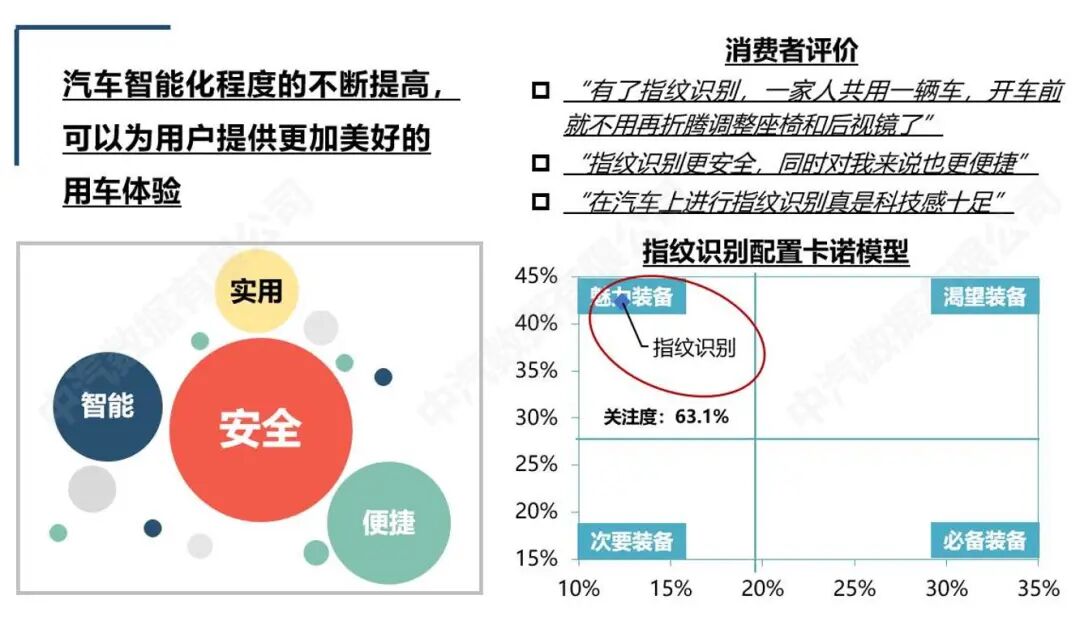 Consumer Demand and Evaluation of Fingerprint Recognition ConfigurationFingerprint recognition enhances product attractiveness while improving consumers’ vehicle experience. To avoid falling behind in this technological race, automotive companies are actively engaged in the research and application of fingerprint recognition technology. Currently, several automotive companies, including Audi, Hyundai, and Geely, have applied fingerprint recognition technology in their products. Great Wall has also equipped fingerprint recognition in its Concept H vehicle, which is expected to be launched in the second half of this year with the Haval H6 equipped with fingerprint recognition.
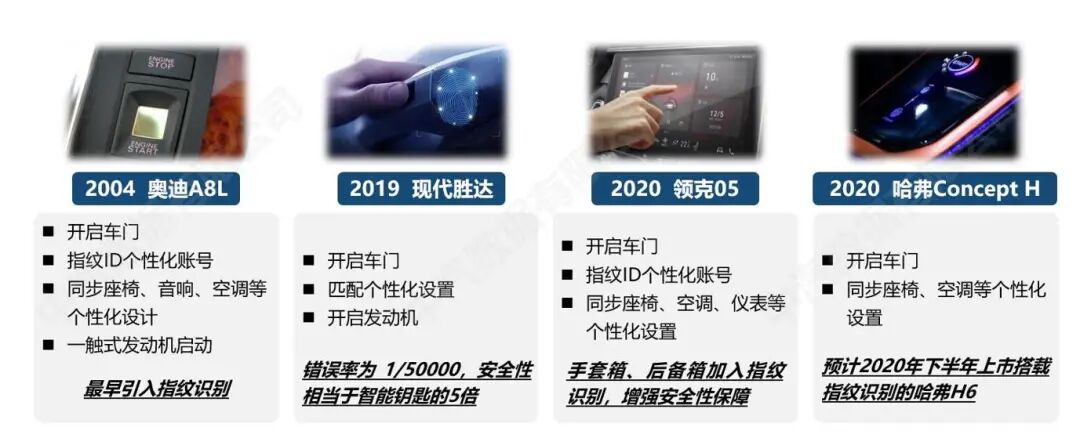 Models Equipped with Fingerprint RecognitionWith the rapid development of the automotive industry, more and more intelligent technologies are being developed and applied. Fingerprint recognition, as an important part of this, can provide users with a more convenient and comfortable driving experience, with a very broad application prospect. As related technologies mature, fingerprint recognition will overcome the influence of environmental and finger conditions, and more models will gradually adopt fingerprint recognition technology, which will become a mainstream development trend in the automotive industry.Recommended Configuration No.4 – LCD KeyAn LCD key refers to a car key equipped with an LCD touch screen, combining smart vehicle control with automotive keys. Users can perform functional operations through the touch screen to achieve intelligent remote control of the vehicle. Currently, the existing LCD keys on the market have rich functionalities, enabling not only remote engine start/stop and remote air conditioning control but also automatic unlocking when approaching the vehicle, automatic locking when moving away, and automatic alarm in case of vehicle anomalies, making it very convenient and practical for users.
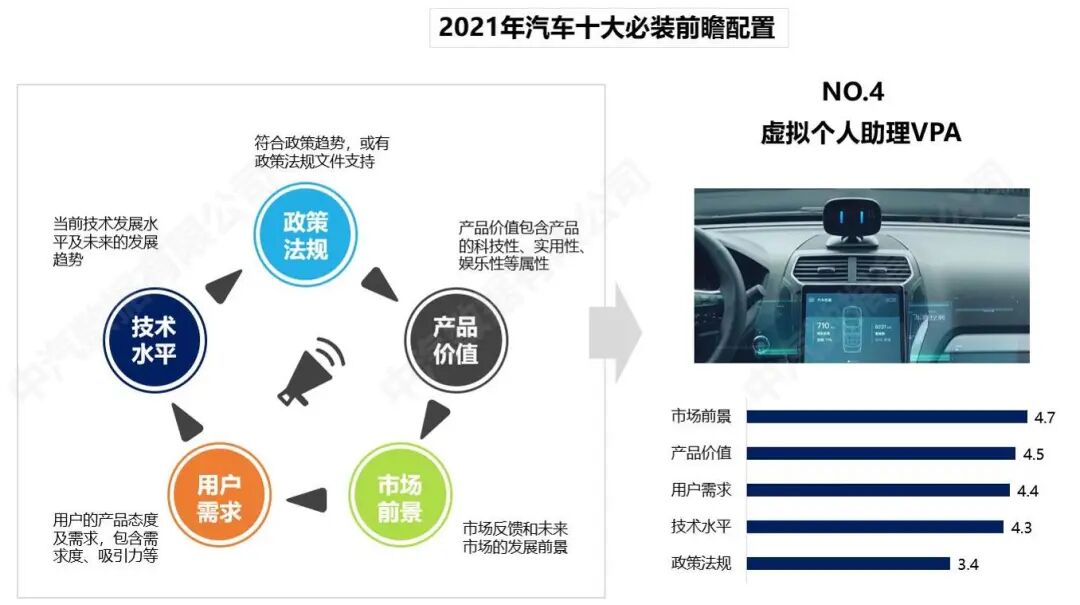 2021 Top Ten Essential Forward-Looking Configurations – No.4 LCD KeyAs the level of vehicle intelligence continues to rise, the LCD key, as one of the intelligent configurations, can enhance consumer flexibility and convenience in vehicle use. At the same time, a cool multifunctional LCD key is also a unique symbol of high-end automotive products. In the consumer survey conducted by China Automotive Data, the overall market equipment rate of LCD keys shows a year-on-year upward trend. In the survey of equipment rates in various sub-markets, the configuration of LCD keys is mainly concentrated in the C-class and D-class vehicle markets, with the equipment rate of LCD keys in the D-class market increasing from 0.95% to 33.03% over four years. Although the equipment rate of LCD keys in C-class vehicles is not as high as in D-class vehicles, it has also achieved continuous growth over four years, with consumers generally expressing positive evaluations and a high recognition level for LCD keys.
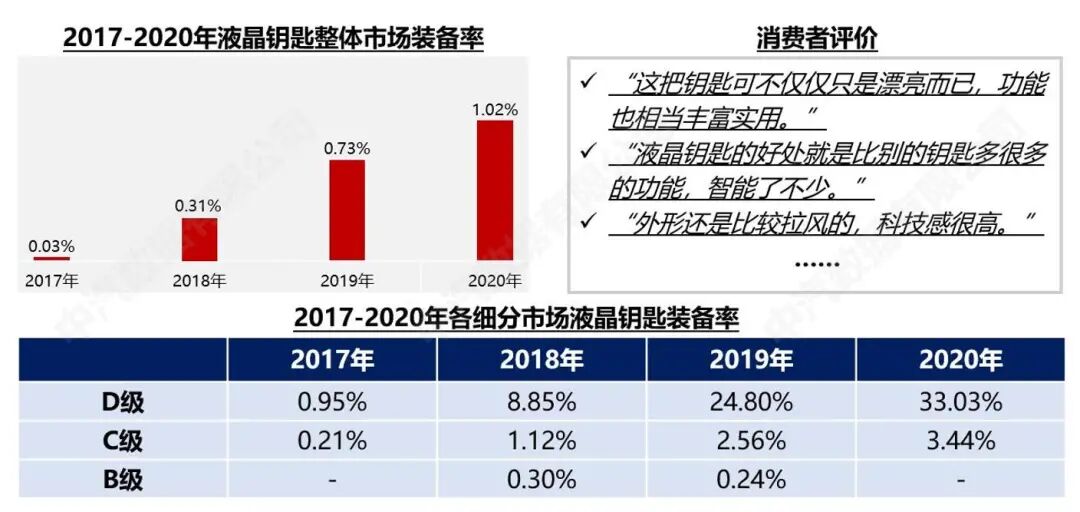 Equipment Rate and Consumer Evaluation of LCD KeysThe LCD key was initially a black technology exclusive to BMW, appearing only in the BMW 7 Series. Although there are still technical challenges related to battery life and extreme environmental conditions, with technological advancements and increasing consumer demand, many automotive manufacturers have begun to apply it in their products. It is now available in models from Land Rover, BMW, Mercedes-Benz, and domestic brands like Geely Borui GE, significantly enhancing the technological feel while greatly improving the consumer’s vehicle experience.
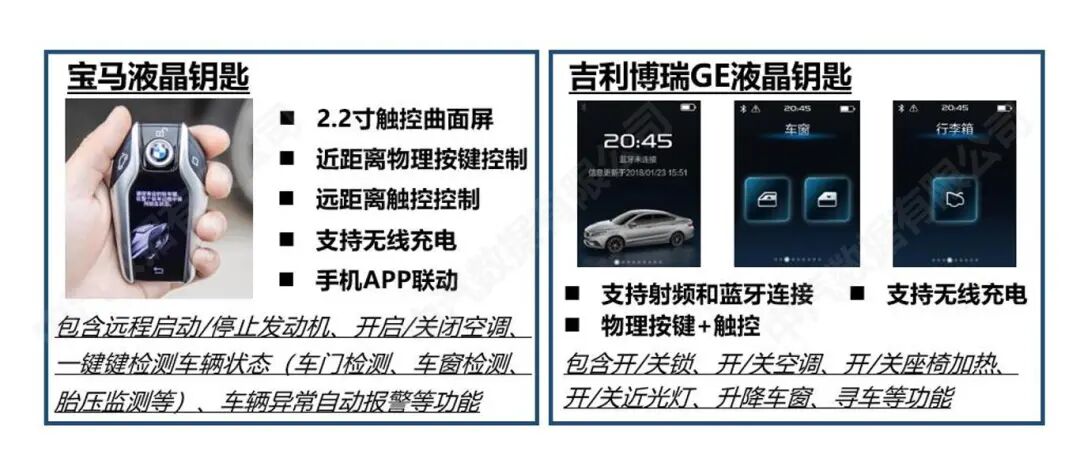 Current Status of LCD Key AdoptionAs one of the important products of automotive intelligent applications, the LCD key can achieve remote control of the vehicle, reducing traditional cumbersome operation processes, while enhancing the technological feel of the vehicle, aligning with the development direction of automotive intelligence and connectivity. In the future, more automotive companies will invest in the research and application of LCD keys. As related technologies mature, LCD keys will become one of the essential configurations for vehicles, providing users with a better vehicle experience.Recommended Configuration No.5 – Virtual Personal Assistant (VPA)The Virtual Personal Assistant (VPA) refers to an in-car voice interaction system embedded in the vehicle, currently available in three forms: screen avatars, physical robots, and holographic images. Since its launch, it has received positive feedback from many consumers, especially during long-distance travel and monotonous commutes, serving as a great conversational partner. Currently, the VPA mainly carries the function of a voice assistant, with general AI learning capabilities.
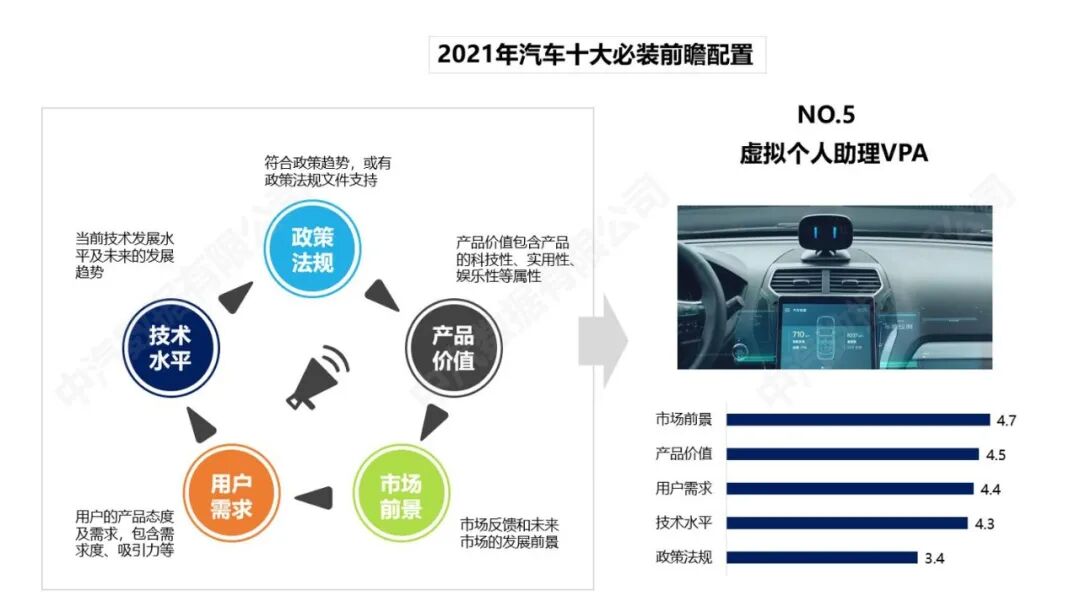 2021 Top Ten Essential Forward-Looking Configurations – No.5 Virtual Personal Assistant (VPA)
 With the continuous development of technology, the intelligence of Virtual Personal Assistants (VPA) has significantly improved, and consumers are increasingly valuing the level of intelligence in their vehicles. In the consumer configuration survey conducted by China Automotive Data, there is a high demand for vehicles equipped with VPA, with preferences for holographic and physical robot forms of VPA being 43.0% and 35.8%, respectively.
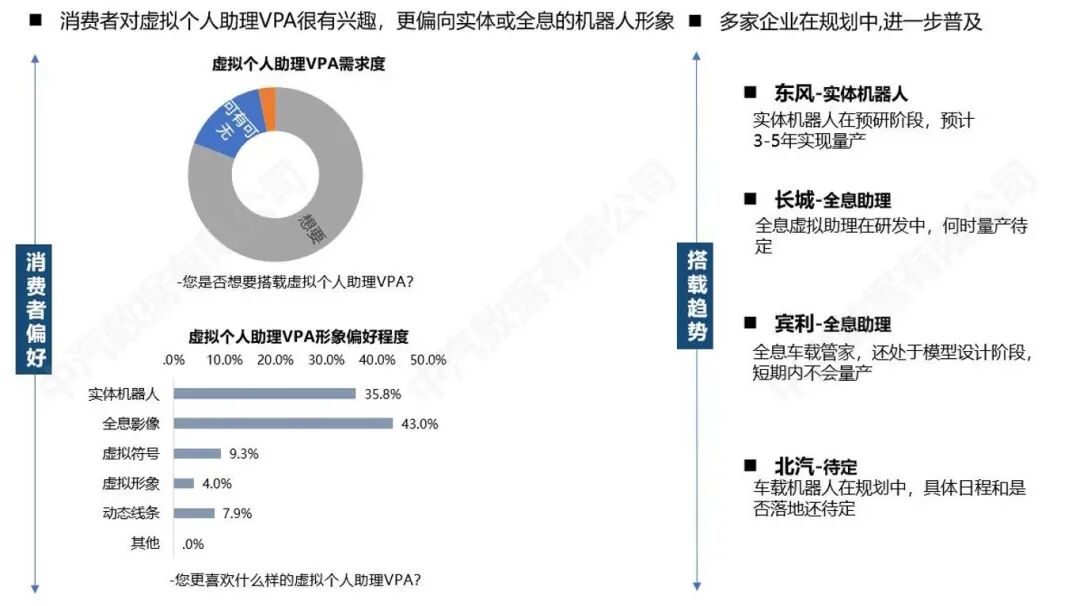 Consumer Demand for Virtual Personal Assistant (VPA) ConfigurationAs consumer demand for driving entertainment increases, many automotive companies are accelerating their deployment of VPA to meet consumer purchasing needs. Currently, automotive brands equipped with VPA include Hozon, NIO, Bestune, Toyota, Mercedes-Benz, RIVIAN, XPeng, Li Auto, Chery, and Changan, mainly focusing on new forces and luxury brands. However, the current products still fall short of user requirements. It is expected that from 2020 to 2025, physical robots will remain a trend, and from 2025 to 2030, with the commercialization of true medium-free holographic technology, holographic virtual assistants will rapidly develop.Some Automotive Companies’ VPA ConfigurationCurrent Forms and Adoption Status
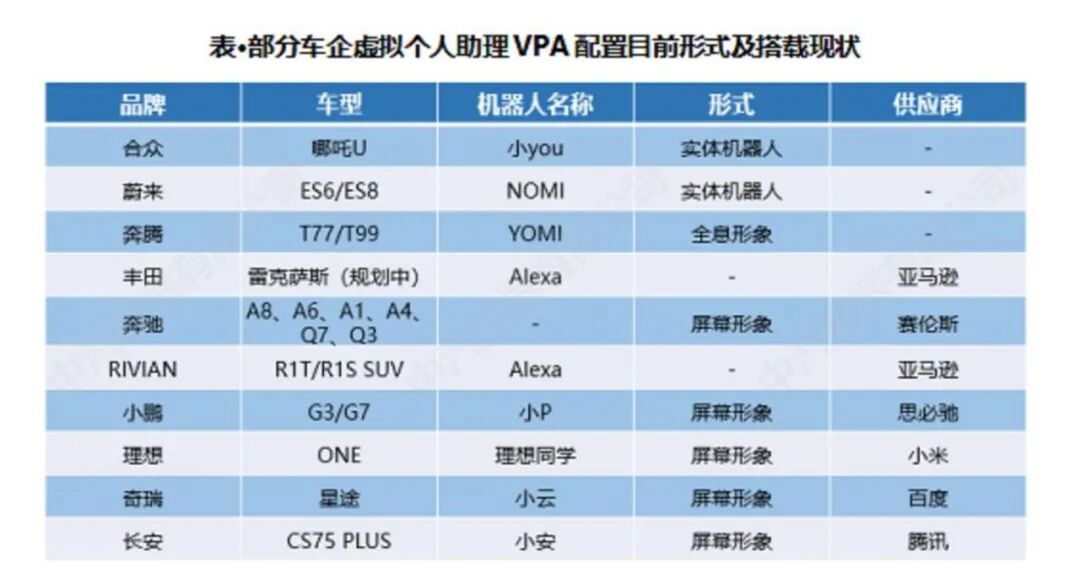 With the accelerated development of intelligent in-car virtual personal assistant products, the further development of people’s driving needs, and the rapid upgrade of the in-car derivative industry, the future development of VPA will become more “diversified”, no longer limited to a few forms of presentation. More “personalized” services will achieve customized functions for passengers, becoming more “emotional” and understanding human needs, while also aligning with “scenario-based” design. The adoption of virtual personal assistants (VPA) will gradually become a mainstream trend.
 In the previous issue, we introduced the top ten essential forward-looking configurations for 2021, including AR-HUD, facial recognition, fingerprint recognition, LCD key, and Virtual Personal Assistant (VPA). In this issue, we will continue to introduce the top ten essential forward-looking configurations for 2021, including driver monitoring, night vision capability, intelligent front lights, health cabin, and smart home connectivity.
 Recommended Configuration No.6 – Driver MonitoringDriver monitoring can detect fatigue behaviors and abnormal actions of the driver during the driving process, such as monitoring behaviors like making phone calls, smoking, drinking water, identity verification, and attention concentration. Its principle is to capture the driver’s biological information, such as eyes, face, heart, and brain activity, and analyze the changes in their characteristics. The most commonly applied fatigue monitoring currently analyzes the driver’s driving behavior by recording and interpreting characteristics such as steering wheel rotation and brake application to determine whether the driver is fatigued; or using image analysis methods to assess fatigue based on the driver’s facial and eye features.
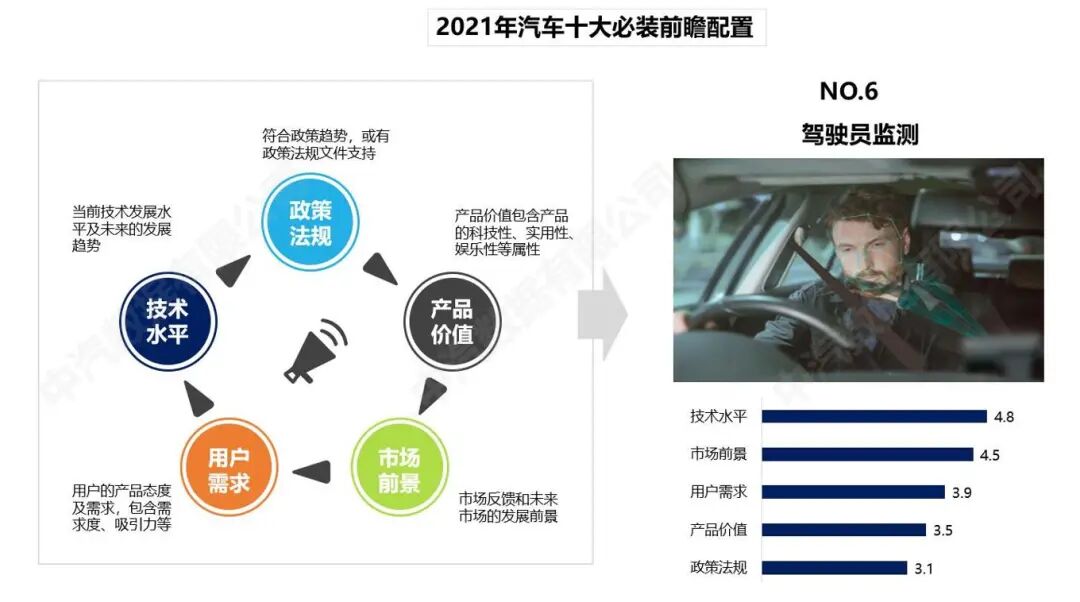 2021 Top Ten Essential Forward-Looking Configurations – No.6 Driver MonitoringDriver monitoring can significantly improve driving safety by detecting whether the driver is in a fatigued state, thus attracting considerable consumer attention. Currently, there are few models equipped with complete driver monitoring systems, while fatigue monitoring systems are an important component of driver monitoring. The overall market and various segment market equipment rates are increasing year by year, with the equipment rate for D-class/C-class vehicles exceeding 50% in 2020. In the consumer configuration survey conducted by China Automotive Data, fatigue monitoring systems have a high attraction for consumers, classified as attractive equipment.
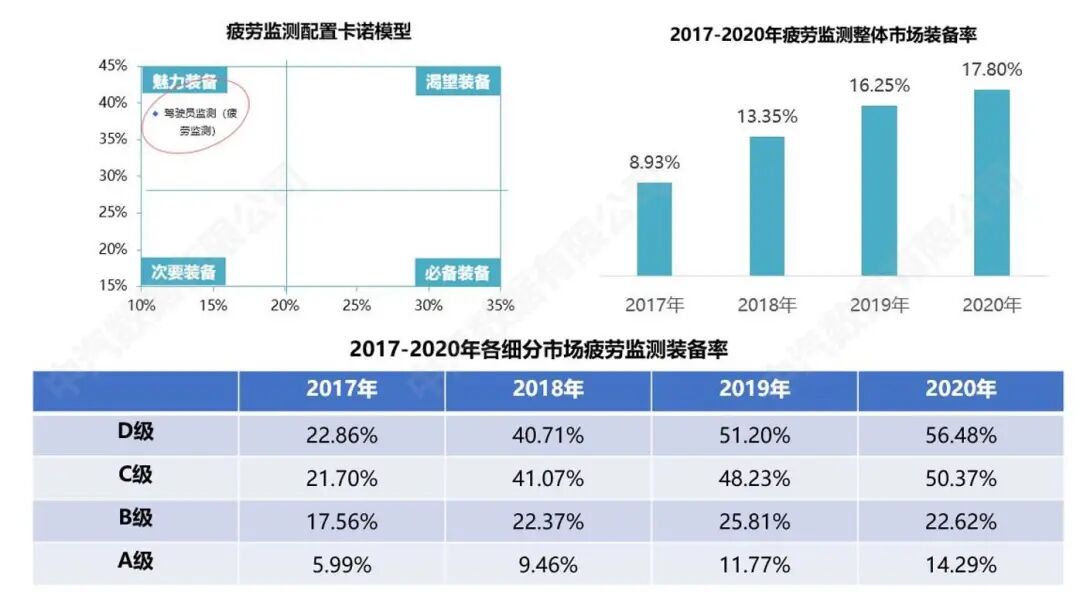 Fatigue Monitoring System Equipment Rate and Consumer DemandThe Volvo XC90 can monitor the driver’s blood sugar levels through pupil monitoring and notify hospitals and the driver’s relatives in case of health issues. The Subaru Forester uses facial recognition algorithms to monitor whether the driver is fatigued or distracted. The newly launched GAC New Energy Aion LX is equipped with a driver fatigue monitoring system that uses infrared cameras placed inside the vehicle to monitor the driver’s facial information in real-time. When it detects that the driver is fatigued or distracted, it provides reminders through voice and dashboard indicators. Currently, the main suppliers developing driver behavior monitoring functions include Continental, Valeo, Veoneer, Denso, Mitsubishi Electric, and Osram.The market prospects for driver monitoring are broad, especially as the technology develops to a certain level, enabling emotional perception and recognition, which is an important component of intelligent cockpits. However, currently, this technology is not yet mature and is still under development. In the future, with the reduction of production costs and the advancement of intelligent technology, it is expected that after 2021, driver monitoring systems will see greater commercialization and gradually become more suitable for ordinary consumers’ family vehicles.Recommended Configuration No.7 – Night Vision CapabilityThe night vision system is an emerging automotive driving safety assistance system that provides drivers with enhanced foresight during nighttime or low-light driving, offering comprehensive and accurate information or early warnings about potential dangers. Its working principle is that any object emits heat, and objects at different temperatures emit different amounts of heat. Humans, animals, and moving vehicles emit more heat compared to their surroundings. The night vision system collects this information and converts it into visible images, clearly presenting objects that are otherwise difficult to see at night, thereby increasing safety during nighttime driving.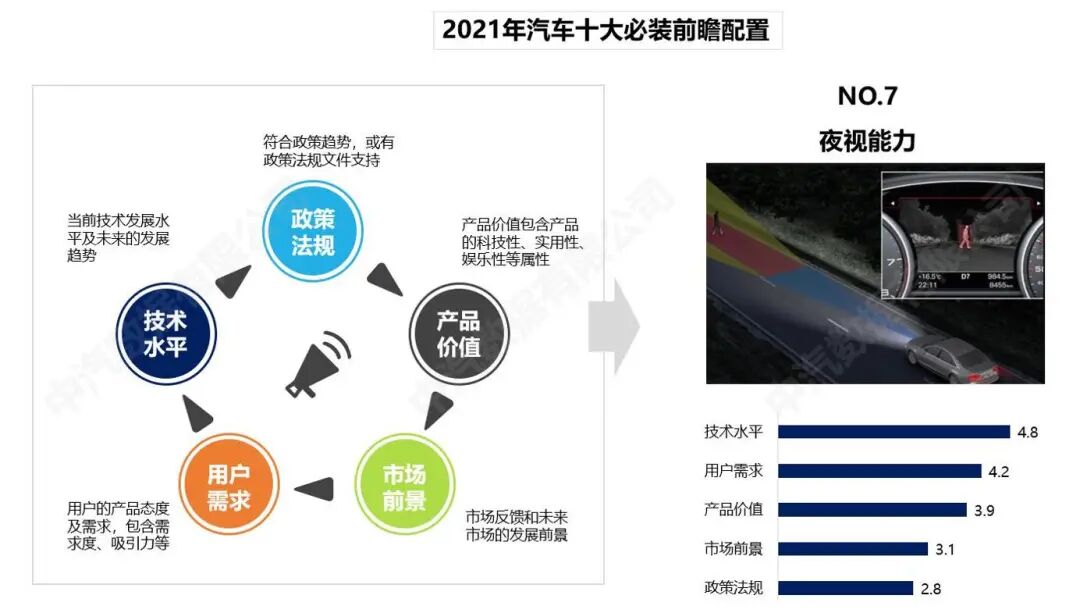
 2021 Top Ten Essential Forward-Looking Configurations – No.7 Night Vision CapabilityThe night vision system can significantly enhance safety during nighttime driving, and there is a high consumer demand for it. In the consumer configuration perception study conducted by China Automotive Data, the awareness of this configuration reached 72.7%, with attention and attraction both exceeding 35%, significantly higher than the median attraction of 30% for forward-looking technology equipment, classifying it as attractive equipment.However, currently, the overall market equipment rate for this configuration remains low due to the high cost of night vision systems, maintaining around 0.7% from 2017 to 2020. In terms of vehicle class, the equipment rate for D-class vehicles is relatively high, consistently above 10% over the years.
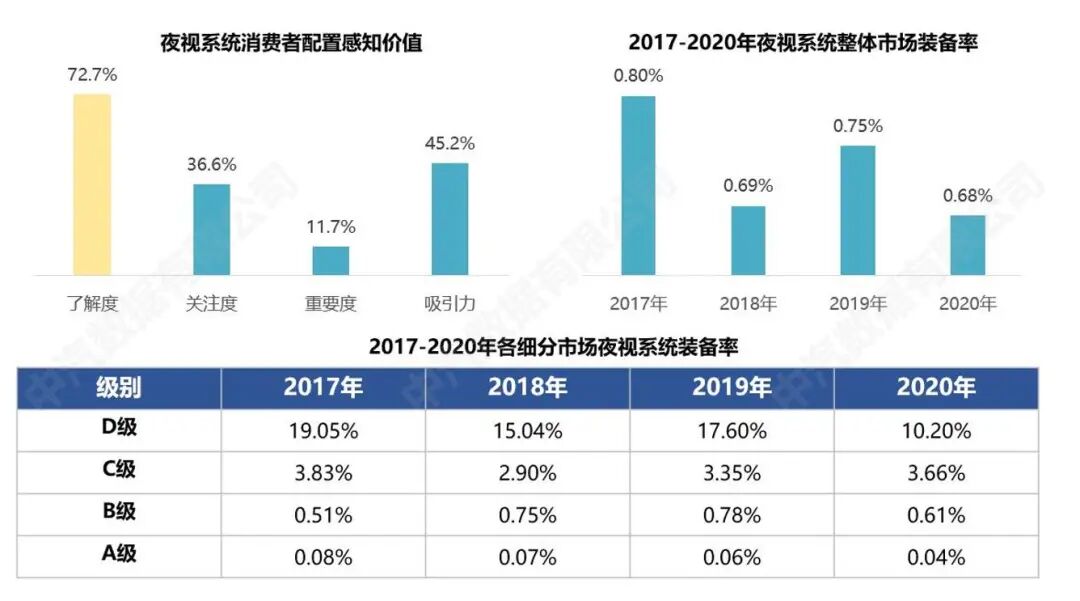 Night Vision System Equipment Rate and Consumer DemandCurrently, joint venture automotive companies such as General Motors, BMW, Toyota, Mercedes-Benz, Audi, and Peugeot have equipped their flagship models with night vision systems. Cadillac was the first brand in the world to equip a night vision system in a vehicle. Domestic brands also have models equipped with night vision systems, such as the Dachen G70 and Hanteng X7. Currently, the main technology suppliers for night vision systems include Autoliv, Delphi, Visteon, Bosch, and Valeo.
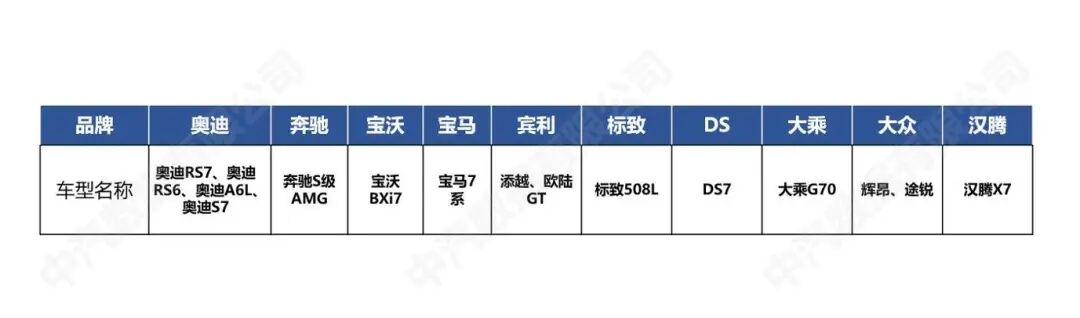 Models Equipped with Night Vision Systems from Various BrandsThe principles and technologies used in night vision systems can significantly affect their overall performance and the driver’s experience during nighttime driving. The enhancement of technology, the combination of equipment, and research experiments based on human ergonomics complement each other, continuously driving the advancement of automotive night vision technology. Night vision systems can greatly enhance the technological aspect of vehicles, but due to their high cost, currently, only luxury brands use them in their flagship models. However, as consumer demand for driving safety increases, the popularity of autonomous driving technology, and the reduction of production costs for night vision systems, it is expected that in the future, in-car night vision systems will gradually become more suitable for ordinary consumers’ family vehicles.Recommended Configuration No.8 – Intelligent Front LightsAutomotive headlights are the most “intuitive” technology of vehicles, serving not only as the “eyes” of a car but also as a form of silent “communication”. Vehicles need to interact with road participants through their lights. A new vehicle lighting technology is rapidly developing – intelligent pixel headlights, which divide the high and low beam patterns into multiple areas and control the on/off or brightness of each area based on data input from cameras or sensors and preset algorithms. This enables multi-road mode switching, intelligent adaptive steering, automatic glare-free high beams, road sign recognition, pedestrian warnings, and other intelligent lighting actions. Automotive companies are mainly developing and researching four high-pixel technologies: LED LCD, LED DMD, Laser DMD, and µAFS.
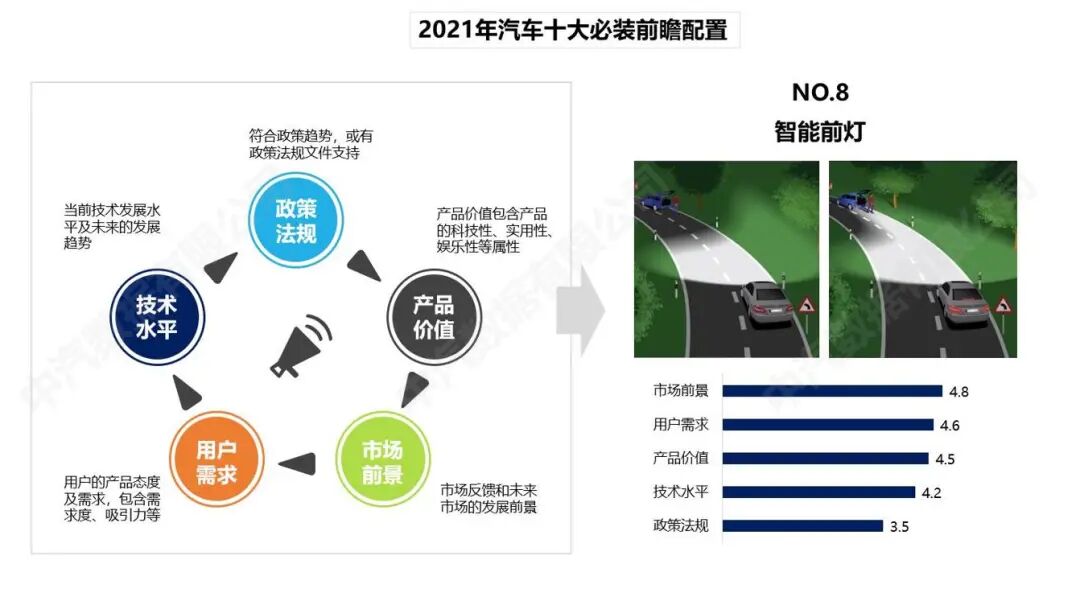 2021 Top Ten Essential Forward-Looking Configurations – No.8 Intelligent Front LightsAutomotive headlights are not only used for vehicle illumination but also serve as a safety prompt for drivers. With the development of intelligent interaction in vehicles, consumers are increasingly valuing the technological and safety aspects of automotive headlights. In the consumer survey conducted by China Automotive Data, most configurations of intelligent front lights are concentrated in the attractive equipment area, with attention rates exceeding 35%. Among them, the adaptive brightness adjustment for high and low beams (active intelligence) has an attention rate of 58.9%.
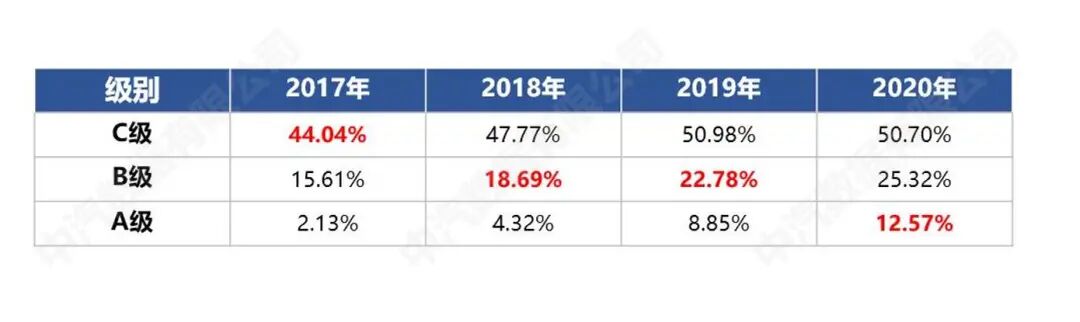
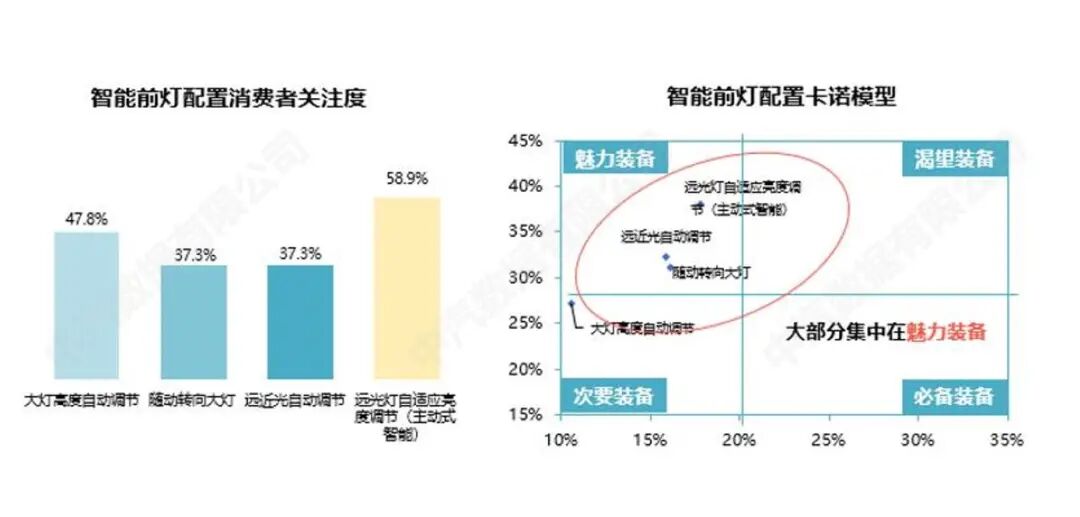 Consumer Demand for Intelligent Front LightsWith the rapid development of technology, the equipment rates for adaptive high and low beam lights are increasing year by year, showing a trend of descending from high-end models to lower-end models. Currently, many luxury models, including the Mercedes-Benz GLE/S-Class, BMW 5 Series/7 Series, Audi A8, and Volvo S90, are equipped with intelligent front lights. Among domestic brands, the adaptive high and low beam light equipment rate for Geely is as high as 27.27%, while for joint venture brands, Toyota’s equipment rate for this configuration reaches 51.95%, close to that of many luxury brands. The steering headlights are currently mainly equipped in luxury brands, with BMW having the highest equipment rate at 68.29%.– 2017-2020 Equipment Rates in Various Sub-Markets –Adaptive High and Low Beam Light Equipment Rates
 – Some Brands’ Adaptive High and Low Beam Light –Equipment Rates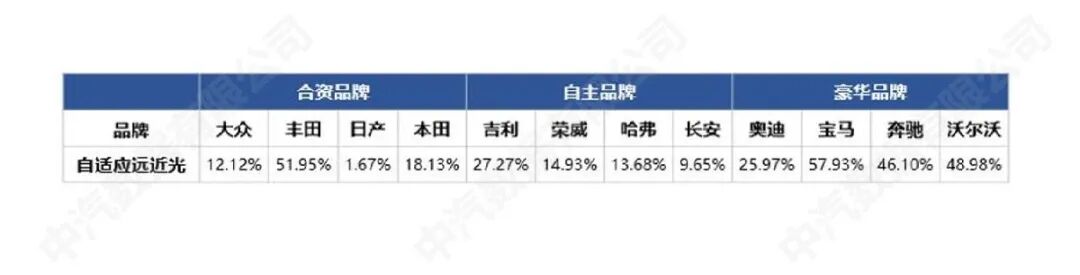
 Intelligent front lights represent the future direction of automotive lighting development, helping to improve driving safety while significantly enhancing the technological feel of vehicles, aligning with the current trends in intelligent driving development. With the technological innovation of automotive intelligent safety technologies and the continuous improvement of policies, intelligent headlights are expected to gradually become a mainstream development trend, protecting the lives of drivers and pedestrians.Recommended Configuration No.9 – Health CabinThe health cabin refers to a cabin that can provide health protection for the driver and passengers, including fresh air, antibacterial and anti-mold features, healthy materials, electromagnetic cleaning, and low noise insulation. Currently, automotive companies are mainly focusing on germicidal and antibacterial technologies, PM2.5 air conditioning filters, and intelligent monitoring with remote one-click disinfection functions, relying on four major air purification technologies: HEPA (High-Efficiency Particulate Air), activated carbon, ozone generators, and electrostatic dust collectors.
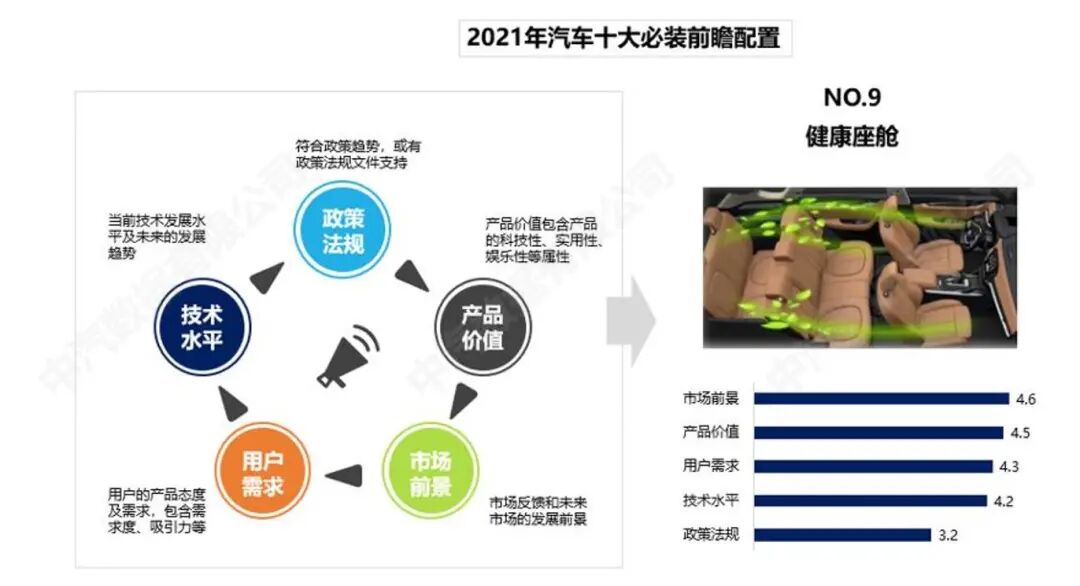 2021 Top Ten Essential Forward-Looking Configurations – No.9 Health CabinWith increasing air pollution and the global outbreak of the novel coronavirus pneumonia, consumers are paying more attention to safety and health issues in vehicles. In the consumer survey conducted by China Automotive Data regarding health cabin configurations, most health cabin configurations are concentrated in the attractive configuration area, with a high attraction for active noise reduction systems reaching 46.2%. All configurations have attention rates exceeding 30%, with the negative ion purifier having the highest attention rate of 64%.
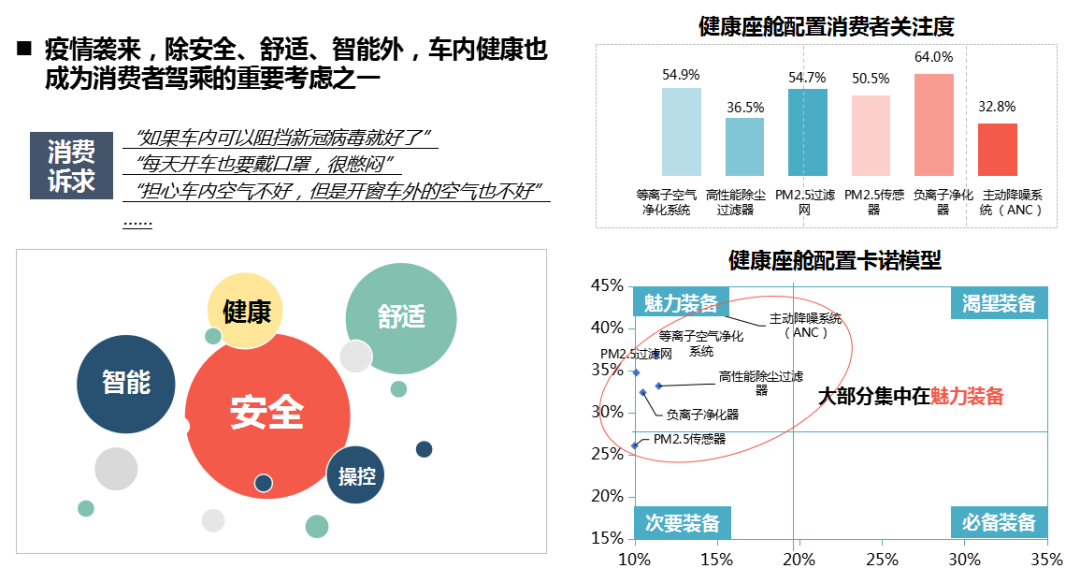 Consumer Demand for Health Cabin ConfigurationCurrently, several automotive companies in China, including SAIC Roewe, Great Wall Haval, FAW Hongqi, Tesla, and Buick, have launched corresponding health cabin solutions combined with health technology, with different companies focusing on different highlights. Many companies’ health cabins are equipped with negative ion generators and AQS air detection. On February 12, 2020, Huacheng Certification launched the first CN95 certification in China, and on February 28, the third-party certification agency Kairui under the China Automotive Research Institute launched the “Smart Health Cabin” certification. The future development of health cabins will undoubtedly become more standardized and regulated.Some Automotive Companies’ Health Cabin Configurations and Technologies
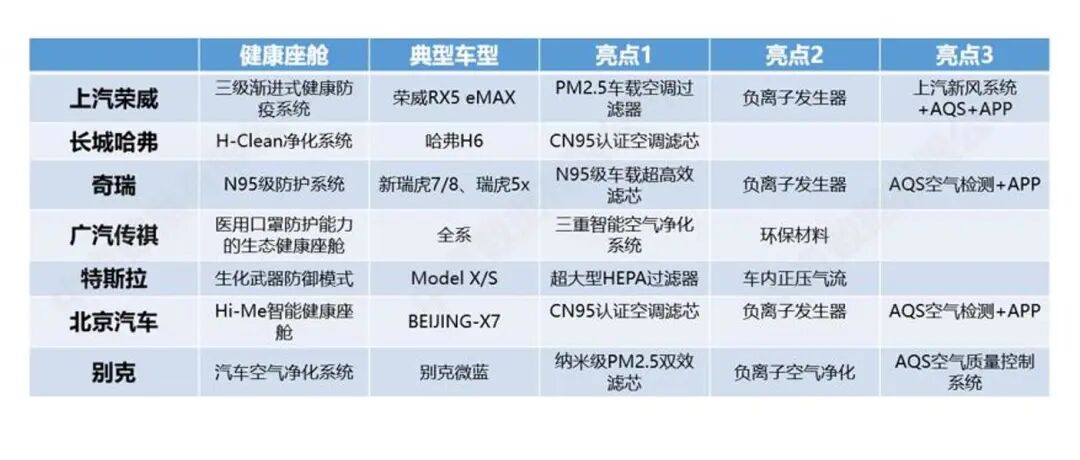 As a “private space” for users, enjoying a healthier and greener driving experience has become a “necessity”. Equipping this function can not only meet users’ needs for a clean cabin environment but also continuously optimize their driving experience. The health cabin has broad application prospects, and more automotive companies will create healthy automotive cabins, gradually becoming a mainstream development trend.Recommended Configuration No.10 – Smart Home ConnectivitySmart home connectivity links the two major scenarios of travel and home, extending smart home voice control to connected vehicles, integrating the personalization of home and vehicle. This is achieved through in-car voice assistants and smart speakers at home, allowing for two-way connectivity between the car and home, such as controlling air conditioning, refrigerators, and other smart home devices from the car, and controlling vehicle unlocking, temperature control, and vehicle status inquiries from home.
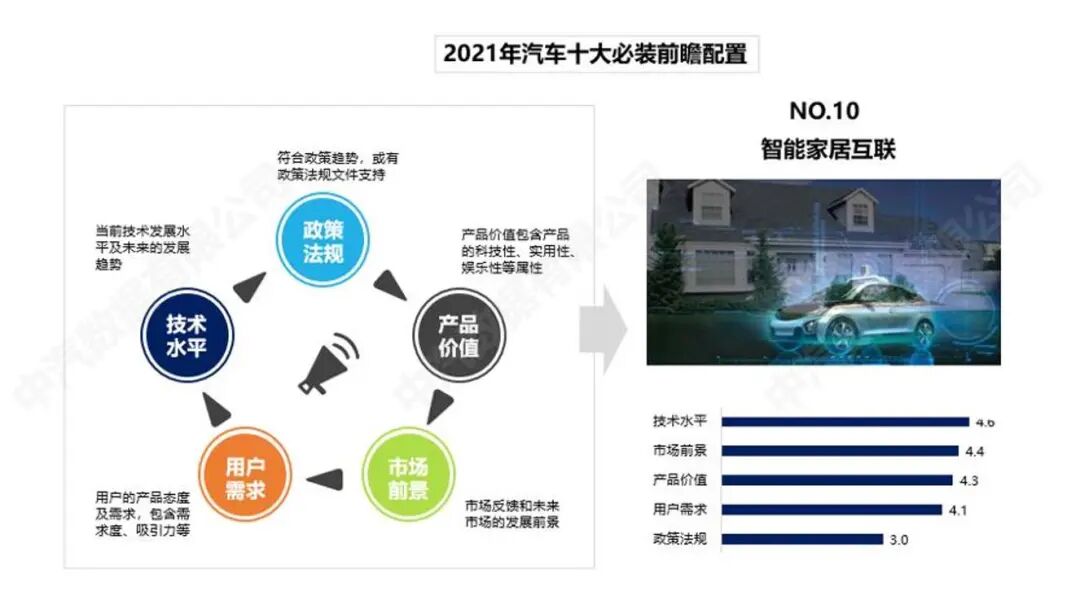 2021 Top Ten Essential Forward-Looking Configurations – No.10 Smart Home ConnectivitySmart home connectivity aligns with the development trends of automotive intelligence and connectivity. The rapid application of technologies such as IoT, 5G, and AI has also created conditions for the integration of travel and home scenarios. Nowadays, automotive consumption is shifting towards diversification, youthfulness, and personalization, with younger car-buying groups pursuing technological intelligence and valuing experiential aspects. In the consumer survey conducted by China Automotive Data regarding the most desired in-car functions, smart home connectivity ranked sixth, with a high attraction, as 51.9% of users hope to have this function, with the top three desired application scenarios being: (1) starting the car’s air conditioning before leaving; (2) turning on the home air purifier before arriving home; (3) monitoring children or pets at home via the car’s central control screen. Smart home connectivity allows consumers to seamlessly connect online and offline experiences, providing a smarter and more convenient travel experience.
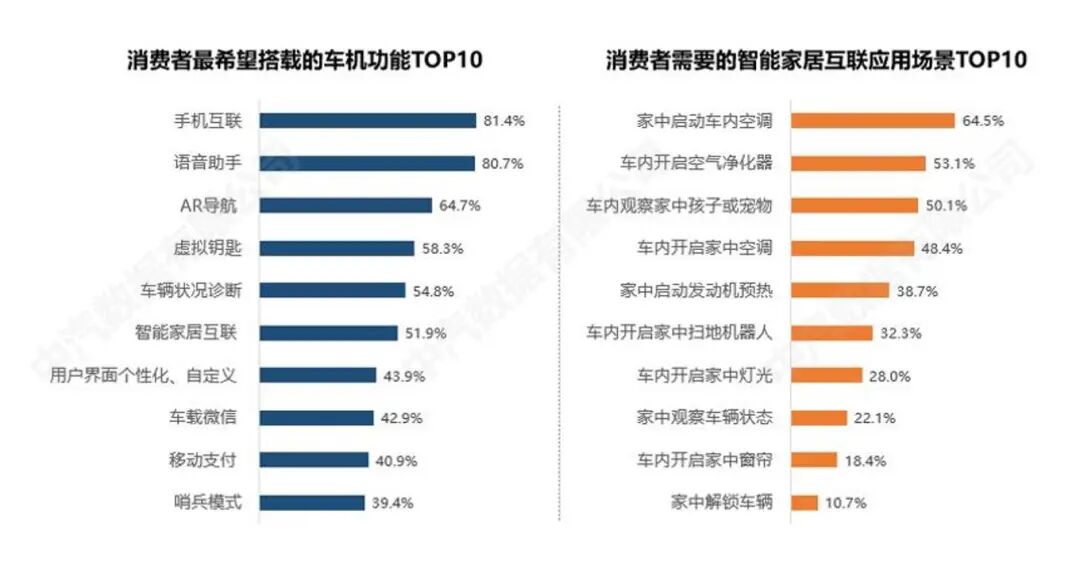 Consumer Demand for Smart Home ConnectivityCurrently, the main technology suppliers involved in smart home connectivity in China are four tech companies: Baidu, Alibaba, Tencent, and Xiaomi. Smart speakers are an important intermediary for smart home connectivity, with partner automotive companies covering mainstream luxury, joint venture, domestic, and new force enterprises. Models such as the Hyundai ix5, WM EX5, and Changan CS95 are already equipped with this feature, and major suppliers are accelerating their layout, with more models equipped with smart home connectivity expected to be launched in the future.Smart Home Connectivity Supplier – Company Cooperation Table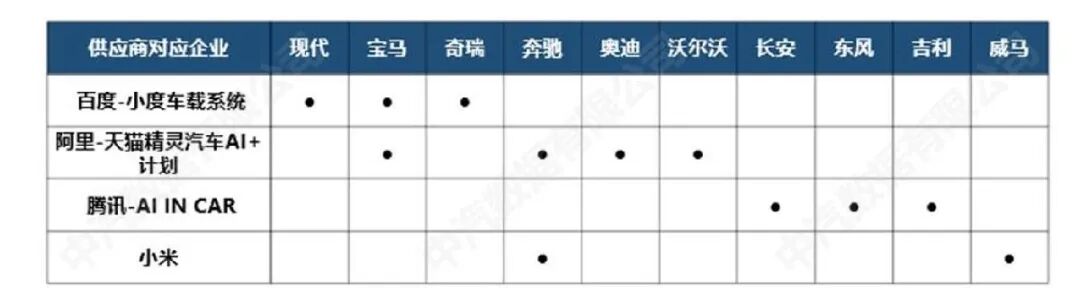
 Smart home connectivity redefines the future of automotive and home, helping vehicles transition from traditional transportation tools to “third space” life partners, with a wide range of applicable scenarios. Equipping this function can enhance the product’s intelligent technology and innovate user experience, increasing user stickiness, with strong application prospects.There are dozens of groups in the automotive industry, including complete vehicles, key components, new energy vehicles, intelligent connected vehicles, aftermarket, automotive investment, autonomous driving, and vehicle networking. Please scan the administrator’s WeChat to join (please indicate your company name).There is also a startup financing group, welcome angel round and A-round companies to join.