
Editor’s Note: To exchange the latest policies, new theories, new standards, new specifications, new technologies, new methods, new processes, and new models in the sand and gravel and equipment industry from various countries, to discuss the future development direction of stone mining, sand and gravel production, and equipment manufacturing, to understand and grasp the infrastructure construction projects and real estate investment situation launched by various countries to drive economic recovery, the major engineering construction projects of countries along the “Belt and Road” initiative, to grasp the supply and demand situation and development trend of the sand and gravel and equipment industry, to discuss the countermeasures and new paths for the sand and gravel and equipment industry during the economic downturn, to provide strategic guidance for rational development of enterprises, to promote cooperation and common development of the sand and gravel industry in various countries, to promote the green, low-carbon, sustainable, and high-quality development of the global sand and gravel and equipment industry, and to play the supporting role of the sand and gravel industry in the global economy, efficiently serving national construction and economic recovery. The China Sand and Gravel Association will hold the 8th China International Sand and Gravel Conference from December 5 to 7, 2023, in Shanghai (click to read). This conference widely solicited academic papers within the sand and gravel industry.
Today, the China Sand and Gravel Association Media Center launched an article co-authored by Li Pingfeng and Xie Shoudong titled “Research on Wireless Remote Initiation System Based on LoRa” for readers.
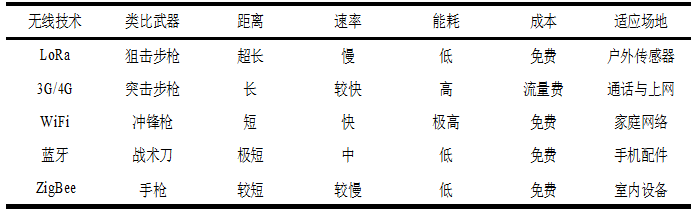
Research on Wireless Remote Initiation System Based on LoRa Li Pingfeng, Xie Shoudong (Hongda Blasting Engineering Group Co., Ltd., Guangzhou 511300)【Abstract】 In order to improve the blasting operation efficiency and the safety of operators in open-pit mines, to overcome safety accidents caused by insufficient initiation energy or network connection failures leading to misfires, an intelligent wireless remote initiation system based on LoRa technology is proposed, with a working frequency of 433MHz, a communication distance of >5000 (visual distance), and using FSK modulation for LoRa spread spectrum transmission technology, making the initiation system more robust and reliable. The initiation system uses an intelligent initiation controller to achieve blasting area control; the digital electronic detonators are connected to the intelligent wireless initiation module, allowing each digital electronic detonator to operate independently, improving the efficiency and safety of the blasting network. Numerous tests have proven that the wireless remote initiation system based on LoRa can still operate normally under long distances, different terrains, and electromagnetic interference, while reducing costs and maintaining good safety and reliability.【Keywords】 Mining engineering; blasting; remote initiation; LoRa technology The initiation system in mining blasting is a key aspect that must be considered in engineering blasting design and construction, as its reliability and safety are related to personal safety, property loss, and blasting effectiveness. A wireless network long-distance initiation system can eliminate the physical connection of wires in traditional initiators, improve blasting operation efficiency, reduce the chances of personnel entering high-risk areas, maximize the safety of blasting operators, and avoid safety accidents caused by insufficient initiation energy or network connection failures, achieving a less personnel-intensive and inherently safe blasting operation. Compared to traditional wire-controlled initiation, it offers greater flexibility, safety, reliability, convenience, and economy. Currently, initiation systems at home and abroad are divided into wired and wireless categories, with wireless initiation methods including microwave initiation, laser initiation, and shock tube initiation. Kan Wenxing et al. summarized the key technologies and development overview of micro initiation systems and proposed prospects for the next generation of initiation systems. Zhang Bo et al. designed a separate non-explosive initiation device to solve the safety issues of initiation systems, with field applications indicating that the system performs reliably. Liu Qing et al. designed a remote-controlled initiation system that includes a wireless remote control, electronic initiator, and supporting capacitive firing pin using a PIC microcontroller and high-reliability spread spectrum wireless control technology, addressing issues of poor reliability and high consumption of existing initiation methods. Xi Chengxian et al. designed a new initiation control system, and practice proved that the system’s work efficiency, reliability, and safety meet field requirements. Yin Guofu et al. designed an addressable initiation network system based on RS485 bus, and tests proved that the system possesses intelligence and high safety. Liang Cheping et al. designed a synchronous initiation system based on the high safety of explosive foil initiation technology, and experimental analysis shows that the synchronization of initiation is related to parameters such as equivalent resistance and equivalent inductance between each group of detonators. Wang Peng et al. completed the design of a micro-efficient impact tube detonator initiation system, and practice proved that the system significantly reduces volume, has fast initiation speed, and is flexible and controllable. Han Kehua et al. tested and compared three types of multi-point synchronous initiation systems, with results showing that the multi-point synchronous initiation system based on impact tube detonators has the best synchronization. Hong-peng C studied remote wireless initiation network security encryption technology and system safety design, achieving remote control blasting while ensuring safety. Miao Y et al. proposed a new symmetric bilinear initiation system (SBI) method to create convergent detonation wave collisions, which not only avoids material waste but also simplifies operation. Addressing the shortcomings of existing initiation systems, including poor anti-interference capability, heavy equipment, and high costs, this paper proposes a research on intelligent wireless remote initiation system based on LoRa technology, including the design scheme of the wireless remote communication system and the safety control technology of the intelligent remote initiation system.1 Research on Wireless Remote Communication System Technology1.1 Selection of Working Frequency Currently, the radio frequency defined by the International Telecommunication Union in the 30-1000 MHz band is part of the very high frequency (meter wave) and ultra-high frequency (decimeter wave). The main propagation methods of this frequency are space wave propagation within line of sight, as well as tropospheric scattering and ionospheric scattering. Tropospheric scattering can replace radio relay systems in some cases, allowing propagation distances to reach hundreds of kilometers without using relay stations, while also having large capacity (multi-channel transmission), which low-frequency bands cannot achieve. Compared to high-frequency bands, the advantage of this band is that small-sized antennas can be used for low-capacity systems. In summary, using the 30-1000 MHz frequency band for the wireless initiation system is appropriate, as it not only increases capacity but also allows for more channels. Thus, a working frequency of 30-1000 MHz is selected.1.2 Signal Modulation Method Since frequency and phase modulation provide better noise suppression, FSK is the preferred solution for today’s mainstream digital communication devices. The main advantages of FSK frequency shift keying are: ease of implementation, good anti-noise and anti-attenuation performance, and widespread application in medium to low-speed data transmission. 2FSK can be seen as the sum of two different carrier frequencies of ASK modulated signals. Demodulation methods include coherent and non-coherent methods. Types include binary frequency shift keying (2FSK) and multi-level frequency shift keying (MFSK). The FSK signal modulation method meets the signal requirements needed for initiation, and this study utilizes FSK modulation to modulate the initiation signal.1.3 Selection of Wireless Technology Wireless initiation technology must meet the requirements of long-distance transmission while achieving low power consumption and low cost. LoRa wireless technology features long-distance, low power consumption (long battery life), multi-node, and low cost, meeting the requirements for wireless initiation technology. LoRa operates in globally free frequency bands, including 433, 868, and 915 MHz. LoRa is based on linear frequency modulation spread spectrum, maintaining the same low power consumption characteristics as FSK modulation, significantly increasing communication distance.Table 1 Differences Between LoRa and Other Wireless Technologies
Through the above analysis: the HM-TRLR-S433MHz wireless transceiver module is the most compatible with the initiation system. This wireless transceiver module has advantages such as long communication distance, strong anti-interference, and small size, meeting the needs of the initiation system. LoRa technology spread spectrum transmission offers long communication distances and strong anti-interference; ultra-small size, surface-mounted design, convenient for embedding; supports multiple modulation modes for easy networking; supports deep customization for special applications; convenient production without RF debugging; supports frequency hopping communication (LoRa mode); supports periodic self-reset function; supports module firmware upgrade function; basic parameters of the wireless transceiver module HM-TRLR-S: working frequency: 433/470/868/915 MHz (±20 MHz adjustable); modulation method: LoRa/FSK; transmission power: 2-20 dBm adjustable; receiving sensitivity: -139 dBm (Max); transmission rate: 1.2-115.2 Kbps adjustable; transmission current: 130 mA (+20 dBm); receiving current: 20 mA; standby current: 2 μA; transmission frequency offset: 10-50 KHz; receiving bandwidth: 42-166 KHz; transmission rate: 1200-115200 Kbps adjustable; data interface: 8N1/8E1/8O1 TTL UART (supports RS232 or RS485 interface); communication distance: >5000 meters (LoRa mode, visual distance); circuit diagram shown in Figure 1.
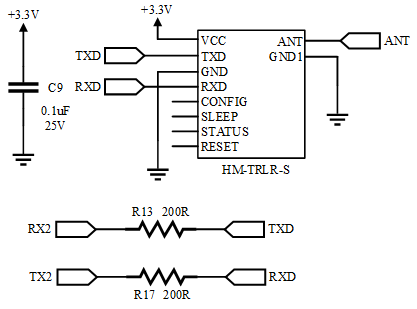 Figure 1 Wireless Communication Module Circuit Diagram2 Research on Safety Control Technology of Remote Initiation System The blasting industry is a high-risk industry, and the safety and stability of initiation systems are particularly important. The safety control technology of the intelligent remote initiation system includes safety control of the intelligent initiation controller and safety control of digital electronic detonators.2.1 Safety Control of Intelligent Initiator The intelligent initiation controller mainly implements functions such as: bidirectional communication with mobile terminals, signal relays, or intelligent wireless initiation modules, positioning, data storage, and bidirectional data transmission with the mobile APP “Blasting Assistant”. The intelligent initiation controller can send initiation commands to the intelligent wireless initiation module, while also addressing the safety risks of digital detonators failing to initiate due to insufficient initiation energy, leading to misfires. Additionally, the intelligent initiation controller itself is equipped with GPS positioning capabilities, which can confirm through the mobile “Blasting Assistant” APP whether the intelligent initiation controller is registered with the relevant authorities and whether blasting operations are being conducted within the approved blasting areas. The initiation system guarantees the exclusivity and closure of the initiation network through on-site registration mechanisms. The GPS module in the intelligent initiation controller uses the Air530Z module. The Air530Z module can achieve real-time acquisition of the GPS coordinates of the initiation controller, meeting the management requirements for digital electronic detonators in the blasting area.2.2 Safety Control of Digital Electronic Detonators Digital electronic detonators are the result of integrating modern electronic technology, information technology, and traditional detonator technology, employing integrated chip control technology, encryption technology, and electronic precision delay technology, enhancing the overall safety of the initiation system. Digital electronic detonators use the iridium ignition system, primarily composed of digital electronic detonators, iridium ignition devices, and iridium ignition modules, with a delay range set between 0-15000 ms, with an error of less than 1 ms. The working principle diagram of digital electronic detonators is shown in Figure 2. When the initiator sends the initiation command, it is received by the Zigbee wireless transmission module, then the STM32 microcontroller enters an interrupt, and after a 10 ms timer delay, it sets low PB5, cutting off V1, releasing K1, and disconnecting the normally open contact, stopping the oscillation boost circuit, quickly discharging C1 and C2 to detonate the digital electronic detonator.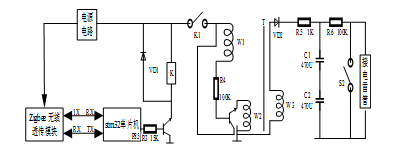
Figure 2 Working Principle Diagram of Digital Electronic Detonators
2.3 Safety Control During Implementation of the Intelligent Initiation System Research and organization of safety measures during the implementation process of the intelligent wireless remote initiation system include: (1) The intelligent initiation controller, intelligent wireless initiation module, and digital electronic detonators can only be used with authorization from relevant authorities and in approved blasting areas; (2) The intelligent initiation controller can only complete pre-initiation preparations after obtaining the networking password; (3) The intelligent initiation controller can only control initiation after pressing both the “B” and “H” keys simultaneously (Figure 3). Industrial blasting tests and multiple reliability analysis tests (such as initiation distance, terrain interference, electromagnetic interference intensity, multi-initiation reliability, etc.) are conducted in open-pit mines.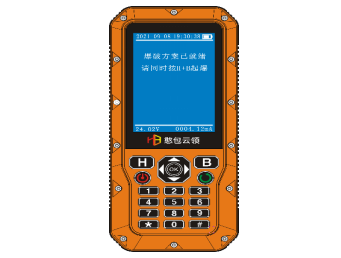 Figure 3 Interface of the Intelligent Initiation Controller Pressing the “B” and “H” Keys3 Experimental Scheme Design3.1 Experimental Preparation Prior to the experiment, preparations include digital electronic detonators, intelligent wireless initiation modules, intelligent initiation controllers, and signal relays.
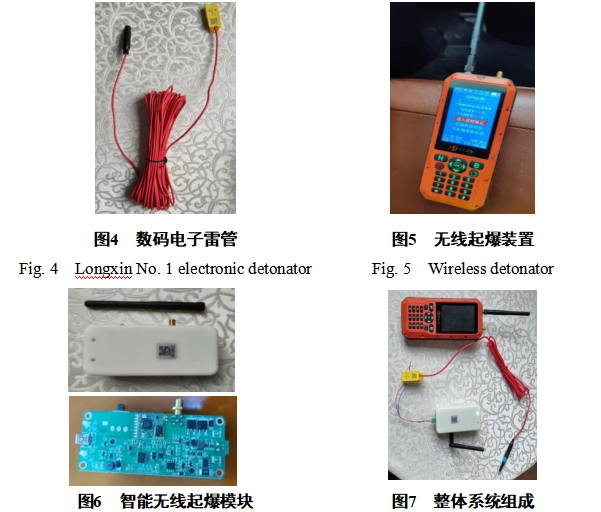
3.2 Experimental Steps The implementation steps of the intelligent wireless remote initiation system require that before entering the test site, registration, verification, authorization, and testing of the digital electronic detonators, as well as testing of the intelligent wireless initiation module, must be completed; upon entering the test site, connect the detonator leads to the intelligent wireless initiation module. (1) Bidirectional communication signal: The intelligent initiation controller sends an initiation signal to the intelligent wireless initiation module to verify whether the intelligent wireless initiation can receive the initiation signal; simultaneously, the intelligent wireless initiation module sends feedback information to verify that it can send feedback information to the intelligent initiation controller. (2) Inject delay time: The intelligent initiation controller sends a delay time signal to the intelligent wireless initiation module to ensure that the intelligent initiation controller receives the signal indicating successful delay time from the intelligent wireless initiation module. (3) Networking: The intelligent initiation controller sends a networking signal to the intelligent wireless initiation module to ensure that the intelligent initiation controller receives the signal indicating successful networking from the intelligent wireless initiation module.
(4) Initiation: The intelligent initiation controller sends an initiation command to the intelligent wireless initiation module, accurately initiating the detonator.
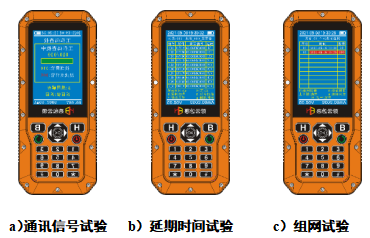
Figure 8 Experimental Process
4 On-Site Experiment The experimental mine primarily produces sand and gravel aggregates, with an elevation range of 1744m-1622m, and a general relative height difference of about 122m. The mining method is slope-type open-pit mining, road development, medium-deep hole blasting, and stepped mining. Tests of the intelligent wireless remote initiation system include distance tests, anti-interference tests, terrain tests, and reliability tests to verify the practicality of the intelligent wireless remote initiation system.4.1 Distance Test The test verifies whether the intelligent wireless remote initiation system can successfully initiate electronic detonators at long distances. Distance tests: Connect the digital electronic detonator to the field charge lead, connect the intelligent wireless initiation module to the digital electronic detonator, and the horizontal distance between the intelligent wireless initiation module and the intelligent initiation controller is set at 200m, 500m, and 1000m, both located at the same elevation in open terrain. Test personnel send initiation commands to verify whether the digital electronic detonator accurately initiates.
Table 2 Distance Test Result Statistics
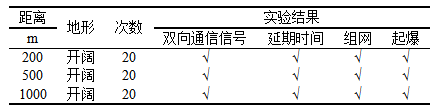
Distance test results indicate that the intelligent initiation controller can maintain bidirectional communication signals, delay time, networking, and initiation functions at distances of 200m, 500m, and 1000m in open terrain. Repeated tests have proven that: the system maintains high stability even at long distances, meeting actual needs.4.2 Terrain Test The test verifies whether the intelligent initiation controller can accurately initiate digital electronic detonators in special terrain environments. Terrain tests: Connect the digital electronic detonator to the field charge lead, connect the intelligent wireless initiation module to the digital electronic detonator, and the horizontal distance between the intelligent initiation controller and the intelligent wireless initiation module is set at 200m, with height differences of 50m and 100m, respectively, in a valley terrain, testing whether the intelligent initiation controller can accurately initiate the digital electronic detonator.Table 3 Terrain Test Result Statistics
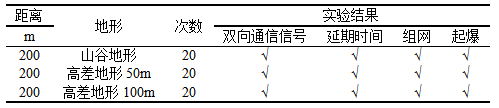
In terrain tests with height differences of 50m and 100m in valley terrain, the intelligent initiation controller can accurately initiate digital electronic detonators. Multiple tests indicate that the intelligent wireless initiation system meets actual work requirements.4.3 System Anti-Interference Test The test assesses the impact of external environmental factors on the intelligent wireless remote initiation system and proposes measures to eliminate or reduce interference effects. Interference tests: Electromagnetic interference involves placing mobile phones and walkie-talkies at the location of the intelligent wireless initiation module to form interference sources; vibration interference involves checking the impact of vibrations generated by vehicles and mining machinery during operation on the equipment; stray current interference involves checking the impact of powered equipment (vehicle charging, power lines, high-voltage lines, powerful electric welding machines, etc.) on the system.Table 4 Interference Test Result Statistics
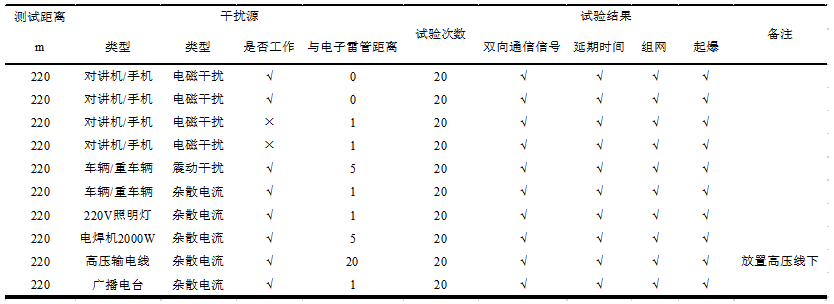
The results of on-site interference tests indicate that electromagnetic interference, stray current interference, and pre-test vibration interference do not affect the system itself; however, the blasting vibration interference after the test has a certain impact on the intelligent wireless initiation module (but does not affect its initiation capability). Over 90% of the intelligent wireless initiation modules retain their integrity and usability after blasting, meeting design requirements for interference effects.4.4 System Reliability Test The reliability of the intelligent wireless initiation system during operation primarily refers to the effectiveness of the initiation tests, demonstrating the feasibility and economy of the system. Reliability tests of the intelligent wireless remote initiation system confirm that under the same conditions of distance, terrain, and interference factors, the wireless remote initiation system can accurately initiate detonators, with repeated tests (20 times) verifying the reliability of the wireless remote initiation system under the same conditions.Table 5 Reliability Test Result Statistics
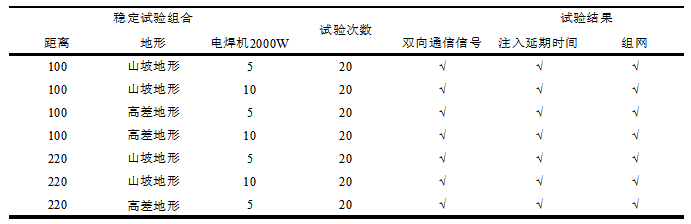
The reliability test results indicate that when conditions are constant, repeated initiation tests can achieve normal initiation, demonstrating the system’s strong anti-interference, high stability, long distance, and safety and reliability technical advantages, meeting on-site blasting requirements.5 Conclusion (1) The intelligent wireless remote initiation system based on LoRa technology utilizes a working frequency of 433MHz, a communication distance of >5000 (visual distance), and FSK modulation for LoRa spread spectrum transmission technology, characterized by long communication distances, strong anti-interference, good stability, low power consumption, and low cost. (2) Through distance tests, the system was tested at distances of 200m, 500m, and 1000m, maintaining normal working conditions, proving that the wireless long-distance initiation system maintains high stability even at long distances. (3) Through terrain tests, the system was tested in valley terrains with height differences of 50m and 100m, and the initiation system continued to function normally, demonstrating the system’s strong anti-interference, high stability, and safety and reliability technical advantages. (4) Through interference tests and reliability tests, the safety, stability, and anti-interference technology of the initiation system were thoroughly analyzed. The system’s resistance to electromagnetic and vibration interference was tested, and tests demonstrated that the system’s multi-layer safety mechanisms ensure the safety and reliability of wireless initiation.References[1] Han Chuanwei, Huang Jianwen, Li Liang, Wang Wei, Huang Xiaowu, Shu Zhen. Optimization and Upgrade of Blasting Safety Management: From Control Management to Systematic Management [J]. Blasting, 2021, 38(02): 192-196.[2] Chi Hongpeng, Fan Chunchao, Tian Xingzhe, Gong Bing. Research on Underground Remote Control Initiation System Based on Wireless Network [J]. Engineering Blasting, 2021, 27(02): 120-124.[3] Kan Wenxing, Chu Enyi, Liu Wei, Ren Wei, Ren Xiaoming. Current Status and Outlook of Safety Devices for Micro Initiation Systems [J/OL]. Energetic Materials: 1-18 [2021-12-13].[4] Zhang Bo, Zhu Jianxin. Application of a Separated Non-Explosive Safety Ignition System in Oil Perforation [J]. Engineering Blasting, 2021, 27(01): 100-104.[5] Liu Qing, Zhou Guisong, Du Huashan, Hao Yafei, Li Junjie. Design and Application of Remote-Controlled Initiation System [J]. Blasting Materials, 2019, 48(03): 44-48.[6] Xi Chengxian, Kong Chenjie. Design of a New High-Reliability Explosive Control System [J]. Power Supply Technology, 2020, 44(10): 1541-1543.[7] Yin Guofu, Zhang Jincheng, Ren Xi, Han Kehua, Li Liming. Design and Feasibility of an Addressable Initiation Network System [J]. Energetic Materials, 2019, 27(05): 426-433.[8] Liang Cheping, Zhang Yuruo, Jin Li, He Qiang, Wei Zengqiang, Han Kehua. Research on Multi-Point Synchronous Initiation System Based on Impact Tube Detonators [J]. Blasting Materials, 2018, 47(03): 31-36.[9] Wang Peng, Ma Tiehua, Cui Chunsheng. Design Research on Micro-Efficient Impact Tube Detonator Initiation System [J]. Electronic Devices, 2017, 40(02): 486-489.[10] Han Kehua, Jiao Qingjie, Chu Enyi, Li Jiao, Zhang Yuruo. Design Methods and Performance of Two Multi-Point Synchronous Initiation Systems Based on Explosion Synchronization Grid Technology and Impact Tube Detonator Technology [J]. Journal of Ordnance Engineering, 2020, 41(S2): 102-110.[11] Hong-peng C. Research on Underground Remote Control Detonation System [C]//Journal of Physics: Conference Series. IOP Publishing, 2020, 1682(1): 012076.[12] Miao Y, Li X, Yan HH, et al. Research and Application of a Symmetric Bilinear Initiation System in Rock Blasting [J]. Journal of Fujian Agricultural University, 2018, 102: 52-56.[13] Guan Li, Zhang Yuchen. Effective Mitigation of Radio Frequency Interference by AMSR-2 Performance Improvement [J]. Journal of Electromagnetic Waves and Applications, 2020, 35(06): 935-942.[14] Liu Mingqian, Zheng Shifei, Li Bingbing. MPSK Signal Modulation Recognition Based on Deep Learning [J]. Journal of National Defense Science and Technology University, 2019, 41(05): 153-158.[15] Wang Aili, Zhang Jiawei, Jiang Kaiyuan, Wu Haibin, Iwa Hori Yuki. Identifying MPSK Signal Modulation Methods Using a New Convolutional Neural Network [J/OL]. Journal of Harbin University of Science and Technology, 2021(05): 97-103.[16] Zhou Desheng. Design of a LoRa-Based Wireless Communication System for Mines [J]. Coal Mine Safety, 2021, 52(04): 170-173.[17] Huo Zhenlong. Application Analysis of LoRa Technology in Mine Wireless Communication [J]. Automation in Industry and Mining, 2017, 43(10): 34-37.[18] Wang Bo, Dong Yunlong, Chen Zhaofeng, Zhong Yong, Peng Jianghua, Zheng Zhuoyuan, Zhou Mingan. Research on End Control Devices for Digital Initiation Systems of Civil Explosives [J]. Mining Technology, 2020, 20(06): 192-193+198.[19] Chen Haifeng, Nie Weirong. Design of a Multi-Purpose Initiation Circuit Based on STM32 [J]. Firepower and Command Control, 2018, 43(04): 148-151.[20] Xu Chuang, He Qingsong. Design of a Coal Mine Safety Monitoring System Based on Multi-Network Integration and Linkage [J]. Mining Safety and Environmental Protection, 2018, 45(06): 66-68.Editor’s Afterword:
For the sand and gravel industry, with the economic downturn transitioning from an incremental market to a stock market, enterprises face severe challenges such as insufficient market demand, overcapacity, and survival difficulties, the development of sand and gravel and equipment industries in various countries has entered a period of deep adjustment, with reduction optimization, intensive efficiency, and green low-carbon high-quality development being the main directions for the future, making the transition to sustainable development urgent.
The China Sand and Gravel Association will hold the 8th China International Sand and Gravel Conference from December 5 to 7, 2023, in Shanghai, China (click to view conference notice). The conference invites experts and scholars from home and abroad, as well as representatives from sand and gravel aggregate production and equipment manufacturing enterprises, research and design institutes related to sand and gravel production and equipment, colleges and universities, quality inspection and testing institutions, and personnel from upstream and downstream industries such as mining, concrete, dry-mixed mortar, and wet-mixed mortar production, which is highly worthwhile to attend.
Editor | Tian Mengmeng · Review | Zhang Peng
Source: Proceedings of the 8th China International Sand and Gravel Conference
▼ Previous Highlights ▼


 If you like it, you can share it with your friends

Give a thumbs up

Click to view