01
In the treatment of non-small cell lung cancer (NSCLC), a subtype characterized by the deletion of the LKB1 gene has long left clinicians at a loss. These tumors are referred to as “immune deserts”—with almost no trace of anti-cancer T cells, they exhibit near-complete resistance to PD-1/PD-L1 immune checkpoint inhibitors (ICIs), resulting in poor patient prognosis.
However, a recent study from Southern Medical University published in Cell Reports Medicine has brought exciting news to this dilemma: High-dose vitamin C (ascorbic acid, AA) not only precisely kills LKB1-deficient lung cancer cells but also “resurrects the dead” by activating the immune system, significantly enhancing the effects of immunotherapy.
02
This research conducted by the Southern Medical University team reveals that LKB1-deficient lung cancer cells, due to metabolic abnormalities, actively “consume” large amounts of vitamin C, leading to a sharp increase in intracellular reactive oxygen species (ROS), ultimately triggering a form of intense programmed cell death known as pyroptosis. This mode of death differs from traditional apoptosis as it “explosively” releases tumor antigens and inflammatory signals, attracting dendritic cells (DCs) to “clean up the battlefield” and activating a critical subset of TCF1+ precursor exhausted CD8+ T cells (Tpex), thereby reconstructing the anti-tumor immune response.
The study found that the LKB1 gene plays a “master coordinator” role in maintaining cellular metabolic homeostasis. When it is deleted, the cancer cells’ antioxidant capacity is severely compromised, placing them in a vulnerable state of “oxidative stress.” More critically, these cells significantly upregulate the expression of the glucose transporter GLUT1.
GLUT1 not only transports glucose but also efficiently takes up the oxidized form of vitamin C—dehydroascorbic acid (DHA). Therefore, when exogenous high-dose vitamin C enters the body and is oxidized to DHA, LKB1-deficient cancer cells mistakenly perceive it as a nutrient and actively uptake it in large quantities.
Once inside the cells, DHA is rapidly reduced back to vitamin C and, under the catalysis of metal ions, generates large amounts of hydrogen peroxide (H₂O₂) and reactive oxygen species (ROS). Since these cells’ antioxidant systems are already “paralyzed,” ROS accumulates rapidly, surpassing a critical threshold, ultimately activating the caspase-3-GSDME pathway, leading to cell membrane perforation, cell swelling, and rupture—this is “pyroptosis.”
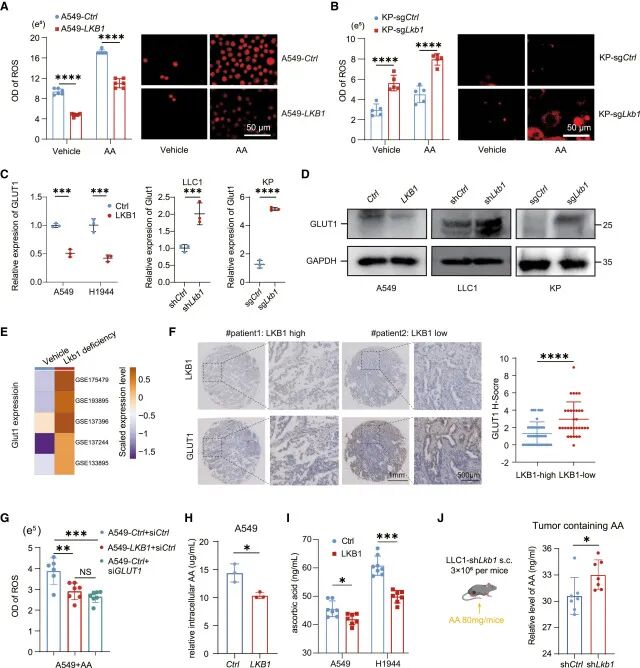 LKB1 deletion in non-small cell lung cancer enhances GLUT1-mediated amino acid uptake and exacerbates redox imbalance
Even more surprisingly, this intense cell death is not “silent” but rather a highly immunogenic “death show.” Pyroptotic cells release a large number of tumor antigens and damage-associated molecular patterns (DAMPs), strongly activating CD103+ dendritic cells (DCs).
These “immune sentinels” mature after taking up antigens and migrate to lymph nodes, presenting tumor information to T cells, particularly promoting the expansion of Tpex cells. Tpex cells are the “main force” in PD-1 immunotherapy; they possess self-renewal capabilities and can differentiate into effector T cells that continuously kill tumors. The emergence of Tpex in the originally “barren” LKB1-deficient tumor microenvironment signifies that the “cold tumor” is being “heated up.”
Researchers confirmed that if key DC subpopulations (Batf3−/− mice) are knocked out in mouse models, or if the pyroptosis execution protein GSDME is knocked out, the efficacy of vitamin C combined with immunotherapy will completely disappear, fully demonstrating the dependence and specificity of this pathway.
03
Currently, high-dose intravenous vitamin C has been tested in clinical trials for various cancers with good safety profiles. This study provides a highly promising combination therapy strategy for LKB1-deficient non-small cell lung cancer: high-dose vitamin C + anti-PD-1 antibody.
Researchers point out that tumors with LKB1 deletion are “self-destructive” due to high GLUT1 expression, making them ideal targets for vitamin C. In the future, by detecting tumor GLUT1 or LKB1 status, it may be possible to screen for patient populations most likely to benefit from this treatment.
Vitamin C, a molecule once misunderstood as a “panacea,” is returning to the anti-cancer battlefield in a completely new way. It is no longer just a vague concept of “boosting immunity” but serves as a precise “metabolic key” that opens the door to the immune silence of “cold tumors.” For those patients with LKB1-deficient lung cancer, who were previously deemed ineffective for immunotherapy, this may be a new light illuminating the path ahead.
References
Sun, Xiangyu, et al. “High-dose ascorbic acid selectively induces pyroptosis in LKB1-deficient lung cancer and sensitizes immunotherapy.” Cell Reports Medicine (2025).