1. Introduction
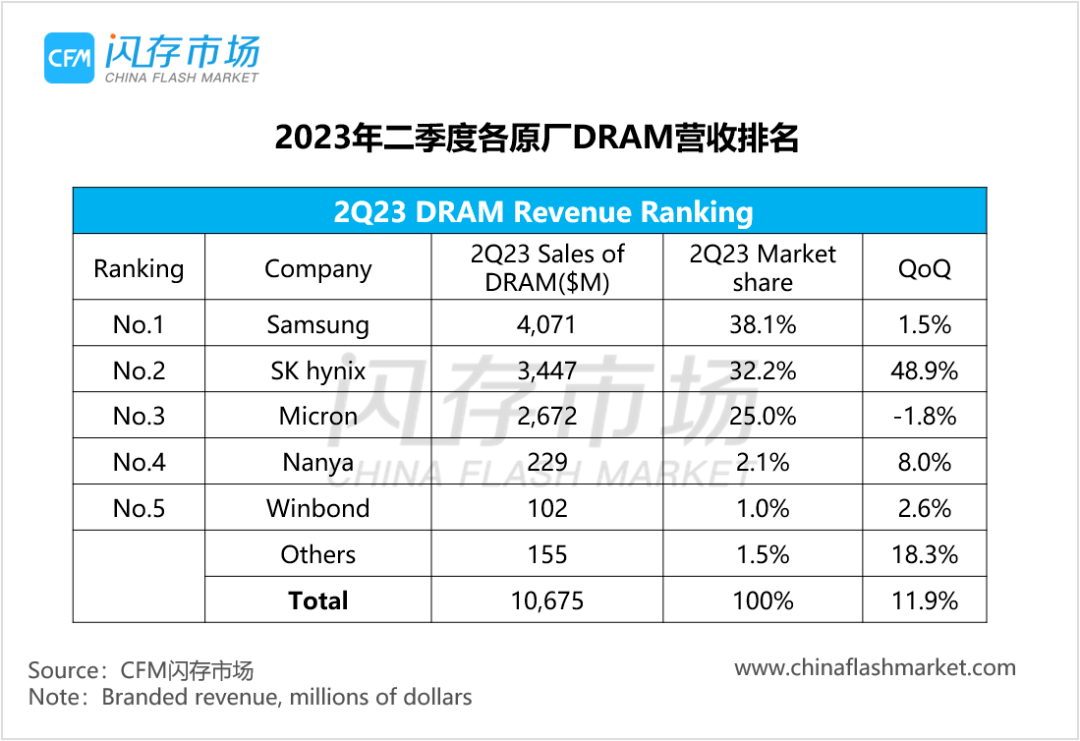
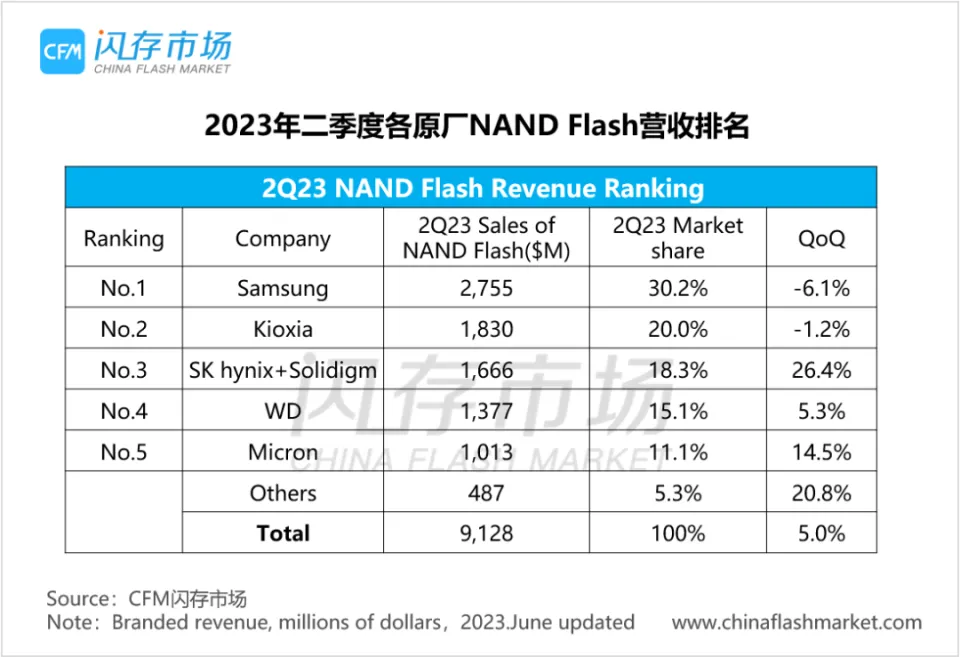
SK Hynix, as one of the major manufacturers in the storage field, is one of the few manufacturers that can fully adopt its own complete material solutions. As early as 2012, SK Hynix acquired the SSD controller manufacturer LAMD, which gave it the capability to design controllers independently; at the same time, SK Hynix has been engaged in the DRAM and NAND fields for many years, allowing it to occupy a certain market share in the industry. In the second quarter of 2023, its DRAM revenue ranked second, with a market share of 32.2%; NAND Flash revenue ranked third, with a market share of 18.3%.
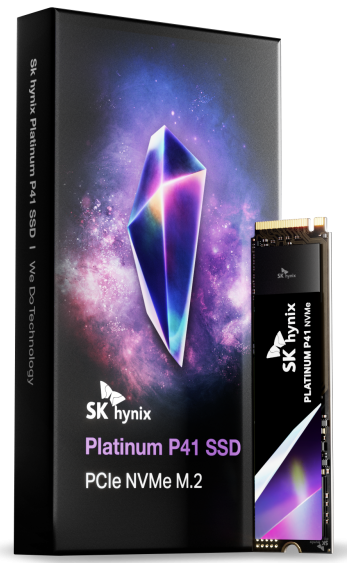
SK Hynix’s previous generation consumer flagship product, the Gold P31, has received a lot of praise from players and consumers abroad in recent years, earning a good reputation. The corresponding OEM version, the PC711, has also received positive feedback among major PC manufacturers! In March 2022, SK Hynix updated and launched the iterative product of the Gold P31 – the Platinum P41, which is SK Hynix’s first consumer-level product supporting PCIe 4.0. Before this consumer-level product was launched, the corresponding OEM version, the PC801, had already been widely distributed in the B2B channel. Taking advantage of SK Hynix’s consumer SSD officially entering the domestic market, let’s take a look at another product – the Platinum P41 2TB. As we approach the PCIe 5.0 era, how does the PCIe 4.0 Platinum P41 2TB perform?
2. Unboxing & Appearance
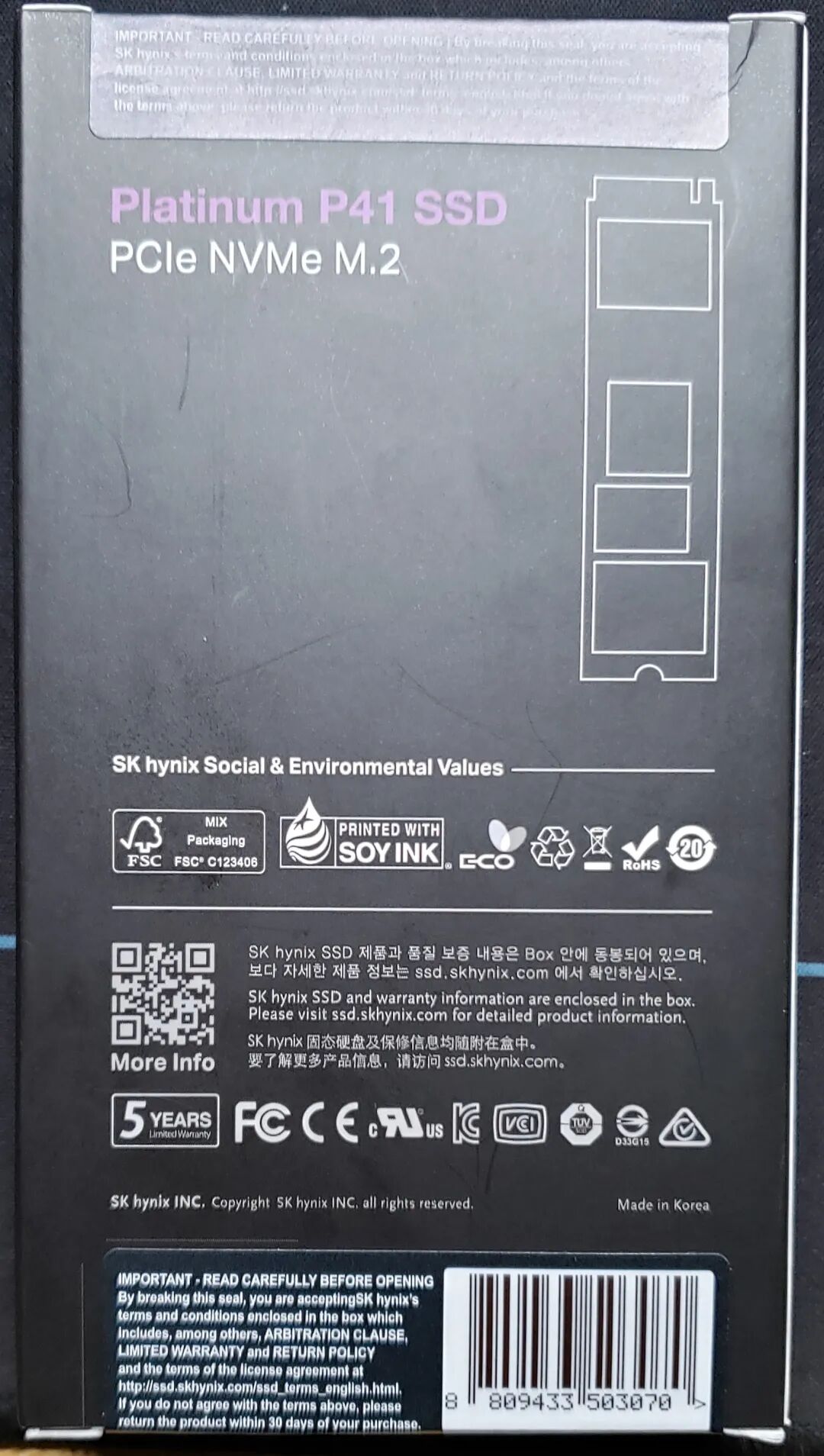
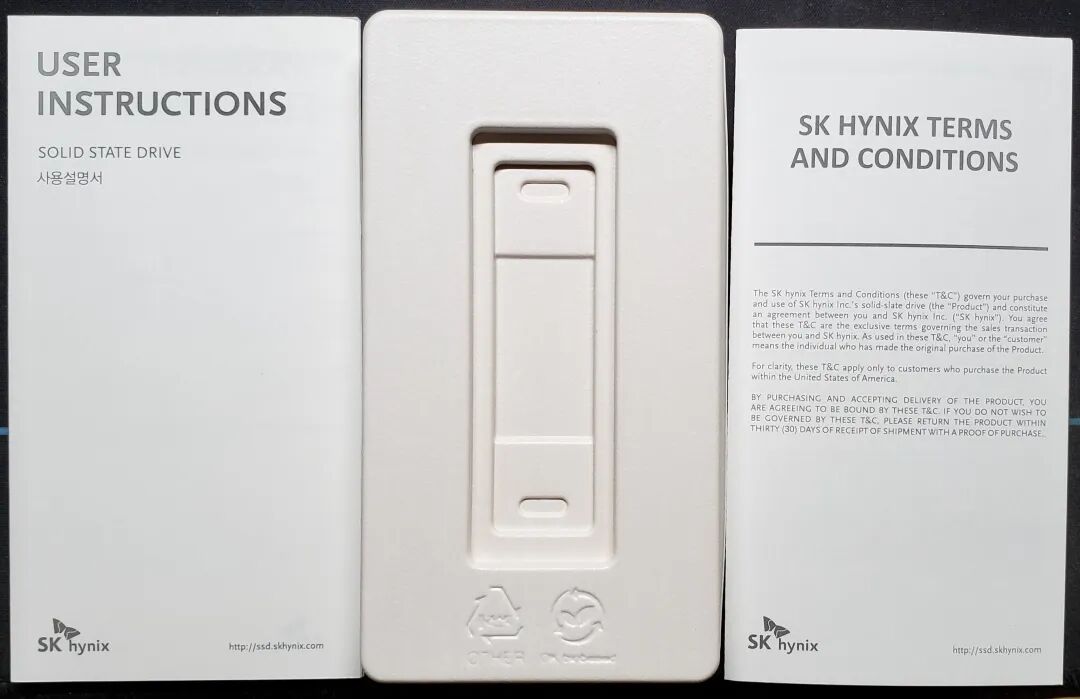
Packaging:
Controller:
DRAM:
Chip:
PCB:
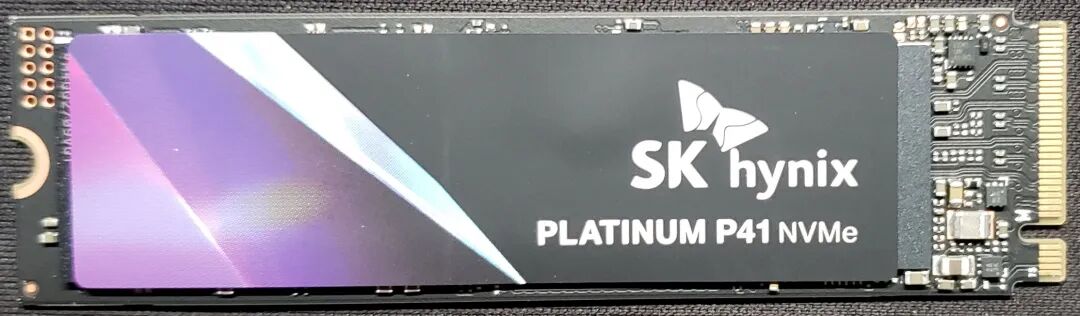
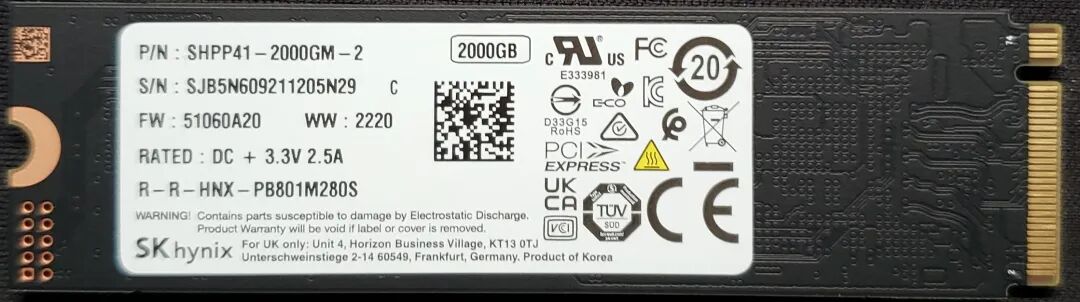
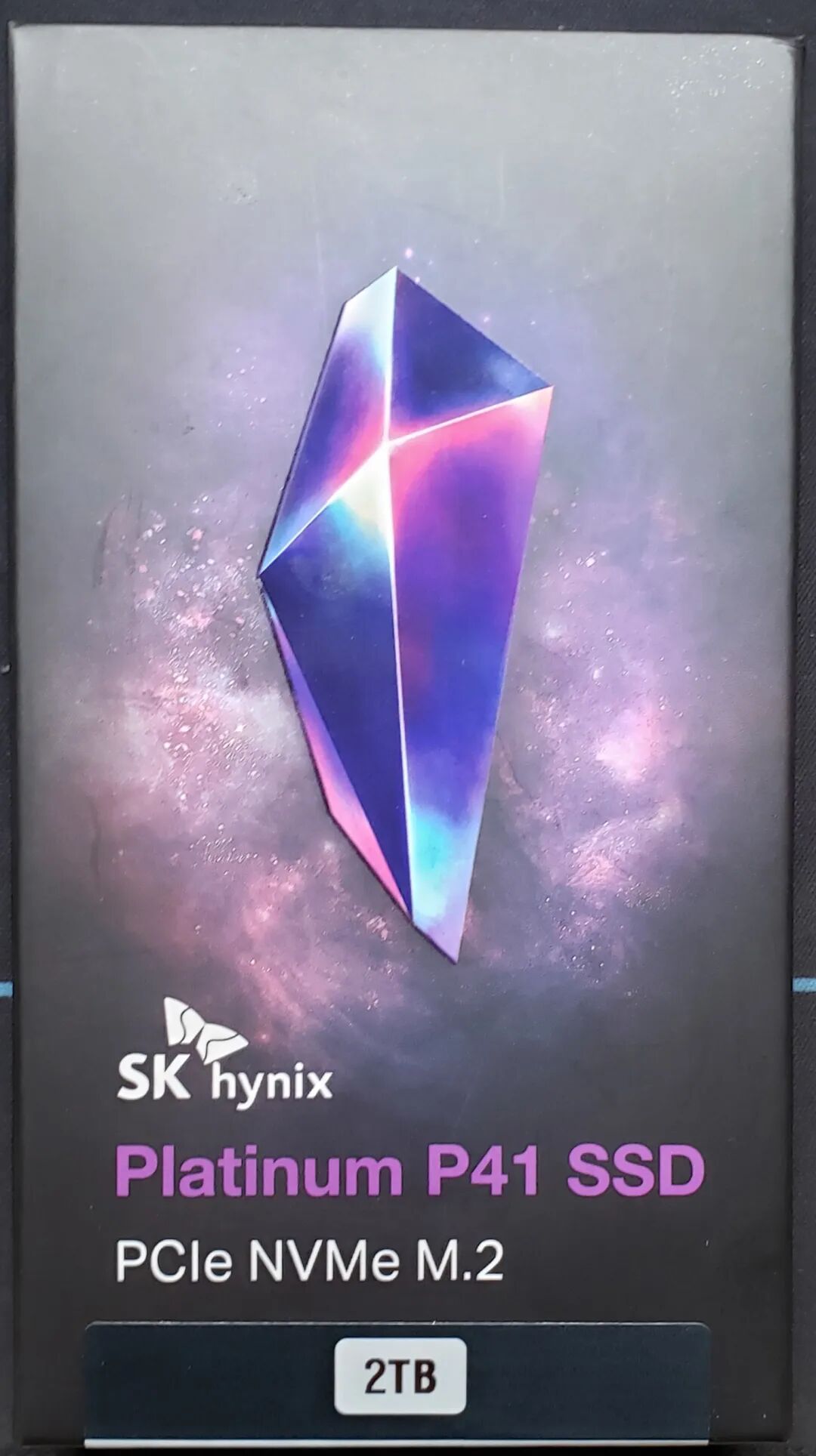
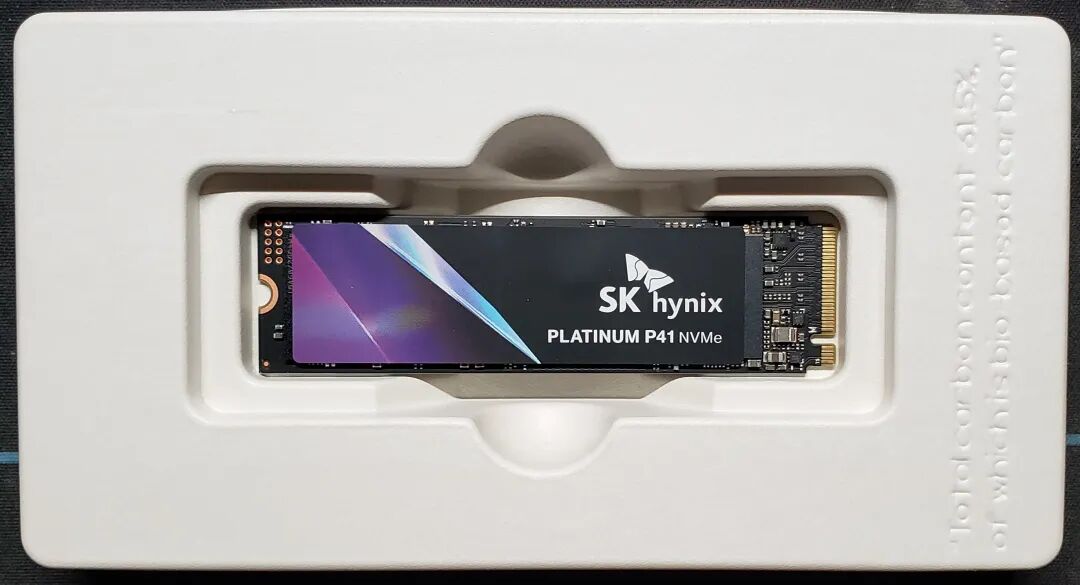
The packaging of the Platinum P41 continues the style of SK Hynix’s previous Gold P31 products, and also maintains the environmentally friendly material inner box of the Gold P31, which is practical!
The PCB adopts a single-sided dual-placed NAND chip layout, with the controller, DRAM, and NAND all produced by SK Hynix.
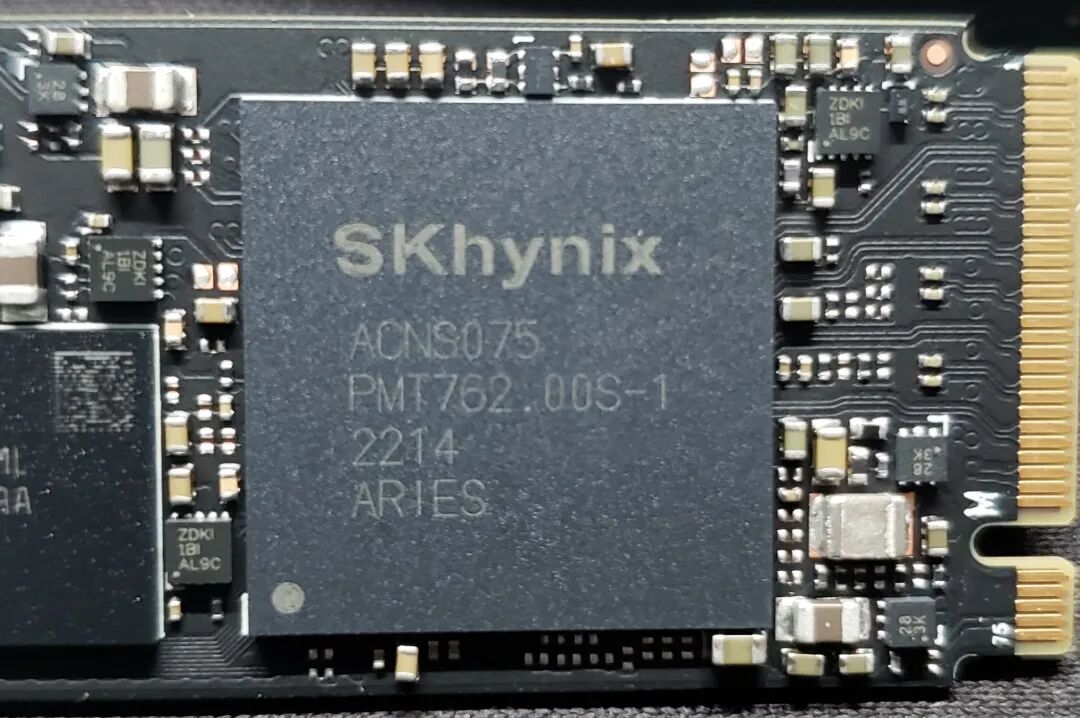
The controller is codenamed ARIES, with the model number ACNS8075-PMT762.00S-1, produced in week 14 of 2022. The controller consists of three ARM Cortex-R8 cores and one ARM Cortex-M7 core, forming a quad-core controller, and uses TSMC’s 12nm process, supporting a 1600MT/s chip IO rate with 8 channels.
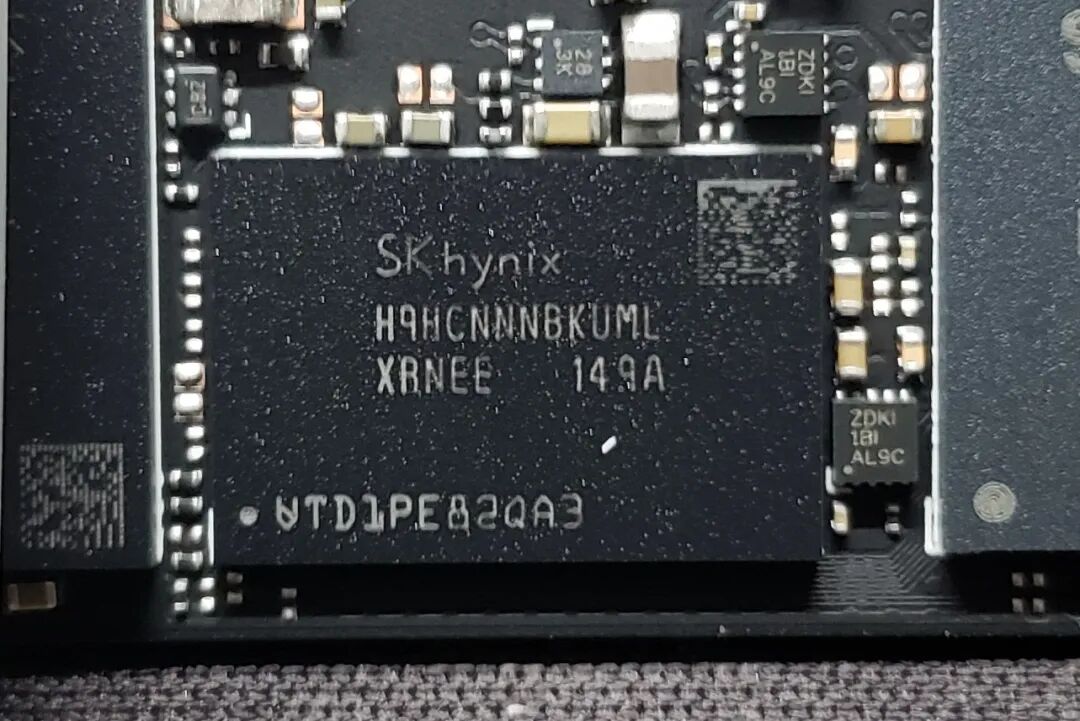
The DRAM chip model number is H9HCNNNBKUMLXR-NEE, which is an LPDDR4 DDR4-4266 chip with a capacity of 2048MB.
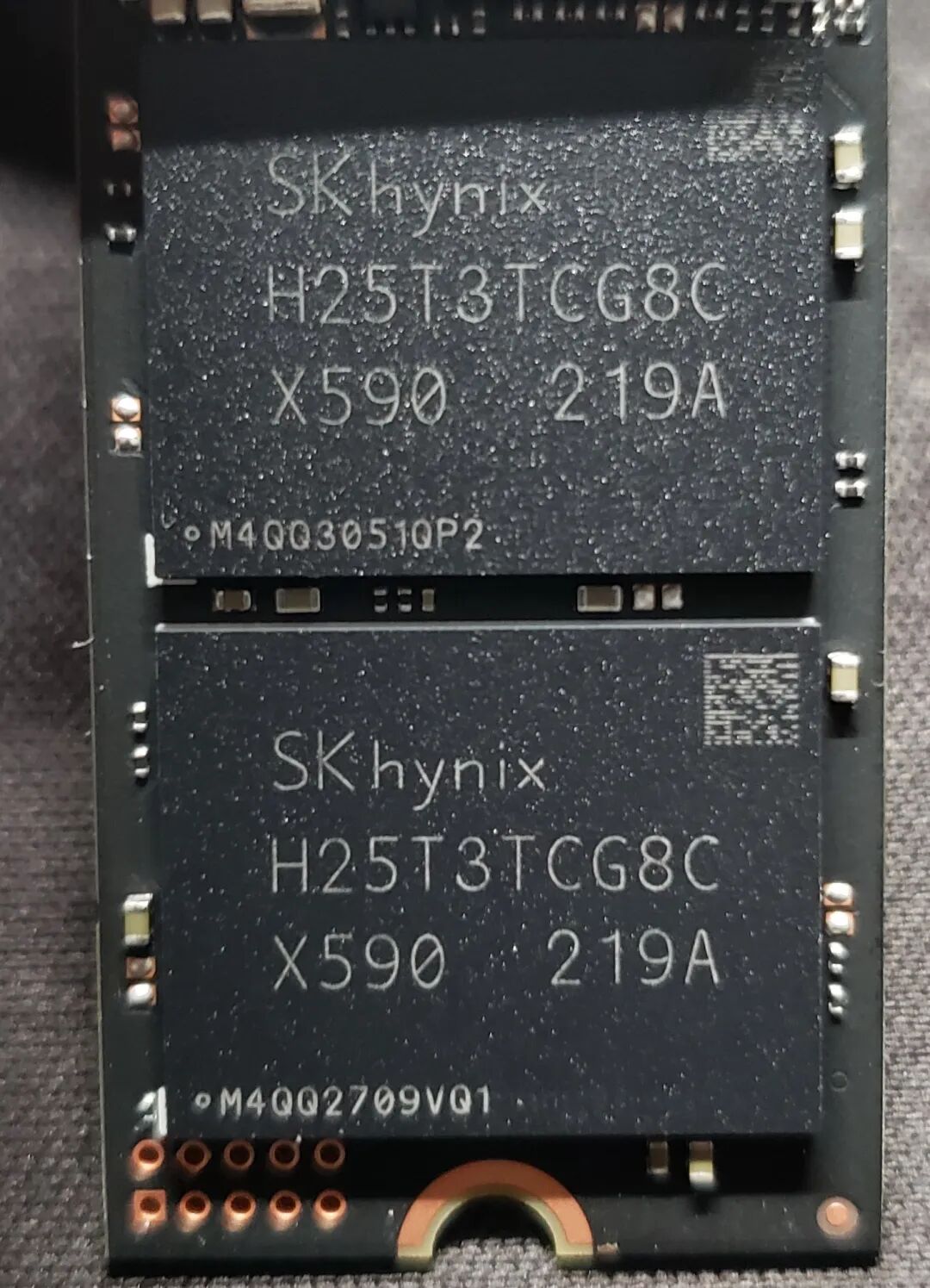
The NAND model number is H25T3TCG8CX590, which is SK Hynix’s SK 4D V7 176Layer chip, with a single chip capacity of 1TB, composed of 512Gib wafers, totaling 16 dies; it is known that the direct write speed of the 512Gib 176Layer die is 168MB/s, and the chip’s IO speed is 1600MT/s, perfectly matching the maximum IO rate of the controller.
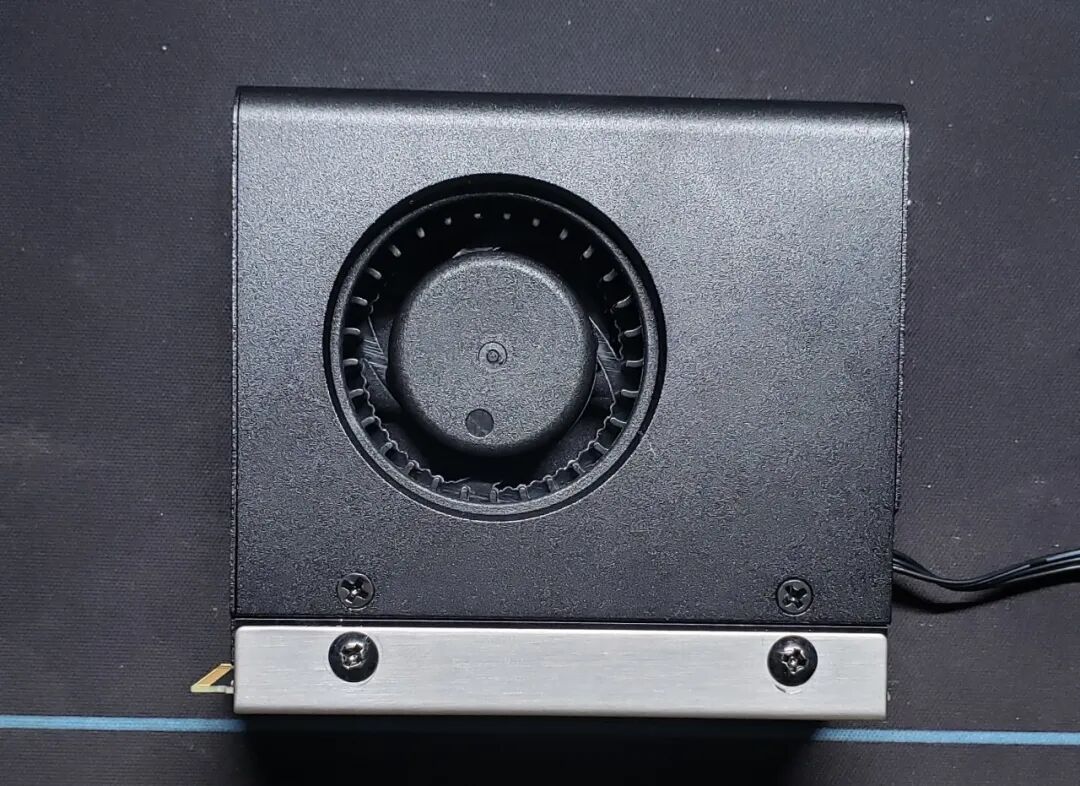
Due to the aggressive performance release of the Platinum P41 2TB, to avoid overheating, I purchased a Jonsbo M.2-10 active cooler with a fan at my own expense.
3. Basic Information
As usual, let’s first check the CDI after receiving the device.
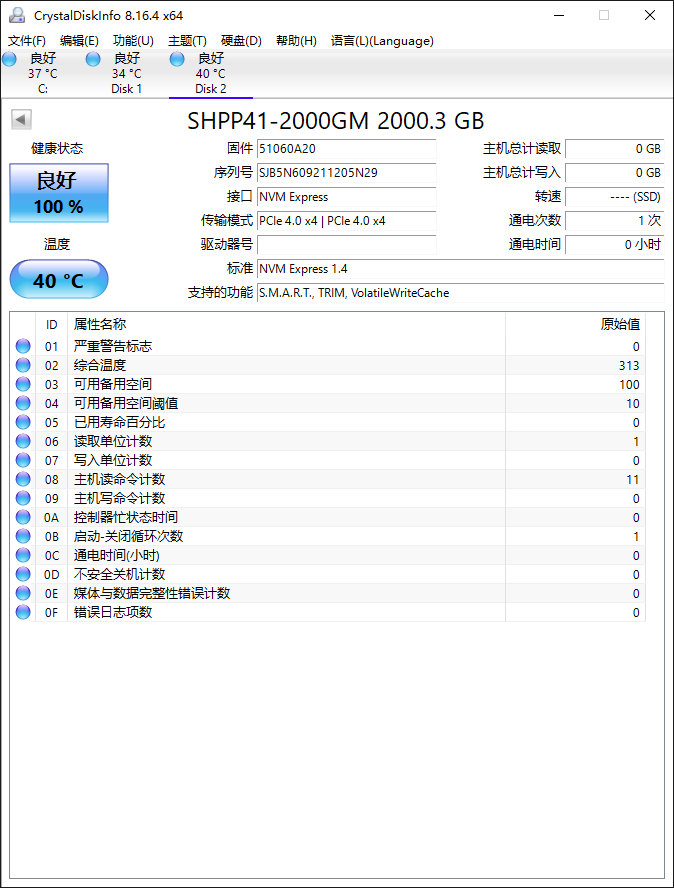
The smart information captured by CDI is quite limited, so I used smartmontools to further capture the smart information of the controller. As shown below:
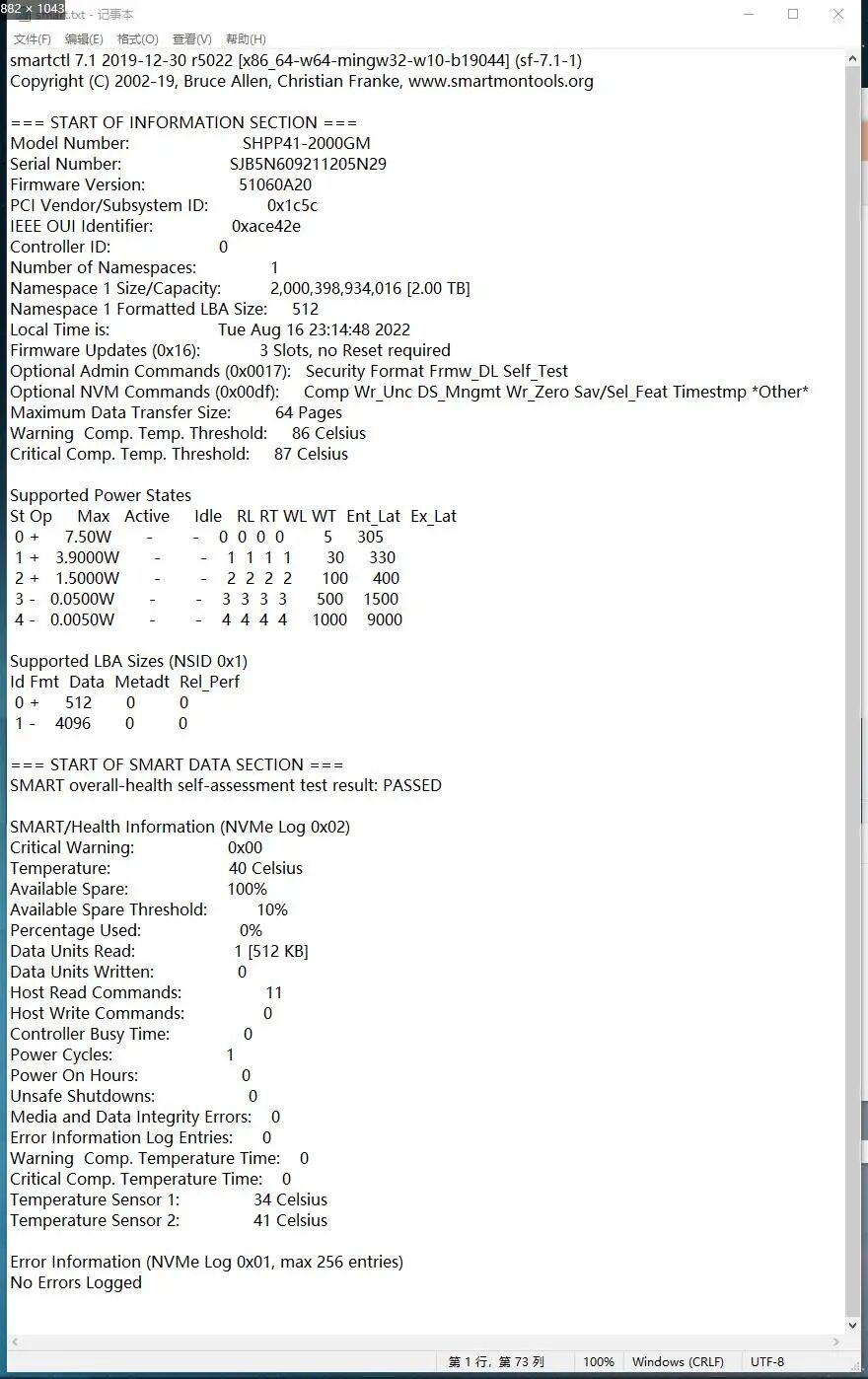
From the Supported Power States captured by smartmontools, it can be seen that the maximum power consumption of the SK Hynix Platinum P41 controller ARIES is 7.50W, which is generally around this value for high-performance PCIe 4.0 drives with DRAM cache.
According to the information captured by smartmontools, there are three actual temperature sensors. I speculate that Temperature corresponds to the controller’s temperature, Temperature Sensor 1 corresponds to the DRAM’s temperature, and Temperature Sensor 2 corresponds to the chip’s temperature. Comparing the temperatures captured by smartmontools with those from CDI, it can be found that the CDI temperature corresponds to the controller’s temperature.
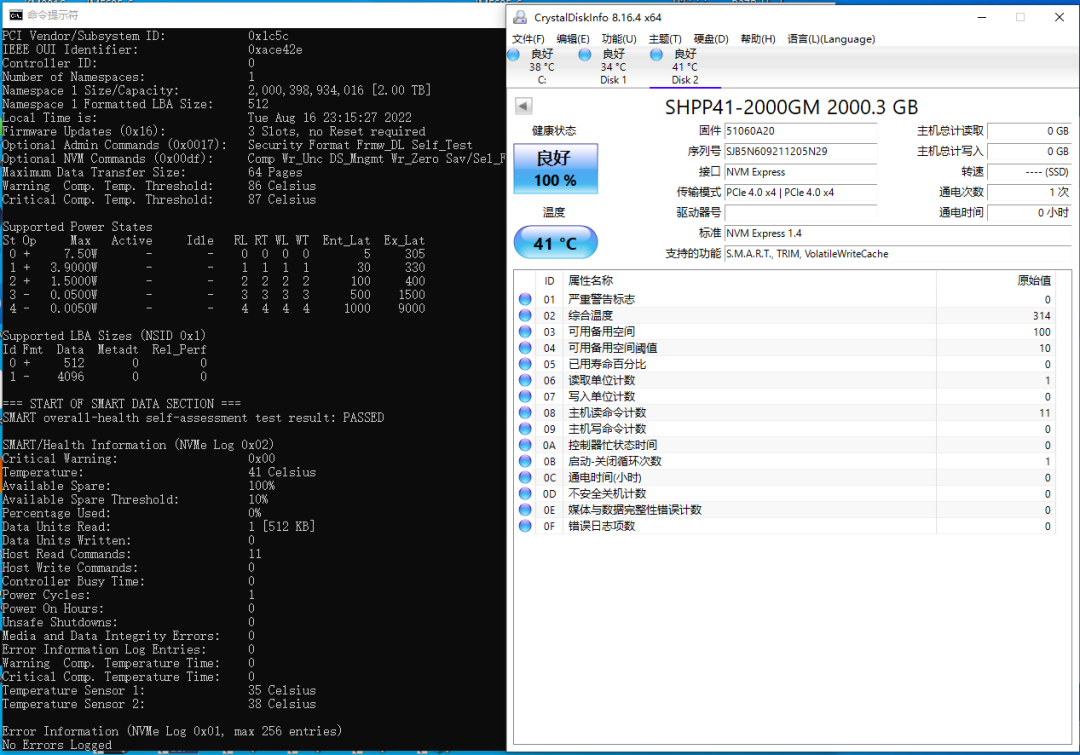
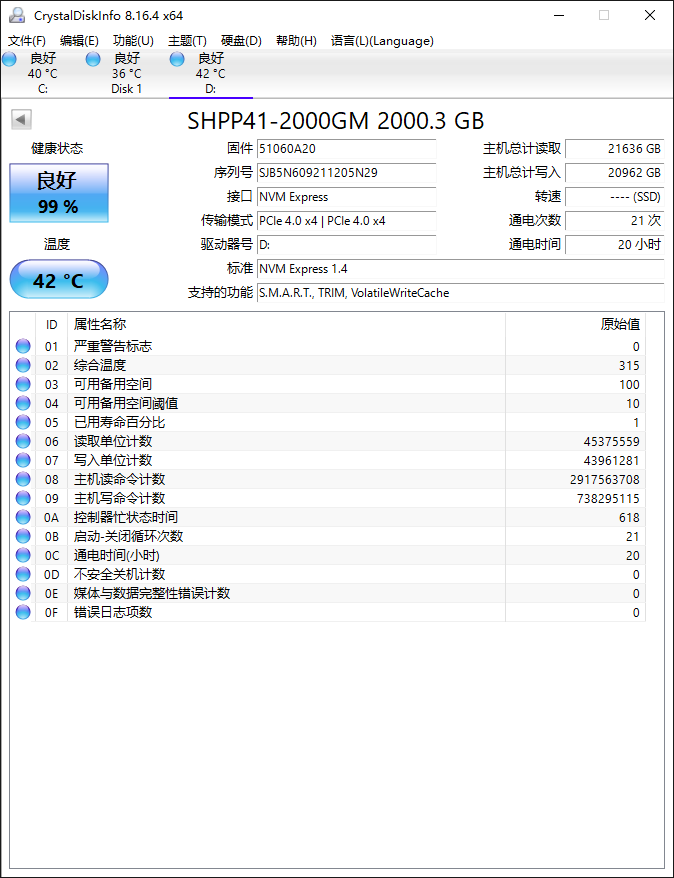
CDI screenshot during testing:
CDI screenshot after testing:
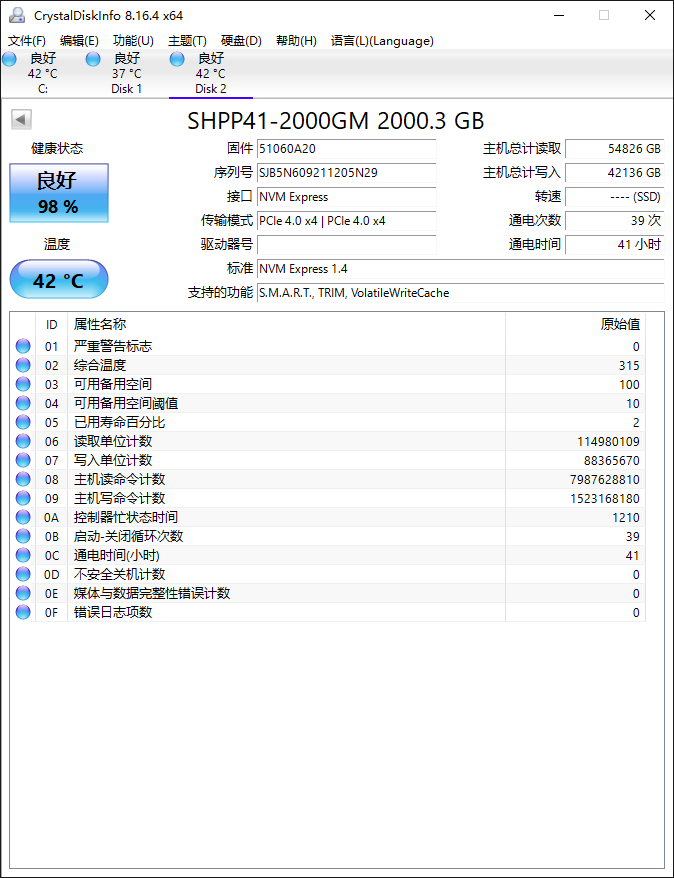
At the end of the test, a total of about 42.1TB of data was written, with a health drop of 2%; during this period, about 21TB of data was written, with a health drop of 1%. Assuming a health drop of 3% for tightening parameters, it is roughly estimated that when the health reaches zero, the write volume is about 1400TB.
4. Test Platform and Settings
Processor: AMD Ryzen 3700X @ 4.4GHz
Motherboard: Micro Star X570 Gaming Plus (BIOS Version: 7C37vAE)
System: Windows 10 Professional 21H2 / Centos 8.4.2105
Heatsink: Jonsbo M.2-10 Radiator
IO Interface: M2_1 slot (From AMD® Processor)
With Heatsink: Added Jonsbo’s heatsink on top of the original.
Since the test was conducted on an AMD platform, the relevant test data may be lower.
5. Basic Performance Testing
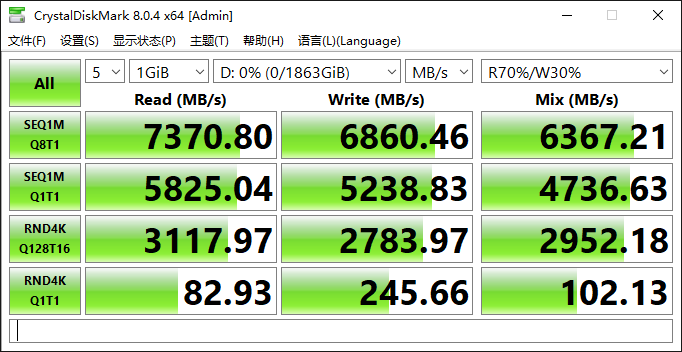
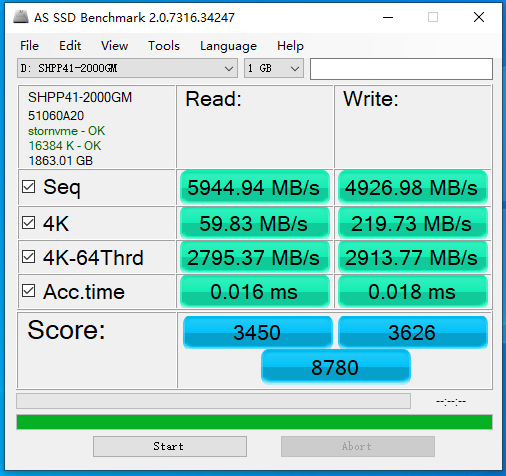
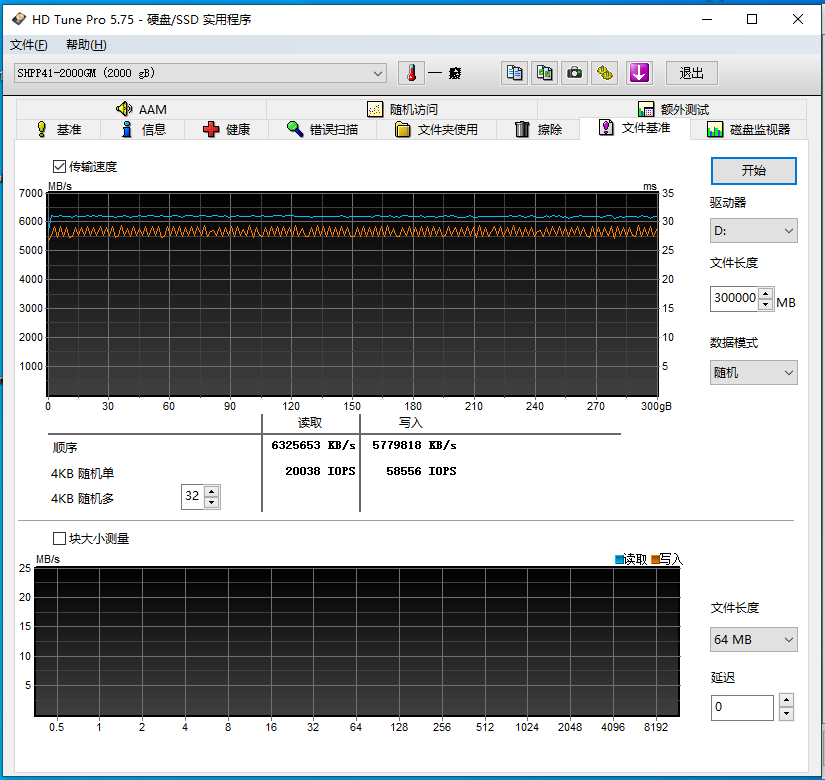
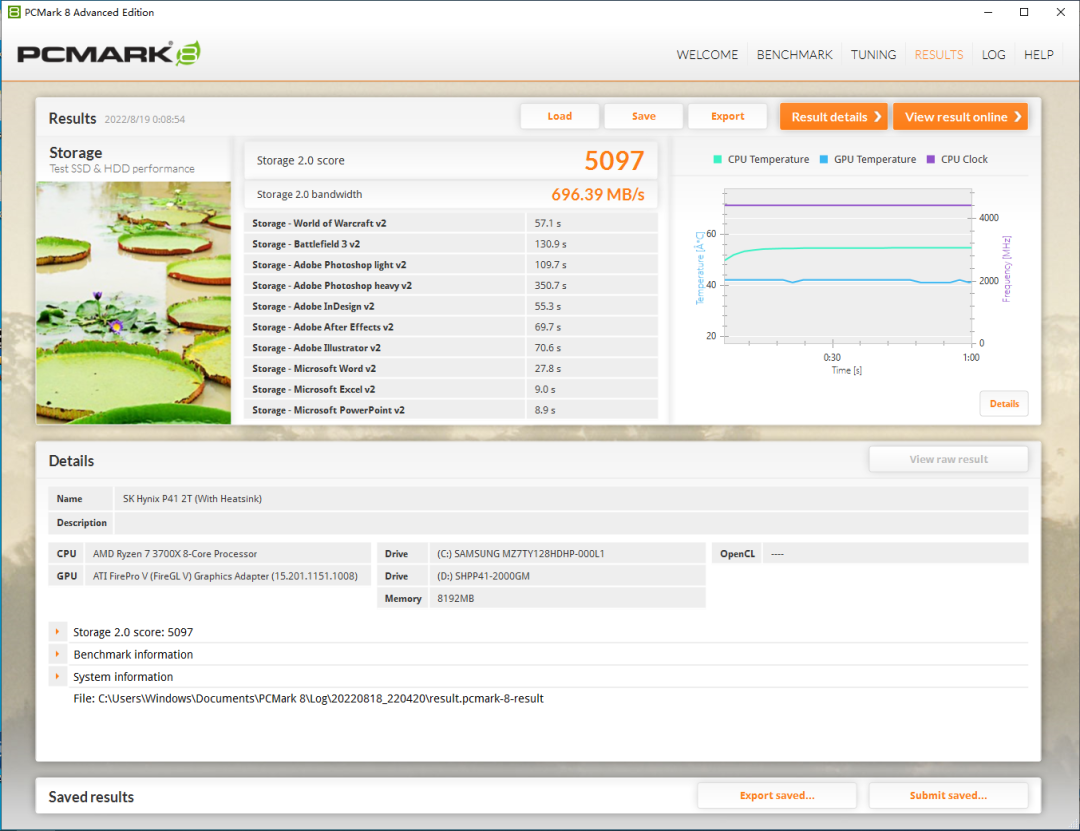
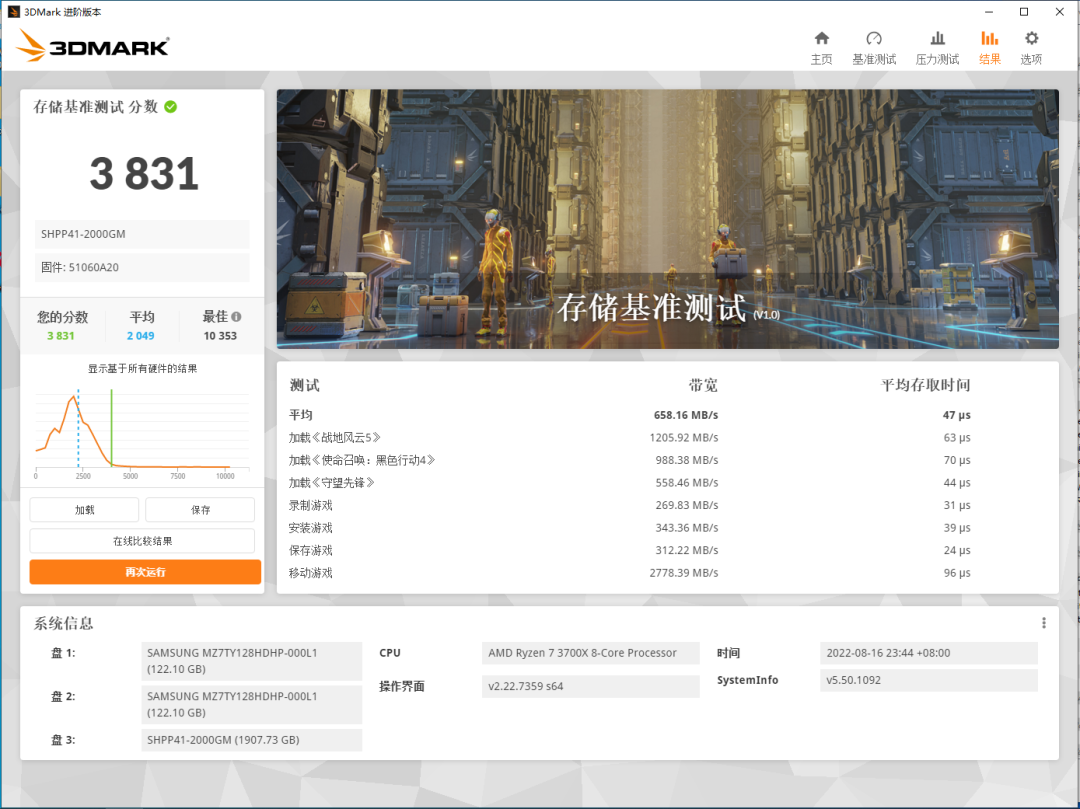
The Platinum P41 2T was tested under Windows using CDM/ASS/HD Tune/PCMark 8/3D Mark, for reference only.
Thanks to the 512KB byte payload of the AMD X570 platform, the Platinum P41 achieved nearly 7400MB/s in sequential read performance under CDM, with sequential write performance nearing 6900MB/s, exceeding SK Hynix’s official performance specifications for the Platinum P41; the Platinum P41 scored 5097 in the PCMark 8 storage test, with a measured bandwidth of 696.39MB/s, an increase of nearly 110MB/s compared to the previous flagship product, the Gold P31 2TB, with loading times for various items improved by about 0.1 to 0.5 seconds, which is not very noticeable; the Platinum P41 scored 3831 in 3D Mark, with significant improvements in bandwidth and average storage time for various loading items compared to the previous flagship.
In HD Tune, 300GB of data was written to the Platinum P41 2T, and there were still no signs of writing out of cache, indicating that the Platinum P41 2T has a large SLC Cache. Further advanced performance tests will further verify the size of the SLC Cache.
6. Advanced Performance Verification
To further test the actual performance of this drive, a continuous and comprehensive performance test was conducted in a Centos environment, which also serves to benchmark the drive’s extreme performance.
(1) Full Disk Read/Write
First, a full disk read/write project:
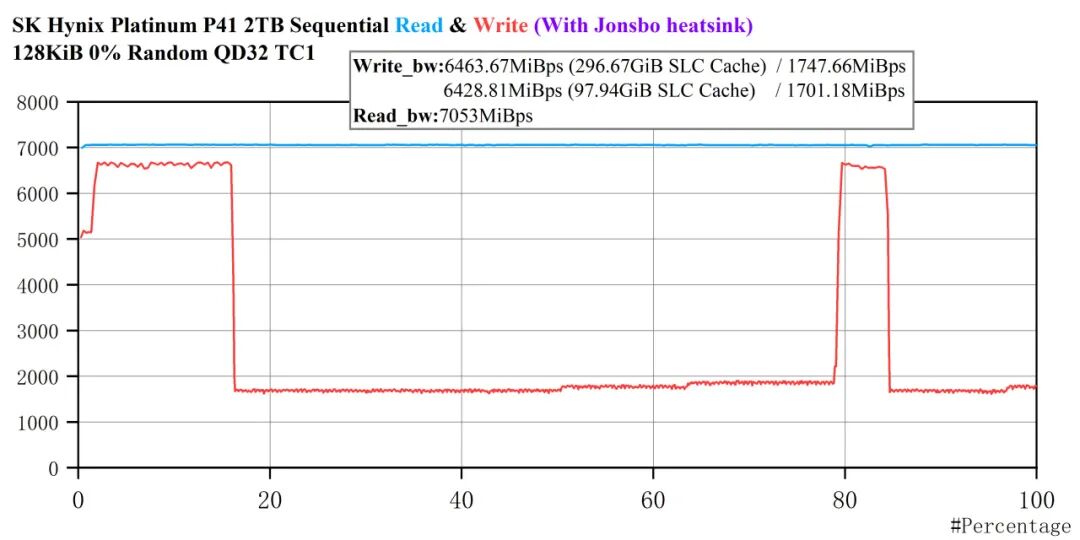
Before the full disk write, a secure erase (Security Erase) was performed on the P41, so it did not initially reach the maximum write speed. After writing about 25GiB, it reached a normal write speed of 6500 MiB/s. The first segment of the SLC Cache was about 297GiB, accounting for about 16% of the total disk capacity; as the controller performed garbage collection (GC) in the background, the out-of-cache write speed of the Platinum P41 was around 1750MiB/s, and the write speed slightly increased in the latter segment; this segment of out-of-cache writing did not reflect the true direct write speed of the TLC chips, and further tests will reveal the actual out-of-cache write situation of the Platinum P41 2T. When the full disk write reached 80%, about 98GiB of SLC Cache was released, with the write speed in the SLC Cache spiking to 6500MiB/s, before entering out-of-cache again, with an out-of-cache speed of about 1700MiB/s.
The full disk read was relatively stable, maintaining at 7053MiB/s, which is approximately 7400MB/s.
(2) 4KiB Full Disk Random Read/Write (QD1T1)
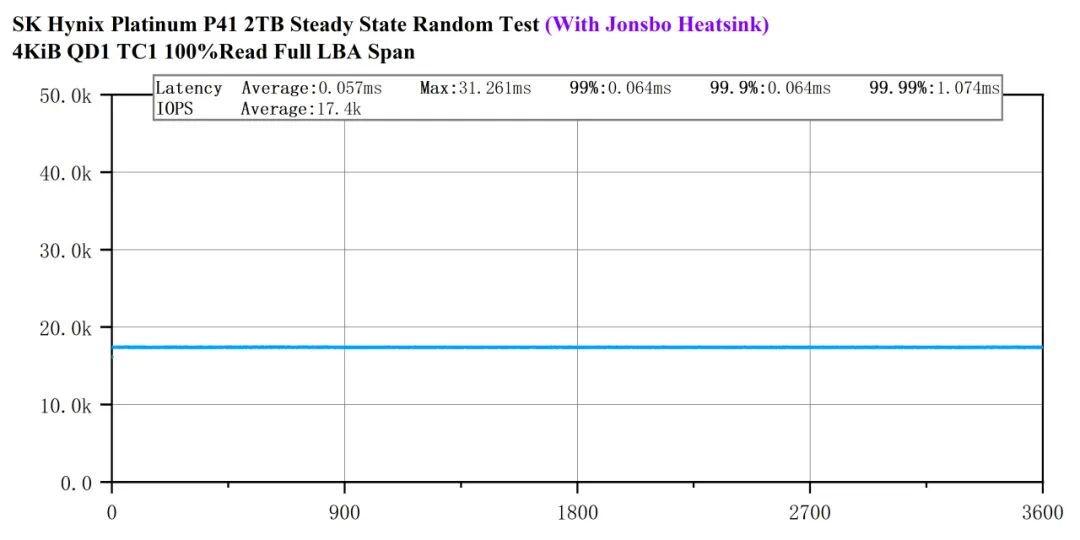
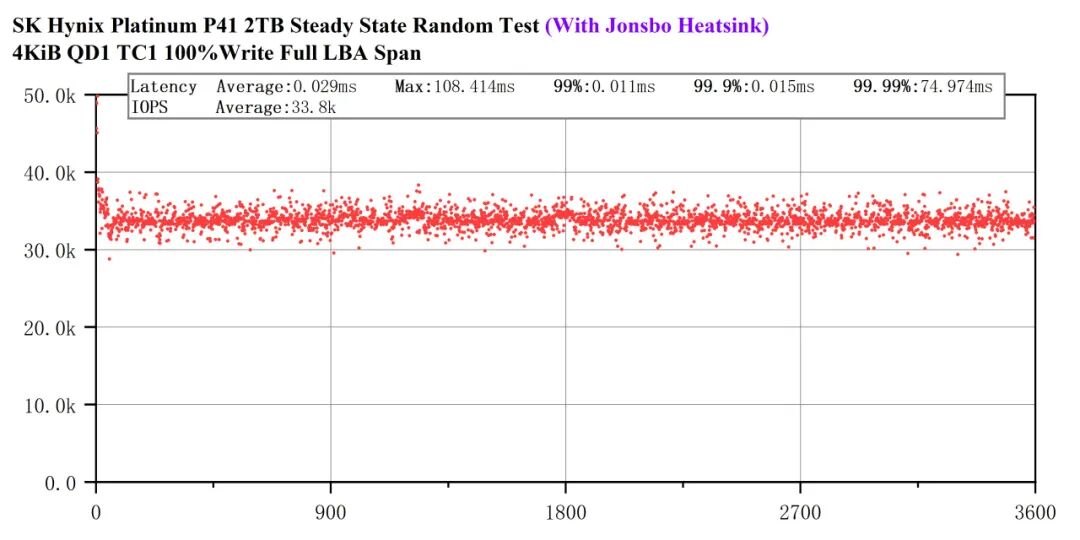
(3) 4KiB Full Disk Random Read/Write (QD32T4)
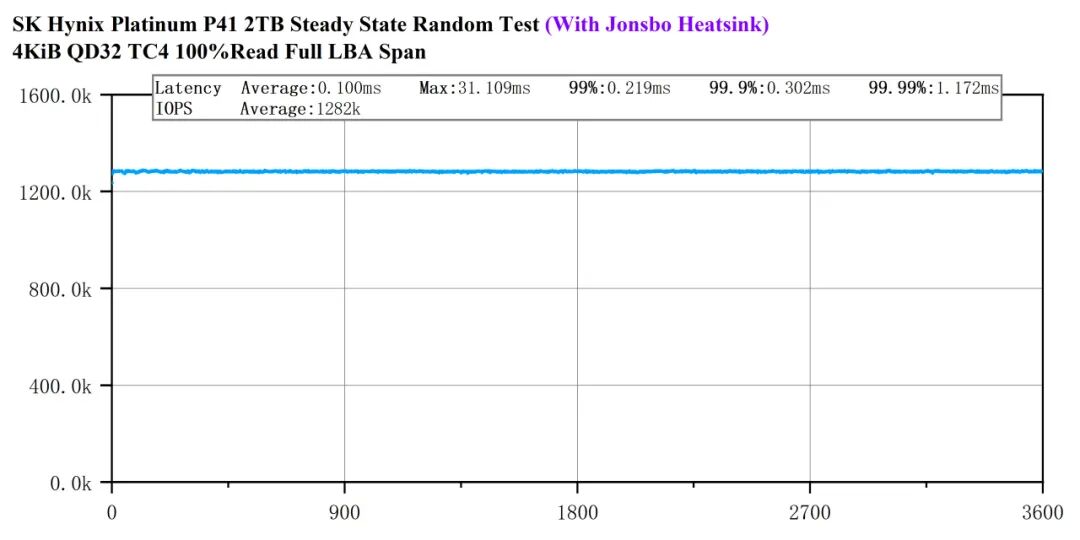
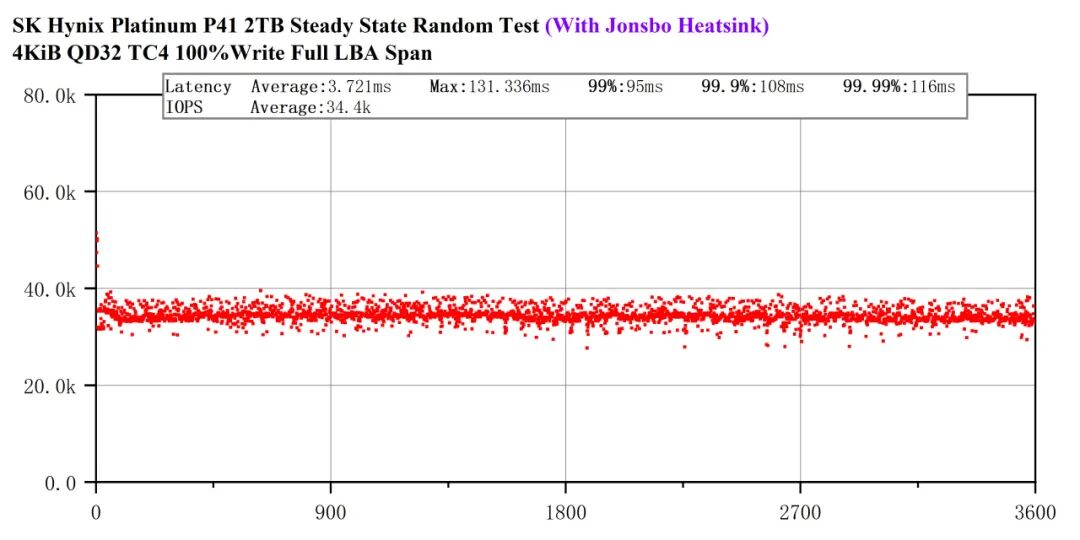
Under QD1T1 conditions, the 4KiB full disk random read consistency was good, and the full disk write also achieved a certain degree of convergence. The random read IOPS reached 17.4K (71.2MB/s), and the random write IOPS was 33.8K (139MB/s), with high maximum latencies for both random read and write, as well as high QOS 99.99% latencies.
Under QD32T4 conditions, the consistency was not much different from QD1T1, with good consistency for 4KiB full disk random reads, and the full disk write also achieved a certain degree of convergence. The random read IOPS reached 1282K (5250MB/s), which is much higher than the RND 4K performance measured in CDM, with good read latency performance, but high maximum read latencies and QOS 99.99% latencies; the random write IOPS was 34.4K (141MB/s), with high maximum write latencies and QOS (99%/99.9%/99.99%) latencies.
(4) 4KiB Full Disk Random 7 Read 3 Write (QD32T4)
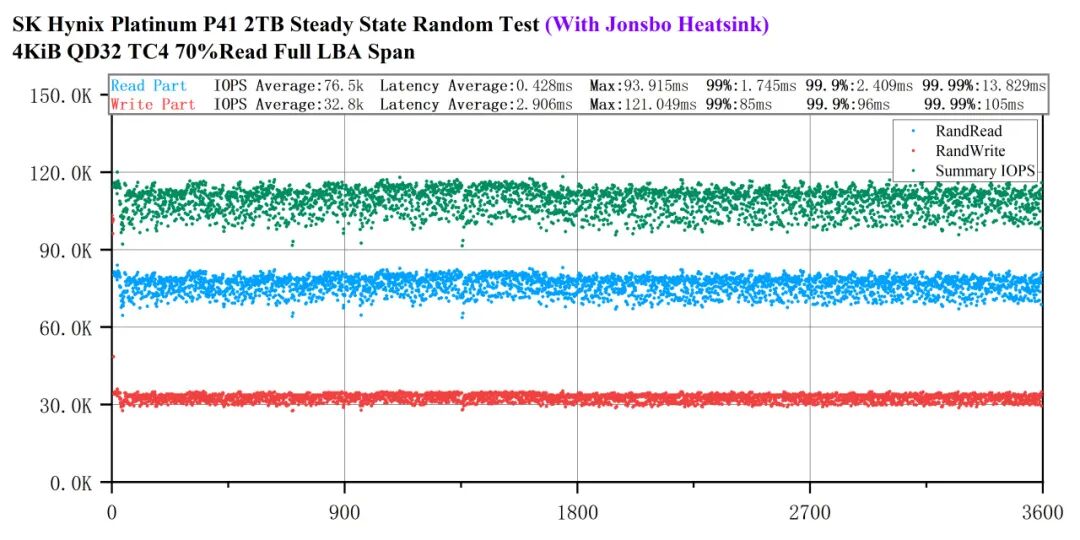
In the 4KiB full disk random 7 read 3 write, although it did not achieve stable and effective convergence, the IOPS discrete points were relatively concentrated. The random read IOPS was 76.5K (313MB/s), the random write IOPS was 32.8K (134MB/s), and the total IOPS was 109.3K (447MB/s). The average latency for random reads, QOS (99%/99.9%/99.9%) latencies, and average write latencies performed well, but the QOS (99.99%) for random reads, maximum latencies for random writes, and QOS (99%/99.9%/99.9%/99.99%) latencies were high.
(5) SLC Cache Write Test
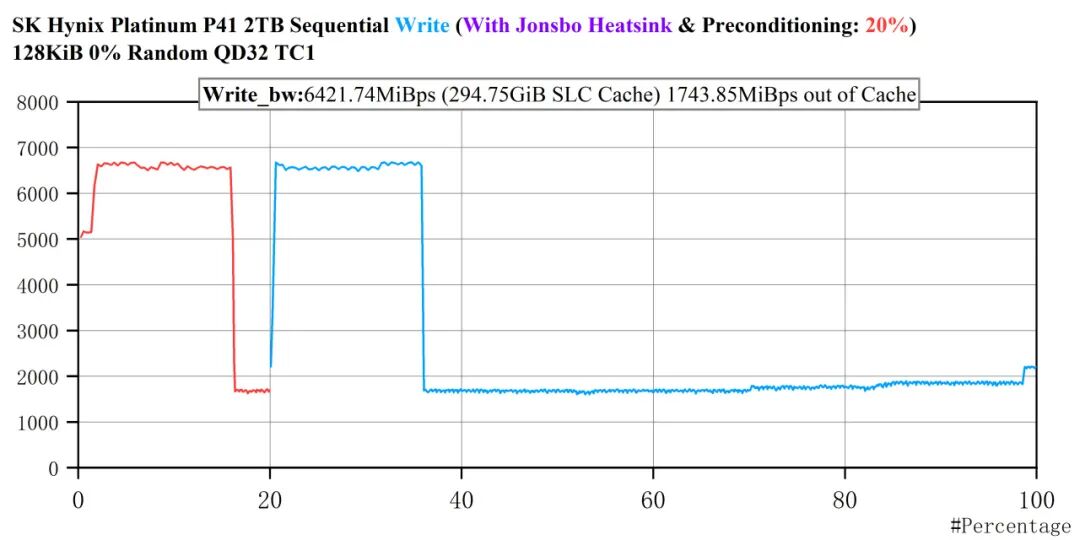
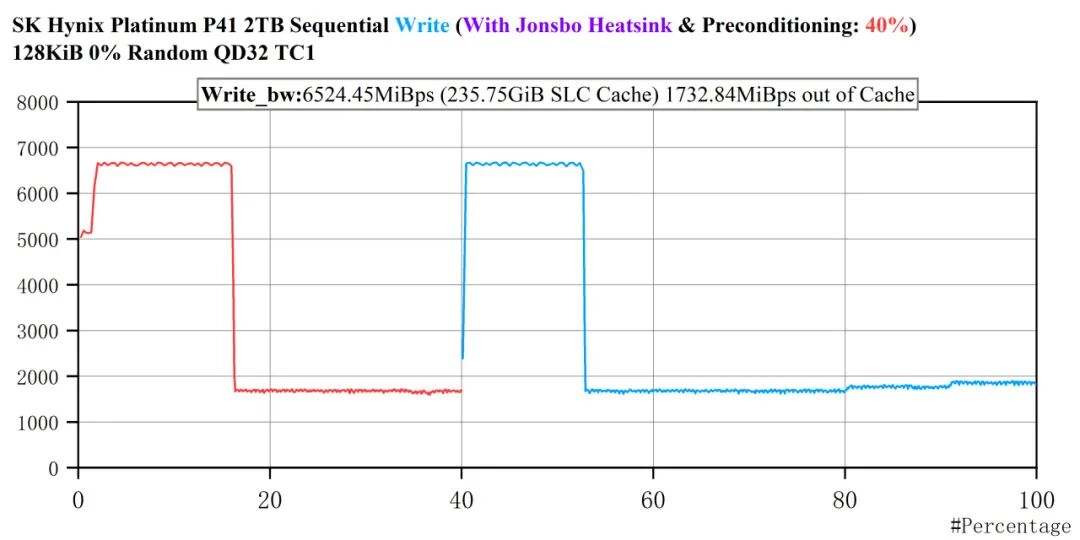
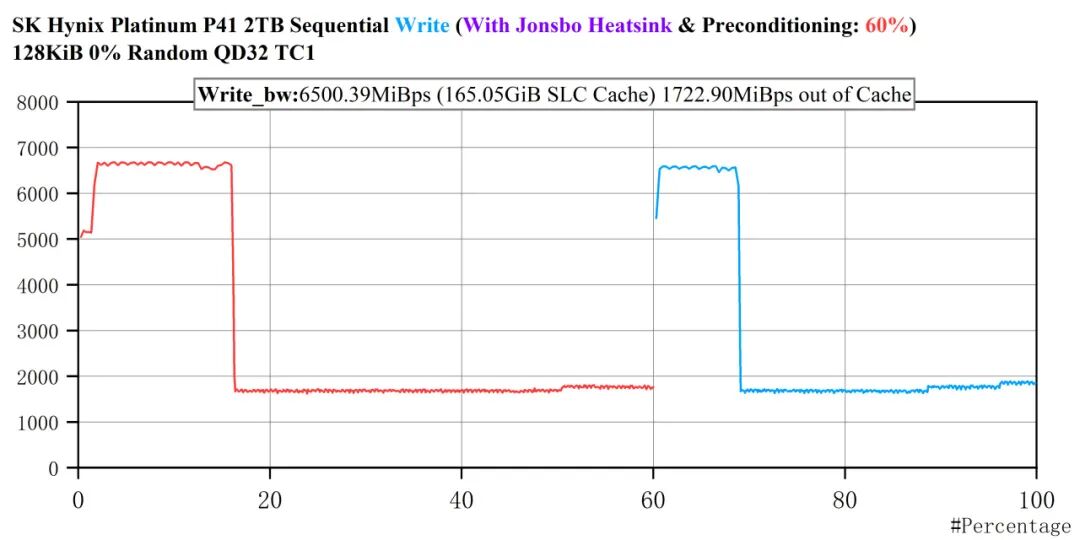
In this phase, the drive was pre-filled to 20%/40%/60%/80%, left to sit for 15 minutes to allow the controller to perform GC (Garbage Collection) operations, and then sequential writes were performed on the remaining space to test its in-cache and out-of-cache sequential write conditions.
① Pre-fill 20%
② Pre-fill 40%
③ Pre-fill 60%
④ Pre-fill 80%
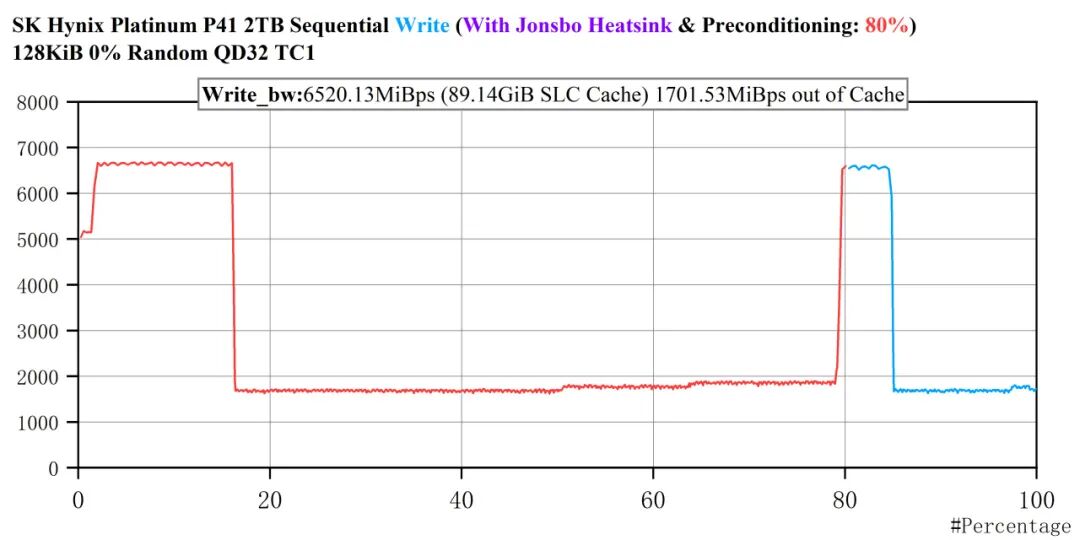
In the SLC Cache testing phase, the sizes of the SLC Cache were 295GiB/236GiB/165GiB/89GiB for pre-fills of 20%/40%/60%/80%, with out-of-cache speeds remaining at 1700MiB/s. As writing progressed, the write speeds continued to increase. At this time, the out-of-cache write speeds did not reach the direct write speeds of the TLC chips, but rather the controller was performing garbage collection (GC) in the background while writing, once again demonstrating the true capabilities of the Samsung 980 Pro.
(6) Steady State Sequential Read/Write
In this phase, the SK Hynix Platinum P41 2T was subjected to a full disk sequential write followed by a sequential write test for 1800s and a sequential read test for 1800s.
The results are as follows:
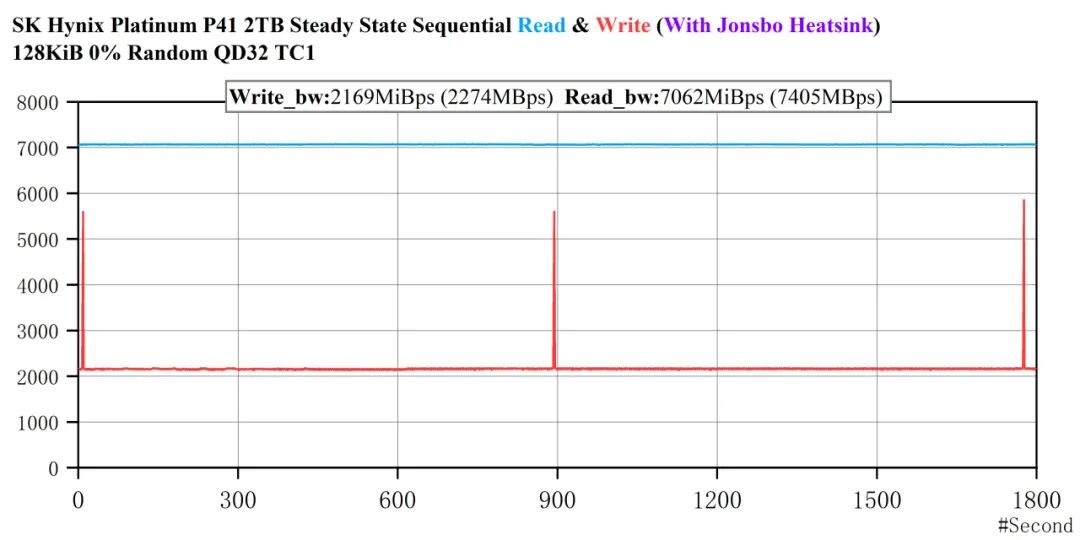
During the long-term steady state sequential read/write, the read speed stabilized at around 7000MiB/s, while the write speed fluctuated but generally remained stable at around 2200MiB/s, which is the true direct write speed of the Platinum P41 2T’s TLC chips. According to relevant information, the direct write speed of the P41 OEM version PC801 1T’s TLC chips is also around 2200MB/s, thus allowing for a judgment on the materials used in the Platinum P41 2T: the wafer uses 512Gb/Die 4D V7 176Layer chips, totaling 32 dies, with each die connected to one CE, totaling 32CE, fully utilizing the bandwidth of the Platinum P41 controller ARIES.
(7) Some temperatures recorded during the test
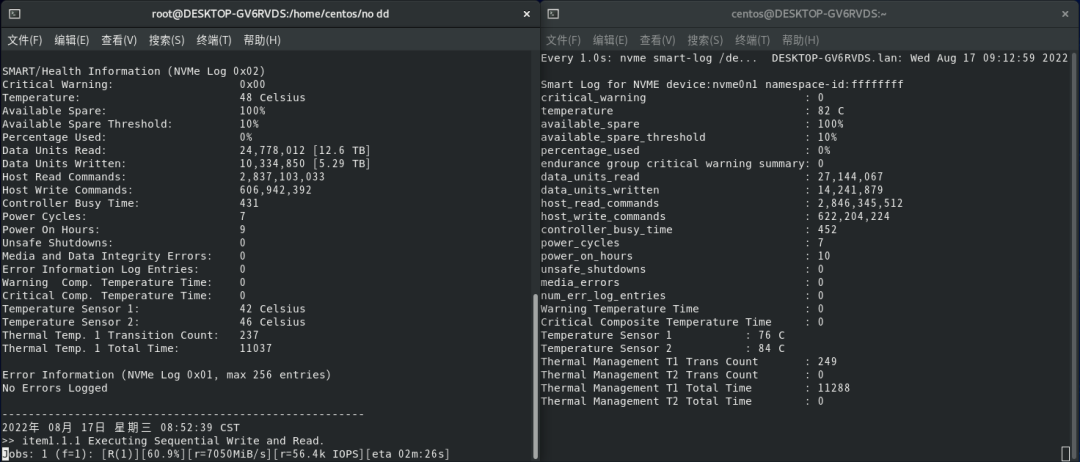
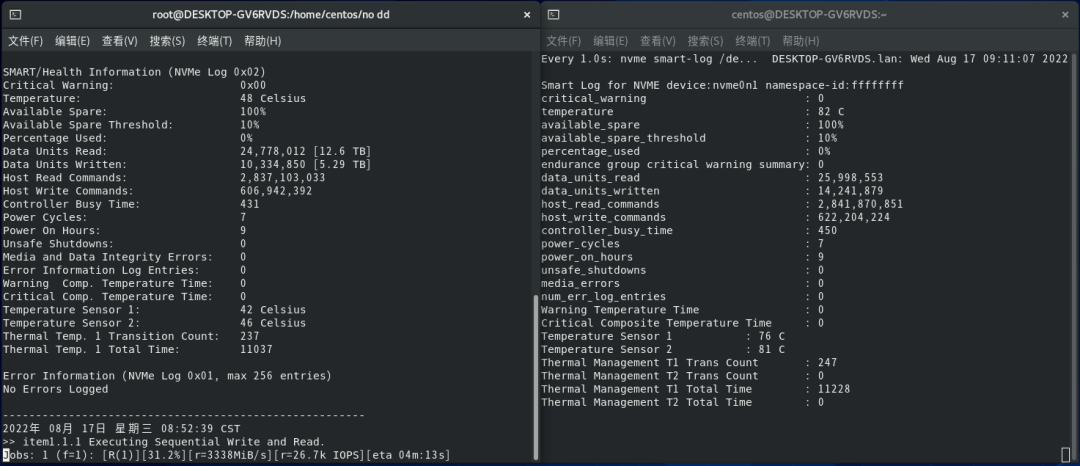
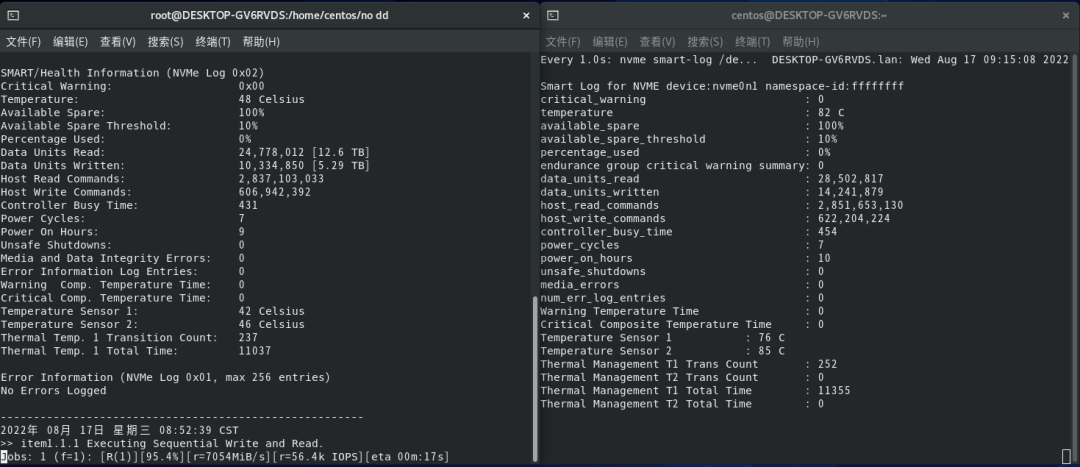
Due to not using the Jonsbo M.2-10 Radiator heatsink directly at the beginning of the test, the Platinum P41 2T experienced multiple slowdowns during the testing process, and I have captured relevant images.
From the images, it can be seen that the Temperature (controller) stabilized at 82°C, Temperature Sensor 1 (DRAM) stabilized at 76°C, while Temperature Sensor 2 (chip) fluctuated between 81-85°C. It is speculated that the chip temperature wall is at 85°C, indicating that the high temperature of the flash memory chips is the main reason for the performance drop of the Platinum P41.
7. Conclusion
1. Due to reasonable hardware pairing and good firmware tuning, the Platinum P41 2T exhibits impressive performance among current PCIe 4.0 consumer SSDs, especially its single-sided PCB design, which provides broad compatibility across different hardware platforms;
2. From the perspective of full disk random read/write, the Platinum P41 mainly focuses on random read performance, which is impressive, but there has been less optimization for random write performance, leading to less than ideal maximum latencies and QOS (99%/99.9%/99.99%) latencies, indicating significant room for optimization;
3. During actual testing, the Platinum P41 2T’s controller and chips generated high heat, with aggressive performance release. It is recommended to implement good cooling measures during daily use to achieve better performance;
4. As SK Hynix enters the domestic consumer market, the only authorized agent in the country is the SK Hynix Storage JD self-operated store. If there is a need in the near future, please purchase related products from legitimate channels!