Drones will become the best tool for the development of urban three-dimensional space.
01
What are the classifications of drones?

1. Multirotor Drones
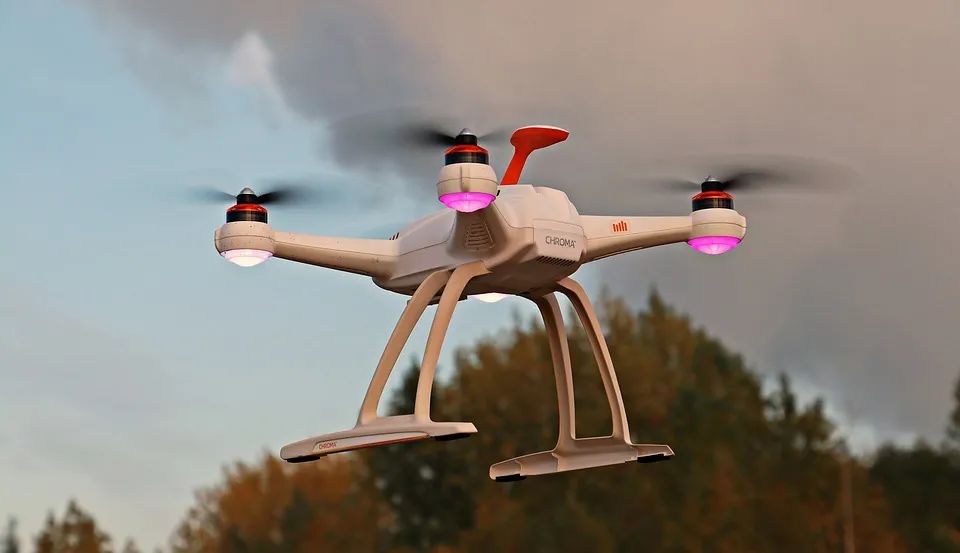
Multirotor drones refer to drones that generate upward lift through propellers, enabling the entire drone to fly.Multirotor drones can be further divided into multirotor drones, helicopters, and autogyros.
The most common type is the multirotor drone, which has three or more rotor axes, typically four-axis, six-axis, or eight-axis. The mechanical structure of multirotor drones is very simple, and the power system only requires motors directly connected to the propellers. The advantages include being foldable, capable of vertical takeoff and landing, hovering, and low site requirements. The disadvantages are shorter endurance and smaller payloads.
Multirotor drones are well-known and loved by many consumers, with notable companies including DJI. We often see numerous aerial photography enthusiasts in parks or by the sea (non-restricted areas) operating drones with remote controllers. This type of drone generally has an endurance time of about 20-40 minutes and is relatively inexpensive.
01
Basic Structure
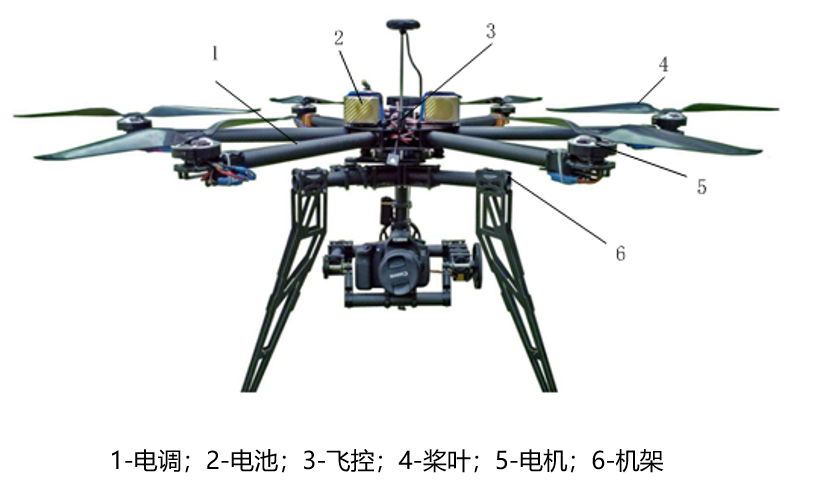
Multirotor drones are the most common type of civilian drones. The basic structure generally consists of frame, power unit, and flight control systems.
02
Introduction to the Frame
The frame is the body of the multirotor drone and serves as the installation base for other structures, providing support.
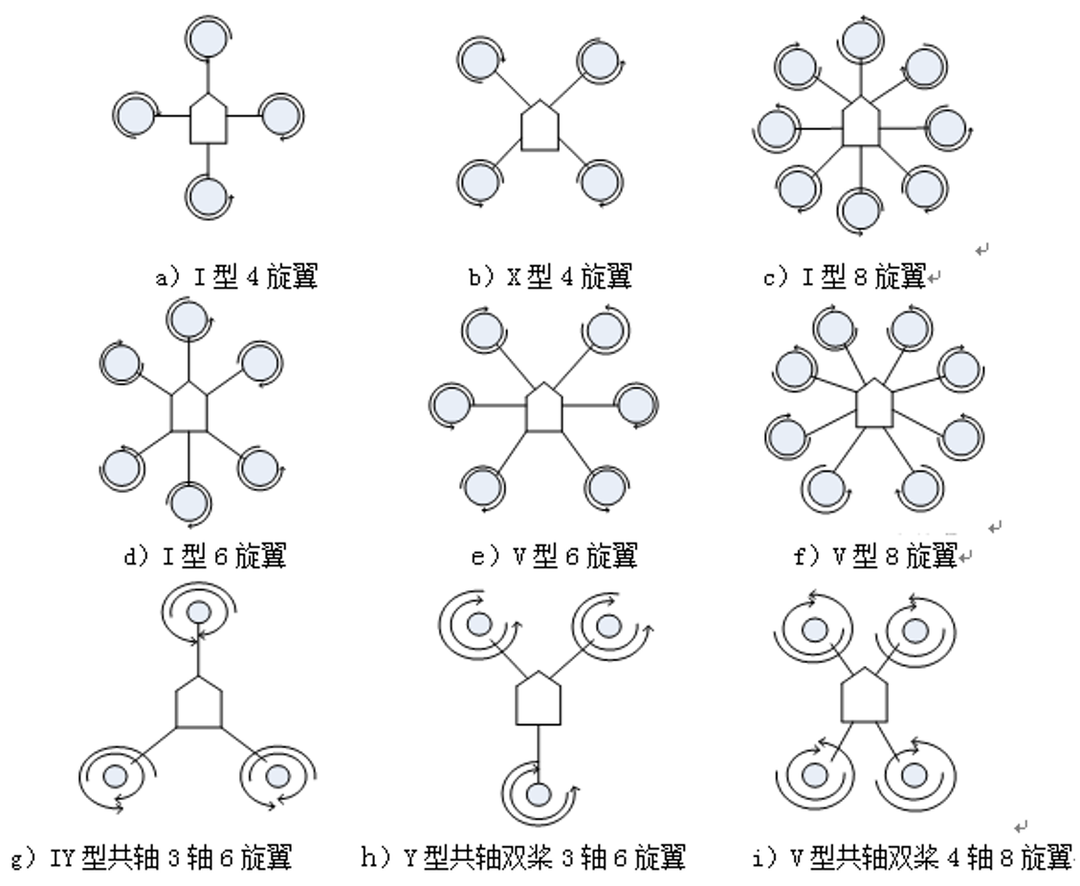
Depending on the number of rotor axes, it can be divided into three-axis, four-axis, etc. Depending on the number of engines, there are three-rotor, four-rotor types, etc. The number of axes and rotors is generally equal, but there are special cases, such as three axes with six rotors.
Frame Materials:
(1) Plastic: Relatively inexpensive, suitable for beginners.
(2) Fiberglass: Compared to plastic frames, fiberglass has higher strength, lighter weight, and is more expensive; the center plate is often made of fiberglass, and the arms are usually tubular.
(3) Carbon fiber: Higher strength than fiberglass frames, but more expensive.
(4) Aluminum alloy/steel: Suitable for self-manufacturing.
Frame Layout: Common layouts include X-type, I-type, V-type, Y-type, and IY-type.
03
Power Structure and Flight Control
The power unit of a drone generally includes the following components:
Battery, mainly providing energy for the drone, with most drones using lithium polymer batteries.
ESC (Electronic Speed Controller), its main function is to amplify the control signals from the flight control board and send drive signals to each switch tube to enable saturation conduction and reliable cutoff, controlling the speed of the motor; converting the power supply voltage to 5V to power the flight control board and remote control receiver; converting DC power to three-phase power to power brushless motors.
Motor, driving the propellers to rotate, generating lift for the multirotor drone. By controlling the speed of each motor, the multirotor drone can complete flight activities.
Propeller, also known as the rotor, generates lift or thrust through rotation to enable flight activities.
Flight control is mainly used to stabilize the flight attitude of the drone and control the drone’s autonomous or semi-autonomous flight.
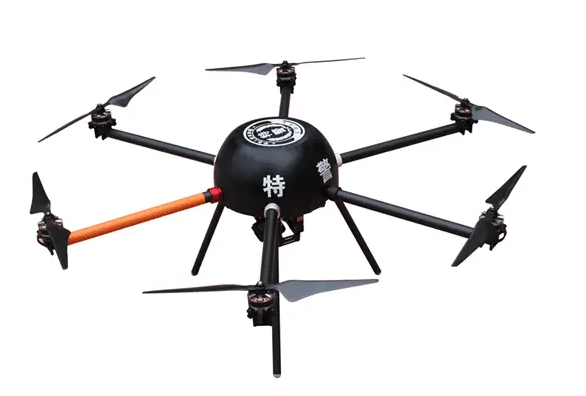
Police Drones

2. Fixed-Wing Drones
As the name suggests, fixed-wing drones have wings that remain unchanged and rely on airflow over the wings to provide lift. Fixed-wing drones require a long runway for takeoff and must land on a runway to decelerate; they have longer endurance, higher flight efficiency, and larger payloads. This type of drone takes off using a glide or catapult method and lands using parachutes or gliding, requiring specific site conditions. Their cruising distance and payload capacity are significantly higher than multirotor drones.
Overall, fixed-wing drones have long endurance, large payload, high operational difficulty, and high platform requirements, suitable for long-distance continuous work. They are now commonly used in unmanned reconnaissance, civil power line patrols, mapping, and medium to long-distance emergency transport.
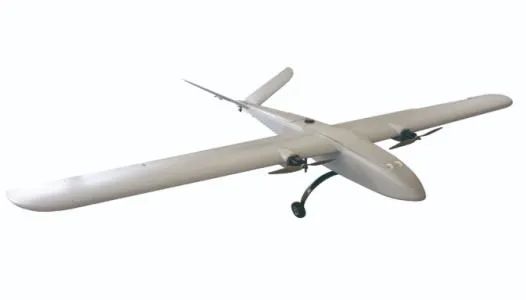
They can achieve manual remote-controlled flight and preset program flight, have strong wind resistance, and come in various types. The development trend is miniaturization and long endurance. Miniaturized fixed-wing drones can be carried in a backpack, and under electric power, their flight time for a single takeoff can be about 40-120 minutes; long-endurance fixed-wing drones are larger, primarily powered by fuel, and can achieve endurance times of over 10 hours, capable of carrying multiple remote sensing sensors simultaneously. Fixed-wing drones require relatively open areas for takeoff and landing, suitable for monitoring forests and grasslands, mining resource monitoring, marine environment monitoring, urban and rural land use monitoring, as well as applications in water conservancy and electricity sectors. Advantages include long endurance and high speed. Disadvantages include the need for runways and inability to take off and land vertically.
The main components of fixed-wing drones
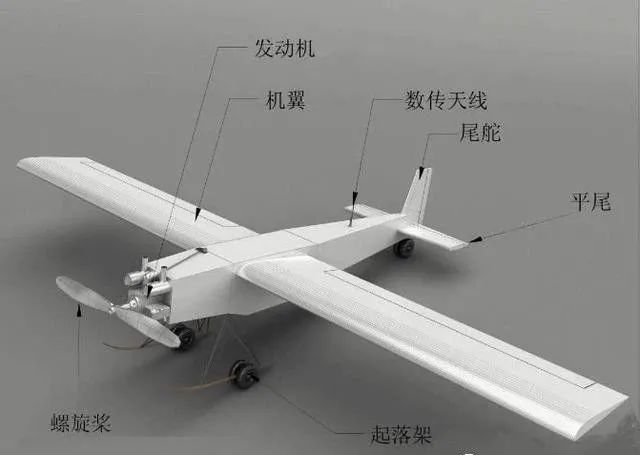
Generally, a fixed-wing drone system consists of five main parts: the airframe structure, avionics system, power system, takeoff and landing system, and ground control station.
1. The airframe structure consists of a modular airframe that is easy to carry and can be assembled and launched in a short time.
2. The avionics system consists of flight control computers, sensors, payloads, wireless communication, and batteries, fulfilling the needs of the aircraft control system.
3. The power system consists of power batteries, propellers, and brushless motors, providing the power needed for the aircraft’s flight.
4. The takeoff and landing system consists of catapult ropes, catapults, and parachutes, aiding the aircraft in completing catapult takeoffs and parachute landings.
5. The ground control station includes ground station computers, handles, radios, and other communication devices to assist in route planning tasks and monitoring the flight process.
3.VTOL Fixed-Wing Drones
After seeing the above introductions, one might wonder if the combination of multirotor drones and fixed-wing drones could be a significant enhancement. Thus, the VTOL fixed-wing drones (hereinafter referred to as VTOL fixed-wings) have emerged.
Advantages of VTOL fixed-wings
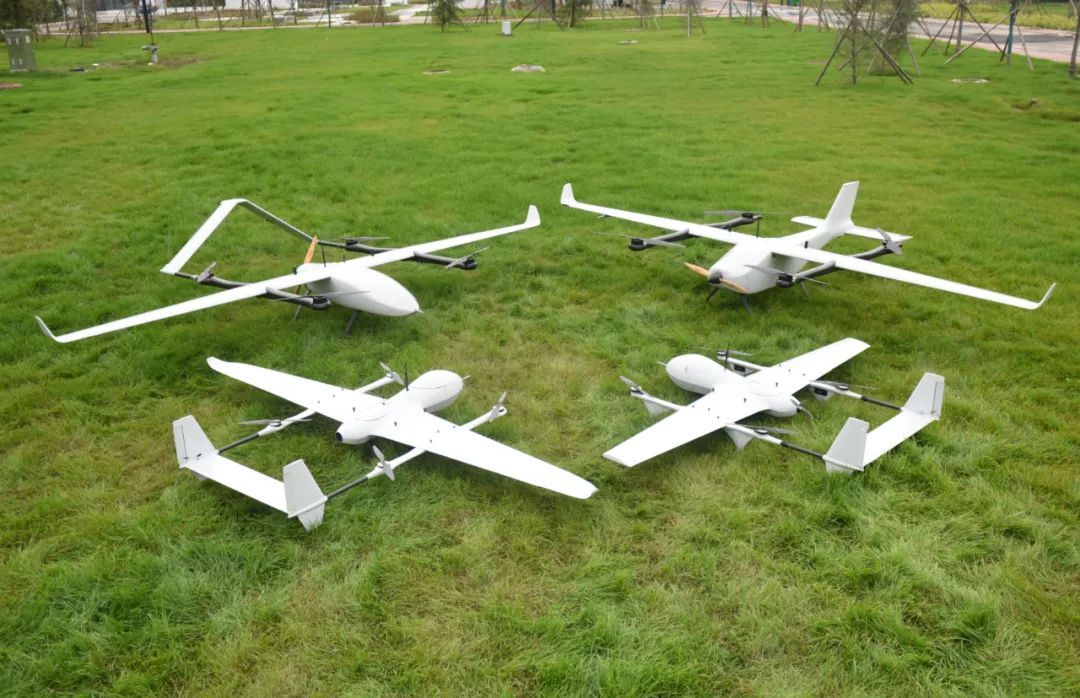
Currently, the VTOL drones on the market are all rotor-based, combining multirotor and fixed-wing characteristics. Therefore, VTOL drones have the takeoff and landing capabilities of multirotors, solving the site requirements of fixed-wing drones, while possessing the advantages of long flight distance, high speed, and high altitude associated with fixed-wing flight, addressing the issues of short endurance, slow speed, and low flight altitude of multirotors.
Industry applications of VTOL fixed-wings
Due to their long endurance and large operational radius, VTOL drones are mainly used for traffic supervision, oil pipeline inspections, large-area surveying, and forest inspections. They have broad prospects in police and military applications.
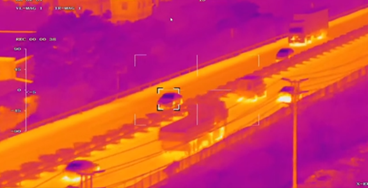
Ultra-long endurance, saving manpower and resources
Routine inspections in high-speed, electric, and forest sectors cover large areas and take a long time, requiring significant manpower and resources, with results often unsatisfactory. The YL series VTOL fixed-wing drones can cruise at speeds of 90-145 km/h for 3-5 hours, equipped with high-definition oblique photography systems, allowing for a “God’s eye view” of the task area, recording and transmitting situations in real-time to the control center, effectively and quickly addressing large-scale inspection tasks.
4. Future Technology —Tilt-Rotor Drones
Unmanned helicopters can take off and land vertically without site restrictions, but their endurance and speed are relatively limited. Fixed-wing drones have long endurance and high speed but require a runway for takeoff. Since the last century, technicians have continuously explored between the two, aiming to find an integrated technology that guarantees high speed and long endurance while allowing for vertical takeoff and landing. Tilt-rotor drone technology emerged at the end of the last century.
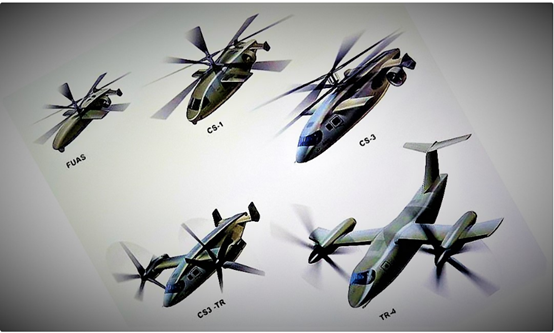
Tilt-rotor aircraft combine the characteristics of helicopters and fixed-wing aircraft, featuring both rotors and fixed wings, with rotors that can convert between vertical and horizontal positions.This type of aircraft has the advantages of helicopter vertical/short takeoff and fixed-wing aircraft high-speed cruising.However, due to the complexity of the development technology and high confidentiality, currently only a few countries have developed and tested related models, obtaining airworthiness certificates.
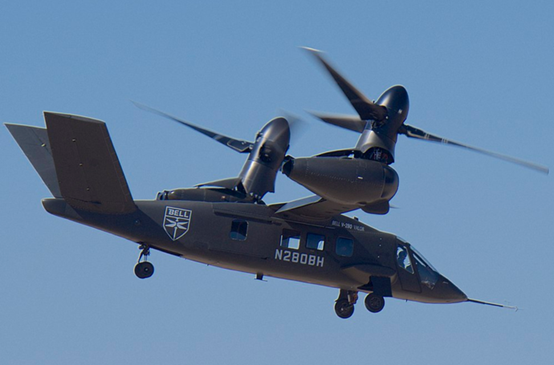 Bell V-280 Valor Tilt-Rotor Aircraft
Bell Company in the USA holds a monopolistic technological advantage in tilt-rotor aircraft, with typical tilt-rotor aircraft including the V-22 Osprey, V-280 Valor, “Eagle Eye” drone, V-247 Vigilant drone, and the AW-609 transport aircraft developed in collaboration with Italy’s Leonardo Company. The V-22 is the world’s first tilt-rotor aircraft to enter service, jointly developed by Bell Helicopter and Boeing over 25 years, officially entering service with the US military in 2006.The V-22 has a maximum takeoff weight of 27.4 tons, a maximum payload of 9 tons, capable of carrying 24 armed soldiers, and can take off and land on US military aircraft carriers and amphibious assault ships, with a maximum range of 3590 km.Since its inception, the V-22 has surpassed all transport aircraft in flight speed, with a maximum speed of 650 km/h.
Highlights of Tilt-Rotor Aircraft
1. Balancing Vertical Takeoff and High-Speed Flight
Tilt-rotor aircraft can take off and land vertically like helicopters without requiring runways, operating normally on ship decks. Helicopters are limited by the stall of the leading rotor blades and flow separation of the trailing rotor blades, with cruising speeds generally not exceeding 360 km/h. Tilt-rotor aircraft can cruise at speeds comparable to conventional fixed-wing aircraft, significantly exceeding typical helicopter speeds. The V-22 aircraft has a cruising speed of 509 km/h, with a maximum speed reaching 650 km/h, comparable to conventional turboprop fixed-wing aircraft. The advantages of tilt-rotor aircraft in vertical takeoff and high-speed flight compensate for the shortcomings of conventional helicopters in time-sensitive missions and the runway restrictions of fixed-wing aircraft.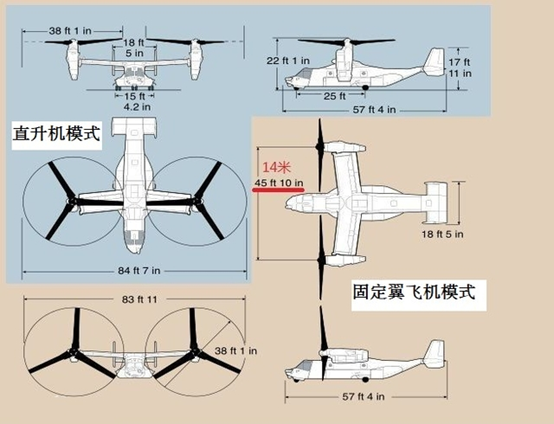 Illustration of Tilt-Rotor Mode Switching2. Low Fuel Consumption, Long Range
Tilt-rotor aircraft generate lift during cruising flight through their wings, with the rotors no longer providing lift, serving merely as two propellers to overcome minor flight resistance, resulting in significantly lower fuel consumption compared to helicopters. Conventional helicopters typically have a range of no more than 1000 km, while the V-22 tilt-rotor aircraft has an internal fuel range exceeding 1850 km; with two auxiliary fuel tanks, the total range can reach 3950 km.
3. Low Transport CostsDue to the combination of low fuel consumption, high speed, long range, and large payload of tilt-rotor aircraft, their transport costs are significantly lower compared to conventional helicopters.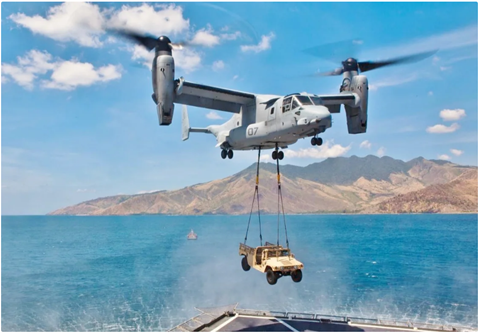 Large Payload, Low Transport Costs
Technical Challenges of Tilt-Rotor Aircraft
Tilt-rotor aircraft have both rotors and wings, and the rotors must transition between vertical and horizontal positions. Therefore, they possess not only the technical characteristics of fixed-wing aircraft and helicopters but are also much more complex in structure, aerodynamics, and control compared to typical fixed-wing aircraft and helicopters, presenting unique technical challenges:
1. Aerodynamic Characteristics and Rotor-Wing Interference During TransitionThe rotor transition is a very complex unsteady aerodynamic process, and determining its aerodynamic characteristics is one of the unique key technologies of tilt-rotor aircraft. Theoretical calculations and experiments are usually combined, but establishing accurate mathematical models and selecting suitable predictive algorithms remain challenging. Additionally, the aerodynamic interference issues of tilt-rotor aircraft are also very complex, involving multiple aspects such as rotor-wing, rotor-rotor, rotor-body, and rotor-tail interactions, with the most significant aerodynamic interference occurring during vertical flight and hovering, greatly affecting the effective payload of tilt-rotor aircraft.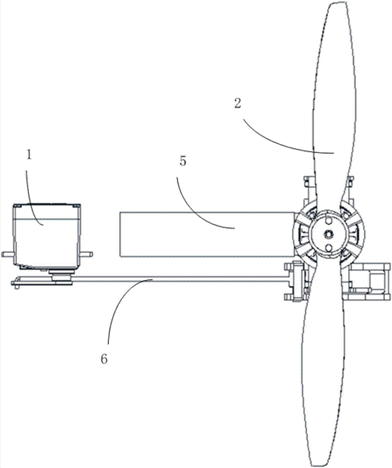 Illustration of Tilt-Rotor Wing Structure2. Dynamics of Rotors and WingsThe vibrations, rotations, and tilting of the rotor system mounted at the wingtips and the engine bay coupled with the wings significantly affect the static and dynamic characteristics, aerodynamic response, stability, and lifespan of the wings. These issues lead to a significant difference in the dynamics analysis of tilt-rotor aircraft compared to traditional helicopter rotors, necessitating new theories and methods for support.
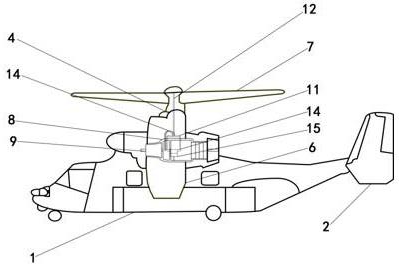 Side View of Tilt-Rotor Aircraft3. Flight Dynamics and Control During TransitionThe flight dynamics model of tilt-rotor aircraft is complex, especially during the transition, where the direction of the rotor axis and rotor speed undergo significant changes, resulting in substantial variations in lift, thrust, and torque, and under the influence of unsteady and nonlinear factors, the predictive accuracy of the rotor dynamics model and aerodynamic model is lower than that of traditional aircraft. These factors indicate that traditional helicopter flight dynamics analysis and control methods may fail for tilt-rotor aircraft, necessitating the establishment of new analytical models and methods.4. Single Engine Failure Issues
Although tilt-rotor aircraft combine the excellent features of both helicopters and fixed-wing aircraft, their unique structure presents different challenges during single-engine failure compared to helicopters or fixed-wing aircraft. Issues such as how to control the aircraft, how to ensure flight safety, and how to select system reliability and redundancy need in-depth research.
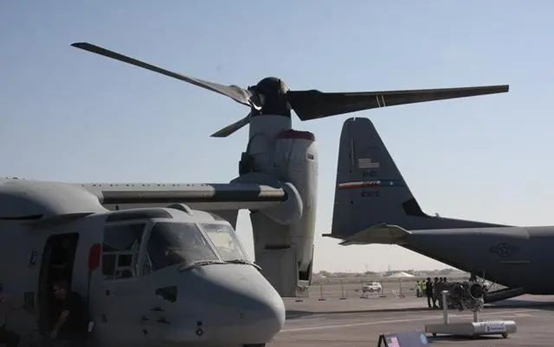 Single-Sided Engine of Tilt-Rotor Aircraft
-03-
Development and Future of Tilt-Rotor Aircraft
Currently, tilt-rotor technology is mastered by only a few countries worldwide. However, its significant technological advantages and broad application scenarios are prompting other countries and institutions to catch up, especially in the field of drones, where research on tilt-rotor aircraft is in full swing.
The “Eagle Eye” drone in the USA employs a tilt-rotor design similar to the Osprey. The “Eagle Eye” drone is approximately 5.56 meters long, with a wingspan of about 7.37 meters and a height of about 1.88 meters. Its empty weight is about 590 kg, with a total weight of about 2250 kg, a maximum cruising speed of about 360 km/h, an endurance time of 6 hours, and a maximum flight altitude of 6096 meters. The “Eagle Eye” drone entered service with the US Navy in 2006, primarily used for reconnaissance, surveillance, search, communication relay, and electronic countermeasures.
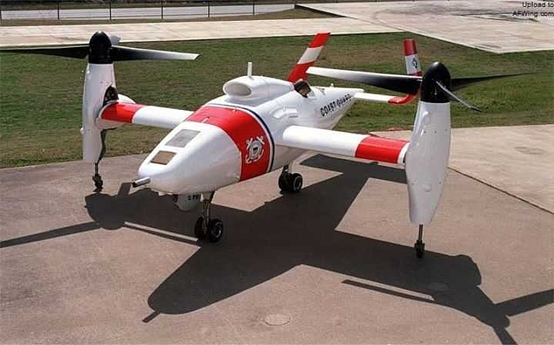 “Eagle Eye” Tilt-Rotor Drone
South Korea has introduced a prototype tilt-rotor drone TR-60, which employs tilt-rotor technology similar to the US V-22 Osprey, allowing for rotor attitude adjustments to change flight modes. This drone has an endurance of about 6 hours and a speed of about 310 km/h, capable of being mounted on vehicles and ships, undertaking reconnaissance, surveillance, and search missions. It has completed takeoff and landing tests from moving vehicles and is planned for mass production in 2024.
Bell Company in the USA has developed the V-247 Vigilant large tilt-rotor drone for Marine Corps missions. The V-247 serves as a force multiplier for the Marine Corps, with a maximum speed of 560 km/h, a range of 2000 km, a service ceiling of 7600 meters, and a payload of 270 kg with an endurance of 11-15 hours.
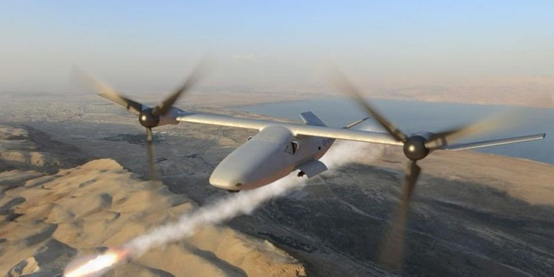 Bell’s “V-247” Tilt-Rotor Drone
At the Zhuhai Airshow, China Aerospace Science and Technology Corporation’s 11th Academy introduced the CH-10 tilt-rotor aircraft. The wingspan is 6.7 meters, with a maximum takeoff weight of 350 kg, and an endurance of 7 hours when carrying a 50 kg payload, with a cruising speed of 150 km/h and a maximum level flight speed of 320 km/h, a hover ceiling of 3000 meters, and a service ceiling of 7000 meters.
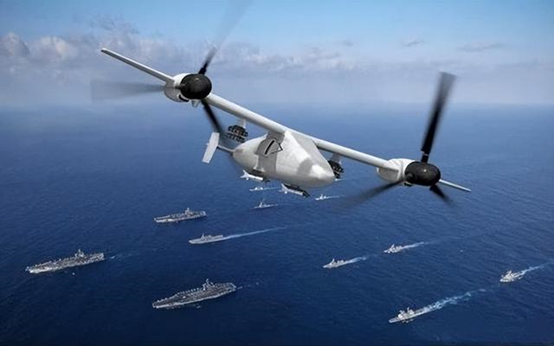 Rainbow-10 Tilt-Rotor Drone
Which type will be more popular and develop better in the future?
We cannot know for sure.
However, everyone surely has their favorite model.
Everyone is welcome to vote for their preferred model.
Drones are here to help you better understand drone knowledge.
Welcome to submit articles or provide corrections. For business cooperation, please leave a message to add WeChat.