
Click the blue text above to follow us

📋📋📋 The contents of this article are as follows: 🎁🎁🎁
Contents
💥1 Overview
📚2 Operating Results
🎉3 References
🌈4 Matlab Code, Data, Literature



1 Overview
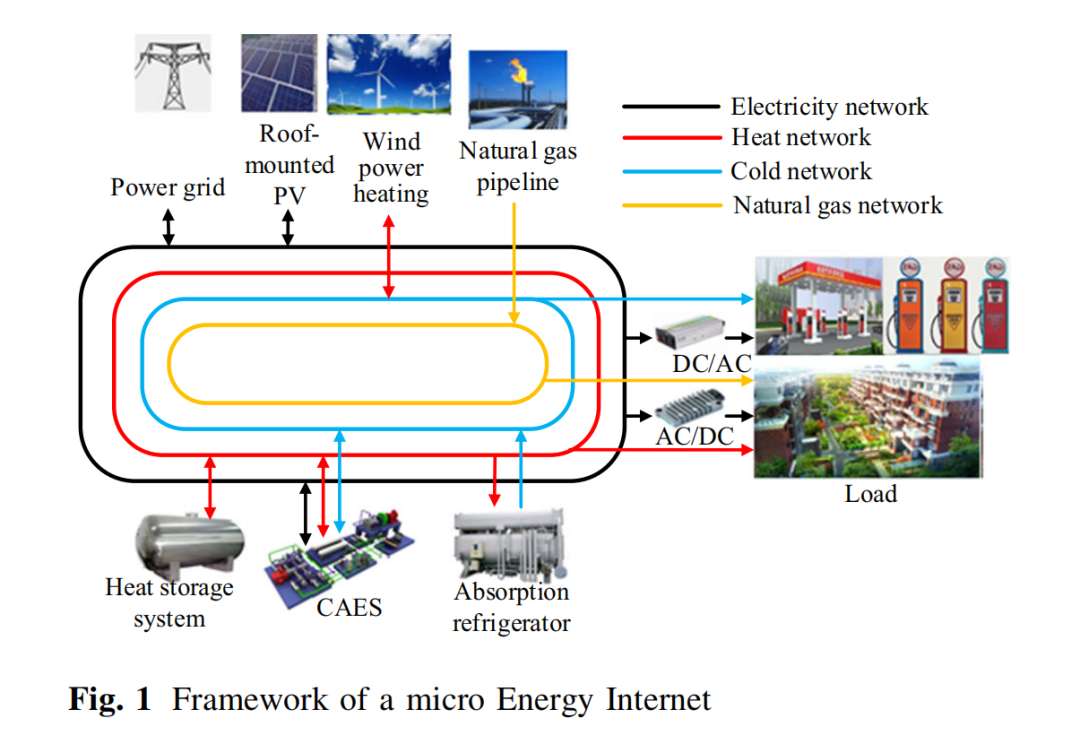
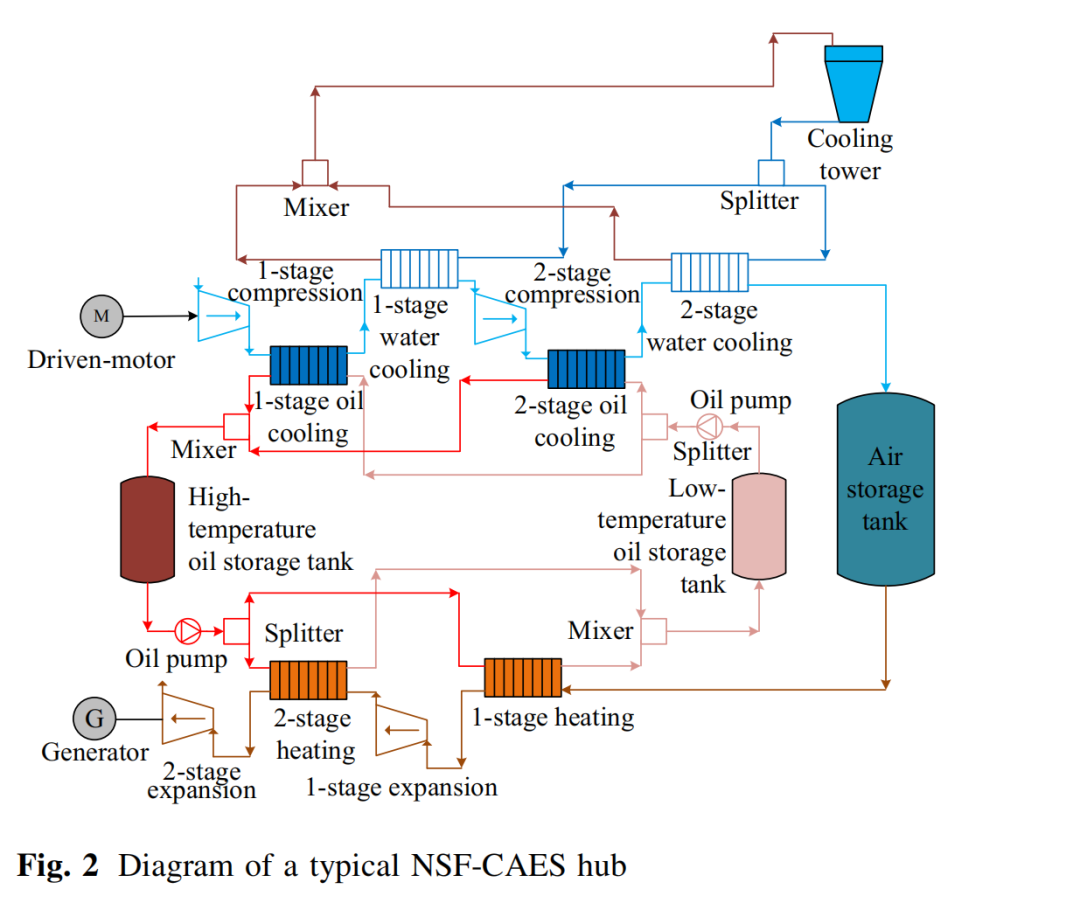
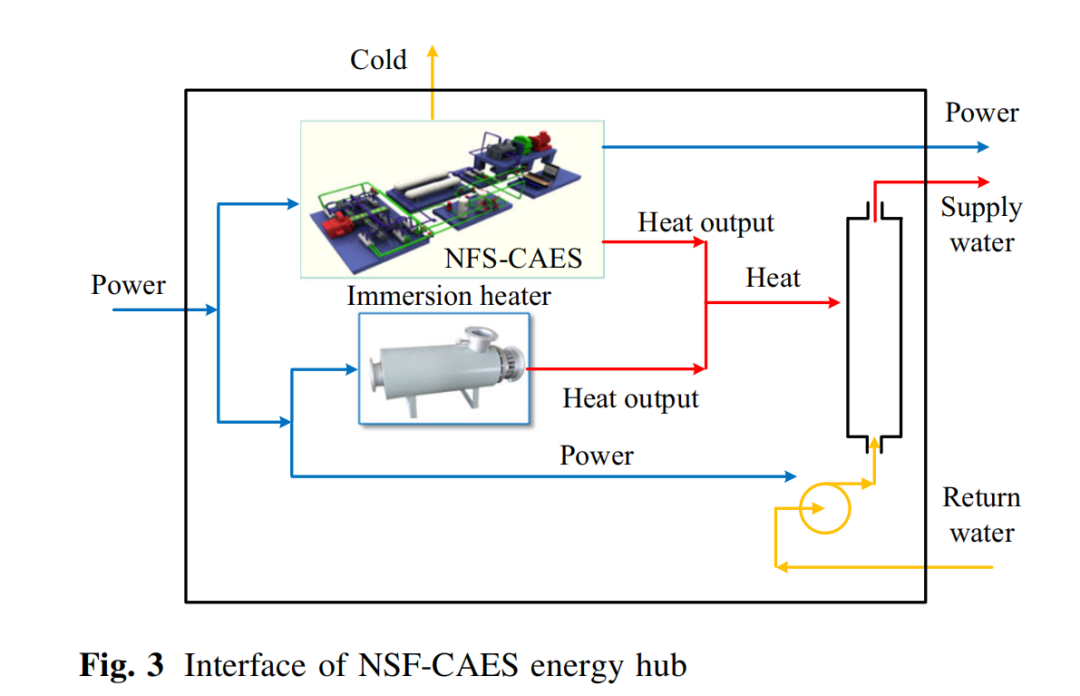
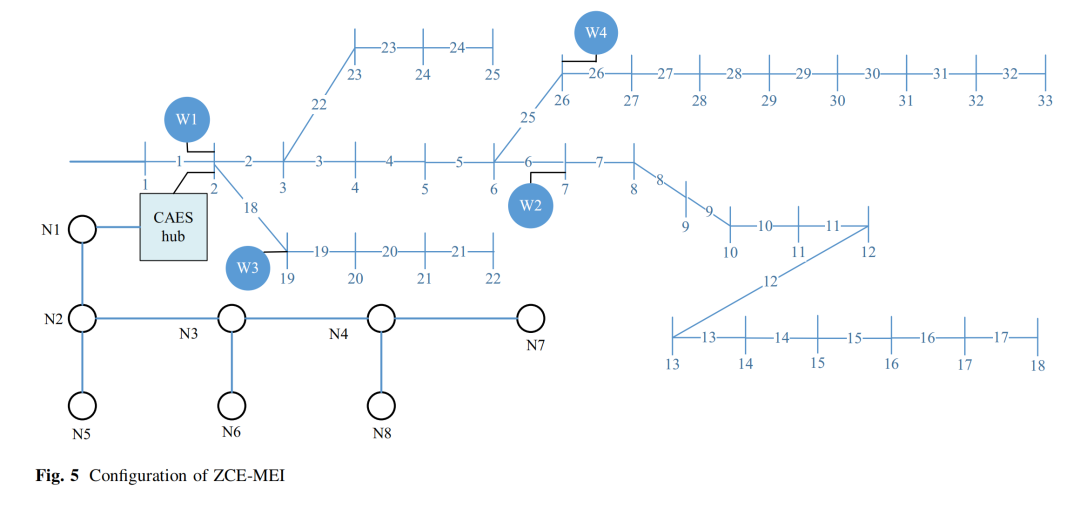
To utilize heat and electricity in a clean and integrated manner, this paper proposes a zero-carbon-emission micro Energy Internet (ZCE-MEI) architecture, centralizing non-supplementary fired compressed air energy storage (NSF-CAES). A typical ZCE-MEI combining power distribution network (PDN) and district heating network (DHN) with NSF-CAES is considered. The formulation of the NSF-CAES hub takes thermal dynamics and pressure behavior into account to enhance dispatch flexibility. An improved DistFlow model is utilized to allow several discrete and continuous reactive power compensators to maintain the voltage quality of the PDN. The optimal operation of the ZCE-MEI is first modeled as a mixed integer nonlinear programming (MINLP). Several transformations and simplifications are applied to convert the problem into a mixed integer linear programming (MILP), which can be effectively solved by CPLEX. A typical test system composed of a NSF-CAES hub, a 33-bus PDN, and an 8-node DHN is adopted to verify the effectiveness of the proposed ZCE-MEI in reducing operational costs and wind curtailment.
Original Abstract:

Abstract: To utilize heat and electricity in a clean and integrated manner, a zero-carbon-emission micro Energy Internet (ZCE-MEI) architecture is proposed by incorporating non-supplementary fired compressed air energy storage (NSF-CAES) hub. A typical ZCE-MEI combining power distribution network (PDN) and district heating network (DHN) with NSF-CAES is considered in this paper. NSF-CAES hub is formulated to take the thermal dynamic and pressure behavior into account to enhance dispatch flexibility. A modified DistFlow model is utilized to allow several discrete and continuous reactive power compensators to maintain voltage quality of PDN. Optimal operation of the ZCE-MEI is firstly modeled as a mixed integer nonlinear programming (MINLP). Several transformations and simplifications are taken to convert the problem as a mixed integer linear programming (MILP) which can be effectively solved by CPLEX. A typical test system composed of a NSF-CAES hub, a 33-bus PDN, and an 8-node DHN is adopted to verify the effectiveness of the proposed ZCE-MEI in terms of reducing operation cost and wind curtailment.
The dual pressure of the global energy crisis and environmental pollution has led to a reform in energy utilization behavior. Developing renewable energy is a global consensus to address energy and environmental issues. Renewable energy, such as wind and solar power, has rapidly developed in both centralized and distributed manners over the past few decades. However, in recent years, the availability of wind and solar energy has significantly decreased, especially in Northeast and Northwest China, hindering the stable development of the renewable energy industry. The integrated utilization of various energy carriers such as electricity, heat, cooling, and natural gas is a trend to reduce the waste of wind and solar energy. Integrated Energy Systems (IES) is a symbolic system that combines multiple energy carriers by connecting several energy hubs (EH) capable of transferring, converting, and storing energy between different energy carriers. Through IES and EH, different energy networks can be collaboratively optimized and managed to improve the utilization of wind and solar energy and increase the dispatch flexibility of the entire energy supply system. Combined heat and power (CHP) units are a type of EH that can simultaneously provide heating and electricity. In this regard, CHP is used to jointly optimize the heating network and the power grid to enhance flexibility and reduce wind and solar curtailment. Unfortunately, CHP requires natural gas backup generation, which undermines the original intention of addressing environmental issues caused by carbon emissions from fossil fuel combustion. Compressed air energy storage (CAES) is a promising energy storage technology that also uses natural gas combustion for power generation, leading to environmental issues similar to CHP. By integrating thermal energy storage systems (TES) into CAES, advanced adiabatic compressed air energy storage systems (AA-CAES) and non-supplementary fired compressed air energy storage systems (NSF-CAES) can store the heat generated during the air compression process in storage tanks and release it during power generation to heat the compressed air. Therefore, in these advanced CAES systems, gas combustion is not required. Similar to CHP, NSF-CAES is a type of EH that can combine cooling, heating, and power generation. Due to the zero-carbon emission characteristics of the NSF-CAES hub, it can be used to construct a zero-carbon IES. Based on this, a zero-carbon-emission micro Energy Internet (ZCE-MEI) architecture is proposed, developing NSF-CAES into a clean EH covering the power distribution network (PDN) and district heating network (DHN). The feasibility of using NSF-CAES as a clean energy hub for the energy internet is analyzed, while emphasizing the scheduling of ZCE-MEI. Research applicable to CAES modeling has been provided in various studies. CAES systems and NSF-CAES systems have been formulated and implemented for power network scheduling operations. Studies have optimized the scheduling of wind power integrated with CAES in transmission systems. Meanwhile, considering wind power generation and CAES, low-carbon emission microgrid architectures and corresponding thermal-wind-storage joint operation scheduling methods have been proposed. Reports have discussed optimal operating strategies for CAES in the price-volatile electricity spot market. On the other hand, the joint operation of power and heating systems has been studied in some literature. Optimal operating strategies have been developed to accommodate wind power generation. The scheduling issues of CHP and the transmission constraint unit commitment for the collaborative optimization of PDN and DHN have been studied. Two combined analytical methods have been developed to analyze the operation of heating and power networks. The optimal flow of integrated electric-thermal systems has also been researched. Furthermore, the coordinated scheduling of energy resources in distributed regional heating and cooling systems within integrated energy networks has been studied. Although some existing references specifically discuss the operation of CAES and the combined operation of integrated electric-thermal systems, most references have established simplified efficiency-based power block models for CAES without modeling the pressure and temperature dynamics of CAES. CAES is a natural EH capable of jointly producing cooling, heating, and electricity. It is necessary to consider pressure behavior and temperature dynamics to enhance scheduling flexibility. Moreover, with the high penetration of renewable energy, voltage management in PDN has become more challenging and important compared to traditional PDN. Therefore, it is necessary to formulate voltage, reactive power, and corresponding reactive power compensators to maintain reactive balance and voltage quality in the optimal operation of PDN. Additionally, most existing CHP systems use CHP as an interface between PDN and DHN, which undoubtedly contradicts the requirements for zero carbon emissions. In this regard, we intend to develop a short-term day-ahead scheduling model for the proposed ZCE-MEI integrating NSF-CAES to reduce wind curtailment and save system operating costs.


2 Operating Results
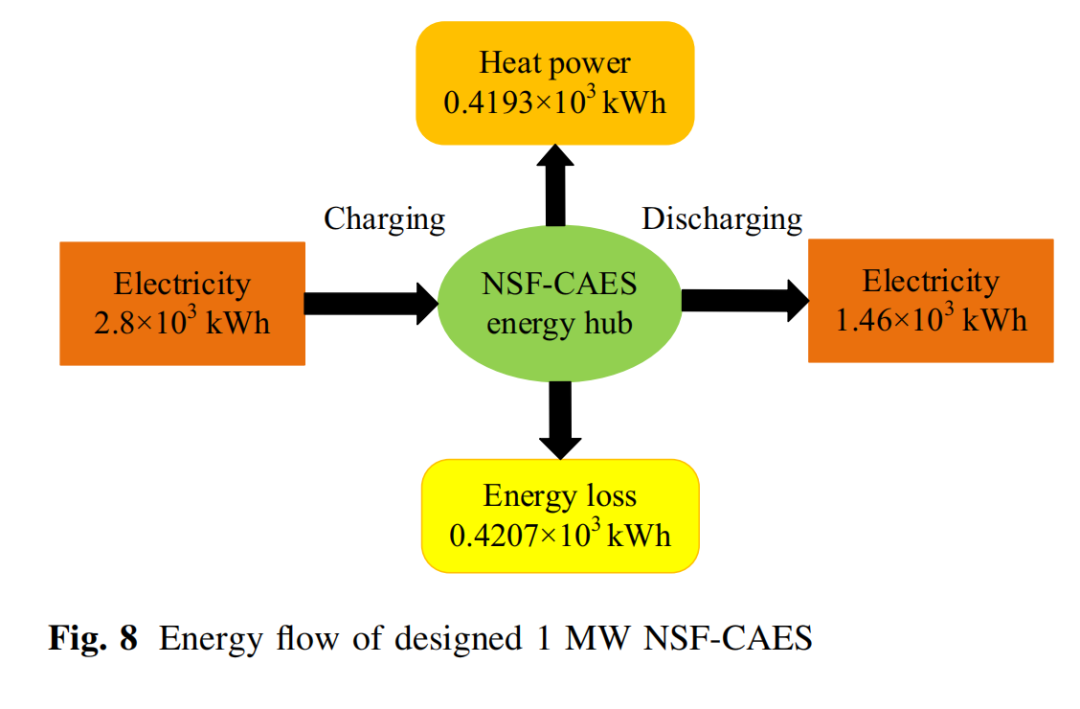
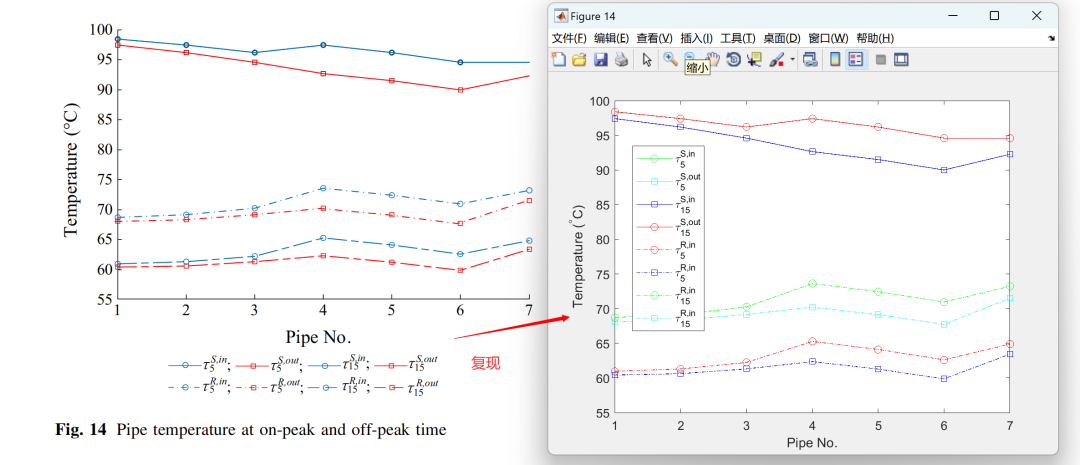
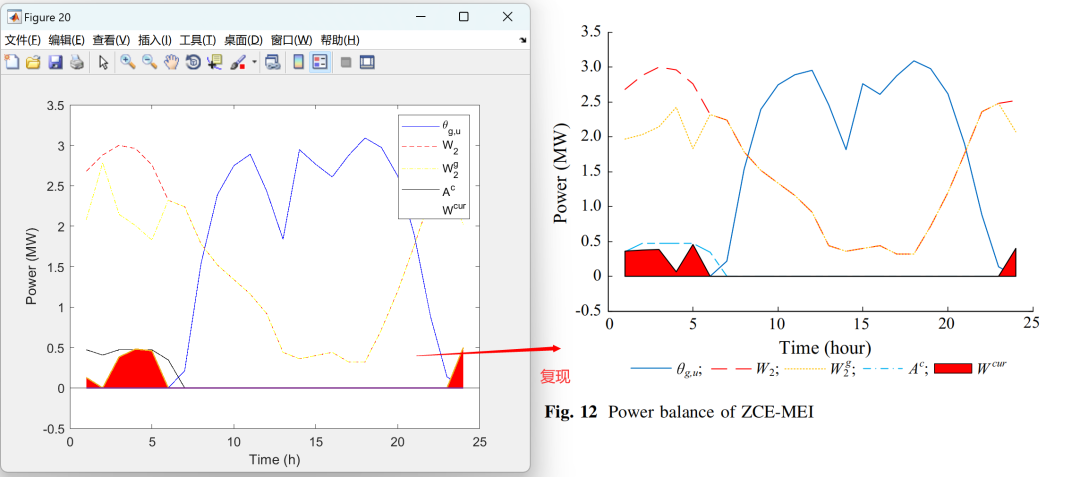
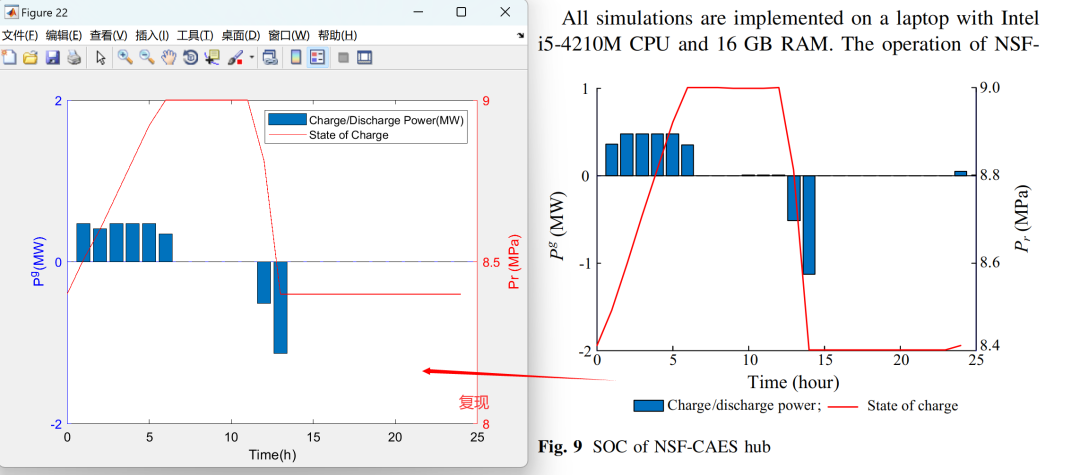
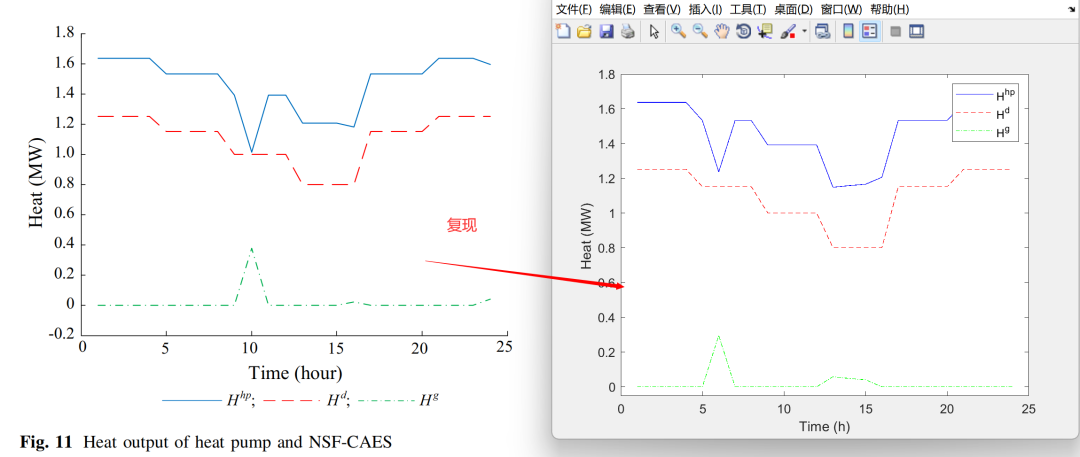 Other operating results will not be displayed one by one.


3References
Some theoretical sources are from the internet; please contact us for removal if there is any infringement.

[1] R. Li, L. Chen, T. Yuan and C. Li, “Optimal dispatch of zero-carbon-emission micro Energy Internet integrated with non-supplementary fired compressed air energy storage system,” in Journal of Modern Power Systems and Clean Energy, vol. 4, no. 4, pp. 566-580, October 2016, doi: 10.1007/s40565-016-0241-4.


4 Matlab Code, Data, Literature
Previous Recommendations
MATLAB|【Integrated Energy】including solar thermal power plants, organic Rankine cycle, P2G’sIntegrated Energy optimization scheduling
MATLAB| including solar thermal power plants’ cooling, heating, and electricityIntegrated Energy system optimization scheduling【Node Network】
Considering the uncertainty of new energy output in the coordinated optimization of electrical equipment integrated energy systems (Matlab code implementation)
MATLAB| Research on the electric-thermal coordinated operation optimization of parkIntegrated Energy system considering carbon trading mechanism
MATLAB| Distributed photovoltaic generationConsidering meteorological factors and output prediction methods research
MATLAB|Considering green certificate trading and carbon emissions in the optimization scheduling of smart building microgrids
Considering demand-side response day-ahead and intra-day two-stage robust reserve optimization (Matlab code implementation)
MATLAB|【Distribution Network Reconstruction】 under high proportion of clean energy accessConsidering demand response in distribution network reconstruction【IEEE 33 nodes】
MATLAB|Considering demand response in the improved grey wolf optimization algorithm for wind, solar, biomass, and storage capacity optimization configuration
MATLAB|Considering N-k security constraints in the power system optimization scheduling model including solar thermal power plants【IEEE 14 nodes, 118 nodes】
Considering the uncertainty of source-load in the integrated energy production unit operation scheduling and capacity configuration optimization research (Matlab code implementation)
【Robust Optimization, Big M Method, C&CG Algorithm】Considering wind, solar, and load uncertainty two-stage robust optimization (Matlab code implementation)
【Multi-Microgrid】Considering carbon emissions based on the alternating direction method of multipliers (ADMM) for multi-microgrid energy interaction distributed operation strategy research (Matlab code implementation)
Considering the economic scheduling of solar thermal power plants’ thermal storage capacity configuration method【IEEE 30 nodes】(Matlab code implementation)
Considering demand response in the optimized scheduling of island microgrids based on the improved antler algorithm (Matlab code implementation)
【Power System Optimization Scheduling】Considering the uncertainty of source-load on both sides in the low-carbon scheduling of power systems including wind power (Matlab code implementation)
Considering the optimized scheduling strategy of microgrids and cluster electric vehicles’ comprehensive demand-side response in wind power grid operation (Matlab code implementation)
Under the two-level electricity market environmentConsidering the risk of optimal purchasing model for inter-provincial traders (Matlab code implementation)
Considering the optimization scheduling of virtual power plants including carbon capture and waste incineration in the electric-gas collaborative (Matlab code implementation)
Considering the low-carbon characteristics of carbon capture power plants in the multi-time scale scheduling method of power systems including wind power (Matlab code implementation)
Considering the energy price calculation method of electric-gas-thermal integrated energy systems considering carbon emission costs (Matlab code implementation) + practical experience with web scraping (python)