✅ Author’s Profile: A research enthusiast and Matlab simulation developer, skilled in data processing, modeling simulation, program design, complete code acquisition, paper reproduction, and scientific simulation.
🍎 Previous Reviews: Follow my personal homepage:Matlab Research Studio
🍊 Personal Motto: Investigate to gain knowledge, complete Matlab code and simulation consultation available via private message.
🔥 Content Introduction
In modern power systems, ensuring accurate and real-time monitoring of grid operating status is a key aspect of maintaining the safety, stability, and economic operation of the power system. Phasor Measurement Units (PMUs), as advanced measurement devices in power systems, can directly measure critical electrical quantities such as generator power angles and bus voltage phasors, transmitting data to the dispatch center at extremely high sampling frequencies (typically dozens or even hundreds of times per second). This provides solid data support for state estimation, transient stability analysis, fault location, and isolation in power systems, earning PMUs the title of the “eyes of state perception” in power systems.
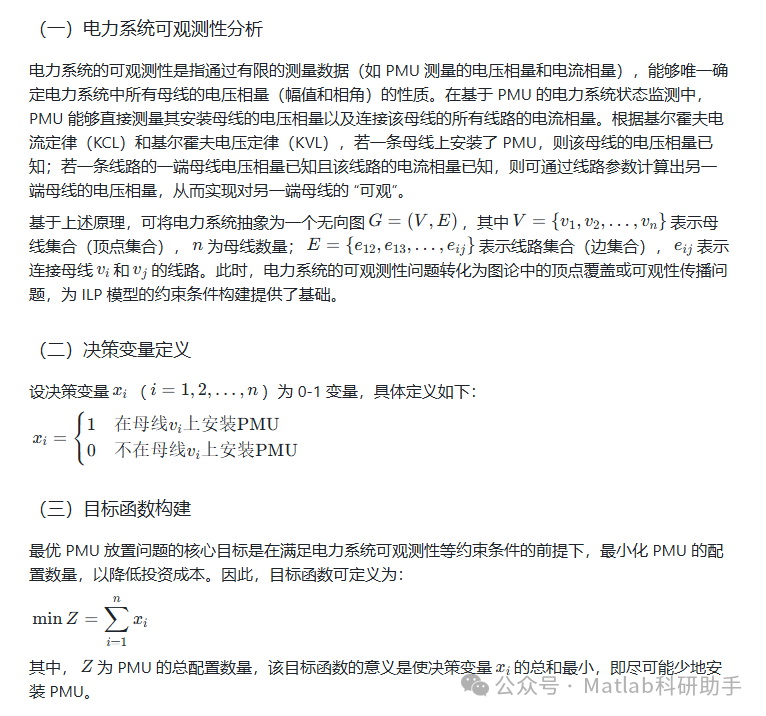
However, the acquisition cost, installation cost, and subsequent maintenance costs of PMUs are relatively high. Additionally, due to constraints such as the topology of the power system, communication conditions, and the lack of installation conditions on certain buses, it is not feasible to install PMUs on every bus in the power system. Therefore, how to reasonably select the installation locations of PMUs to minimize the number of PMUs while ensuring complete observability of the power system (i.e., the ability to uniquely determine all state variables of the power system through PMU measurement data) or specific observation accuracy requirements has become an important research topic in the field of power system planning and operation, known as the Optimal PMU Placement (OPP) problem.
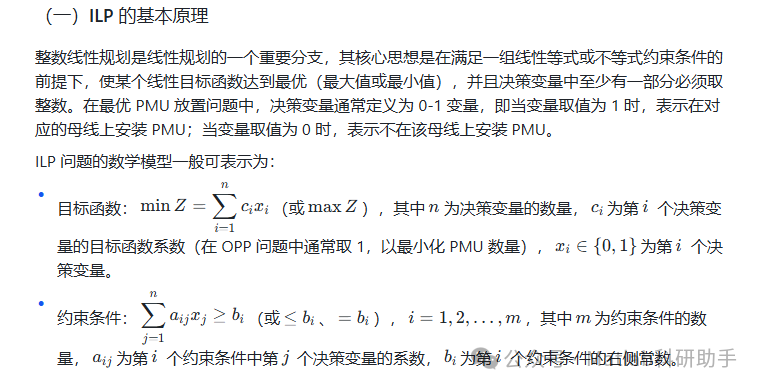
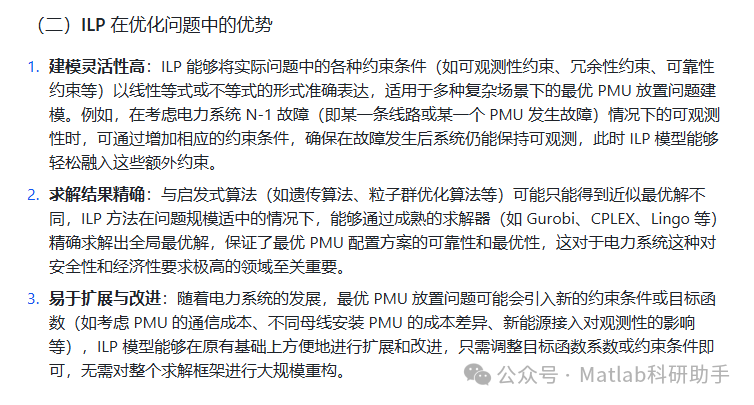
Integer Linear Programming (ILP), as a mature mathematical optimization method, has unique advantages in handling optimization problems with discrete decision variables (such as the 0-1 decision problem of “whether to install a PMU on a certain bus”) and linear constraints (such as observability constraints, redundancy constraints, etc.). Applying the ILP method to the optimal PMU placement problem can accurately solve the optimal PMU configuration scheme that meets various constraints by establishing a rigorous mathematical model, providing scientific and reliable decision-making basis for power system planners, which has significant theoretical value and practical application significance.
II. Overview of the Integer Linear Programming (ILP) Method
III. Construction of the Optimal PMU Placement Model Based on ILP
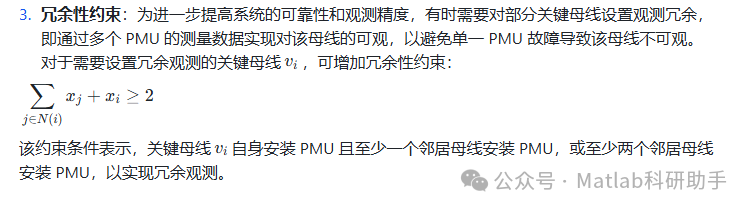
IV. Model Solving and Result Analysis
(1) Selection of ILP Solver
Currently, there are many types of solvers for ILP problems, among which widely used and high-performance commercial solvers include Gurobi, CPLEX, etc. Additionally, there are open-source solvers such as GLPK (GNU Linear Programming Kit). These solvers employ advanced algorithms such as branch-and-bound and cutting-plane methods, efficiently handling large-scale ILP problems.
When selecting a solver, it is necessary to comprehensively consider factors such as problem scale (number of buses, number of constraints), solving efficiency, solving accuracy, and software cost. For small power systems with fewer buses (e.g., dozens of buses), the open-source solver GLPK can meet the solving needs; for large power systems with many buses (e.g., hundreds or even thousands of buses), commercial solvers like Gurobi or CPLEX, with their efficient solving algorithms and optimization techniques, can obtain precise optimal solutions in a shorter time, making them more suitable.
(2) Solving Steps
- Data Preparation: Collect the topology data of the power system (number of buses, line connection relationships, line parameters, etc.), determine whether to consider special constraints such as N-1 faults and redundancy observations, and clarify the optimization direction of the objective function (minimizing the number of PMUs).
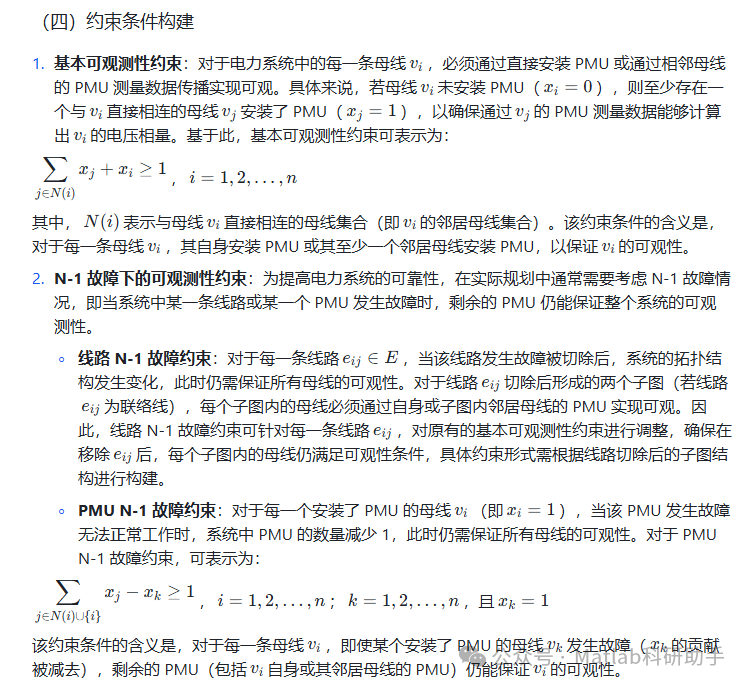
- Model Construction: Based on the above data and constraints, use mathematical modeling tools (such as MATLAB’s Optimization Toolbox, Python’s PuLP library, etc.) to construct the optimal PMU placement model based on ILP, define decision variables, objective functions, and various constraints, and convert the model into a format recognizable by the solver (such as MPS format, LP format).
- Model Solving: Input the constructed ILP model into the selected solver, set solving parameters (such as solving time limits, accuracy requirements, etc.), and start the solver for computation. The solver will gradually search the feasible solution space through branch-and-bound, pruning, and other operations, ultimately finding the global optimal solution that satisfies all constraints (or finding an approximate optimal solution within the set time).
- Result Output: After solving is complete, the solver will output the optimal PMU configuration scheme (i.e., which buses need to install PMUs), the total number of PMUs, and the optimal value of the objective function. It will also output the satisfaction of the constraints to verify the feasibility and correctness of the model.
(3) Result Analysis
- Analysis of Optimal PMU Quantity: Compare the optimal number of PMUs under different constraints (such as considering only basic observability, considering line N-1 faults, considering PMU N-1 faults, considering redundancy constraints) and analyze the impact of constraints on the number of PMUs. Generally, the stricter the constraints considered (such as N-1 faults, redundancy observations), the more PMUs are required, as additional PMUs are needed to meet observability or redundancy requirements after faults. For example, when only considering basic observability, a certain power system may only need to install 10 PMUs; however, after considering line N-1 faults, to ensure observability after faults, it may need to increase to 13 PMUs.
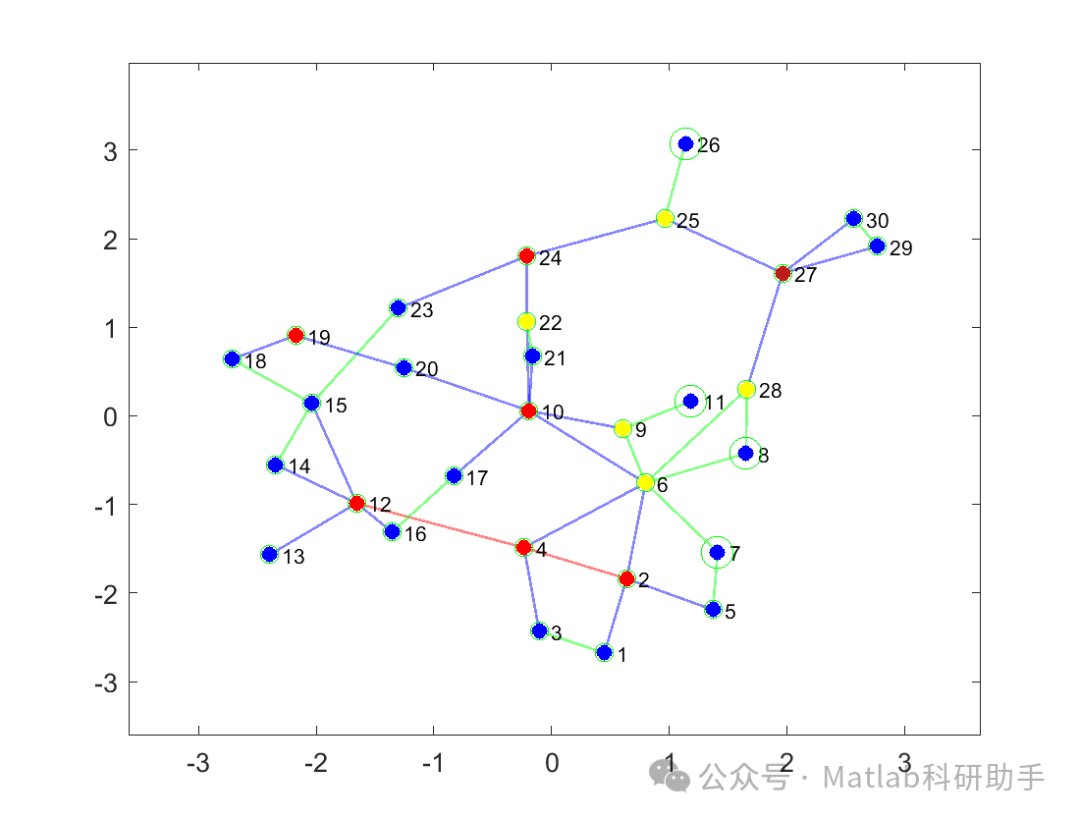
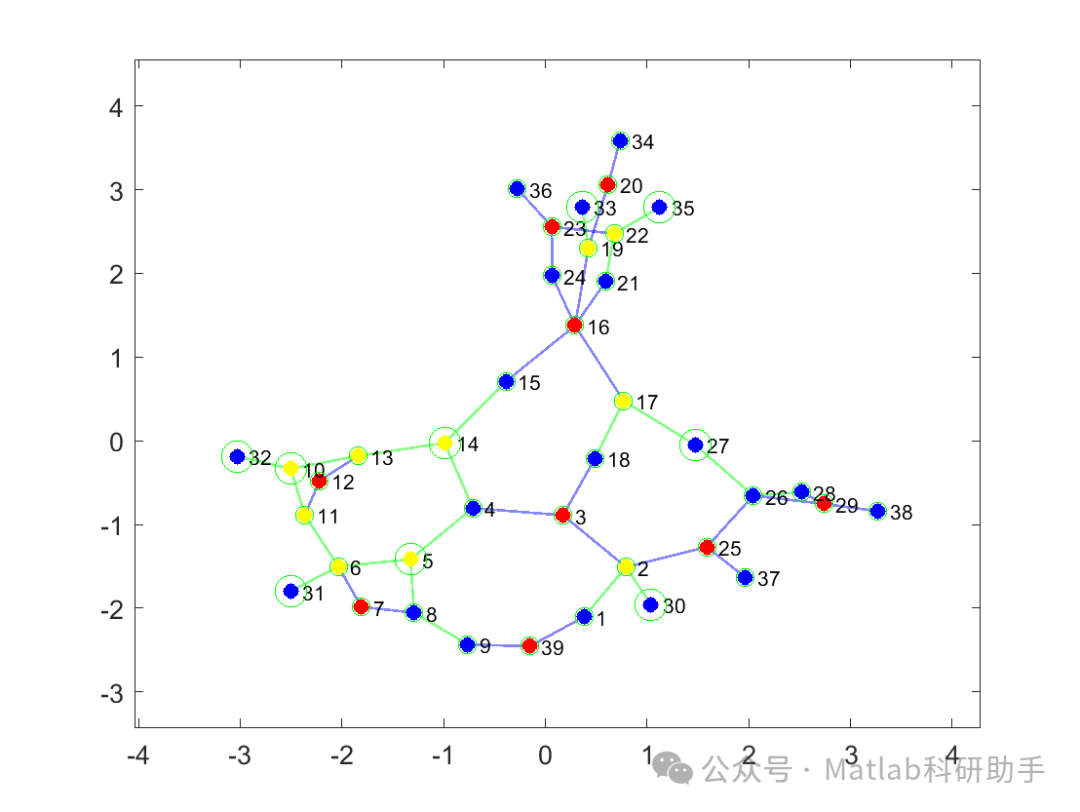
- Analysis of PMU Installation Location Reasonableness: Analyze the installation locations of PMUs in the optimal PMU configuration scheme to determine whether they are located at key nodes in the power system (such as hub substation buses, interconnection buses connecting multiple regions, buses for concentrated access of renewable energy, etc.). Installing PMUs at key nodes can maximize the observation range of PMUs, achieving observability of more buses through the propagation of observation data, thereby reducing the total number of PMUs. For example, installing a PMU on an interconnection bus connecting two regional power grids can achieve observability of some buses in both regions, improving observation efficiency.
- Economic Analysis: Based on the unit acquisition cost, installation cost, and maintenance cost of PMUs, calculate the total investment cost of the optimal PMU configuration scheme and compare it with the costs of other feasible schemes (such as those obtained through heuristic algorithms) to verify the economic advantages of the optimal PMU placement scheme based on ILP. Additionally, analyze the trade-off between the cost increment brought by the increase in the number of PMUs and the improvement in system reliability, providing a more comprehensive decision reference for power system planners.
- Sensitivity Analysis: Change the topology of the power system (such as adding or removing lines), adjust the strictness of constraint conditions (such as changing the number of buses for redundancy observation), or modify the coefficients of the objective function (such as considering the cost differences of installing PMUs on different buses), re-solve the ILP model, and analyze the impact of these changes on the optimal PMU configuration scheme and the number of PMUs. Sensitivity analysis can help planners understand the robustness of the model and how to adjust the PMU configuration scheme when system parameters change.
V. Research Challenges and Prospects
(1) Current Research Challenges
- Efficiency Issues in Solving Large-Scale Power Systems: As the scale of power systems continues to expand (e.g., inter-regional interconnected grids, smart grids), the number of buses and lines increases dramatically, leading to a significant increase in the number of decision variables and constraints in the ILP model, making solving more difficult. Traditional ILP solvers may face issues such as excessive solving time and memory consumption when handling large-scale ILP problems, and may even be unable to obtain optimal solutions within a reasonable time, limiting the application of ILP methods in the optimal PMU placement problem of large-scale power systems.
- Impact of Uncertainty Factors: There are many uncertainty factors in power systems, such as the randomness of renewable energy (wind and solar) output, the volatility of loads, PMU measurement errors, and the randomness of line faults. These uncertainty factors can affect the observability of the power system, leading to the optimal PMU configuration scheme obtained from deterministic ILP models potentially failing to meet observability requirements in actual operation. How to incorporate uncertainty factors into the ILP model and construct a robust optimal PMU placement model is an important challenge facing current research.
- Handling Multi-Objective Optimization Problems: In practical optimal PMU placement problems, in addition to minimizing the number of PMUs, other objectives may also need to be considered, such as minimizing the total investment cost of PMUs (as the installation costs may vary across different buses), maximizing the system’s observation redundancy, and minimizing the communication delay of PMUs. These objectives may conflict with each other (e.g., increasing observation redundancy may lead to an increase in the number of PMUs, thereby increasing investment costs). How to construct a multi-objective ILP model and solve effective solutions in the Pareto optimal solution set to meet different planning needs is a problem that current research needs to address further.
(2) Future Research Prospects
- Improving ILP Solving Algorithms to Enhance Efficiency in Solving Large-Scale Problems: On one hand, the computational load during the solving process can be reduced by relaxing the ILP model (e.g., relaxing 0-1 variables to continuous variables), decomposing (e.g., using Benders decomposition, Dantzig-Wolfe decomposition methods to break down large-scale models into multiple smaller sub-models), or utilizing the special structure of the problem (e.g., sparsity, symmetry). On the other hand, artificial intelligence technologies (such as deep learning, reinforcement learning) can be combined to intelligently search and prune the feasible solution space of ILP problems, improving solving efficiency. For example, using deep learning models to predict candidate installation locations for PMUs can narrow the decision variable range of the ILP model, thereby reducing solving difficulty.
- Introducing Uncertainty Modeling Methods to Construct Robust ILP Models: For the uncertainty factors in power systems, methods such as Stochastic Integer Linear Programming (SILP) and Robust Integer Linear Programming (RILP) can be used to construct optimal
⛳️ Operational Results
🔗 References
[1] Bao Wei. Research and Application of Practical Optimization Techniques for Ultra-Large-Scale Power Systems [D]. Zhejiang University, 2019.
[2] Bao Wei. Research and Application of Practical Optimization Techniques for Ultra-Large-Scale Power Systems [D]. Zhejiang University, 2015.
[3] Li Jincan. PMU Configuration for Fault Observability in Power Systems Based on BPSO Algorithm [J]. Journal of Jiangxi Normal University: Natural Science Edition, 2017, 41(2):5. DOI:10.16357/j.cnki.issn1000-5862.2017.02.03.
📣 Partial Code
🎈 Some theoretical references are from online literature; please contact the author for removal if there is any infringement.
👇 Follow me to receive a wealth of Matlab e-books and mathematical modeling materials
🏆 Our team specializes in guiding customized MATLAB simulations in various research fields to support your research dreams:
🌈 Various intelligent optimization algorithm improvements and applications
Production scheduling, economic scheduling, assembly line scheduling, charging optimization, workshop scheduling, departure optimization, reservoir scheduling, three-dimensional packing, logistics site selection, cargo location optimization, bus scheduling optimization, charging pile layout optimization, workshop layout optimization, container ship loading optimization, pump combination optimization, medical resource allocation optimization, facility layout optimization, visual domain base station and drone site selection optimization, knapsack problem, wind farm layout, time slot allocation optimization, optimal distribution of distributed generation units, multi-stage pipeline maintenance, factory-center-demand point three-level site selection problem, emergency supply distribution center site selection, base station site selection, road lamp post arrangement, hub node deployment, transmission line typhoon monitoring devices, container scheduling, unit optimization, investment portfolio optimization, cloud server combination optimization, antenna linear array distribution optimization, CVRP problem, VRPPD problem, multi-center VRP problem, multi-layer network VRP problem, multi-center multi-vehicle VRP problem, dynamic VRP problem, two-layer vehicle routing planning (2E-VRP), electric vehicle routing planning (EVRP), hybrid vehicle routing planning, mixed flow shop problem, order splitting scheduling problem, bus scheduling optimization problem, flight shuttle vehicle scheduling problem, site selection path planning problem, port scheduling, port shore bridge scheduling, parking space allocation, airport flight scheduling, leak source location.
🌈 Machine learning and deep learning time series, regression, classification, clustering, and dimensionality reduction
2.1 BP time series, regression prediction, and classification
2.2 ENS voice neural network time series, regression prediction, and classification
2.3 SVM/CNN-SVM/LSSVM/RVM support vector machine series time series, regression prediction, and classification
2.4 CNN|TCN|GCN convolutional neural network series time series, regression prediction, and classification
2.5 ELM/KELM/RELM/DELM extreme learning machine series time series, regression prediction, and classification
2.6 GRU/Bi-GRU/CNN-GRU/CNN-BiGRU gated neural network time series, regression prediction, and classification
2.7 Elman recurrent neural network time series, regression prediction, and classification
2.8 LSTM/BiLSTM/CNN-LSTM/CNN-BiLSTM long short-term memory neural network series time series, regression prediction, and classification
2.9 RBF radial basis neural network time series, regression prediction, and classification
2.10 DBN deep belief network time series, regression prediction, and classification
2.11 FNN fuzzy neural network time series, regression prediction
2.12 RF random forest time series, regression prediction, and classification
2.13 BLS broad learning system time series, regression prediction, and classification
2.14 PNN pulse neural network classification
2.15 Fuzzy wavelet neural network prediction and classification
2.16 Time series, regression prediction, and classification
2.17 Time series, regression prediction, and classification
2.18 XGBOOST ensemble learning time series, regression prediction, and classification
2.19 Transform various combinations of time series, regression prediction, and classification
Covering wind power prediction, photovoltaic prediction, battery life prediction, radiation source identification, traffic flow prediction, load prediction, stock price prediction, PM2.5 concentration prediction, battery health status prediction, electricity consumption prediction, water body optical parameter inversion, NLOS signal identification, precise prediction of subway stops, transformer fault diagnosis.
🌈 In the field of image processing
Image recognition, image segmentation, image detection, image hiding, image registration, image stitching, image fusion, image enhancement, image compressed sensing.
🌈 In the field of path planning
Traveling salesman problem (TSP), vehicle routing problem (VRP, MVRP, CVRP, VRPTW, etc.), UAV three-dimensional path planning, UAV collaboration, UAV formation, robot path planning, grid map path planning, multimodal transport problems, electric vehicle routing planning (EVRP), two-layer vehicle routing planning (2E-VRP), hybrid vehicle routing planning, ship trajectory planning, full path planning, warehouse patrol.
🌈 In the field of UAV applications
UAV path planning, UAV control, UAV formation, UAV collaboration, UAV task allocation, UAV secure communication trajectory online optimization, vehicle collaborative UAV path planning.
🌈 In the field of communication
Sensor deployment optimization, communication protocol optimization, routing optimization, target location optimization, Dv-Hop localization optimization, Leach protocol optimization, WSN coverage optimization, multicast optimization, RSSI localization optimization, underwater communication, communication upload and download allocation.
🌈 In the field of signal processing
Signal recognition, signal encryption, signal denoising, signal enhancement, radar signal processing, signal watermark embedding and extraction, electromyography signals, electroencephalography signals, signal timing optimization, electrocardiogram signals, DOA estimation, encoding and decoding, variational mode decomposition, pipeline leakage, filters, digital signal processing + transmission + analysis + denoising, digital signal modulation, bit error rate, signal estimation, DTMF, signal detection.
🌈 In the field of power systems
Microgrid optimization, reactive power optimization, distribution network reconstruction, energy storage configuration, orderly charging, MPPT optimization, household electricity.
🌈 In the field of cellular automata
Traffic flow, crowd evacuation, virus spread, crystal growth, metal corrosion.
🌈 In the field of radar
Kalman filter tracking, trajectory association, trajectory fusion, SOC estimation, array optimization, NLOS identification.
🌈 In workshop scheduling
Zero-wait flow shop scheduling problem (NWFSP), permutation flow shop scheduling problem (PFSP), hybrid flow shop scheduling problem (HFSP), zero idle flow shop scheduling problem (NIFSP), distributed permutation flow shop scheduling problem (DPFSP), blocking flow shop scheduling problem (BFSP).
👇